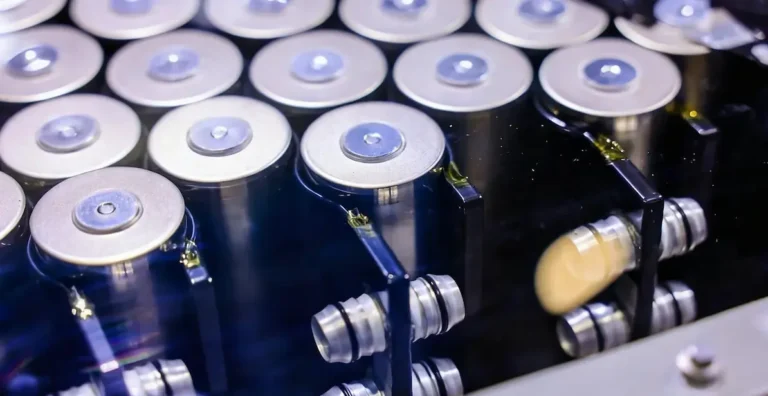
Lithium battery stacking VS winding manufacturing process
When the honeycomb energy thermal composite fly stacking technology breaks through 0.125 seconds / piece, the stacking process formally blowing the horn of counterattack – this lasts for 30 years of lithium battery stacking VS winding manufacturing process war, is reshaping the trillion-dollar battery industry pattern.

I.Lithium battery stacking process: the art of the limit of energy density
Technology evolution trilogy:
1.Z-type stacking (traditional): 0.8 seconds / piece → pole piece damage rate> 3%
2. Thermal composite stacking: 0.4 seconds / piece → diaphragm preheating bonding to reduce cutting stresses
3.Fly Stacking Technology:
Beehive Energy 4.0 Program: 0.125 sec/sheet
Core Breakthrough:
Visual positioning–>Synchronized gripping of multiple pole pieces–>Laser pre-welded pole lugs–>Hot press lamination
Yield: 99.9% (AI defect detection)
Crushing performance advantage:
| parameters | Lamination process | Winding process | Gap amplification mechanism |
|---|---|---|---|
| Space utilization | >95% | <90% | Zero bending stress on pole piece |
| energy density | 5-7% increase | reference value | BYD Blade Battery Empirical Evidence |
| Fast charging capability | 4C multiplication rate capacity retention >98% | <92% | Multi-pole ear parallel design |
| safety limit | 46-ton truck crushed without leakage | Failure at 20 tons of compression | Layered heat diffusion |
II. Winding process: Jedi counterattack of the efficiency king
Three major revolutions of Tesla 4680:
1. large cylindrical structure:
Diameter 46mm → number of cores ↓76%
shell share ↓15% → energy density ↑20%
2. Dry electrodes:
Elimination of solvent coating → cost ↓30%
pole loading ↑40
3. Full lug design:
Internal resistance ↓5 times → 6C fast charging without lithium precipitation
Irreplaceable root area:
Consumer electronics: 70% market share (cell phones/notebooks)
Moat advantage:
Equipment investment cost is only 60% of stacking line
Automation rate >95% (slitting → winding → shelling)
Achilles’ heel:
1. Dimensional limit:
For length >300mm, bending stress of pole piece leads to >8% active substance shedding rate
2. Lithium analysis risk:
Uneven current distribution during fast charging (edge current density ↑300%)
3. Recycling challenge:
Spiral structure makes black powder separation efficiency <70

III. Technology Inflection Point: Process Options for Solid State Batteries
The death of all-solid-state batteries Selection Questions:
| challenge | Stacking Solutions | Coiling feasibility |
|---|---|---|
| electrolyte crispness | Interlayer flat compressive stress<5MPa | Bending stress >50MPa |
| interface contact | Isostatic densification | Poor contact in lug area |
| Speed of mass production | Honeycomb 0.125 sec/slice | No success stories |
Data validation:
Sulfide solid-state batteries using the stacking process:
Interface impedance <20 Ω-cm² (winding >100 Ω-cm²)
Cycle life >2000 cycles (winding <500 cycles)

IV. Future Battlegrounds: 2030 Process Penetration Projections
Disruptive Technology Roadmap:
Power Battery Process Share Trend
“Stacking Process” : 60
“Winding Process” : 30
“New Process” : 10
Winning Scenario:
1. Supercharging field (>6C):
Stacked-chip multi-electrode solution becomes the only choice (internal resistance <0.8mΩ)
2. Longer and thinner cells:
Energy storage cells >1m length → stacked-chip cycle life ↑30%
3. Material revolution:
Silicon based anode (expansion rate >300%) must rely on stacked-chip buffer design

The Engineer’s Guide to Process Selection
The Golden Decision Triangle Model:
| take | Preferred Process | Core rationale |
|---|---|---|
| Automotive Grade Power Battery | laminated | Energy density/safety/fast charging |
| consumer electronics | spool | Cost/Maturity |
| All Solid State Battery | Stacked pieces (unique solution) | Brittle material compatibility |
| Large-scale energy storage | lamin | Cycle life > 8000 cycles |
Cutting-edge breakthrough tracking:
Stacking 4.0:
Pilot Intelligent Magnetic Levitation Stacking Table: 0.08 sec/sheet (mass production in 2025)
Laser-induced micro-welding: pole-ear resistance ↓90%
Winding Revolution:
Tesla Dry Electrode + Pre-Lithiumization: cost reduced by another 40
When the process precision enters the micron level (±0.2mm), stacking and winding is not only a technical route dispute, but also the ultimate balancing act of energy density, safety boundary and cost iron triangle.