Home Energy Storage Load Panel Upgrade Requirements
After a decade of sizing lithium battery systems for residential retrofits, I can tell you the most underestimated component in a home energy storage project is not the battery, the inverter, or the BMS. It is the 200-amp box on the garage wall. When a customer asks for a quote, the first thing I want to see is a photo of the main service panel interior, not the roof. The panel determines how much inverter power we are legally allowed to backfeed, and roughly 30 to 40 percent of the retrofit projects I review end up touching the panel in some way — a breaker reshuffle, a main breaker derate, a supply-side tap, or a full service upgrade. Understanding home energy storage load panel upgrade requirements before you sign a contract is the difference between a two-week installation and a two-month ordeal involving the utility, the inspector, and your wallet.

This article walks through the electrical math that governs panel capacity, the code paths that avoid a costly upgrade, and the situations where replacement is genuinely unavoidable — all based on the US National Electrical Code (NEC) 2023 cycle and real installs my team has commissioned.
Why the Main Service Panel Decides Your Battery System Size
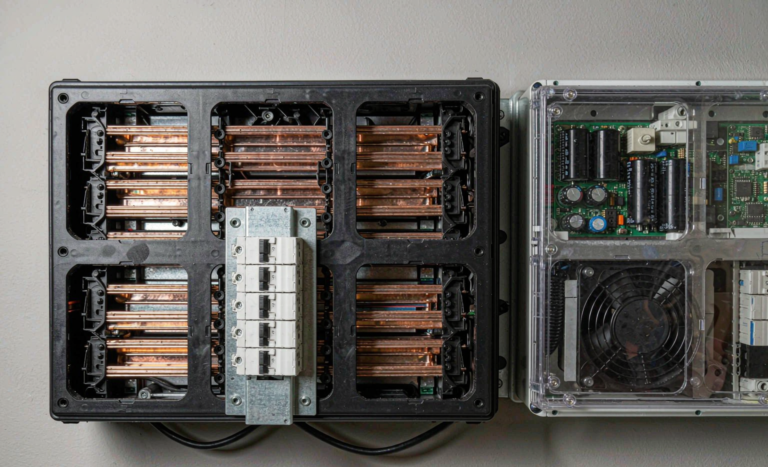
A home battery does not consume power from the panel — it pushes power into it. The inverter connects to a dedicated breaker inside your main service panel and backfeeds the busbar, which is the copper strip that distributes current to every branch circuit in the house. That busbar was sized for one direction of power flow: from the utility, through the main breaker, out to the loads. When you reverse the flow, two current sources can end up feeding the same copper bar from the same end, and the code exists to prevent the busbar from being overloaded beyond its thermal rating.
This is why the question “how big is my battery?” is the wrong starting point for panel planning. The governing number is the battery’s continuous AC output in kilowatts, not its storage capacity in kilowatt-hours. A 13.5 kWh battery with 5 kW of output and a 13.5 kWh battery with 11 kW of output store identical energy, but the second one demands more than twice the backfeed breaker capacity and is far more likely to trigger a panel upgrade. Before I let a larger inverter force an electrical service change worth thousands of dollars, I ask what the customer actually needs to power — a furnace blower, refrigerator, network gear, and lights rarely exceed 3 kW combined.
The 120 Percent Rule Explained With Real Numbers
The core constraint comes from NEC 705.12, the section governing load-side connections for on-site power sources. The commonly cited version is the 120% rule: when the backfeed breaker is positioned at the opposite end of the busbar from the main breaker, the sum of the main breaker rating and 125 percent of the inverter’s rated output current must not exceed 120 percent of the busbar rating. In practice, that gives you this formula for the maximum backfeed breaker:
Max backfeed breaker = (1.2 × busbar rating) − main breaker rating
Let me run the numbers for the three panel ratings I encounter most often:
- 200A busbar / 200A main breaker: (1.2 × 200) − 200 = 40A of backfeed allowance. At 240V, a 40A breaker supports up to 9.6 kW of continuous inverter output — enough for a typical 7.6 kW home battery inverter with margin to spare.
- 225A busbar / 200A main breaker: (1.2 × 225) − 200 = 70A. Many “200A” panels actually carry a 225A-rated busbar; the rating is stamped on the interior label. This headroom accommodates an 11.4 kW inverter (47.5A output, 60A breaker) without any hardware change.
- 100A busbar / 100A main breaker: (1.2 × 100) − 100 = 20A, or just 4.8 kW. This is the classic bottleneck for older homes. A 100A service almost always needs either a main breaker derate, a supply-side tap, or a full upgrade before we can land even a mid-size battery.
First, the opposite-end requirement is physical, not theoretical: if no free slot exists at the far end of the busbar, an electrician may need to rearrange breakers or install a slim Quadplex-style breaker pair, which is cheap if your panel accepts them and impossible if it does not. Second, without the opposite-end position, the allowance collapses from 120% to 100% of the busbar — on a 200A/200A panel, that is zero room.
Main Breaker Derating and Supply-Side Taps
When the 120% math does not work, there are two intermediate options before committing to a full service upgrade. The first is main breaker derating, sometimes called a “down-rate”: swapping the 200A main breaker for a 175A unit. The formula then becomes (1.2 × 200) − 175 = 65A of backfeed allowance. The busbar is still physically rated for 200A, but the code calculation treats the protective device as the limit. The trade-off: the household now has 175A of utility capacity instead of 200A, so a documented load calculation must confirm the home never draws more than 42 kW at 240V — true for virtually every single-family home.
The second option is a supply-side connection under NEC 705.11, historically called a line-side tap. Instead of connecting the inverter through a breaker inside the panel, we splice into the service conductors between the meter and the main breaker, usually through a fused disconnect. Because the connection is upstream of the main breaker, the 120% rule does not apply — the busbar is never exposed to the reversed current at all. The constraints shift to conductor ampacity and tap rules: the fused disconnect must protect the service conductors, and many utilities require specific meter-main-battery combination enclosures rated for the full service current. On the last three supply-side installs I supervised, the tap hardware and extra labor added roughly $800 to $1,500 versus a standard load-side connection, but each avoided a $4,000-plus panel replacement.
Power Control Systems: The Code Path That Can Skip the Upgrade Entirely
The 2023 NEC introduced section 705.13, and in my opinion it is the most important change to home energy storage load panel upgrade requirements in a decade. It creates a new equipment category — the Power Control System (PCS) — which is listed to UL 1741 Supplement SB and can actively monitor the panel and curtail inverter output in real time so that the busbar current never exceeds its rating, regardless of what the plain 120% formula allows. In plain terms: a PCS-listed system watches the main breaker current with CT sensors and, if the house approaches its utility draw limit, it throttles the battery’s export instead of letting the busbar overload.
The practical consequence is dramatic. A 200A/200A panel that would be limited to a 40A breaker under the 120% rule can accept an 11.4 kW or even larger inverter at full nameplate if the inverter is UL 1741 SB certified as a PCS and is configured with the appropriate current monitoring hardware. Major inverter platforms have shipped PCS-certified firmware since 2023, and the cost delta is typically a $300 to $600 monitoring gateway. One caveat: acceptance varies by jurisdiction. Some AHJs adopted the 2023 NEC eagerly; jurisdictions still enforcing the 2017 or 2020 code may not recognize 705.13 at all, so this is the first question I ask the local inspector before I promise a customer they can skip the upgrade.
Load Calculations and When a Service Upgrade Is Truly Unavoidable
Code compliance is not only about backfeed; it is also about whether the house as a whole has enough service capacity to begin with. NEC 220.83 provides the standard method for load calculations on existing dwellings: take 100 percent of the first 8 kVA of general loads plus 40 percent of everything beyond that, then add 100 percent of the nameplate of any newly added large appliances — an EV charger, a heat pump, an electric range, and, in some jurisdictions, the battery system itself when configured for whole-home backup. If the calculated load exceeds the service rating, the inspector can require a service upgrade no matter how clean the 120% math looks.
From my project log, a genuine upgrade becomes unavoidable in three scenarios. First, legacy 100A services in homes that have already electrified water heating or HVAC — the load calculation simply fails. Second, meter-main combinations with no working room: some early-2000s meter-main units have fixed interiors with no opposite-end position and no PCS recognition, leaving no compliant configuration short of replacement. Third, aluminum branch wiring or deteriorated busbar interiors discovered during the site survey; if the panel is unsafe for any reason, the battery project becomes the trigger for a justified replacement. In the first two cases I typically spec a 200A meter-main combination with a solar/battery-ready interior, and in the third the replacement is a safety measure that would have been needed regardless of the battery.
Subpanels, Critical Load Panels, and Meter-Main Architectures
Not every panel interaction is an upgrade. In many of my designs, the cleanest solution is to leave the main panel untouched and install a dedicated critical loads subpanel fed by the battery’s backup port — the furnace, refrigerator, well pump, internet, and a handful of lighting circuits get re-terminated there. This architecture is electrically simple, passes inspection quickly, and keeps the backfeed breaker as the only new element in the main panel. The trade-off is that the rest of the house stays dark during an outage, which is why I spend real time on load prioritization rather than selling a bigger inverter the panel cannot legally accept.
When a whole-home backup is non-negotiable and the main panel must also be replaced, the equipment choice matters. A meter-main combination with extra interior provisions lets the utility meter, main disconnect, and battery backfeed breaker live in one enclosure, eliminating a separate disconnect and simplifying the exterior mounting. I always order interiors with a 225A busbar rating even when the service is 200A, because that additional 70A of backfeed headroom under the 120% rule costs almost nothing at purchase time and removes the single most common rework order I see: swapping interiors two years later when the customer adds a second battery stack or an EV charger.
Cost, Timeline, and Permitting Realities
Budgeting for the panel work should happen at quotation, not at inspection. From my 2025–2026 project records: a like-for-like panel replacement with no service change runs $2,500 to $4,500 installed; a full 100A-to-200A service upgrade with utility coordination and meter relocation runs $3,500 to $8,000, and can exceed $10,000 if the utility requires a transformer upgrade or underground service rework. A PCS-capable monitoring gateway adds $300 to $600. Permits run $200 to $600 depending on jurisdiction, and the timeline is dominated by the utility queue: meter socket upgrades and service disconnects typically take 4 to 10 weeks from permit approval to power-on in my region, while a load-side breaker reconfiguration is a same-day task inside the normal installation window.
One more lever customers rarely know about: several state and utility demand-response programs now rebate service upgrades or smart panels when they enable storage or managed EV charging. On two projects last year, incentives covered more than half of the panel scope — worth a phone call before absorbing the full cost.
Frequently Asked Questions
Does every home energy storage installation require a load panel upgrade?
No. A majority of homes with 200A service can host a typical 5 to 7.6 kW battery inverter on a standard load-side breaker under the 120% rule, provided a free breaker position exists at the opposite end of the busbar. Upgrade pressure concentrates on 100A services, meter-main combinations with inflexible interiors, and projects above roughly 10 kW of continuous inverter output.
What is the 120% rule for home energy storage?
It is the NEC 705.12 constraint that limits the sum of your main breaker rating and 125% of the inverter output current to 120% of the panel busbar rating, applying only when the backfeed breaker sits at the opposite end of the busbar from the main. On a 200A/200A panel it permits a 40A backfeed breaker, which covers up to 9.6 kW of continuous battery output at 240V.
Can I install a home battery on a 100-amp service?
Sometimes. The plain 120% calculation allows only a 20A backfeed breaker on 100A/100A service, about 4.8 kW — enough for a small critical-loads battery. Beyond that, the realistic paths are a main breaker derate backed by a documented load calculation, a supply-side tap under NEC 705.11, a PCS-listed inverter under NEC 705.13 where the local code cycle allows it, or a full service upgrade.
What is a power control system and how does it avoid a panel upgrade?
A power control system is an inverter or gateway listed to UL 1741 Supplement SB that continuously monitors the main service current and curtails battery export so the busbar never exceeds its rating. Because the equipment actively guarantees the limit, NEC 705.13 lets it connect at full nameplate output without the 120% breaker math. Availability depends on your jurisdiction having adopted the 2023 NEC or equivalent amendment.
How much does a load panel upgrade for home energy storage cost?
A like-for-like panel replacement typically costs $2,500 to $4,500 installed, while a 100A-to-200A service upgrade with utility coordination runs $3,500 to $8,000, more if trenching or transformer work is involved. Adding a PCS-capable gateway costs $300 to $600, and utility demand-response or state storage programs may rebate a substantial share of the panel scope.
Do I need a subpanel for my battery backup loads?
You need a defined backup boundary, which is most cleanly implemented as a critical loads subpanel fed from the battery’s backup port. It is not a code requirement to isolate loads, but without it the battery must energize the entire main panel during an outage, which demands a larger inverter and often triggers the very panel upgrade you were trying to avoid. Right-sizing the subpanel is usually the cheapest way to protect what matters during an outage.
How long does a panel upgrade take from permit to power-on?
The electrical work takes one to two days; the schedule is dominated by approvals: permit review runs one to three weeks in most jurisdictions, and utility meter-socket or service-disconnect coordination adds four to ten weeks depending on queue depth. I treat a service upgrade as a two-month critical path item and sequence battery delivery accordingly.
Will a panel upgrade affect my battery system warranty?
The upgrade itself does not void a battery warranty, but the connection method must match the inverter manufacturer’s installation instructions. Connecting through a non-listed tap or configuring a PCS system without the certified current-monitoring hardware can put the warranty and the interconnection approval both at risk. Keep the commissioning report, UL listing references, and final inspection sign-off with your warranty registration.
Further Reading
References