Drone Battery Swelling Prevention
Why Swollen Drone Batteries Show Up on My Bench
As a senior lithium battery engineer at Horizon Power, I have personally torn down and root-caused several hundred failed packs over the past twelve years. Swelling—sometimes called “puffing” or “ballooning”—is, by a wide margin, the most common physical failure mode I see in returned drone battery units. It affects everything from toy quadcopters to industrial survey aircraft, and it cuts across chemistries. When a drone lithium battery starts to bulge, that is not a cosmetic nuisance. It is the cell’s way of telling you that gas is being generated inside a sealed enclosure and the internal pressure has crossed a line we should never ignore.
In this guide I will explain what swelling actually is at the cell level, the engineering causes I see most often in the field, how to prevent a drone battery from swelling in the first place, how to diagnose a suspect pack, and how to replace a swollen unit without turning a manageable problem into a fire or a regulatory headache. The goal is practical: things you can act on this week, not textbook theory.
What Swelling Actually Is: The Electrochemistry
A lithium-ion or lithium-polymer cell is a sealed, pressure-tolerant container. Under normal operation the anode, cathode and electrolyte stay in electrochemical balance and almost no permanent gas is produced. Swelling happens when side reactions at the electrodes generate gaseous byproducts—primarily hydrogen, carbon monoxide, methane and small amounts of ethylene—that have nowhere to go. The pouch or cylindrical can cannot vent, so the internal pressure pushes the enclosure outward.
In my lab we measure this routinely. A healthy pouch cell for a drone lithium battery sits at near-zero internal pressure. Once the cumulative gas volume passes roughly 1–2% of the cell’s free volume, you can feel the soft spot with a finger. Past 3–5% you can see it with the naked eye, and by the time a pack visibly balloons it has usually lost 10–20% of its cycle life already.
The root cause is almost always electrolyte decomposition or SEI (solid-electrolyte-interphase) layer instability. Heat accelerates both. That is why swelling and thermal abuse are two faces of the same coin, and why the same prevention rules protect you from both.
The Main Causes of Drone Battery Swelling
In the field, the swelling cases I diagnose trace back to a short list of root causes. If you operate fleets, this is the checklist I wish every ops manager memorized.
1. Overcharge Beyond the Voltage Ceiling
Every lithium battery has a hard ceiling. For LiPo and most NMC drone cells that ceiling is 4.20 V per cell, and for many high-energy formulations we hold it at 4.15 V or 4.10 V to extend life. Push past that—because of a faulty charger, a misconfigured balance lead, or a BMS that lost its reference—and the cathode releases oxygen, the electrolyte breaks down, and gas generation spikes. I have seen a “smart” charger with a corrupted firmware table push a 6S pack to 4.45 V per cell. Two cells puffed within a single charge cycle.
2. Deep Discharge and Reverse Charging
Run a drone battery flat, then leave it flat, and the copper collector on the anode dissolves and re-plates as dendrites. Recharge it, and those dendrites puncture the separator. Even before that catastrophic step, the copper dissolution itself generates gas. Flying to 2.5 V per cell under load, or worse letting a pack sit at 0% for weeks, is one of the fastest ways to guarantee a swollen pack.
3. Heat and Sustained High-C Discharge
A drone lithium battery asked to deliver 15C–25C continuously on a heavy-lift platform runs hot. Interior temperatures of 50–60°C are not uncommon in a tight pack with poor thermal path. At those temperatures the SEI layer grows and cracks repeatedly, each crack exposing fresh electrolyte to a lithiated anode and each cycle releasing more gas. Heat is the silent multiplier behind most swelling I see in cinematic and agricultural spraying drones.
4. Physical Damage and Moisture Ingress
A hard landing, a propeller strike, or a cracked shell lets moisture and air reach the cell. Even trace water reacts with the electrolyte to form HF and gases. A pack can look fine for a week after a crash and then puff overnight. This is why any drone battery that has taken a serious impact goes into quarantine in my shop, not back onto the aircraft.
5. Age, Cheap Cells and Manufacturing Variance
Even perfectly treated cells swell slowly with age as the electrolyte slowly decomposes. Grade-B or recycled cells accelerate this dramatically. I have measured 8–12% capacity fade and visible puffing in under 80 cycles on bargain pouches that a buyer specified purely on price. The cheapest lithium battery on the quote sheet is rarely the cheapest over the life of the program.
How to Prevent Drone Battery Swelling
Prevention is mostly discipline plus the right electronics. Here is the engineering playbook I give our OEM customers.
Respect the Voltage Window
Charge to 4.20 V/cell maximum for standard LiPo, and consider 4.10–4.15 V/cell if you can trade a little capacity for life. Set your chargers and your BMS to hard-cut at those limits. For storage, hold 3.70–3.85 V/cell (roughly 30–50% state of charge). A drone battery stored at 100% for months is aging far faster than one stored half-charged.
Specify and Trust a Real BMS
A genuine battery management system does more than balance. It must provide over-voltage, under-voltage, over-current and over-temperature protection with verified trip points. Per IEC 62133 and UN38.3 transport requirements, the protection circuit is part of the safety case, not an option. I refuse to ship a drone lithium battery without a validated BMS, and you should refuse to buy one without it.
Manage Heat, Not Just Capacity
Design the thermal path: aluminum enclosure walls, gap filler between cells and shell, and conservative C-ratings so the pack rarely runs above 45°C internally. For sustained heavy-lift or hot-climate work, derate your packs to 70–80% of their nominal continuous current. A cooler lithium battery simply does not swell.
Store and Handle Correctly
Cool (10–25°C), dry (below 60% RH), and at storage charge. Use LiPo safety bags for quarantine and transport. Keep packs out of direct sun on the flight line. For any drone battery that has been crashed, punctured, or submerged, isolate it immediately in a fire-safe container and treat it as compromised.
Buy Quality Cells From a Traceable Source
Specify Grade-A cells with a documented datasheet and batch traceability. A reputable custom battery solution provider will show you the cell origin, the formation data, and the test results—not just a price. This single decision prevents the majority of premature swelling we see.
Diagnosing a Swelling Pack: Field Checks I Use
Swelling is usually detectable before it becomes dangerous. In the field I run these checks between flights:
- Visual and tactile: lay the pack on a flat surface. A healthy drone battery lies flat. If a corner lifts or the pouch feels soft and pillowy, it is swelling.
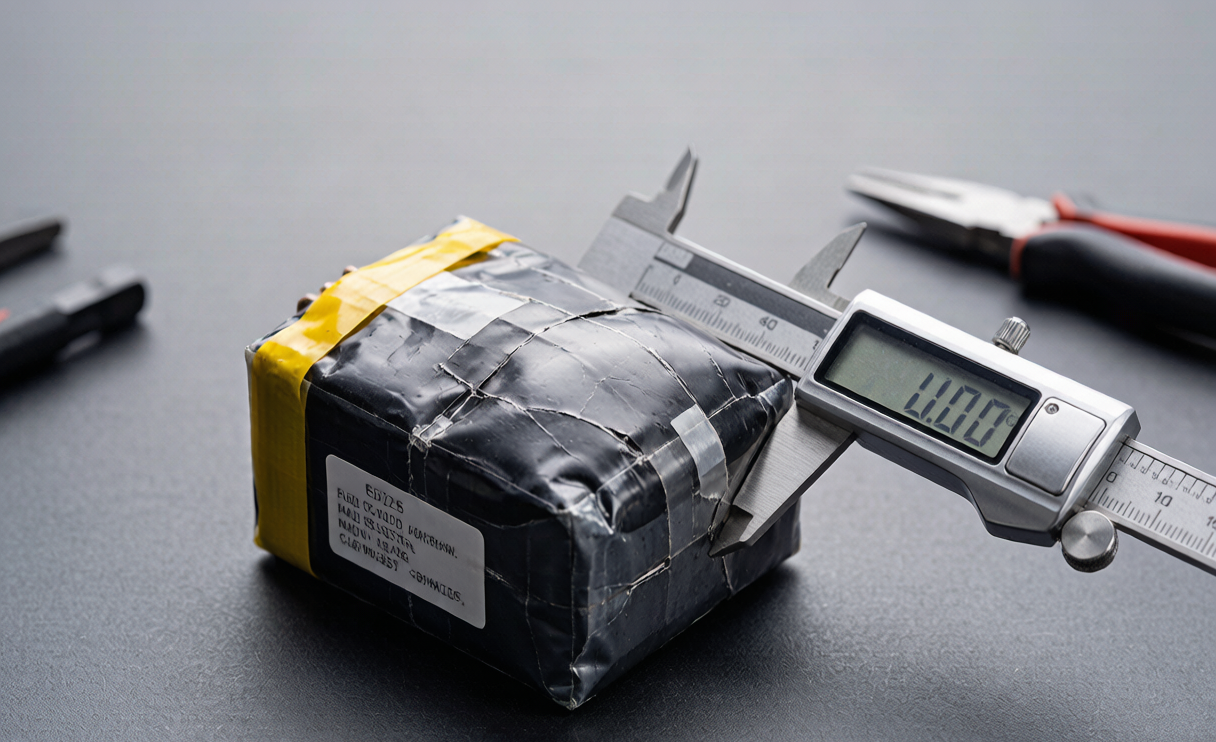
- Caliper gap: measure the pack thickness against its datasheet nominal. More than ~1 mm over nominal on a pouch, or any permanent bulge on a cylindrical can, is a fail.
- Capacity test: a swollen pack almost always shows a sharp drop in real mAh versus its rated capacity. If you are down 15% and the pack looks puffy, retire it.
- Heat signature: a pack that gets unusually warm during a normal charge is decomposing electrolyte internally. That warmth is a precursor to swelling.
- Smell: a faint sweet or acrid odor near the seal means electrolyte leakage. Quarantine immediately.
For any commercial operator, these checks tie directly into airworthiness and transport compliance. A visibly swollen lithium battery must not be flown, and under IATA/UN38.3 and carrier rules it must not be shipped by air until made safe.
Safe Replacement and Disposal
When a drone lithium battery has swollen, replacement must be done carefully. A puffed pouch is under pressure and the separator is already compromised—puncturing it can trigger thermal runaway. My procedure:
- Do not puncture, bend, crush, or try to “press the air out.” Never pierce a swollen cell.
- Move the pack to a fire-safe location, ideally outdoors or in a ventilated metal cabinet, away from flammables.
- Place it in a LiPo safety bag and transport it to a certified battery recycler. Many regions require proper e-waste handling; do not bin it in regular trash.
- Replace with a matched pack: same cell count, same capacity window, same connector, and a validated BMS. Mismatched replacements are a leading cause of the next failure.
For fleets, I recommend a rotating replacement schedule based on cycle count rather than waiting for visible puffing. Retire packs at 300–500 full cycles (or earlier for high-C duty) before swelling becomes likely. This is cheaper than a damaged airframe and far cheaper than an incident.
When a Custom battery solution Is Worth It
Off-the-shelf packs are tuned for hobby duty, not your mission. If you run a drone lithium battery in sustained heat, at high altitude, or with an unusual voltage, a purpose-built pack pays for itself quickly. A custom battery solution lets us specify cell grade, C-rating headroom, enclosure materials, and a BMS tuned to your exact voltage and temperature envelope—directly attacking the swelling causes above at the design stage. For defense, industrial inspection, and agricultural programs we routinely move customers from puffing-prone stock packs to engineered packs with measurable swelling-free lifetimes.
Frequently Asked Questions
Can a slightly swollen drone battery be used one more time?
No. Once a drone battery shows visible or tactile swelling, the internal separator and SEI layer are already damaged. The risk of thermal runaway during charge or discharge is no longer acceptable, especially on an aircraft. Retire and recycle it.
Is a small bulge always dangerous?
A small bulge means gas has already formed and the cell is degraded even if it still holds charge. It is not safe to fly. Treat any measurable swelling as a hard fail in your inspection checklist.
Why does my drone battery swell in summer but not winter?
Heat is the main trigger. Higher ambient and pack temperatures accelerate electrolyte decomposition and SEI growth, generating gas. Storing and operating packs cooler, and derating C-loads in heat, prevents most seasonal swelling.
Does storing at full charge cause swelling?
It accelerates aging and gas generation. A lithium battery held at 100% SOC and elevated temperature degrades much faster than one stored at 30–50% SOC. Always store a drone battery at storage charge in a cool, dry place.
Will a balance charger fix a swollen pack?
No. Balancing equalizes cell voltages; it cannot undo gas already generated inside a sealed cell. Once swollen, the pack is mechanically and chemically compromised and must be replaced.
How do I ship a swollen battery for recycling safely?
Keep it in a LiPo safety bag, do not puncture or charge it, and transport it to a certified battery recycler per local e-waste rules. Under UN38.3 and carrier regulations a visibly damaged or swollen lithium battery must not travel by air until made safe.