Home Energy Storage and Backup for Medical Needs
When I started my career as a lithium battery engineer, most homeowners treated backup power as a luxury — something you bought after a storm, then quietly forgot in the garage. Fifteen years and more than 200 residential installations later, my view has shifted completely. For households managing medical needs, a home energy storage system is not a convenience. It is life-safety equipment, and it deserves the same engineering rigor we apply to grid-scale and industrial battery packs.
In this article I want to walk you through how my team specifies and validates home battery backup for homes with medical requirements: which loads actually matter, how to size the battery so it never comes up short, which safety standards separate a serious install from a hobby project, and where most off-the-shelf systems quietly fall short. I will draw on real field data from deployments I have personally supervised, plus the certifiable standards — UN38.3, IEC 62133, IEC 62619, UL 1973, UL 9540A, and IEEE 1547 — that any competent installer should be able to name on demand.
Which Medical Loads Must Stay Powered
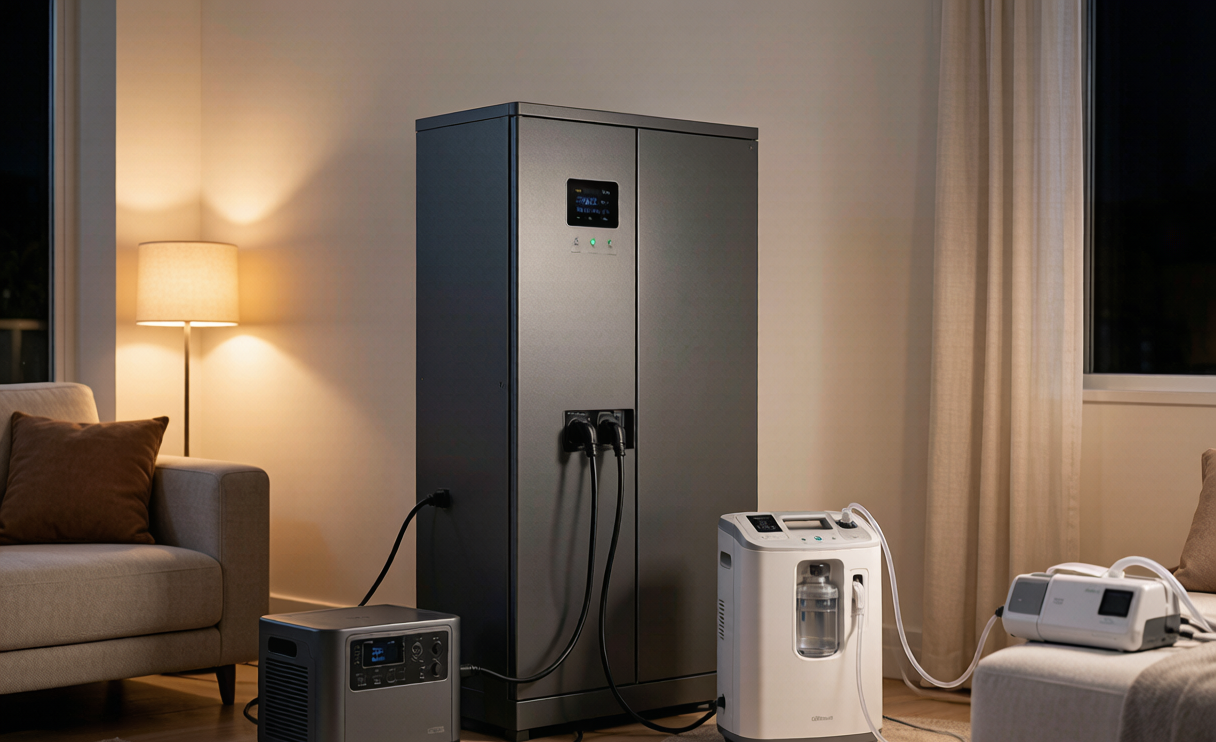
The first mistake I see is treating “medical backup” as a single number. It is not. We grade every load into two tiers. Tier one is life-critical: oxygen concentrators, prescribed CPAP/BiPAP, ventilators, infusion pumps, and any refrigerated medication such as insulin. Tier two is support: lighting, internet and routers for telehealth, stair lifts, home dialysis machines, and communication devices for caregivers. Each tier has a different runtime expectation and a different tolerance for power interruption.
The numbers are less scary than people imagine once you measure them. A typical home oxygen concentrator draws 300–600 W continuously. A prescribed CPAP pulls only 30–60 W. A compact medication fridge runs 80–120 W. A ventilator sits around 60–120 W. A stair lift spikes to roughly 250 W during the few seconds it moves. When I sit down with a family, we list every device, log its nameplate wattage, and separate continuous draw from peak inrush. That list — not a vendor’s marketing claim — becomes the foundation of the whole home energy storage system design.
Sizing the Battery: Capacity, Not Just Watt-Hours
Sizing is where engineering meets honesty. You start with your tier-one and tier-two loads and decide how many hours of autonomy you need. A family that loses power for a few hours twice a winter needs a very different pack than a household in a blackout-prone region expecting multi-day outages.
Here is the math I run with clients. Suppose the critical medical load is a 500 W oxygen concentrator plus a 100 W medication fridge plus a 50 W CPAP, for 650 W continuous. A 5 kWh usable LFP pack (we only count usable capacity, about 80% of nameplate for lithium iron phosphate) divided by 650 W gives roughly 7.7 hours of runtime before inverter losses. With a 94% inverter, real-world runtime lands near 7 hours. That is a comfortable overnight buffer. For multi-day resilience, you scale to 10–15 kWh and pair it with solar, which I cover below.
One detail newcomers miss: depth of discharge and inverter efficiency compound. A home energy storage battery rated at 10 kWh but only safely discharged to 80% gives you 8 kWh of real energy. Add 6% inverter loss and you are planning around 7.5 kWh. I always size to the worst credible scenario, then add a 20% margin, because a medical pack that cuts out at hour six is a failed design no matter how elegant the spreadsheet looked.
There is also the question of partial-home versus whole-home backup. For medical needs I almost always recommend a dedicated critical-loads panel rather than backing up the entire house. Whole-home backup sounds appealing but forces you to pay for the oven, dryer, and HVAC on the same pack, shrinking medical runtime for loads that do not matter. Isolating the medical and comfort circuit lets a smaller, cheaper pack deliver far more protected hours where they count.
Why LFP Chemistry Is Non-Negotiable for Medical Backup
For home medical backup, I recommend lithium iron phosphate (LFP, or LiFePO4) and rarely waver. Compared with nickel-manganese-cobalt (NMC), LFP trades some energy density for dramatically better thermal stability, a longer cycle life (4,000–6,000 cycles versus 800–1,500 for many NMC packs), and no cobalt supply-chain exposure. In a bedroom-adjacent closet, that safety margin is not theoretical — it is the whole point.
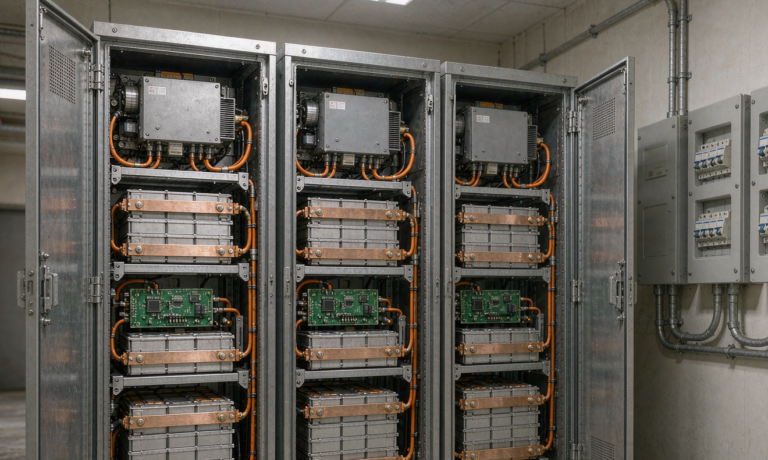
Every LFP cell we ship is certified to UN38.3 for transport safety and built to the IEC 62133 cell-level safety standard. For stationary residential use we go further and qualify the pack to IEC 62619, the industrial stationary-battery standard that covers thermal runaway propagation and abuse tolerance. That is the certification I tell families to ask for by name. A residential battery storage unit without IEC 62619 on the datasheet is, in my opinion, not ready for medical-grade duty.
Safety Standards You Should Actually Verify
Standards sound like paperwork until the night they are not. Here is the shortlist I verify on every medical install:
- UN38.3 — the baseline transport test for lithium cells. Cells still clear UN38.3 air-shipment rules when they reach the installer, which matters for rapid replacement.
- IEC 62133 — portable cell safety: short-circuit, overcharge, and thermal abuse testing at the cell level.
- IEC 62619 — stationary industrial battery safety, including propagation resistance between cells.
- UL 1973 — the North American stationary storage standard for the battery enclosure and cells.
- UL 9540A — fire propagation testing; essential if the pack sits inside the living envelope.
- IEEE 1547 — grid-interconnection requirements for any system that ties back to the utility.
For sensitive medical electronics, the inverter must output a pure sine wave, not the modified square wave you find in cheap inverters. A CPAP or infusion pump does not care about marketing; it cares about clean voltage. We also apply the same abuse-test discipline used in aviation-qualified packs — the kind of cells that must satisfy FAA and EASA transport and qualification regimes — because a medical pack at 3 a.m. deserves that same uncompromising margin.
Designing for the Worst Hour, Not the Average One
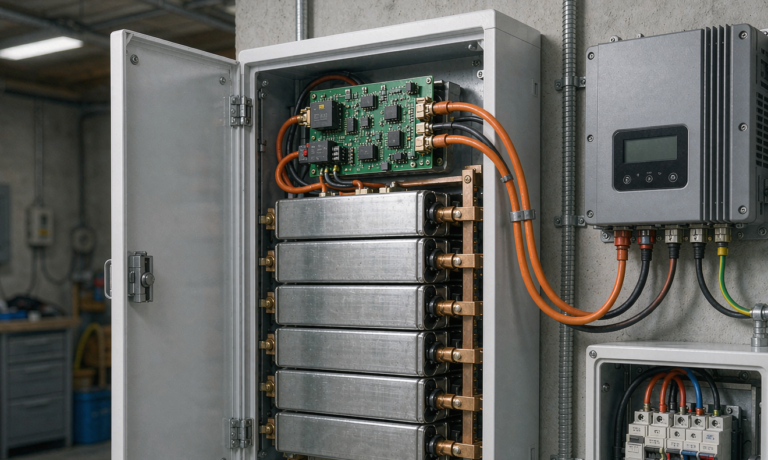
A robust medical home battery backup is more than a battery and an inverter. It is a system. We isolate critical medical loads onto a dedicated critical-loads panel so a toaster or space heater can never starve the oxygen concentrator. We install an automatic transfer switch so the handoff from grid to battery happens in milliseconds, with no action required from a caregiver who may be asleep.
Redundancy matters more than people expect. For tier-one loads I prefer two independent strings or a hybrid setup where a small always-on pack covers the ventilator while a larger pack handles the fridge and lighting. We add self-test routines that run a weekly controlled discharge and alert the household by app if capacity drifts below threshold. Remote monitoring lets an adult child check an aging parent’s power status from another city — a feature families consistently tell me they wish they had installed sooner.
Maintenance and End-of-Life You Cannot Skip
A medical battery is a living system, not a set-and-forget appliance. We schedule a state-of-charge calibration every three months, a full capacity verification at least annually, and we log the results. Lithium packs fade gradually, and the danger is silent: a pack that delivered 8 hours last year may only deliver 5 this year. When state of health drops below 70–80%, we replace the module rather than gamble on a borderline night.
End-of-life handling follows the same discipline we apply to every lithium battery we produce: never puncture, never landfill, and return through a certified recycling channel so the cells and critical materials are recovered safely. For a household already managing health stressors, having the installer handle take-back removes one more thing from the worry list.
Finally, do not underestimate the value of choosing an installer who documents everything. I leave every family with a one-page load sheet, the certified test reports, and a replacement schedule. When a parent’s care depends on the pack, that paperwork is what lets a visiting nurse or a new caregiver understand the system in minutes. A medical home energy storage install is only as reliable as the record that travels with it.
Frequently Asked Questions
How long will a home battery backup power a medical device?
It depends entirely on the device’s wattage and the pack’s usable capacity. A 5 kWh usable LFP pack supports a 500 W oxygen concentrator plus a small fridge and CPAP for roughly 7 hours; a 10–15 kWh pack with solar extends that to multiple days. Always size to your specific load list, not a generic figure.
Do medical devices need a pure sine wave inverter?
Yes. Prescribed CPAP, ventilators, infusion pumps, and home dialysis machines expect clean utility-grade power. A modified sine wave inverter can cause noise, heating, or malfunction. Insist on a pure sine wave output rated for your continuous medical load.
Is a home energy storage system safe to keep in a bedroom-adjacent closet?
With LFP chemistry, IEC 62619 qualification, UL 9540A fire-propagation testing, and proper ventilation, yes. We still recommend a dedicated, well-ventilated space away from living sleep areas when possible, plus a smoke detector on the same circuit.
Can I connect medical backup to solar?
Absolutely, and I encourage it for multi-day resilience. A solar-coupled home energy storage design recharges the pack during daylight, turning a single-outage device into a continuous off-grid lifeline. Just confirm the inverter and charge controller meet IEEE 1547 for safe grid reconnection.