Semi-Solid State Battery Interface Wetting and Impedance
In fifteen years of building lithium cells I have watched more semi-solid state battery programs fail on a step nobody photographs than on chemistry itself. The chemistry papers get the applause. The quiet killer is interface wetting: whether the gel electrolyte actually spreads into every pore of the electrode and hugs every particle before the cell is sealed. When wetting is incomplete, the impedance data tells on you immediately, and it keeps telling on you for the life of the pack. In this article I will walk through how wetting and impedance are connected, how we measure that connection, and which process levers actually move it on a production line.
Why Wetting Decides Performance in a Semi-Solid Cell
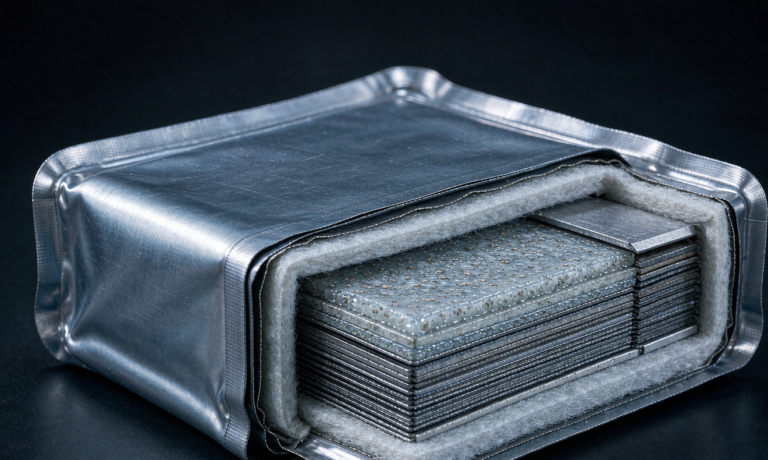
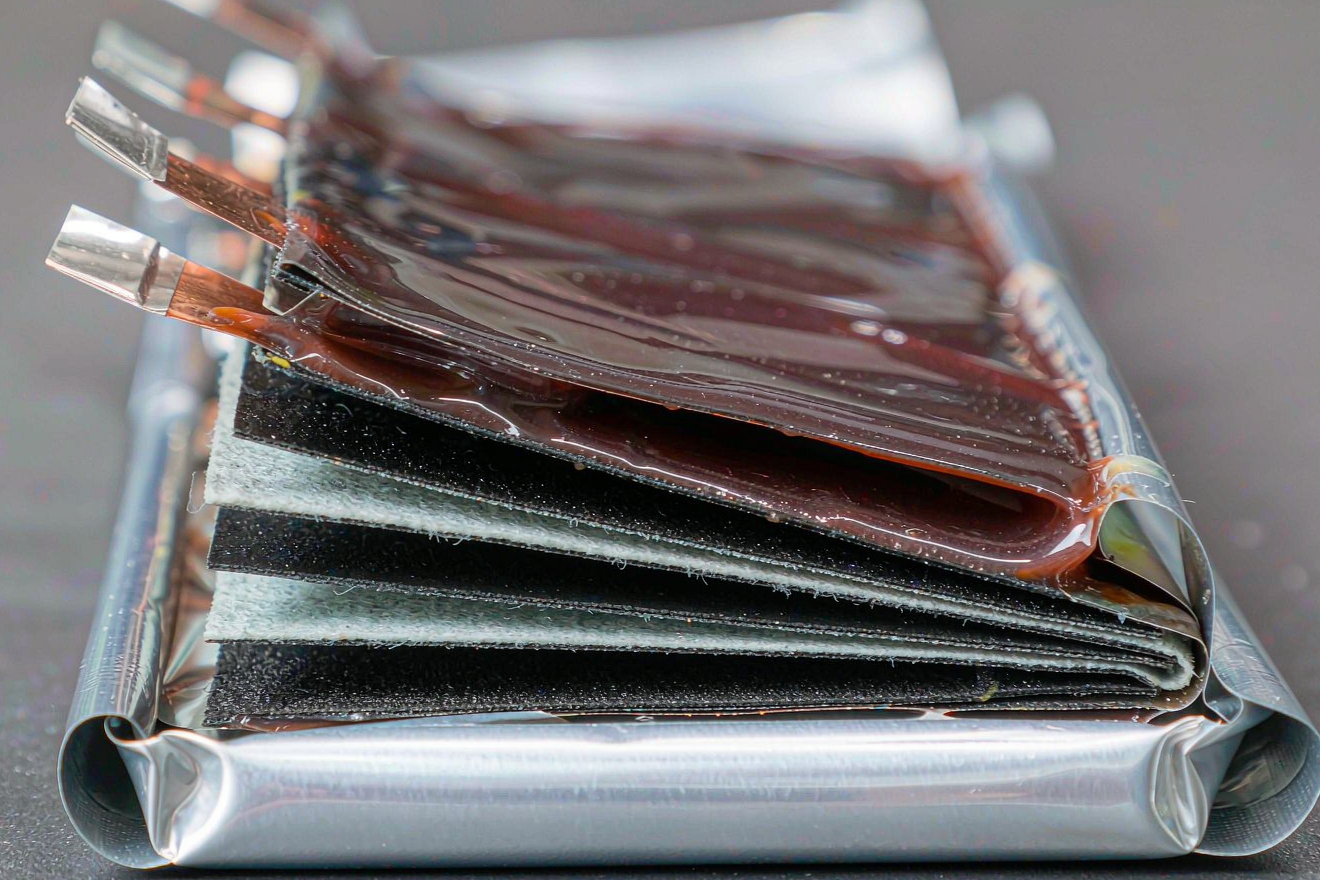
A semi-solid state battery sits between a conventional liquid-electrolyte lithium-ion cell and a true all-solid design. Instead of a free-flowing liquid, the cell carries a semi-solid gel electrolyte, often a polymer matrix swollen with a limited amount of liquid solvent. That limited liquid is the whole point, because it improves safety and suppresses leakage, but it is also the problem: there is far less wetting fluid available to find its way into the electrode coating.
In a liquid cell, excess electrolyte forgives sloppy filling. In a semi-solid cell there is no forgiveness. Every micron of electrode thickness that the gel fails to reach becomes dead area. The active material is present, the current collector is present, but ionic pathways are missing, so those regions neither deliver current evenly nor accept it back. The result shows up as capacity loss at high rate, heat generation during fast charge, and accelerated aging localized exactly where the gel ran short.
The Wetting Window: Viscosity, Contact Angle and Time
Three variables govern whether the gel reaches the pores: viscosity, contact angle, and the time and pressure you allow for both. Gel electrolytes for semi-solid designs commonly run between 3,000 and 40,000 mPa.s depending on polymer fraction, which is one to two orders of magnitude more viscous than a standard carbonate electrolyte at roughly 1 to 2 mPa.s. Push the polymer content up for better mechanical strength and the wetting time climbs steeply.
Contact angle matters just as much. On a pristine ceramic-coated separator a well-formulated gel will spread to a contact angle below roughly 20 degrees, but contamination by moisture, residual binder solvent, or fluorinated surface residues can push that above 40 degrees and stall the wetting front entirely. We learned this the expensive way: a batch of cathode coating that had absorbed trace moisture during a humid summer week wetted so poorly that first-cycle impedance doubled across the batch, with no change in formulation at all.
Time is the third axis. A wetting front moving through a 150-micron electrode at useful speed needs minutes to hours depending on porosity and viscosity, and vacuum assistance cuts that dramatically. The process window is therefore a triangle, and any program that fixes two corners and ignores the third will discover the constraint in pilot data rather than in the lab.
What Poor Wetting Looks Like in Impedance Data
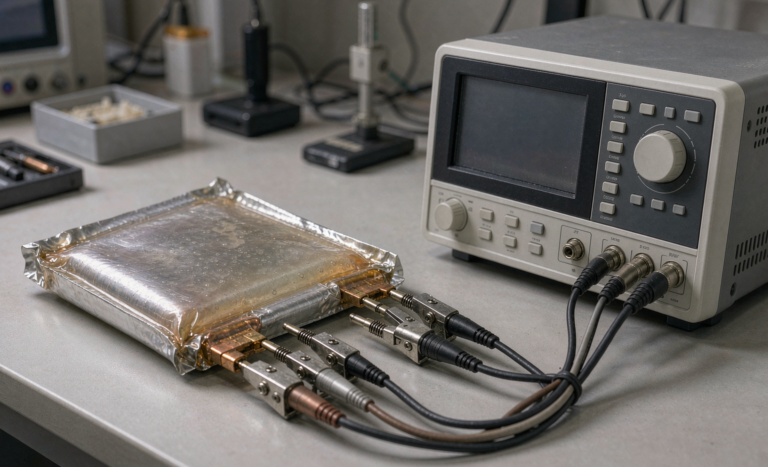
Electrochemical impedance spectroscopy, or EIS, is the most direct window we have on wetting quality, and it is cheap to run at end of formation. A well-wetted semi-solid cell produces a characteristic spectrum: a small high-frequency intercept from electronic paths and the separator bulk, a single depressed semicircle from charge transfer across the interface, and a clean low-frequency tail from solid-state diffusion.
Poor wetting distorts that picture in predictable ways. The high-frequency intercept usually rises first, because the gel film between electrode and separator is patchy and locally thin. Then the charge-transfer semicircle grows and often splits into two overlapping arcs as the electrode develops wetted and unwetted populations of particles in parallel. In severe cases the low-frequency tail bends upward, the signature of a blocking electrode where ions simply cannot reach a meaningful fraction of the active material.
The useful discipline is to treat these shapes as a language rather than fitting them blindly. When we see a split semicircle on a semi-solid cell, we do not reach for a catalyst explanation or blame the cathode; we check filling records, dwell time, and stack pressure first. In my experience more than half of unexplained impedance outliers trace back to wetting, not chemistry.
Quantifying Wetting Degree Across a Batch
Scanning electron micrographs of teardown cross-sections are beautiful but destructive, so production needs numbers you can collect on every cell. We rely on three complementary indicators. First, the wetting degree index: the ratio of charge-transfer resistance at end of formation against a well-wetted reference cell, tracked as a distribution rather than an average. Second, capacity recovery after a high-rate pulse, because unwetted regions drop out of the response first. Third, ultrasound transmission scanning on sampled cells, which maps dry pockets inside the jelly roll without opening it.
The distribution matters more than the mean. A batch with a tight impedance spread and a mediocre average will outlive a batch with a superb average and a fat tail, because the tail cells age fastest and drag module balancing with them. We set release limits on the 95th percentile of the impedance ratio, not the mean, and that single change caught a filling-nozzle clog two weeks before it would have shipped a marginal lot.
Process Levers That Actually Move Wetting and Impedance
On the line, five levers do most of the work. Electrolyte volume margin: we fill semi-solid cells with more gel than stoichiometry suggests and recover the excess at degassing, because starving the fill is the cheapest way to create unwetted corners. Vacuum level and dwell: pulling vacuum before gel introduction, then holding a defined soak, cuts wetting time by more than half on our 3-ampere-hour pouch format. Temperature: warming the gel into a lower-viscosity band before filling improves spread, provided the cell returns to room temperature before sealing so the gel does not slump away from the top edge.
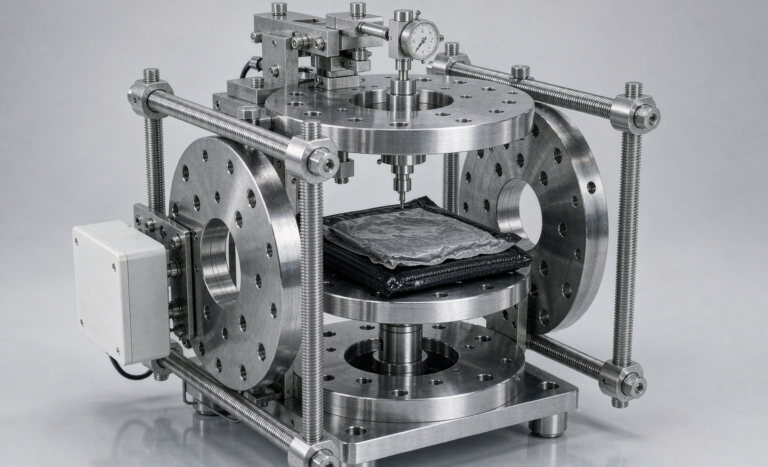
Stack pressure is the lever people forget. A modest, uniform pressure during wetting keeps the separator in intimate contact with both coatings and forces the gel through the pore network instead of around it. We wet under fixtures rather than free-stacked, and end-of-formation impedance spread narrowed measurably when we made that change. Finally, electrode surface quality: calendering conditions, residual moisture, and binder migration all alter the surface energy the gel must wet, so we treat coating as part of the wetting process, not a separate department.
How Wetting Problems Surface in the Field
A cell that ships with marginal wetting rarely fails at delivery. It fails six to eighteen months later as inconsistent capacity fade and rising heat generation under load. Because the unwetted regions sit at higher local impedance, they cycle at a different effective depth of discharge, deposit stress unevenly, and age faster than their neighbors. Fleet telemetry will show it first as widening state-of-health spread across cells that started identical, and module-level balancing will work harder every month to compensate.
That is why we treat wetting metrics as lifetime metrics, not just end-of-line ones. Correlating formation impedance distributions with field aging data closes the loop, and it lets a manufacturer give honest warranty numbers instead of hopeful ones.
FAQ
How long does electrolyte wetting take in a semi-solid state battery?
On our 3 Ah pouch format, passive wetting at room temperature needed more than 12 hours and still left gradients. With vacuum assistance and a controlled soak we reach an equivalent wetting state in roughly 2 to 4 hours. The right answer depends on electrode thickness, porosity, and gel viscosity, so we qualify the schedule per design rather than copying a number between projects.
Can impedance testing detect poor interface wetting before a cell ships?
Yes, and it is the most reliable early signal we have. A cell with incomplete wetting shows an elevated high-frequency intercept and a split charge-transfer semicircle in EIS at end of formation, often months before any capacity symptom. We screen every production cell with a short impedance check and release against the 95th percentile of the distribution, which has caught filling defects that visual inspection missed entirely.
Does higher stack pressure always improve wetting?
No. Moderate, uniform pressure helps the gel penetrate pores and keeps the separator in contact, but excessive pressure can squeeze gel out of the coating, starve the interface, and even damage the separator. The useful range is narrow and design-specific. We map pressure against end-of-formation impedance during qualification and lock the fixture setting there, rather than assuming that more compression is automatically better for the interface.
Why does a semi-solid state battery wet more slowly than a conventional lithium-ion cell?
Two reasons. The gel carries far less free liquid, so there is simply less fluid available to transport into the pore network, and its viscosity is typically one to two orders of magnitude higher than a standard carbonate electrolyte. Capillary flow scales inversely with viscosity, so a semi-solid design that must wet the same electrode volume can take several times longer under identical conditions.
What contact angle should a gel electrolyte achieve on a ceramic separator?
Below about 20 degrees is the target we hold on ceramic-coated separators with our current gel formulation, verified by sessile-drop testing on production-coated foil rather than ideal reference surfaces. Above roughly 40 degrees the wetting front effectively stalls under practical filling schedules. Surface contamination, residual moisture, and binder migration are the usual causes when a formulation that tested well in the lab suddenly refuses to spread on the line.
Can a poorly wetted cell recover after additional formation cycles?
Partially, and this is a trap. Extended high-temperature soaks and gentle cycling can redistribute gel into marginally dry regions and lower impedance somewhat, but it never fully recovers capacity lost to severely unwetted areas, and the extra thermal history accelerates other aging mechanisms. We treat recovery cycling as a rescue for borderline cells only, identified by impedance screening, never as a substitute for getting the filling process right.
Further Reading
References