How to Choose the Right Drone Battery for Long-Range
Long-range surveying turns the drone battery for long-range surveying into the single most important component on the airframe. When a mapping or inspection mission stretches past 25 minutes, every gram of pack weight and every watt-hour of capacity directly changes whether you finish the flight or trigger a forced landing. After building packs for survey operators across agriculture, mining and power-line inspection, I have a simple rule: spec the battery from the mission profile, not from the catalogue.
Calculate Your Mission Energy Budget First
Start with the load, not the cell. A typical quadcopter survey airframe draws 40–70 A at hover and peaks above 120 A during climbs. Multiply average current by nominal pack voltage to get watts, then by planned flight time to get watt-hours. A 22.2 V pack holding 16 000 mAh delivers 355 Wh; at a realistic 80% usable depth that is roughly 284 Wh on the wire. If your airframe burns 600 W in cruise, that is about 28 minutes of safe flight before the reserve.
Build in a 20% reserve for wind, climb-outs and telemetry drift. Operators who skip this step are the ones calling me about unexpected mid-field landings.
Capacity vs Weight: The Endurance Tradeoff
Doubling capacity does not double flight time, because the heavier pack forces the motors to work harder. Beyond a sweet spot — usually around 1.4–1.8 kg pack mass on a mid-size survey quad — the marginal minute of endurance costs more weight than it returns. That is why I rarely spec above 22 000 mAh for a 1.2 m airframe; the drone lithium battery should serve the mission, not dominate it.
Discharge Rate (C-Rating) for Survey-Grade Thrust
Survey flights are not racing, but they do demand burst current for wind correction and ascend. A pack rated at 25C on 16 000 mAh can deliver 400 A briefly — far more than needed, which is good. Underspec the C-rating and voltage sags under load, the flight controller logs undervoltage and the auto-land kicks in early. For survey work I recommend a continuous 15C minimum with 25C burst headroom.
Chemistry Choice: LiPo, Li-ion or Semi-Solid
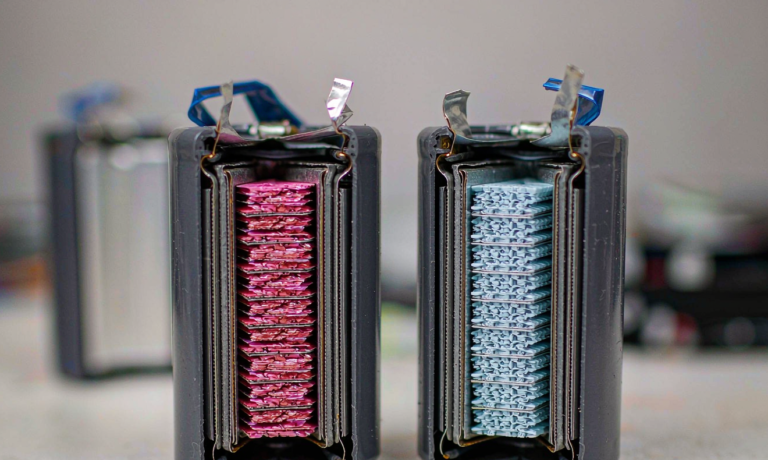
Traditional LiPo still wins on burst current and price, but it is the heaviest per Wh. High-density Li-ion (NMC) trades some burst for ~30% more energy per kilogram, which matters on long transects. The newer semi-solid state battery pushes energy density past 300 Wh/kg while staying far safer under puncture than liquid-electrolyte cells — a real advantage when you fly over people or infrastructure. For most surveying fleets I now default to high-density Li-ion, with semi-solid as the upgrade path.
Battery Management and Telemetry for Long Missions
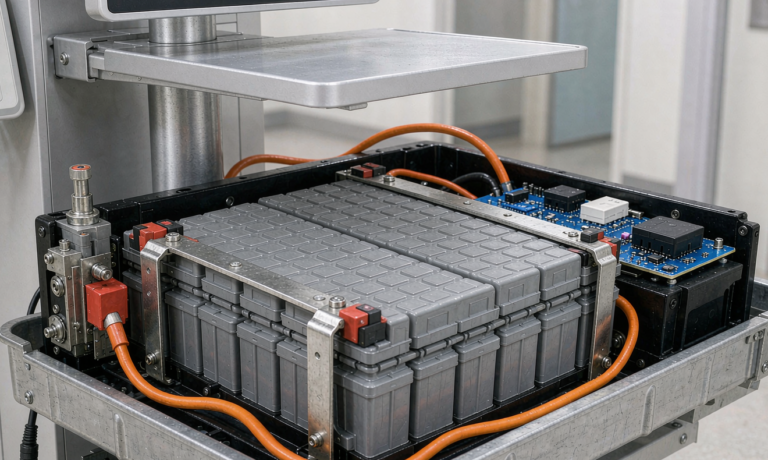
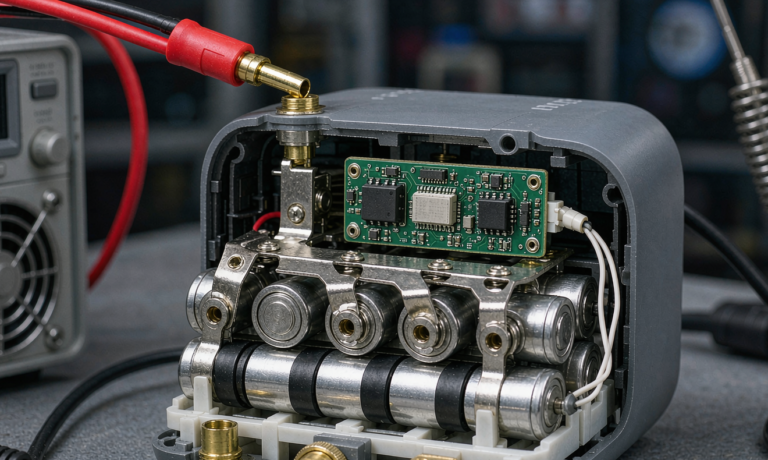
A good drone battery BMS is not optional on long flights. You want per-cell voltage, temperature and remaining-Wh telemetry streamed to the ground station, plus automatic balancing on charge. I have seen packs last 40% longer simply because the operator stopped flying to 3.0 V per cell and started landing at 3.3 V. The battery application solution matters as much as the cells.
Cold-Weather and High-Altitude Considerations
Above 2 000 m or below 5 °C, lithium capacity falls and internal resistance climbs. Keep packs in an insulated bay and warm them to 15 °C before launch; a cold pack can lose 20% of its rated Wh before the first waypoint. This is where a lithium battery built with low-temperature cells earns its premium.
Sourcing a Reliable drone battery manufacturer
When you move from prototypes to a fleet, the cell grade decides your uptime. Insist on Grade A cells with full UN38.3 and IEC 62133 documentation, and ask for the actual capacity test report, not the label. As a lithium battery manufacturer we grade every batch; buyers who skip verification are the ones shipping packs that sag after 30 cycles. Specifying a trustworthy custom battery solution up front saves months of field failures.
Frequently Asked Questions
How many watt-hours do I need for a 30-minute survey flight?
For a 600 W cruise airframe with a 20% reserve, plan for about 360 Wh of usable capacity, which means a ~450 Wh pack at 80% depth of discharge.
Is LiPo or Li-ion better for long-range surveying?
Li-ion (NMC) gives the best endurance per kilogram; LiPo gives the best burst and lowest cost. Most long-range survey fleets should choose high-density Li-ion, keeping LiPo for short, high-thrust work.
Can I use the same pack for mapping and spraying?
Only if the discharge profile matches. Spraying draws heavier sustained current; a mapping pack pushed into spray duty will overheat. Size the pack to the harder duty cycle.
Choosing the right drone battery for long-range surveying is engineering, not guesswork. Size from the mission, protect the cells, and the endurance follows. If you are scaling a fleet, talk to our engineering team about a graded, documented pack built for your exact airframe.