Drone Battery Cost Optimization for Delivery Drones (8)
When operators ask me how to lower the cost of a drone battery program, the instinct is almost always to negotiate the cell price down. After fifteen years engineering lithium packs for commercial UAVs, I have learned that the purchase price is the least interesting number on the spreadsheet. The drone battery that looks cheap on a purchase order can quietly become the most expensive line item in the fleet once you account for the crashes, downtime, and warranty claims it generates. In this article I will walk through a risk-adjusted way of thinking about drone battery cost optimization for delivery drones — one that treats pack reliability as a financial lever, not an engineering afterthought.
Why the Cheapest Pack Is Rarely the Cheapest Pack
A delivery operator running a few hundred aircraft might see two quotes for a 6S NMC pack: one at $92 and one at $118. The $26 gap feels decisive in a budget review. But that gap is measured at a single instant — the moment the pack leaves the factory. It says nothing about the 500 flight cycles the pack will fly, the parcels it will carry, or what happens if it fails at 40 meters over a city street.
I have watched fleets standardize on the low bid, then burn the savings three times over in field replacements and incident response. A drone lithium battery is not a consumable you swap like a filter; it is a flight-critical component whose failure cascades into airframe loss, payload loss, and regulatory scrutiny. When you optimize only the sticker price, you are optimizing one-tenth of the real cost.
The True Cost of a Single Battery Failure
Let me put numbers on a failure. A mid-size delivery quadcopter built around a 6S pack typically carries an airframe value of $4,000–$8,000. The parcel it loses is minor ($50–$400), but the secondary costs are not: an in-flight battery disconnect or a cell-group thermal event forces an uncontrolled landing, which can trigger an incident report, a temporary fleet grounding, an insurance premium review, and a customer SLA penalty.
In my reliability work I treat the all-in cost of one battery-induced crash as $5,000–$12,000, depending on whether the airframe is recoverable and whether the incident reaches a regulator. Now scale that by failure rate. A fleet of 5,000 packs with a 1.5% infant-mortality escape rate expects ~75 premature failures; at a 0.3% rate, ~15. The difference — 60 failures — is worth $300,000 to $720,000 in avoided incident cost alone. That is the number procurement should be arguing about, not the $26 cell delta.
It is worth separating two failure populations. True random failures are rare and evenly distributed across the fleet. Infant-mortality escapes — the lot-specific defects that surface in the first 50 cycles — are where most of the money is lost, because they cluster in a batch you have already deployed. A single poorly graded drone lithium battery lot can generate more incident cost in a quarter than the entire cell-price saving of a yearly procurement.
This is why I tell operators that the lithium battery decision is really a risk decision. Every dollar shaved from reliability shows up later as a dollar of variance in your incident budget.
Building a Risk-Adjusted Total Cost of Ownership Model
The framework I use is a risk-adjusted total cost of ownership, or raTCO. The per-flight battery cost is not just the pack price divided by cycles; it is the pack price plus the expected failure cost, divided by usable cycles:
raTCO per flight = ( Pack BOM + FailureRate × CrashCost ) / UsableCycles
Worked example. Take a $120 pack rated for 500 delivery cycles to 80% capacity. At a robust 0.3% failure rate and an $8,000 all-in crash cost, expected failure cost per pack is 0.003 × $8,000 = $24. Per flight that is ($120 + $24) / 500 = $0.288. Now the cheap $92 pack at a 1.5% failure rate: expected failure cost is 0.015 × $8,000 = $120, so per flight it is ($92 + $120) / 500 = $0.424. The “cheap” pack costs about 47% more per flight once risk is included.
The same model explains why I push for a usable-cycle target rather than a peak-capacity target. A pack that survives 500 cycles beats a pack that peaks higher but retires at 300. In a drone battery cost optimization for delivery drones program, cycle life is a cost multiplier, not a spec footnote.
Where Reliability Investment Pays Back First
The good news is that the failure rate is not fixed — it is engineering-able, and most of the leverage is cheap relative to the risk it retires. In my builds the highest-return investments are:
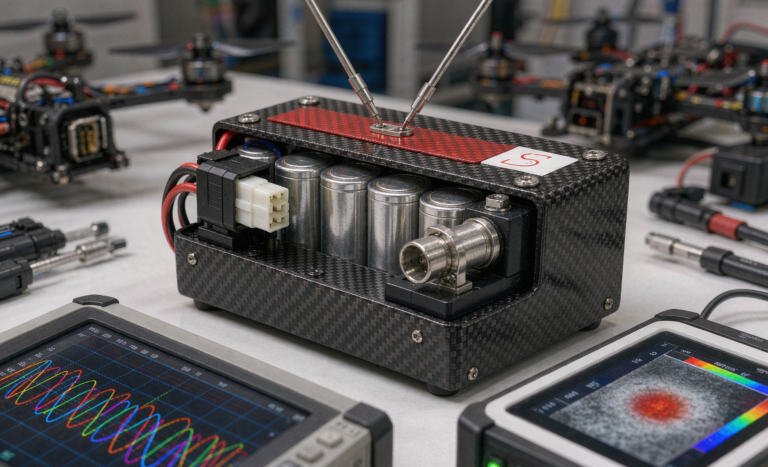
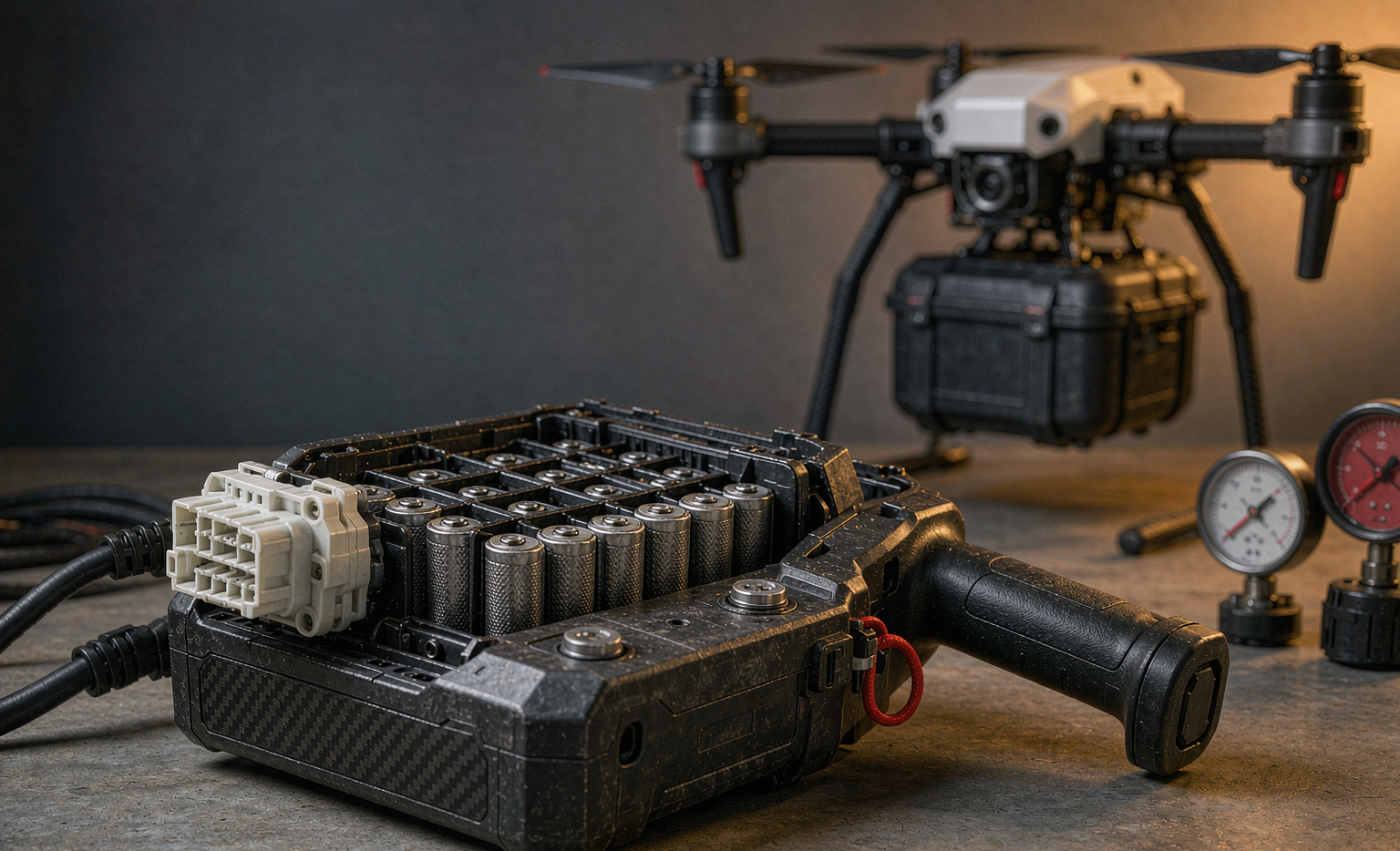
- Cell grading and matching. Sorting cells by DCIR coefficient of variation below 6% and self-discharge (K) below 1.0 mV/day removes the lot-to-lot escapes that cause early, unexplained field deaths. Cost added: $2–$4 per pack.
- Weld and interconnect QC. Laser or ultrasonic welds held under 0.15 mΩ per joint and 25 N pull strength eliminate the vibration-fatigue opens that dominate flight failures. Cost added: $1–$3 per pack.
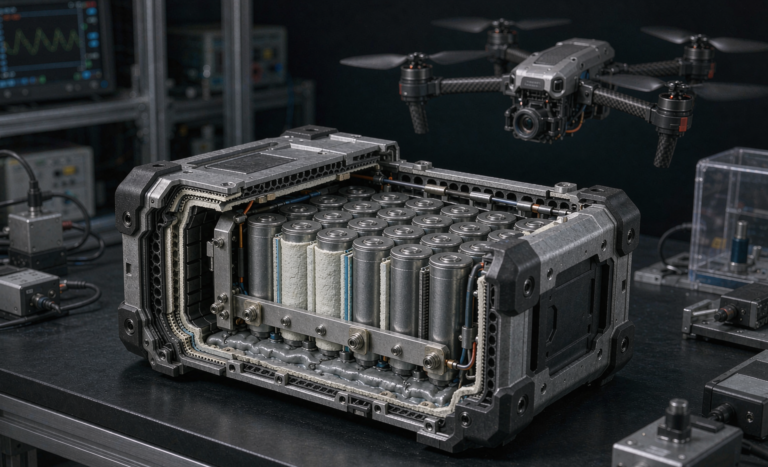
- Dual-channel BMS with a fast fault gate. A monitor that isolates a failing cell group in under 200 ms turns a catastrophic disconnect into a controlled limp-home. Cost added: $4–$7 per pack.
- Conformal potting and strain relief. Stabilizing sense wires and busbars against 1.5–2.0 grms flight vibration prevents the slow mechanical damage that surfaces at 200 cycles. Cost added: $1–$2 per pack.
Add those up: roughly $8–$16 per pack. On 5,000 packs that is $40,000–$80,000 — a fraction of the $300k–$720k in incident cost it can retire by cutting the failure rate from 1.5% to 0.3%. The return on reliability spend is typically 5× to 10× in this model.
Designing a Failure-Resistant Delivery Pack
When I specify a custom battery solution for a delivery operator, the brief is never “cheapest possible.” It is “lowest raTCO at the required mission profile.” That changes the design conversation entirely. We duty-match the chemistry — NMC where energy density drives range, LFP where cycle life and abuse tolerance dominate short-hop loops. We reserve 10–12% state-of-charge headroom so the pack never sits at the knee of degradation, and we cap charge voltage at 4.10–4.15 V to extend cycle life by double digits of percent.
We also design for the warranty, not just the flight. A manufacturer’s warranty reserve is a bet on failure rate; if your pack fails at 1.5%, that reserve silently erodes margin or forces a price increase. A pack engineered to 0.3% lets you offer a longer, cheaper warranty — a differentiator that compounds across the fleet’s life. Every pack leaves the line with a DataMatrix genealogy so a single field failure can be traced to its cell lot, weld batch, and test record within minutes.
A Practical Spec Checklist for Cost-Conscious Operators
If you are scoping a drone battery cost optimization for delivery drones program this quarter, I recommend these non-negotiables in the request for quotation:
- Quoted price and expected failure rate at your mission duty (not a generic lab number).
- Usable cycles to 80% capacity under your actual discharge profile, not peak capacity.
- Cell DCIR CoV < 6% and self-discharge K < 1.0 mV/day, with lot traceability.
- Weld resistance < 0.15 mΩ per joint, 25 N minimum pull, batch-tested.
- Dual-channel BMS with a fault-isolation gate under 200 ms and per-group telemetry.
- Vibration qualification to MIL-STD-810H Method 514.8 at 1.2× flight grms.
- Regulatory evidence: UN 38.3 T.1–T.8, IEC 62133-2, IEC 62619 for industrial duty, and air-transport compliance at FAA/EASA 100 Wh and IATA Section II.
Put those in the RFQ and the “cheap” bid usually stops looking cheap. You are now comparing risk-adjusted cost, which is the only number that survives contact with a real flight schedule.
A well-scoped custom battery solution already bakes these requirements into the mechanical envelope and the BMS firmware before the first unit is built, rather than bolting them on after a failure trend appears. In my experience that upstream discipline is what separates a pack that quietly hits 500 cycles from one that becomes a quarterly line item in the incident report.
Frequently Asked Questions
What is risk-adjusted battery cost for delivery drones?
Risk-adjusted cost (raTCO) is the pack price plus its expected failure cost, divided by usable flight cycles. It accounts for the fact that a battery failure can destroy an airframe and trigger incident costs far larger than the pack itself, so the true per-flight cost includes that risk.
Does a cheaper drone battery really cost more over its life?
Often, yes. A pack that is $26 cheaper but fails five times more often can cost 40–50% more per flight once you add expected crash and downtime cost. The lowest purchase price is rarely the lowest lifecycle cost.
How does a battery failure actually crash a delivery drone?
The most common modes are a sudden cell-group disconnect (loss of bus voltage mid-flight), a BMS lockout from a fault it cannot isolate, or a thermal event that forces an emergency landing. Any of these removes propulsion power or control margin faster than the aircraft can recover.
What reliability tests prevent premature battery failure?
Cell grading by DCIR and self-discharge, weld pull and resistance testing, dual-channel BMS fault-injection under 200 ms, and random-vibration qualification to MIL-STD-810H at 1.2× flight grms. Together these catch the escapes that cause early field deaths.
How should I spec a delivery drone battery to control total cost?
Write the RFQ around expected failure rate and usable cycles, not sticker price. Require cell-lot traceability, weld QC, a fast fault-isolating BMS, and the full regulatory evidence set (UN 38.3, IEC 62133-2, IEC 62619, FAA/EASA 100 Wh, IATA Section II). That lets you compare true risk-adjusted cost across vendors.