Drone Battery for Search and Rescue
When a volunteer fire crew radios that a hiker is missing above the tree line, the clock is not measured in hours—it is measured in body heat. Over my twelve years building packs at Horizon Power, I have shipped drone battery systems into search-and-rescue (SAR) programs on three continents, and the one lesson that never changes is this: a consumer-grade battery that fails gracefully on a cinema shoot can get someone killed on a ridgeline. SAR drones are expected to launch in freezing wind, climb hard, hover steady in rotor wash, and keep a thermal payload alive long after the air gets thin. That is a different engineering problem than endurance for a mapping survey, and it demands a different pack.
In this field guide I will walk through how my team specifies, validates, and maintains a drone lithium battery for SAR work: the cell chemistry tradeoffs, thermal behavior, mechanical ruggedness, the certification stack we are legally required to meet, and the pre-flight discipline that separates a reliable mission from a grounded one. If you are sourcing power for a public-safety drone program, treat this as the engineering checklist we wish every buyer had before their first callout.
Why Search and Rescue Demands a Different Drone Battery
A commercial mapping flight is planned, filed, and flown in benign weather. A SAR flight is reactive: it launches when conditions are worst, often at night, often in precipitation, and almost always against a deadline measured in survival odds. The battery is the single component most likely to end the mission early, so we design for the worst case, not the average.
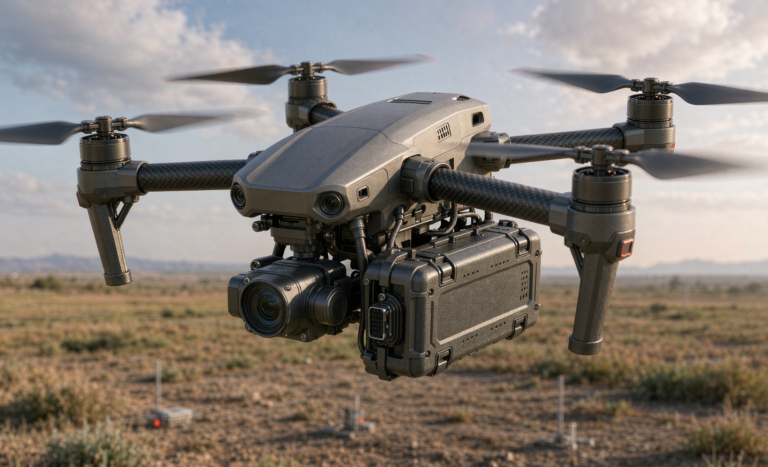
The load profile is also unusual. A SAR airframe typically carries a gimbal camera, a thermal imager, a spotlight, and sometimes a loudspeaker or drop payload. That is a pulsed, high-amplitude draw—hover, punch-out, descend, hover—which stresses a lithium battery far more than a steady cruise. The pack must deliver rated current at high state-of-charge and still hold voltage at the bottom of the curve when the cells are cold and tired. We size for the thermal-imager worst case, not the cruise case.
Finally, SAR programs are accountable. A public-safety agency needs a documented, repeatable power system they can defend in an after-action review. That means traceable cells, logged cycle history, and a custom battery solution that is validated against the same standards every time, not a hobby pack pulled off a shelf.
Cell Chemistry Choices for Mission-Critical SAR
For SAR, the two chemistries that matter are NMC (nickel-manganese-cobalt) and LFP (lithium-iron-phosphate). NMC 18650 or 21700 cells give us 200–250 Wh/kg, which buys endurance and payload margin on airframes where every gram counts. LFP gives 120–160 Wh/kg but a flatter discharge curve and dramatically better thermal stability—it will not go into thermal runaway as easily, a real advantage when a pack is strapped to a airframe that may land in a smoldering wildfire zone.
My rule of thumb: for lightweight multirotors where endurance is the limiting factor, we use high-quality NMC with a conservative C-rating and aggressive balancing. For drones that operate near heat, dust, or rough handling—wildfire overwatch, urban collapse search—we lean LFP despite the weight penalty. A drone lithium battery that survives the environment is worth more than one that is 15% lighter but quits.
We also specify the cell source carefully. SAR is not the place for bargain cells with unknown cycle life. Every cell lot is sampled and capacity-graded; we bin by internal resistance so a pack is built from matched cells, not a random draw. Mismatched cells are the slow killer of field reliability.
Thermal Behavior and Cold-Weather Performance
Cold is the silent enemy of SAR drones. Below about 0 °C, lithium-ion chemistry loses both capacity and power; at −20 °C a pack can deliver barely 60–70% of its room-temperature capacity, and charging it cold can plate lithium metal and permanently damage the cells. Mountain SAR rarely happens in comfort.
We solve this two ways. First, we keep the pack warm with a self-regulating heating film bonded to the cell stack, drawing only a few watts and cutting in below 5 °C. Second, we specify cells with good low-temperature electrolytes and limit the discharge C-rate in cold so voltage does not collapse mid-climb. The result is a lithium battery that holds its rated current down to −20 °C instead of folding at the worst possible moment.
On the hot side, we cap continuous discharge so cell temperature stays under 60 °C even in a sustained hover with a heavy thermal payload. A BMS that only reports voltage is not enough; our SAR packs log cell temperature and throttle the load before chemistry is damaged.
Mechanical Stress, Vibration and Ingress Protection
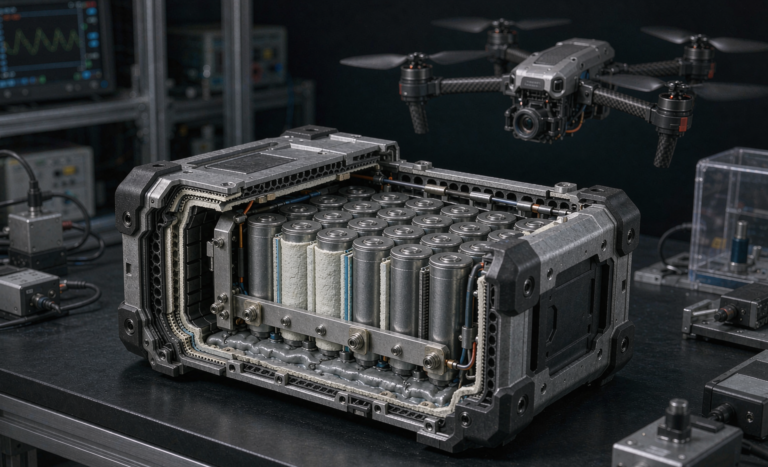
SAR drones land hard, get carried in backpacks, and fly through rotor wash that shakes the airframe constantly. A pack built for a studio drone will loosen its welds and fracture its busbars within a season of this abuse. We build the SAR pack as a structural member: potted cell stack, strain-relieved terminals, and a rigid enclosure rated to at least IP54 so dust and rain on a riverbank search do not find their way to the cells.
Vibration is managed with damped mounting and balanced cells; an unbalanced pack vibrates, and vibration accelerates solder fatigue. We validate the enclosure on a random-vibration profile that mimics a hard-mounted airframe over a 200-hour accelerated life test. If a terminal works loose in the lab, it would have worked loose over a ridgeline at 2 a.m.—better we find it on the shaker table.
Certification and Compliance: UN38.3, IEC 62133, FAA/EASA
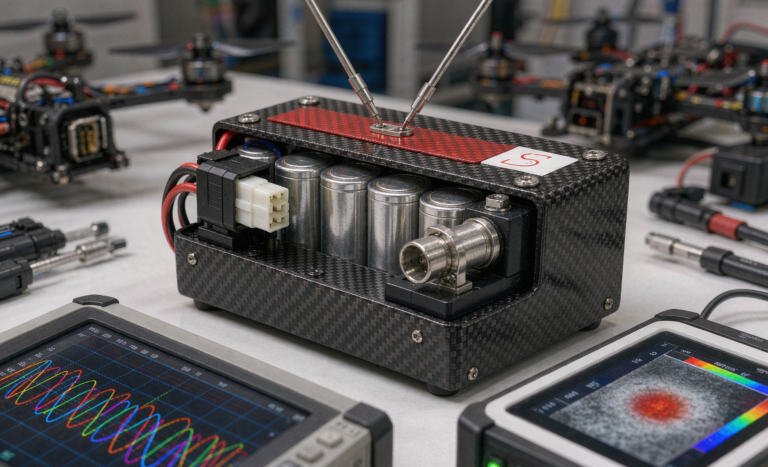
A SAR program is a professional operation, and the battery must clear the same regulatory gates as any commercial shipment and flight. We certify every pack to UN38.3, the transport safety test that includes altitude simulation (T.1), thermal cycling (T.2), vibration (T.3), shock (T.4), external short circuit (T.5), impact (T.6), overcharge (T.7), and forced discharge (T.8). Without a valid UN38.3 test summary, the pack cannot legally move by air or road between staging areas—a real constraint when a team flies in from another region.
For the cell-level safety baseline we reference IEC 62133-2, which covers the design and testing of lithium-ion cells and batteries for safe operation, including abnormal charging and forced-discharge protection. Our BMS and pack construction are documented against it so the design is defensible.
In flight, SAR operators in the U.S. fly under FAA Part 107 rules; in Europe under EASA frameworks. Neither agency certifies the battery directly, but both expect the aircraft and its components to be airworthy and the operator to carry the relevant documentation. We hand every customer the full test-summary packet so their compliance folder is complete before the first flight. A custom battery solution is only as good as the paperwork that lets it fly.
Sizing the Pack: Matching Endurance to the Mission
Endurance is not a single number; it is a function of payload, air temperature, wind, and how aggressively the pilot flies. We start from the airframe’s hover power in watts, add the payload draw (thermal camera plus spotlight can be 30–60 W alone), and divide the usable pack energy by that load. We deliberately use only 80% of nominal capacity as the mission floor so the pilot always lands with margin.
For a typical SAR multirotor drawing 600 W at hover with a 40 W sensor load, a 6S 16000 mAh NMC pack (about 355 Wh usable at 80%) yields roughly 25–28 minutes of effective flight in mild conditions, dropping to 18–20 minutes in cold wind. That is the honest number we give the incident commander, not the marketing number. Underestimating endurance is how teams lose aircraft; we would rather carry a slightly heavier pack than promise a flight we cannot deliver.
Field Maintenance and Pre-Flight Checks
Reliability is built in the factory but protected in the field. Every SAR pack we ship carries an NFC or QR tag logging its cycle count, maximum temperature ever seen, and last balance date. Before each callout the ground crew runs a 30-second check: visual for swelling or casing damage, impedance trend within tolerance, and a capacity confirmation on a known load. A pack that has been through a hard landing gets retired to bench testing, not sent back up.
Storage matters too. SAR packs sit idle between missions, and a pack left at full charge in a hot vehicle degrades fast. We instruct agencies to store at 30–50% state-of-charge in a cool, dry case and to cycle every pack at least monthly. A disciplined program sees 400–600 usable cycles; a neglected one fails in a season.
Frequently Asked Questions
What is the most important feature of a search-and-rescue drone battery?
Predictable performance under stress. A SAR pack must hold its voltage and current in cold, wind, and pulsed loads, and it must fail safely rather than catastrophically. Certification and a documented maintenance history matter as much as raw capacity.
Should SAR drones use NMC or LFP cells?
It depends on the environment. NMC gives the best energy density for lightweight endurance-focused missions. LFP trades weight for superior thermal stability and safety near heat or rough handling. We choose based on the dominant risk of the mission, not a single spec sheet.
How cold can a drone lithium battery operate safely?
With a heated pack and conservative discharge limits, our SAR batteries hold rated current down to about −20 °C. Charging below 0 °C without a heater should never be attempted, as it can permanently damage the cells through lithium plating.
Why does UN38.3 certification matter for rescue teams?
UN38.3 is the international transport safety standard. Without a valid test summary, the battery cannot legally be shipped or moved between staging areas by air or road—a practical blocker when a team is deploying across regions for a large search.
How long should a SAR drone battery last?
With proper storage at 30–50% charge, cool conditions, and monthly cycling, expect 400–600 full cycles. Abuse—full-charge hot storage, hard landings, neglected maintenance—can cut that to a single season.
Can a standard consumer drone battery be used for rescue work?
Not safely for critical missions. Consumer packs are optimized for cost and light use, with limited thermal management, weaker enclosures, and no field lifecycle tracking. A professional custom battery solution adds the heating, ruggedization, logging, and certification a life-safety operation requires.