Drone Battery Firmware and BMS Communication Protocols
When buyers evaluate a drone battery, they almost always start with the numbers that are easy to print on a spec sheet: capacity in mAh, discharge C-rate, energy density in Wh/kg. Those numbers matter, but they are only half the story. The other half lives in the firmware and in the communication protocols that let the battery talk to the flight controller. After fifteen years building packs for commercial UAV programs, I have seen far more fleets grounded by a poorly designed BMS communication layer than by a weak cell. In this guide I will walk through how drone battery firmware and BMS communication protocols actually work in the field, which standards matter, and where the common failure points are.
Why BMS Communication Matters More Than Cell Specs
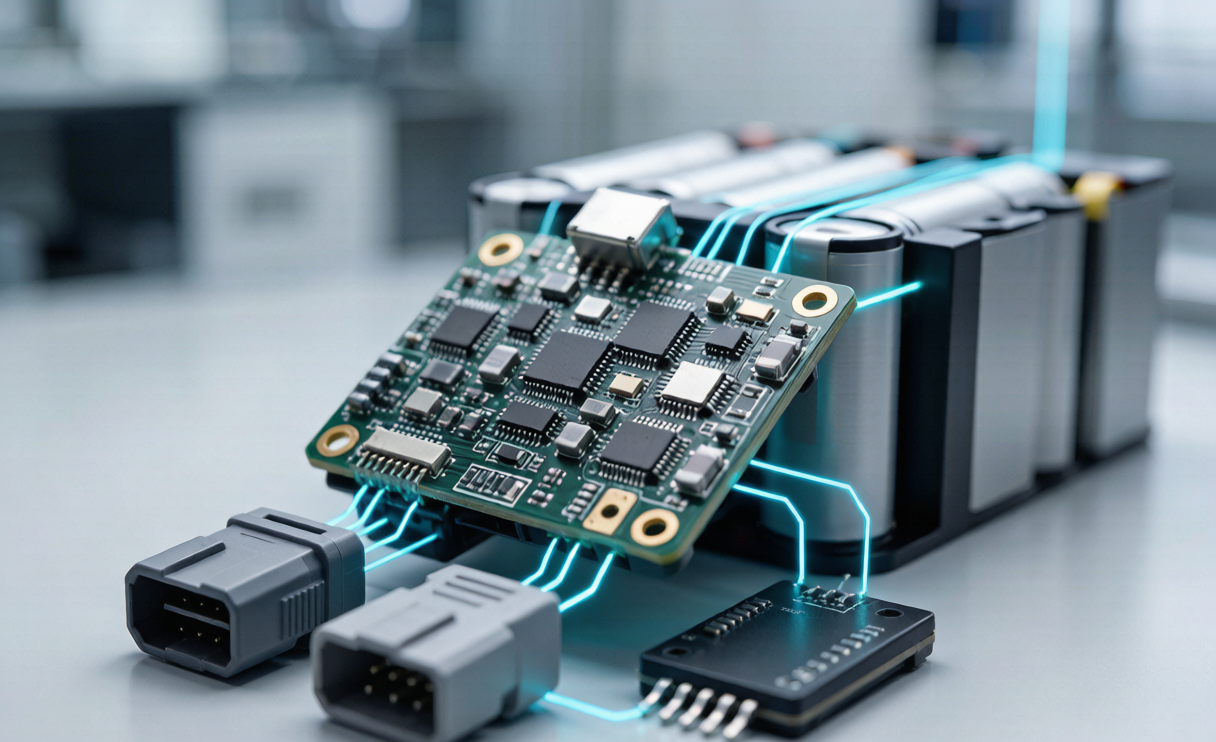
A drone lithium battery is never just cells in a shrink-wrapped brick. It is a system: cells, sense resistors, a protection IC or microcontroller, and a communication interface. The physical layer protects the pack from over-current and over-temperature. The communication layer is what lets the aircraft know the pack is healthy, how much energy remains, and whether it should land now rather than in two minutes.
In a multirotor pulling 60–120 A peak, a communication dropout of even 200 ms can mean the flight controller loses state-of-charge telemetry right at the moment it needs to make a return-to-home decision. That is why I tell every OEM client that the BMS protocol is a safety device, not a convenience feature. When we design a custom battery solution for a survey or inspection program, the communication contract between the pack and the autopilot is the first thing we pin down, long before we argue about cell grade.
- The BMS reports voltage per cell, pack current, temperature, state of charge, and fault flags.
- The flight controller uses that data for geofence-based RTL, payload throttling, and pre-flight checks.
- Ground crews use aggregated BMS logs to decide which packs to retire before they swell.
The Core Protocols: SMBus, I2C, CAN and UART
Most drone battery management systems speak one of four physical and link-layer protocols. Understanding the trade-offs is the foundation of any firmware decision.
SMBus and I2C
SMBus (System Management Bus) is a strict subset of I2C clocked at 10–100 kHz. It is cheap, needs only two wires, and is the backbone of the Smart Battery Data (SBS) standard used in countless laptop and industrial packs. For a small lithium battery in a light quadcopter, SMBus is often enough: the flight controller polls the pack every 500 ms and gets back a clean ManufacturerAccess block. The downside is bus length and noise immunity—I2C was never designed for a carbon-fiber airframe acting as an antenna.
CAN Bus (including CAN FD)
For heavy-lift and industrial platforms, CAN is the workhorse. A differential pair gives it far better noise immunity than I2C, and CAN FD pushes bandwidth to 5 Mbit/s, enough to stream cell-level telemetry from a 14S pack in real time. Most professional autopilots expose a CAN port specifically for smart batteries. The firmware cost is higher—you need a proper stack—but the reliability payoff on a 25 kg aircraft is non-negotiable.
UART and Private Binary
Many consumer packs still use a simple UART with a vendor-specific binary frame. It is easy to implement on a low-cost MCU, but it locks you into one manufacturer’s decoding library. If you are building a custom drone battery for a program that will run for five years, I strongly advise against a closed UART protocol—you will regret the vendor lock-in the first time that chip goes end-of-life.
Smart Battery Data (SBS) and the PEC Security Layer
The Smart Battery Data specification (SBS 1.1, built on SMBus) defines a standard command set: RelativeStateOfCharge (0x0D), Voltage (0x09), Current (0x0A), CycleCount (0x17), and so on. A compliant pack answers the same register addresses regardless of who built it. This is what lets a fleet operator swap a battery from vendor A into an aircraft qualified by vendor B without rewriting the ground software.
One detail I always insist on is PEC—Packet Error Checking. SMBus PEC appends a CRC-8 to every transaction. Without it, a single flipped bit in a noisy environment can report 80% charge when the pack is actually at 12%. In our production firmware we enable PEC by default and reject any frame that fails the check. It is a small overhead that has saved more than one aircraft from a surprise landing.
Drone-Specific Needs: Telemetry, Fault Reporting and Failsafe
A generic laptop BMS and a drone BMS have different jobs. On the ground, a slow response is acceptable. In the air, the BMS must support three drone-specific behaviors.
- Continuous telemetry. The flight controller needs per-cell voltage at least twice per second to detect an imbalance before it becomes a thermal event. A 6S pack with one weak cell can drift 80 mV under load in under a minute.
- Latched fault flags. Over-temperature, over-current, and under-voltage must not silently clear. Our firmware latches the first fault, records the timestamp and peak value, and holds the flag until a deliberate reset. This gives the maintenance team a forensic trail.
- Failsafe handshaking. When the BMS predicts it cannot sustain the current draw, it should warn the controller before cutting output. We implement a two-stage warning: a soft “reduced power” advisory at 15% SoC, then a hard cutoff only at the cell minimum of 3.0 V.
These behaviors are why I steer clients toward a programmable MCU-based BMS rather than a fixed-function protection IC when the application is anything beyond a toy. The IC is fine for a lithium battery in a consumer gadget; it is not enough when a failure means a falling airframe.
Custom Firmware Stacks and OTA Update Paths
A modern custom battery solution is rarely shipped with frozen firmware. Field programs discover new edge cases—a temperature sensor placed too close to a power FET, a CRC quirk with a specific autopilot version—and the pack needs to be updatable. We build our BMS firmware on a bootloader that supports signed OTA updates over the same CAN or SMBus link the aircraft already uses.
The security model matters here. Every firmware image is signed with an ECDSA key; the bootloader refuses an unsigned or rolled-back image. This prevents both accidental corruption and malicious reflashing at a depot. For defense and industrial UAV clients, we add a secure element that holds the root key off the main MCU entirely. It is more engineering, but the alternative—a battery that can be reflashed by anyone with a laptop—is unacceptable for a program flying over people.
Certification and Compliance Touchpoints
Firmware does not escape the safety regime that governs the cells. Two standards shape how we validate a communication-capable drone battery.
- UN38.3. The transport test covers the complete battery, including the BMS. A firmware bug that causes the pack to self-heat during the altitude or thermal test is a failed UN38.3 certification, full stop. We run the firmware through the same environmental stresses as the cells.
- IEC 62133. For portable cells and packs, this standard drives our internal protection design. The BMS communication layer must never be the sole line of defense—hardware protection (fuses, secondary IC) has to hold even if the MCU crashes. I tell clients: the communication protocol is for information; the hardware is for survival.
For aircraft operated commercially, we also document how the BMS reports compliance-relevant data to satisfy FAA and EASA expectations around battery state monitoring. The data the firmware already collects becomes the evidence package for an airworthiness review.
How We Select the Right Stack for a Program
There is no single best protocol; there is only the best fit. For a sub-2 kg cinematic quad, SMBus with PEC is lean and cheap. For a 30 kg agricultural sprayer running 14S at 200 A, CAN FD is the only sane choice. The decision should be made against the failure modes of the specific mission, not against a preference for a particular microcontroller.
When a client comes to us for a custom drone battery, the first document we produce is a communication requirements sheet: update rate, fault latency budget, bus topology, and the autopilot’s supported interfaces. Everything else—cell selection, enclosure, balancing strategy—follows from that contract. Get the protocol wrong and the best cells in the world will not save the program.
Frequently Asked Questions
What is the difference between SMBus and I2C for a drone battery?
SMBus is a stricter, slower dialect of I2C with defined timeout, voltage levels, and the PEC error-checking option. For a drone battery, SMBus gives you a predictable, standards-based link; raw I2C leaves too many behaviors undefined for safety-critical use.
Can I connect a smart drone battery to any flight controller?
Only if the controller supports the same protocol and command set. A CAN FD battery will not talk to an I2C-only port. That is why we always confirm the autopilot’s battery interface before locking the BMS firmware design.
Why does my BMS report a different state of charge than my charger?
Different devices use different coulomb-counting algorithms and calibration constants. A properly implemented SBS pack reports SoC from the BMS’s own integrated current integrator, which is the source of truth in flight. Chargers often estimate from resting voltage, which diverges under load.
Is CAN bus worth the extra cost over UART?
For any aircraft above about 5 kg or any program needing real-time cell telemetry, yes. The noise immunity and bandwidth of CAN FD prevent the silent dropouts that UART links suffer on a vibrating airframe.
How often should drone battery BMS firmware be updated?
Only when a validated fix or feature warrants it. We version every image, sign it, and require a recorded reason for each update. Frequent unvalidated updates are a bigger risk than a stable, slightly older firmware.
Does the BMS communication layer affect UN38.3 certification?
Yes. UN38.3 tests the complete battery including electronics. A firmware fault that triggers self-heating during testing fails certification, so we validate the BMS firmware under the same environmental stresses as the cells.