Drone Battery IP Rating and Environmental Sealing
Every season I get the same call from a drone program manager: “We flew over a river, landed in wet grass, and now the pack won’t charge.” Nine times out of ten the failure is not the cells — it is the seal. A drone battery IP rating is the single most misunderstood specification in our industry, and getting environmental sealing wrong is the fastest way to lose a fleet in the field. This guide is the field-engineer version of what I walk customers through before they sign an RFQ.
I have spent the last decade building packs for agriculture, mapping, and search-and-rescue programs, and the lesson is consistent: the battery enclosure fails before the lithium battery chemistry does. Understanding ingress protection is not a nice-to-have — it is the difference between a pack that flies 400 cycles in the rain and one that corrodes in a month.
What an IP Rating Really Tells You About a Drone Battery
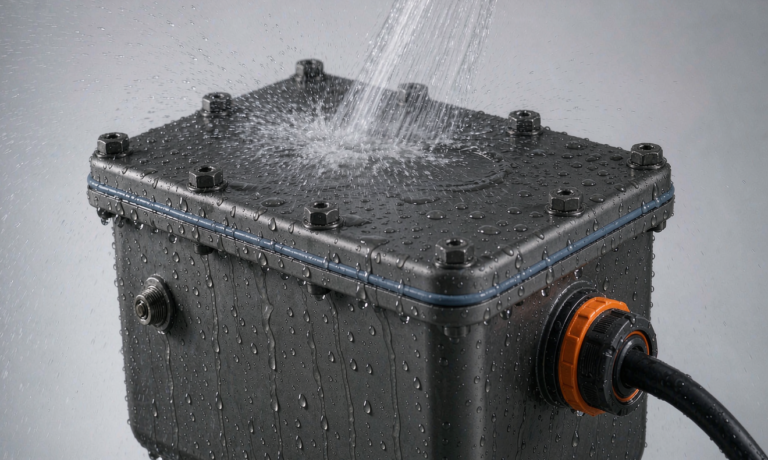
The IP code comes from IEC 60529, the international standard for ingress protection. The two digits matter in a specific order. The first digit rates protection against solid particles (dust), from 0 to 6. The second digit rates protection against liquids, from 0 to 9K. A drone battery IP rating of IP67 means “fully dust-tight (6) and protected against immersion in 1 meter of water for 30 minutes (7).”
For context, here is the spread I specify most often:
- IP54 — limited dust protection and splash resistance. Fine for dusty fields but not for rain landings. I treat this as indoor or fair-weather only.
- IP65 — dust-tight and protected against low-pressure water jets. Good for agricultural spraying where you get misted but not submerged.
- IP67 — my default for most commercial UAV programs. Dust-tight and survives a 30-minute dunk. This is the rating I recommend unless the mission demands more.
- IP68 — dust-tight with continuous immersion beyond 1 meter, defined by the manufacturer. This is what I specify for marine, amphibious, and frequent splash environments.
One thing buyers misunderstand: IP68 is not automatically “better” than IP67 in every way. The test condition for the second digit is manufacturer-defined, so an IP68 rated for 1.5 meters for 30 minutes is very different from one rated for 10 meters. Always ask for the exact depth and duration in writing. A custom drone battery program should pin this down in the validation plan, not in a sales slide.
Where Ingress Actually Happens: The Weak Points
In my teardown room, water and dust never enter through the flat machined face. They enter through the geometry — the places where two materials meet and move. The four classic leak paths are:
- Connector ports. The balance lead, the discharge XT60 or EC5 connector, and the JST communication header are the most exposed. These need either sealed caps or molded grommets that compress when the connector seats.
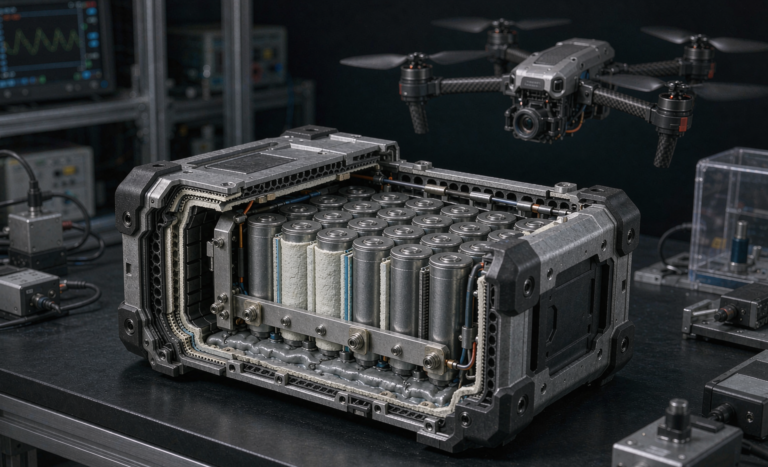
- PCB enclosure seams. The BMS sits in its own sub-enclosure. If that lid is clipped rather than gasketed, humidity walks straight in along the seam.
- Cable glands. The wires that leave the pack pass through the case wall. A poorly crimped or un-potted gland is a direct channel for capillary water ingress.
- Vent membranes. Li-ion cells need pressure equalization. An unsealed vent lets the pack “breathe” in water. The fix is a hydrophobic, IP-rated vent membrane that equalizes pressure but blocks droplets.
I tell customers: seal the path the water will actually take, not the path that looks easy to seal. A beautiful laser-welded aluminum lid means nothing if the balance connector is open to the sky.
Sealing Technologies That Survive Real Missions
There is no single “best” seal. The right method depends on the housing material, the thermal load, and whether the pack is serviceable. These are the four I reach for:
1. Compression gaskets (the workhorse)
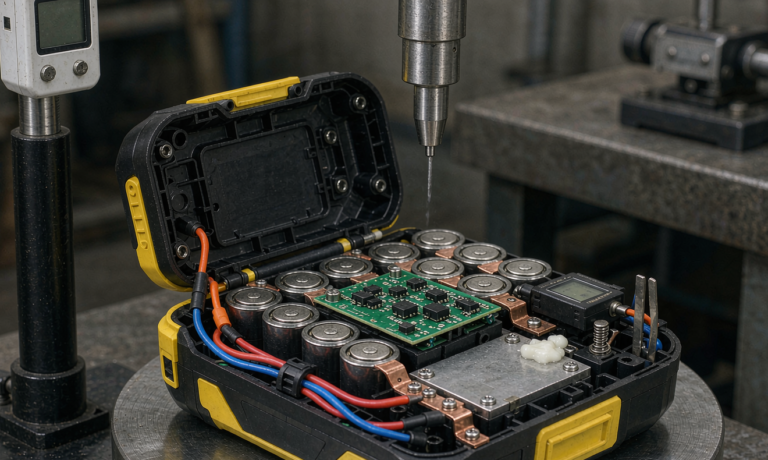
Silicone or EPDM gaskets seated in a tongue-and-groove channel give you a repeatable IP67 with a serviceable lid. The key is compression force: too little and the gasket relaxes; too much and you deform the housing. I target 20–30 percent gasket compression at the seal line and verify it on a torque-controlled lid.
2. Potting and conformal coating
For non-serviceable packs, filled (potted) enclosures eliminate seams entirely. Polyurethane or epoxy potting surrounds the cells and BMS in a solid mass. The trade-off is repairability and heat — a fully potted pack runs warmer, so we model the thermal path before we commit. This is common in a sealed drone battery built for single-use or harsh disposable roles.
3. Ultrasonic welding
For plastic housings, ultrasonic welding fuses the two halves into one seamless shell. It is excellent for high-volume, low-cost IP67, but it is permanent — no field service. I use it where the assembled cost matters more than repair.
4. Hydrophobic vent membranes
Every sealed lithium battery pack needs to breathe as it heats and cools. An IP-rated Gore-type membrane equalizes pressure while repelling water. Skip this and the case will either bulge or suck in moisture through the weakest point. It is a small part that prevents a large failure.
A solid state drone battery or semi-solid cell changes the thermal picture — less flammable electrolyte, but the same sealing discipline still applies to the enclosure. Chemistry does not replace mechanical design.
Matching IP Rating to the Operating Environment
The rating should follow the mission, not the marketing brochure. Here is the mapping I use when scoping a new program:
- Agricultural spraying: IP65 minimum, IP67 preferred. You get chemical mist and occasional puddle landings. The lithium battery chemistry (typically NMC for energy density) is protected, but the connector caps must be chemical-resistant.
- Coastal and marine surveying: IP68 with salt-spray resistance. Salt is far more corrosive than fresh water, so I add a conformal coating on the PCB even inside a sealed case.
- Desert and dusty inspection: IP6X dust-tight is the priority; water rating can be IP65. Fine silica dust is insidious — it gets past “almost sealed” joints.
- Search and rescue in rain or snow: IP67 as a baseline, with sealed cable glands and a pressure-equalizing vent. Cold plus wet is where untreated seams crack.
The point is balance. Over-specifying to IP68 on a fair-weather mapping drone adds cost and weight you could spend on flight time. Under-specifying on a marine drone guarantees a premature return.
Verification and Standards in Our Lab
A rating on a drawing means nothing until it is tested. In our validation lab, a sealed drone battery IP rating goes through the following before it is released:
- IEC 60529 immersion and dust chambers — the literal IP test, run at the rated depth and duration, then opened and inspected for internal moisture.
- Salt-spray (ASTM B117) — 48 to 96 hours of misted salt to confirm corrosion resistance of the housing and glands.
- Thermal cycling with a wet pack — we submerge, then swing the pack from -20°C to 60°C to stress the gasket as it expands and contracts.
- Pressure decay leak test — a non-destructive check on every production unit, not just a sample, to catch a mis-seated gasket before it ships.
These checks sit alongside the safety baseline every pack must pass: UN38.3 for transport, IEC 62133 for cell and pack safety, and the air-cargo expectations of FAA and EASA for shipping. A sealed enclosure does not change the cell certifications — it protects them in the field. When I brief a drone battery manufacturer, I ask for the actual test reports, not a compliance checkbox.
Specifying Sealing When You Brief a Manufacturer
If you are sourcing a custom drone battery, put the sealing requirements in the RFQ as hard numbers, not adjectives. “Weatherproof” is not a spec. Write this instead:
- Target IP rating and the exact test depth/duration (e.g., “IP67, 1 m, 30 min, per IEC 60529”).
- Operating temperature range and whether the seal sees thermal cycling.
- Chemical exposure — pesticides, salt, de-icing fluids — and the expected lifetime in that environment.
- Serviceability: must the end user open it, or is it sealed for life? This decides gasket vs. ultrasonic welding.
- Leak-test requirement on 100% of units versus AQL sampling.
The clearer the RFQ, the fewer surprises at first article inspection. I would rather spend an hour on the spec than a week explaining a field failure.
Field Care and End-of-Line Checks
Even a perfect seal degrades with handling. In the field, the failure I see most is a technician who re-seats the lid without checking the gasket. My pre-flight checklist for a sealed pack:
- Visually confirm the gasket is seated and free of debris or nicks.
- Confirm connector caps are in place before and after each flight.
- Wipe the case dry after a wet landing; do not let water sit at a seam.
- Log any impact — a hard crash can crack a housing that still looks fine.
- If a pack is submerged beyond its rating, treat it as suspect and bench-test before reuse.
Environmental sealing is a system, not a sticker. The IP number is the promise; the gasket, the gland, the vent, and the field habit are what keep it.
Frequently Asked Questions
Is IP67 enough for a drone that lands in wet grass?
Yes, for most commercial programs IP67 is sufficient. It is dust-tight and survives a 1-meter, 30-minute immersion — far beyond a wet-grass landing. If your drone frequently sits in puddles or is hosed down, move to IP68 with defined depth and duration.
Does a higher IP rating make the drone battery heavier?
Somewhat. Gaskets, sealed glands, and vent membranes add grams, but the bigger cost is usually in the housing material and the welding or potting process. In my programs the sealing system is typically 3–6% of total pack mass — a reasonable price for field reliability.
Can I make an existing pack waterproof by adding tape?
No. Field tape is a temporary fix at best and a false confidence at worst. Proper ingress protection requires a designed seal path, compression-controlled gaskets, and a leak-tested enclosure. Tape will let capillary moisture in.
Do solid-state cells need less sealing?
No. A solid state drone battery changes the electrolyte safety story, but the enclosure still has to keep water and dust off the BMS, connectors, and cells. The sealing discipline is the same; only the internal risk profile shifts.
How do I verify a supplier’s IP claim?
Ask for the IEC 60529 test report with the exact depth and duration, plus salt-spray and pressure-decay results if your environment is harsh. A credible drone battery manufacturer will share these without hesitation. If they only offer a marketing claim, keep looking.
Should the vent membrane be serviceable?
Generally no — the hydrophobic membrane is a sealed component rated for the pack’s life. If it is damaged, the pack should be returned for service. Inspecting it visually during routine maintenance is fine; do not try to “clean” it open.