Home Energy Storage Installation Permits and Inspections
Home Energy Storage Installation Permits and Inspections: What Installers and Homeowners Must Clear Before Power-On
I still remember the first residential home energy storage project I commissioned that failed inspection twice. The hardware was flawless — a properly rated home battery backup cabinet and a UL 1741 inverter — but the conduit runs and the disconnect labeling did not match the approved plan set. As Karl Huang, Senior lithium battery Engineer, I have since approved hundreds of installations, and the lesson is always the same: the battery is the easy part. The paperwork, the permits, and the inspection are what actually stand between you and flipping the system on. This guide walks through exactly what authorities having jurisdiction (AHJs), utilities, and third-party inspectors expect before a home energy storage system earns the right to carry live load.
Why Permits and Inspections Matter More Than the Hardware
A modern residential battery storage pack stores enough energy to start a serious fire if it is misapplied. That is not fear-mongering — it is why the National Electrical Code dedicates an entire article to energy storage systems. Permits exist so that a qualified reviewer sees your design before a single wire is pulled, and inspections exist so that a second set of eyes confirms the field build matches that design.
In my experience, skipping or rushing this phase is the single most common cause of delayed commissioning. A homeowner who installs a home battery backup without a permit may save two weeks up front and lose two months later when the utility refuses interconnection or the insurer denies a claim after an incident. The permit trail is also what protects the manufacturer’s warranty — most battery OEMs require evidence of code-compliant installation to honor a failure claim.
The Core Codes and Standards You Will Be Held To
Before you submit anything, learn the acronyms your inspector carries. These are the documents I keep open on a second monitor during every plan review:
- NEC Article 706 (Energy Storage Systems) — the backbone rule for stationary storage, covering disconnects, marking, ventilation, and fire separation.
- NEC Article 705 (Interconnected Power Production Sources) — governs how your storage interacts with the grid-tied inverter and the point of common coupling.
- NEC Article 710 (Standalone Systems) — applies to off-grid home energy storage that is not connected to utility service.
- UL 9540 — the installation standard for energy storage, often the minimum certification your AHJ asks for on the equipment itself.
- UL 9540A — the test method for thermal runaway fire propagation; some jurisdictions require it explicitly for larger systems.
- UL 1741 / IEEE 1547-2018 — inverter interconnection and grid-support functions required for any grid-tied home energy storage system.
- IEC 62619 / IEC 62109 / IEC 62477-1 — the international safety benchmarks I reference when sourcing cells and power-conversion equipment, especially for systems built on a custom battery solution.
- UN38.3 — the transport safety test every lithium cell must clear (T.1–T.8) before it ever reaches your job site.
- NFPA 855 — the installation standard for stationary energy storage fire safety, including maximum allowable energy capacity per fire area.
Regional amendments vary, but if your design satisfies NEC 706, UL 9540, IEEE 1547, and NFPA 855, you are speaking your inspector’s language.
Step-by-Step: From Plan Set to Final Inspection
A clean home energy storage permits inspections cycle usually runs in five stages:
1. Pre-application and AHJ research
Call the building department before you design. Ask whether they follow the adopted NEC year, whether energy storage requires a separate fire department review, and what plan-set details they expect. Some jurisdictions want a single-line diagram; others want full three-line drawings with conduit fill calculations.
2. Plan submittal
Submit the equipment cut sheets (showing UL 9540 / UL 1741 listings), the site plan, the electrical single-line diagram, the battery location with clearances, and the interconnection application if grid-tied. I always include a one-page summary that maps each drawing to the relevant NEC article — reviewers love it, and it cuts back-and-forth.
3. Permit issuance
Once approved, you receive the permit with conditions. Read every condition. A common one is “battery must be installed per manufacturer’s instructions and NFPA 855 spacing” — which means you cannot simply wall-mount wherever is convenient.
4. Rough and final inspection
For a simple wall-mounted home battery backup, there may be a single final inspection. For larger residential battery storage with new subpanels or feeders, the AHJ may want a rough-in inspection of the conduit and grounding before the drywall closes.
5. Utility interconnection and PTO
Permission to operate (PTO) is the finish line. Grid-tied systems cannot energize until the utility confirms the inverter settings meet IEEE 1547 and the meter paperwork is complete.
Common Permit Pitfalls That Delay Installation
These are the mistakes I see most often, and every one of them is avoidable:
- Wrong clearance to the electrical panel. NEC 706 requires working space and separation; cramming a battery cabinet against the main panel fails instantly.
- Missing or mismatched disconnect labeling. Every disconnect must be field-marked and accessible. Unlabeled means fail.
- Ventilation assumptions. Even sealed lithium packs need the temperature and spacing the listing allows. NFPA 855 energy limits per fire area are hard stops.
- Interconnection paperwork filed late. File the utility application the same day as the building permit. The utility clock is slower than the building clock.
- Equipment swapped after approval. Substituting an inverter that is not the one on the approved plan forces a re-review. Keep the as-built identical to the as-submitted.
Working With Your AHJ and Utility Without the Headaches
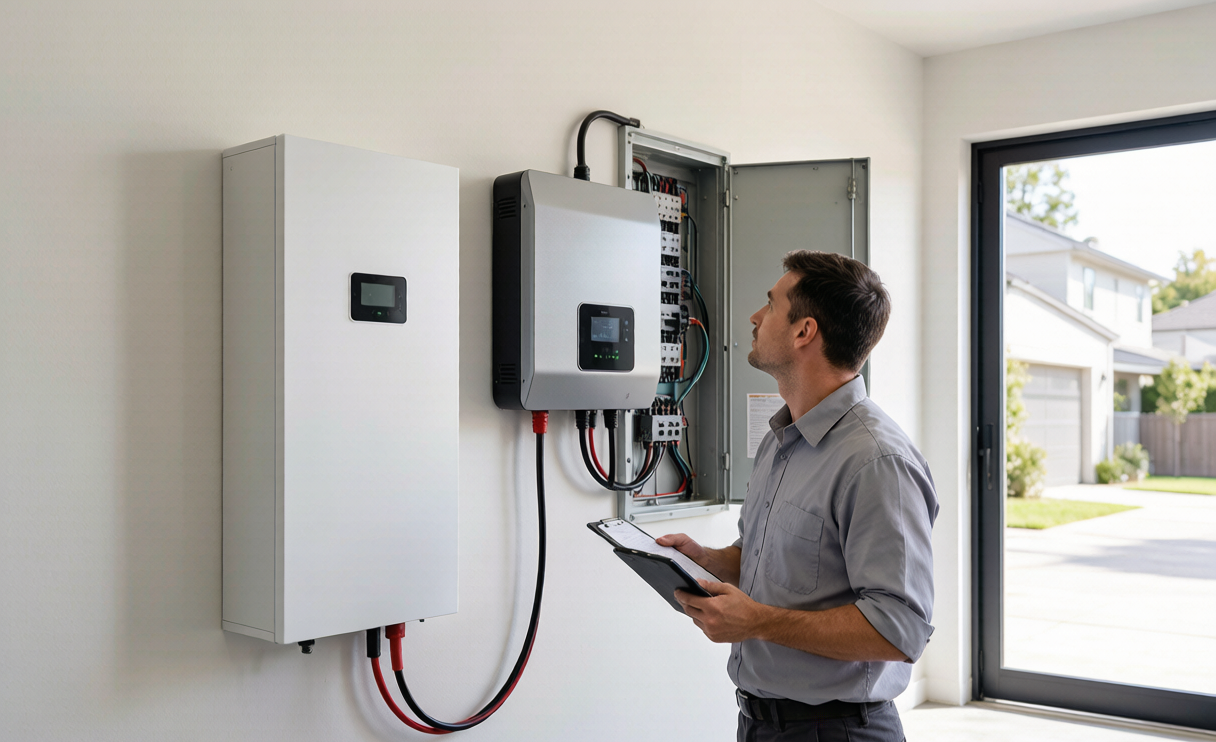
The fastest home energy storage permits inspections process is a collaborative one. I tell my installers to treat the plan reviewer as a design partner, not an adversary. Offer to walk them through the single-line diagram on a call. Provide the UL 9540A report up front if the system is above the local NFPA 855 threshold. And document everything: photos of the as-built, torque values on lugs, and the commissioning test results.
For the utility side, understand that IEEE 1547-2018 changed the rules — modern inverters must ride through voltage and frequency disturbances and support intentional islanding only when explicitly listed for it. A home energy storage system that “back-feeds” during an outage without an approved transfer scheme is both a code violation and a lineman-safety hazard. Your inspector will check for a listed backup disconnect that visibly isolates the premises from the grid.
Inspection Day: What the Inspector Actually Checks
When the inspector arrives, they move fast and look for the same handful of things every time:
- Equipment listings visible and matching the approved plan (UL 9540, UL 1741).
- Proper working clearances and fire separation per NEC 706 and NFPA 855.
- Grounding and bonding — the battery enclosure, inverter, and subpanel all bonded to the same electrode system.
- Disconnects present, accessible, and labeled, including the marked utility service disconnect.
- Conductor sizing and overcurrent protection consistent with the single-line diagram.
- Ventilation, temperature, and mounting per the manufacturer’s installation manual.
If all six line up, you walk away with a signed card and, after utility PTO, a live home battery backup that is safe, insurable, and warranty-valid.
Karl’s Field Checklist Before You Call for Inspection
After fifteen years of commissioning storage, I use a personal pre-inspection routine:
- Print the approved plan set and lay it next to the as-built. Circle any deviation.
- Verify every disconnect opens the correct circuit and is field-labeled in permanent ink.
- Photograph the grounding bond and the torque-marked lugs.
- Confirm the inverter’s IEEE 1547 settings match the utility’s interconnection agreement.
- Keep the UN38.3 and UL 9540A documentation on site — inspectors sometimes ask.
Get these right and the inspection becomes a formality rather than a fight.
FAQ
Do I need a permit for an off-grid home energy storage system?
Yes. Even standalone systems covered by NEC Article 710 require an electrical permit and inspection. The misconception that “no utility connection means no permit” causes a lot of expensive teardowns. Any permanently wired residential battery storage install triggers the code.
How long does the home energy storage permits inspections process take?
Plan review typically runs one to four weeks depending on jurisdiction backlog, with inspection scheduled a few days after rough-in or final install. The utility interconnection is usually the long pole — six to ten weeks in some service territories. Start the utility application on day one.
Can I install a home battery backup myself to avoid the permit?
You should not. Most jurisdictions require a licensed electrician for the permanent wiring, and the permit protects your insurance and warranty. A DIY home energy storage system that later fails often leaves the homeowner fully liable. Use a qualified installer and keep the paper trail.
What happens if my system exceeds the NFPA 855 energy limit per fire area?
You will need additional fire separation, dedicated fire-rated enclosures, or a split layout across multiple fire areas. The reviewer will flag it at plan stage, which is exactly why we submit early. Designing within the limit from the start is far cheaper than re-engineering after rejection.
Will a failed inspection void my battery warranty?
Not the inspection itself, but an installation that violates the listing and the manufacturer’s instructions can. OEMs require code-compliant installation as a warranty condition, so a clean home energy storage permits inspections outcome is also your proof of eligibility for support.