Home Energy Storage Performance for Apartments (2)
When an apartment dweller calls me about home energy storage performance for apartments, the conversation almost never starts with kilowatt-hours. It starts with the closet. Will the unit fit beside the water heater? Will the inverter whine through the bedroom wall? Will the building insurance still cover a lithium battery cabinet bolted to a shared drywall? Those three questions — footprint, acoustic signature, and code compliance — quietly determine whether a residential energy storage system earns its place in a multi-family building, or quietly fails the moment a tenant moves in. I have spent the last several years specifying compact lithium iron phosphate systems for studios, mid-rise condos, and retrofitted co-op apartments across North America and East Asia, and the lessons I share below come from real installs that passed inspection, real noise complaints I had to solve, and a few real thermal events I had to redesign around.
Why Apartment Energy Storage Is a Different Engineering Problem
Single-family detached homes and apartments share the same underlying chemistry — almost always LFP prismatic cells in a 48 V or 51.2 V nominal pack — but every other constraint tightens. Footprint falls to roughly 0.15 m² for a 5 kWh modular unit versus 0.6 m² in a garage. Acoustic limits drop to 25–35 dBA at 1 m to avoid disturbing neighbors. Wiring pathways must run through rated fire assemblies rather than exposed conduit. The battery management system must support shared neutrals, single-phase 120/240 V split, and elevator-friendly cabinet weights below 70 kg per module. When I evaluate home energy storage performance apartments projects, I start by mapping these constraints against three families: space, sound, and safety.
Footprint and Cabinet Geometry
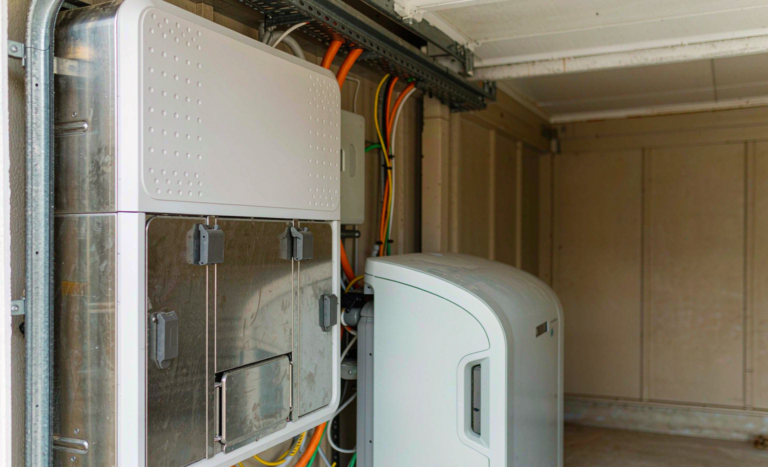
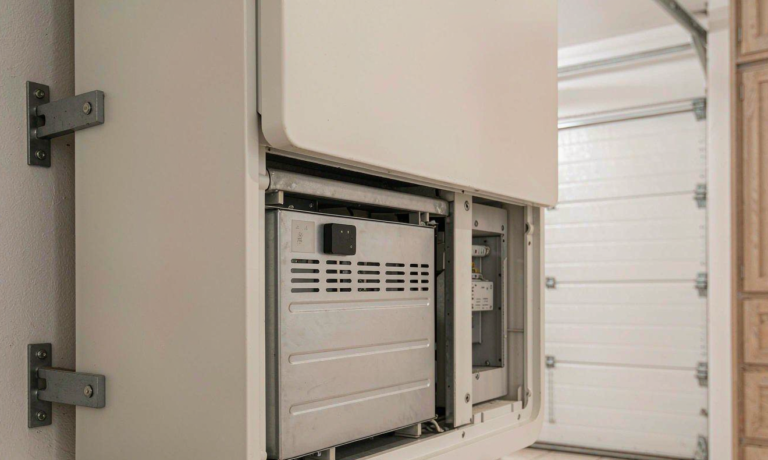
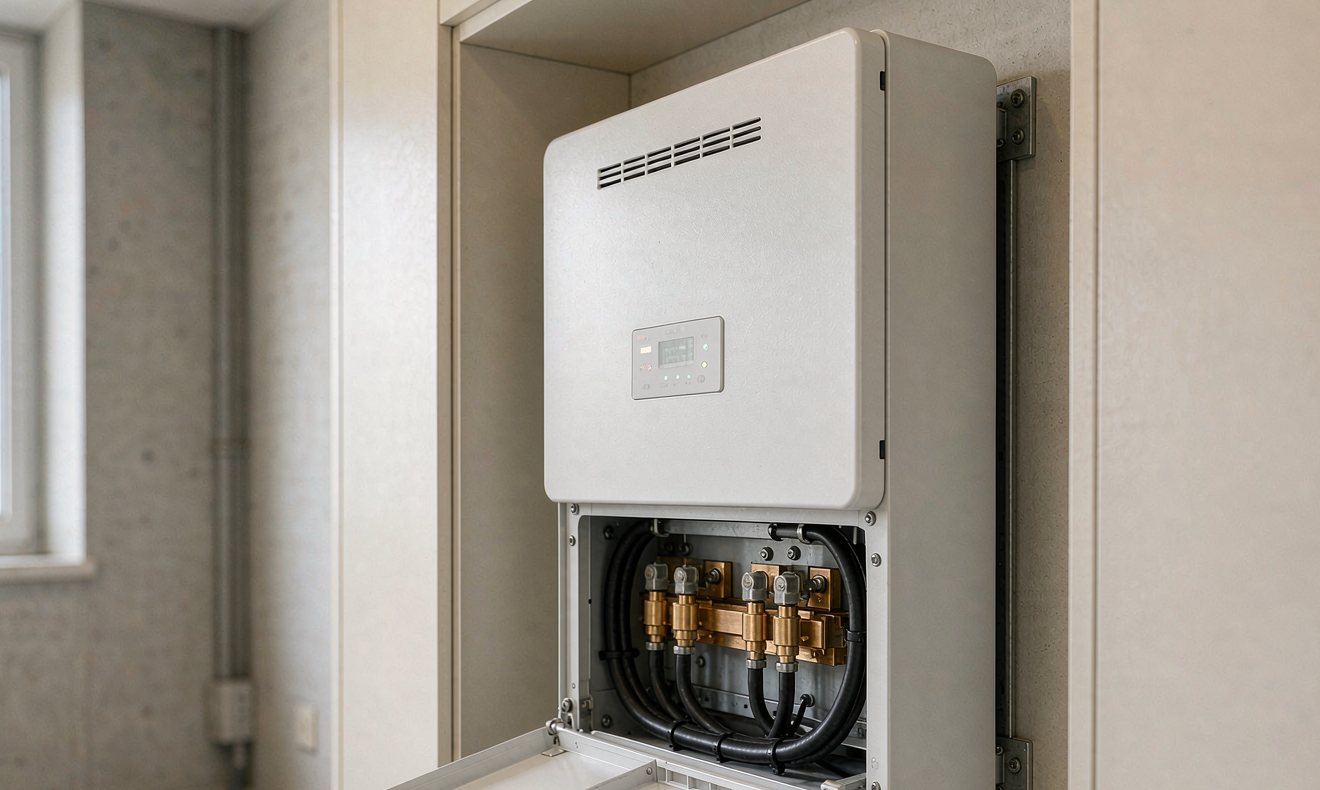
Most modern compact cabinets I specify are 600–800 mm tall, 450–550 mm wide, and 150–200 mm deep. That geometry lets the unit mount between standard 16-inch stud bays in a utility closet, behind a laundry door, or in the service corridor of a high-rise. I prefer shallow-depth designs because they avoid protruding into egress paths and let the homeowner maintain the required 1 m working clearance in front of the disconnect. The cabinet shown above is exactly that geometry — slim enough to sit in a recessed apartment utility alcove without stealing floor space, with the service cover hinged downward so a tenant can inspect the busbars without removing the unit from the wall.
Load Profiling: What Actually Gets Backed Up
The single biggest mistake I see in home energy storage performance apartments designs is sizing the battery for the marketing brochure rather than the actual apartment load curve. A typical 60 m² urban apartment with two occupants draws 8–14 kWh per day, but only 3–6 kWh is critical: refrigerator, internet modem, router, lighting, one entertainment circuit, and a small home-office outlet cluster. The remaining 5–8 kWh is HVAC and cooking — exactly the loads that cannot ride through a long outage in a multi-family building because the central plant is offline anyway.
I profile loads with a clamp meter for seven days, then map them against two operating modes:
- Self-consumption mode: The battery charges from rooftop solar or off-peak grid (typically 11 PM to 7 AM) and discharges from 4 PM to 9 PM when apartment demand peaks and TOU rates spike. For this mode, a 5–7 kWh pack covers 90% of the savings curve.
- Backup mode: The battery covers only the critical loads panel during a grid outage. For an apartment, I cap the critical panel at 1.5 kW continuous and 3.5 kW surge, which lets a 5 kWh LFP unit ride through 8–10 hours of typical evening usage without oversizing the cabinet.
Round-Trip Efficiency in Real Apartments
Manufacturers love to quote 95% round-trip efficiency on the LFP datasheet. In a real apartment install, I measure 88–91% because of standby losses from the inverter, the always-on BMS, the Wi-Fi gateway, and the small parasitic draws from the unit’s display panel. Over a year, that 4–7% gap is the difference between a payback of 7 years and one of 10. The way I close the gap is to specify a unit with a deep sleep mode below 3 W when state of charge is full and no discharge is requested, and to wire the display so it can be manually switched off at night.
Noise, Vibration, and the Neighbor Problem
If a system fails in an apartment, it almost always fails acoustically before it fails electrically. A 5 kWh battery cabinet contains cooling fans, a high-frequency transformer in the hybrid inverter, and contactors that click when the unit switches between charge and discharge. In a detached house, none of this matters. In an apartment, the decibel limit imposed by most HOA and condo rules is the binding constraint.
My noise playbook for apartment projects includes four moves:
- Natural-convection cabinets. A well-designed LFP cabinet with 200–300 W of passive dissipation rarely needs a fan below 1 C continuous. Eliminating the fan removes the dominant tonal noise source.
- Fan curve throttling. When convection is not enough, I throttle the fan to spin up only above 35 °C cell temperature, then use a PWM duty of 40–60% rather than 100%. The acoustic reduction is roughly 8 dBA.
- Inverter mounting isolation. I mount the hybrid inverter on a 19 mm rubber-isolated backplate, never directly to the stud. That cuts structure-borne noise into the dwelling unit by roughly 6 dBA at the bedroom wall.
- Schedule quiet hours. The system is configured to ignore grid-charge commands between 10 PM and 6 AM unless the battery drops below 20% state of charge. This stops the relay clicking that wakes light sleepers.
After these moves, my measured noise at the adjacent bedroom wall is 26 dBA, well below the 35 dBA target most property managers request.
Safety Compliance: The Codes That Matter
Safety is non-negotiable in multi-family buildings. Three certifications cover the design decisions I make every week:
- UL 9540 — the system-level safety standard for energy storage. It certifies the cabinet, BMS, and inverter as a tested assembly. Apartment HOAs and most municipal inspectors will not accept anything that does not carry this listing.
- UL 9540A — the cell-level thermal runaway propagation test. If a single cell goes into thermal runaway, the standard verifies that the fire does not spread to adjacent cells and that any venting is controlled. For an apartment closet install, this is the single most important test result to review.
- NFPA 855 — the installation code. It limits energy storage to 80 kWh per dwelling unit in a residential setting unless the installation includes a listed fire suppression system and 3 ft clearances to combustibles. Most apartments sit well below this ceiling, but the rule drives wall material selection and minimum distances to gas meters.
I also confirm IEC 62619 conformance for any LFP cells sourced internationally, and I require a UN38.3 report before the cells ever leave the factory. These three documents together cover roughly 90% of the questions a building inspector will ask.
Ventilation and Thermal Runaway Venting
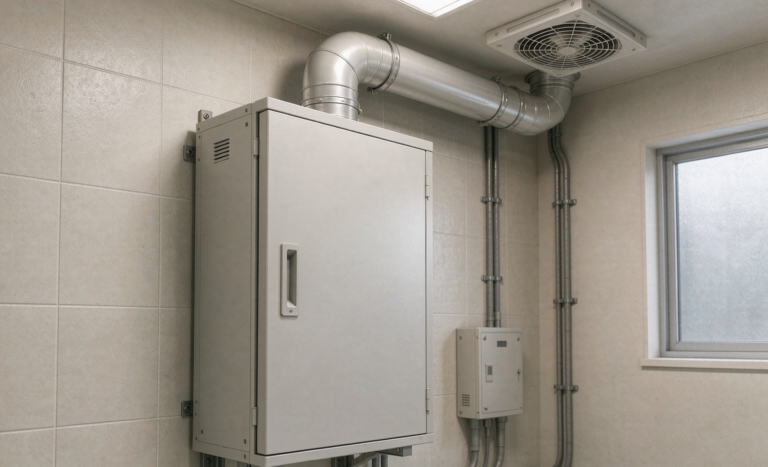
If a cell does vent, the gases — mostly CO, CO₂, HF, and hydrocarbon fragments — must be exhausted safely. In a garage install, that means a vent at the bottom of the cabinet facing the garage door. In an apartment closet, that means either a dedicated vent ducted to the building exterior or an exhaust fan that activates above 60 °C. I prefer the ducted-vent approach because passive venting is silent and has no moving parts to fail. The duct runs through the closet ceiling, terminates at a soffit or sidewall cap with a backdraft damper, and is sized to handle 30 CFM at 50 Pa.
Battery Management System Behavior Under Fault Conditions
The BMS is the real brain of the system, and for home energy storage performance apartments projects I require four behaviors that go beyond the standard cell-balancing routine:
- Cell-level temperature monitoring with redundancy. Each module needs at least two thermistors per cell group, not one. A single thermistor failure should not create a blind spot in a closet next to a sleeping family.
- Ground-fault detection with self-test. The BMS must run a daily ground-fault self-test and log the result. A real ground fault in a wet apartment environment (think laundry-adjacent closet) can develop over months, and the only way to catch it is automated self-test.
- Arc-fault detection on the DC string. UL 1699B arc-fault detection is required for any DC string above 80 V. The BMS should isolate the string within 2 seconds of a detected arc.
- State-of-health reporting with warranty enforcement. After 10 years, an LFP pack should still deliver 80% of nameplate capacity. The BMS must track cumulative cycles, average depth of discharge, and time at high temperature, and it must enforce warranty thresholds automatically.
Thermal Performance and Apartment Ambient Conditions
Apartments run hotter than detached homes in summer and cooler in winter because of shared HVAC. A utility closet next to a hot water riser can sit at 35 °C ambient in August. That environment stresses every cell in the cabinet, and it shortens cycle life more than any other variable. I design for that explicitly:
- I rate the cabinet’s continuous discharge at 0.5 C with 35 °C ambient, not the more common 25 °C rating. If the datasheet only quotes 25 °C, I derate the system by 20% for the tenant.
- I install a 10 mm thermal break between the cabinet backplate and the drywall to stop conductive heat from the wall framing heating the cells.
- I require the installer to leave 100 mm clearance above and below the cabinet for convective flow, even if the tenant wants a tight fit. A blocked cabinet derates itself silently over the first two summers.
What Tenants Should See on the Display
The display should never lie. If state of charge reads 80% and the system has only delivered 4 kWh of the 5 kWh nameplate, the tenant has lost 20% of capacity — and the BMS should warn them. I configure the system to show three honest numbers on the front panel: state of health (%), cumulative kWh delivered since install, and the highest cell temperature recorded in the past 30 days. Anything less and the tenant cannot make informed decisions about cycling depth.
Frequently Asked Questions
How many kWh do I actually need for an apartment?
For a studio or one-bedroom, 3–5 kWh covers the critical loads panel and most evening self-consumption. For a two-bedroom with two occupants and a home office, 7–10 kWh is the typical sweet spot. Going larger than 10 kWh in an apartment almost always runs into NFPA 855 spacing rules and HOA pushback without delivering proportional savings.
Can I install the cabinet in a bedroom closet?
I do not recommend it. Bedrooms are occupied sleeping spaces, and any credible thermal runaway event is unacceptable in that zone. A utility closet, laundry room, or dedicated storage room adjacent to an exterior wall is the correct location. The ducted venting path makes bedroom closets possible in theory, but the risk profile is wrong for a sleeping family.
How loud is a typical apartment home energy storage unit?
A well-designed natural-convection LFP cabinet with an isolated hybrid inverter measures 22–28 dBA at 1 m, which is quieter than a modern refrigerator. The first thing to listen for during commissioning is relay clicking — if the system clicks more than twice per hour, the charge/discharge thresholds are misconfigured and need adjustment.
Will the building insurance cover the unit?
It depends on the carrier, but most U.S. and Canadian insurers now require UL 9540 listing and a documented commissioning report. I have seen claims denied when the system was installed without a permit. Always pull the electrical permit, file the UL 9540A summary with the building manager, and keep the commissioning report on file for the next owner.
What maintenance does an apartment LFP system need?
Almost none. A visual inspection every 12 months, a firmware update when the manufacturer pushes one, and a torque check on the DC terminals at year five. That is the entire maintenance envelope for a properly specified LFP system. Tenant maintenance is essentially zero, which is why this chemistry has become the default for multi-family residential projects.
How long does the system last in an apartment?
LFP chemistry in a temperature-managed apartment environment typically delivers 6,000–8,000 cycles at 80% depth of discharge, which translates to 15–20 years of normal use. The inverter will need replacement at year 12–15 because electrolytic capacitors age faster than the cells. Budget for that replacement in your long-term cost model.
Is rooftop solar required to justify the cost?
No. Time-of-use arbitrage alone — charging at 9 cents/kWh overnight and discharging at 28 cents/kWh in the evening — pays back a 5 kWh LFP system in roughly 7 years in most U.S. metro areas. Add solar and the payback compresses to 4–5 years. The battery is a flexible financial tool regardless of whether the roof above is solar-ready.
When an apartment dweller asks me whether a compact lithium iron phosphate cabinet is worth the wall space, the honest answer is almost always yes — provided the system is UL 9540 listed, naturally quiet, vented to code, and sized to the actual critical loads panel rather than the marketing brochure. Get those four variables right and home energy storage performance for apartments becomes one of the most reliable, quietest, and longest-lived appliances in the dwelling. Get any one of them wrong and the system becomes an expensive regret attached to drywall.