Drone Battery Self-Discharge and Realistic Shelf Life
Why Self-Discharge Matters More Than Buyers Expect
When I walk a new B2B customer through a drone battery specification sheet, the conversation almost always starts with capacity, C-rating, and weight. Shelf life and self-discharge usually come up last — if at all. In my fifteen years as a lithium battery engineer, I have learned that ignoring self-discharge is exactly how fleets end up with “dead” packs that were never flown hard, just stored badly. A drone battery that sits on a shelf is still aging, and it is quietly losing charge every single day.
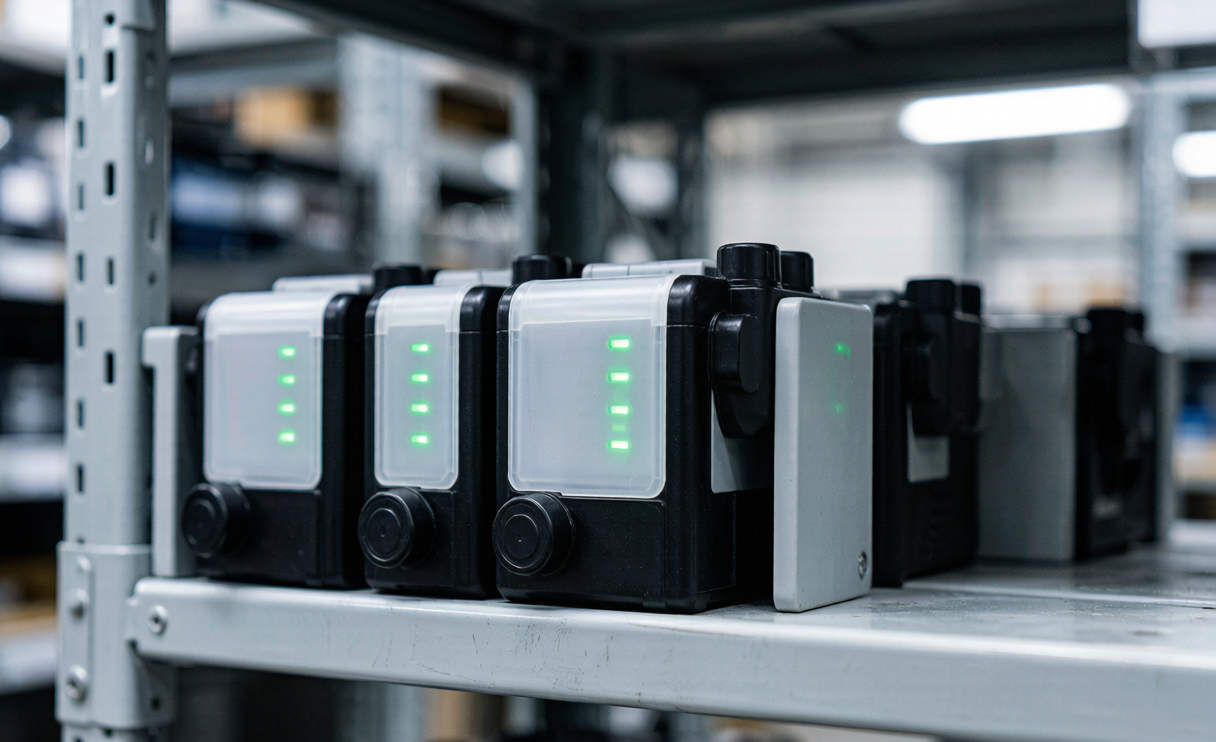
Self-discharge is the unavoidable loss of stored energy inside a cell even when nothing is connected. No load, no drone, no BMS draw — yet the voltage still creeps downward. For a drone lithium battery, understanding and planning around this rate is the difference between a pack that is mission-ready after six months in storage and one that needs a full charge cycle before it can even arm the motors.
What Self-Discharge Actually Means in a Drone Battery
Every lithium cell has internal side reactions. At the anode, a small fraction of lithium ions react with the electrolyte to form the solid-electrolyte interphase (SEI) layer. That process consumes charge. At the cathode and separator, trace impurities and micro-shorts bleed a trickle of current. The net result is a slow, continuous voltage drop that we quantify as the self-discharge rate.
For a modern lithium battery using NMC or LFP chemistry, the intrinsic self-discharge rate is low — but it is never zero. In my lab measurements at Horizon Power, a fresh, well-formed 6S pack at 25°C loses roughly 1–3% of its state of charge per month. Push the storage temperature to 40°C and that rate can triple. This is why I tell buyers that the printed capacity on the label is only true at the moment of formation; shelf time quietly erodes it.
The practical takeaway: self-discharge is a storage phenomenon, not a usage phenomenon. You cannot “exercise” it away by flying. You manage it with the right storage state of charge (SOC) and the right environment.
Typical Self-Discharge Rates You Should Expect
Buyers deserve real numbers, not marketing fog. Based on our internal aging database across thousands of cells, here is what a qualified engineer should plan for:
- Quality NMC drone pack at 20–25°C, 50% SOC: ~1–2% per month. After six months, expect 88–94% remaining.
- Quality LFP pack at 20–25°C, 50% SOC: ~1–1.5% per month. LFP is slightly better on idle loss and far better on calendar life.
- High temperature (35–45°C) storage: 3–6% per month, plus accelerated permanent capacity fade. We treat this as damage, not just discharge.
- Cold storage (0–10°C), 40–50% SOC: ~0.5–1% per month. Cold slows the chemistry, but you must warm the pack to room temperature before charging.
- Low-grade or recycled cells: 5–10%+ per month, often with unstable voltage. This is the single biggest reason I advise buyers to specify Grade A cells with a formation report.
When you request a custom battery solution from a manufacturer, ask for the self-discharge specification at two temperatures. A supplier who cannot give you a number is telling you they have not tested it — and untested cells are a liability in a commercial fleet.
How Shelf Life Differs From Cycle Life
This is the most common confusion I correct. Cycle life is how many charge-discharge loops a cell survives before it drops to 80% of original capacity. Shelf life (or calendar life) is how long the cell lasts while sitting unused, regardless of cycles.
A drone battery can have an excellent 500-cycle rating and still lose 20% of its capacity in eighteen months on a hot shelf. The two aging mechanisms are independent:
- Cycle aging is driven by mechanical stress, lithium plating, and SEI growth during charge/discharge.
- Calendar aging is driven by time, temperature, and SOC — purely chemical, happening whether the pack flies or not.
For seasonal operators — agriculture, search-and-rescue, winter surveying — shelf life is the dominant concern. Your packs may only see 30 flights a year, so calendar aging, not cycle aging, sets your replacement schedule.
Storage Conditions That Protect or Destroy Shelf Life
Environment is everything. In our abuse testing, storage temperature and SOC explain more than 80% of the variance in long-term shelf performance. My standard guidance to fleet managers:
- Temperature: Store at 10–25°C. Every 10°C above 25°C roughly doubles the rate of calendar aging. A climate-controlled cabinet beats a metal shipping container every time.
- State of charge: Store at 30–60% SOC, ideally ~40–50%. Storing at 100% SOC accelerates cathode stress; storing near empty risks the protection circuit dropping below its cutoff and the BMS going to sleep permanently.
- Humidity: Keep below 60% RH. Moisture creeps into connectors and label seams, inviting corrosion on the balance leads.
- Metal contacts: Never store packs loose in a bin where terminals can touch. A shorted pack is a fire, not a shelf-life problem.
- Periodic topping: For storage beyond three months, recharge back to the 40–50% window every 3–6 months to counter self-discharge.
These rules apply whether you fly a consumer mapping quad or a heavy industrial UAV. The chemistry is the same; only the consequences of failure scale with the payload.
How We Validate Shelf Life at Horizon Power
I do not trust a shelf-life claim that was not measured. At Horizon Power our drone lithium battery lines go through a formation and aging protocol before they ever reach a customer:
- Formation: Every cell is slow-charged and gently cycled 1–2 times to stabilize the SEI layer and lock in capacity.
- OCV soak test: Packs sit at 45°C for 7 days, then we measure open-circuit voltage drift. A stable pack shows under 0.02 V/day drift; anything higher is graded out.
- Calendar aging sample: A statistical sample is stored at 25°C and 45°C for 12+ months with quarterly capacity checks, building the dataset we quote to buyers.
- BMS verification: We confirm the protection circuit’s sleep current is under a few microamps so the pack is not quietly draining itself through its own electronics.
This is the kind of verification I push every buyer to request, especially when a custom battery solution is involved. A formation report and a self-discharge number should be part of the deliverable, not a favor.
Practical Storage and Rotation Rules for Fleets
Treating batteries as a managed inventory, not a pile of spare parts, is what separates a reliable operation from a grounded one. My field checklist for commercial fleets:
- Label everything with a storage date and SOC. A pack with no date is a guess.
- Rotate first-in, first-out. Use the oldest packs on scheduled flights; keep fresh packs in reserve.
- Log voltage monthly. A pack that drops faster than its peers has an internal fault — retire or bench it.
- Recondition before seasonal return. Before a drone comes out of winter storage, balance-charge every pack and verify capacity against the spec.
- Set a retirement floor. Any pack that cannot hold 80% of rated capacity after storage is pulled from flight duty and moved to training or recycling.
None of this is exotic. It is disciplined housekeeping backed by real numbers — and it is the cheapest insurance you can buy for uptime.
FAQ
How much does a drone battery self-discharge per month?
A quality drone lithium battery at room temperature and ~50% SOC loses about 1–3% of its charge per month. Poor-grade cells or high-temperature storage can push that to 5–10% or more. The rate is chemistry- and temperature-dependent, so always ask your supplier for a measured number at 25°C and 45°C.
Should I store drone batteries fully charged?
No. Storing at 100% SOC accelerates cathode degradation and calendar aging. For long-term shelf storage, keep packs at 30–60% SOC, ideally around 40–50%. Only charge to full immediately before a flight.
How long can a drone lithium battery sit unused?
With proper storage — cool temperature, ~40–50% SOC, dry environment — a quality pack stays flight-worthy for 12–18 months with periodic top-ups every 3–6 months. Beyond that, expect gradual permanent capacity loss from calendar aging even if the voltage looks fine.
Does cold storage extend shelf life?
Yes, within reason. Storing at 0–10°C can roughly halve the self-discharge rate compared to 25°C. But you must bring the pack to room temperature before charging, and avoid condensation. Do not freeze packs, and never charge a cold cell.
When should I retire a battery that has been stored too long?
Retire any pack that, after proper balancing, cannot hold 80% of its rated capacity, or that shows voltage drift far above its peers. For a commercial fleet, a stored pack that fails a capacity verification check belongs in training or recycling — not on a paying mission.