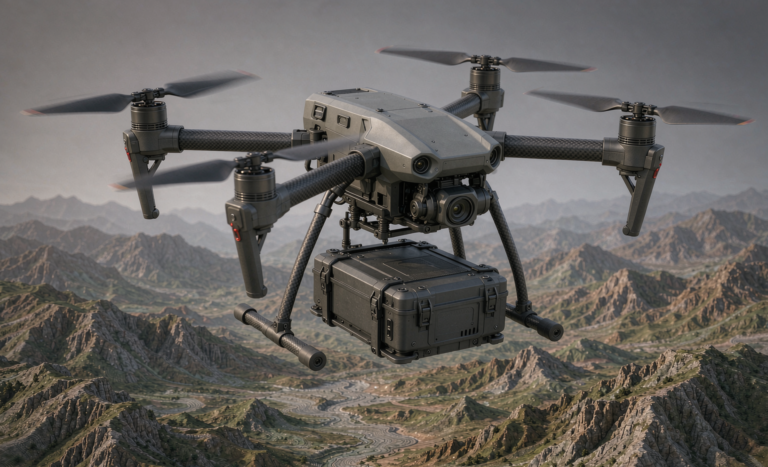
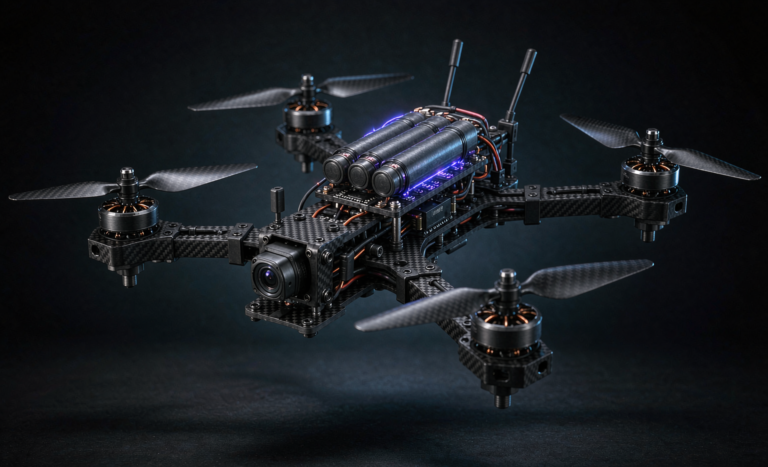
Drone Battery Design for Inspection UAVs: Engineering (2)
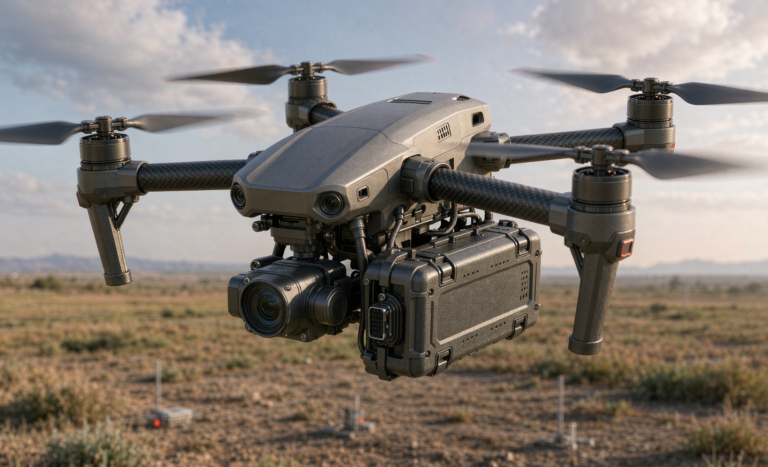
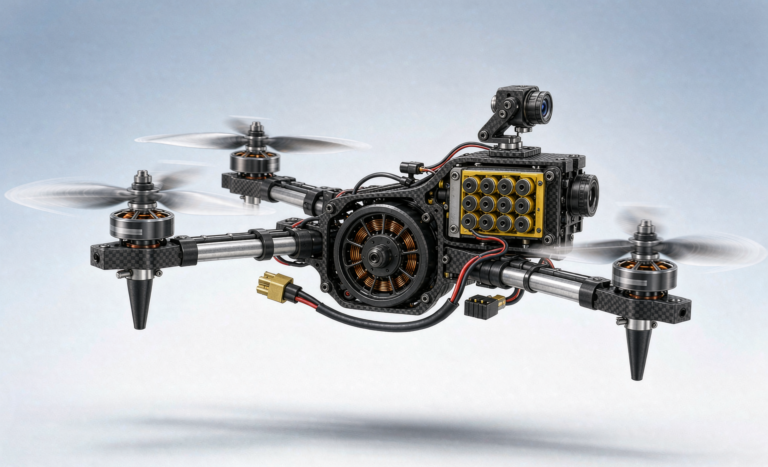
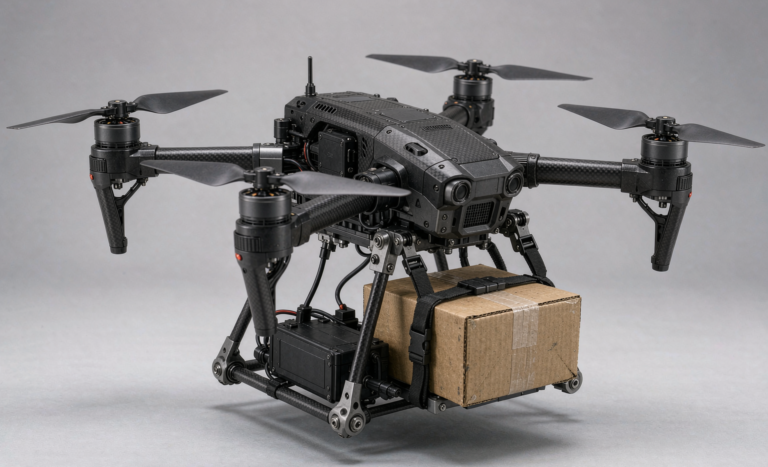
When people ask me what makes a good drone battery, they usually mean energy density or flight time. After fifteen years engineering packs for commercial fleets, I tell them the more honest question is: what does this lithium battery do the moment it hits a steel tower leg at 40 km/h? Inspection UAVs live a different life from mapping or racing aircraft. They work close to structures — rooftops, pipelines, power-line towers, bridge undersides, silos — and that proximity is exactly what turns a controlled landing into a hard impact. In my workshop I have cut open packs that were crushed in a prop-strike and still did not go into thermal runaway. That outcome is not luck; it is design. This article is about engineering a drone lithium battery that survives the crash, not just the flight, for inspection duty.
Why Inspection Duty Creates a Unique Impact Threat Profile
Every drone application has a failure signature. Racing packs die from burst C-rate; long-endurance survey packs age from shallow cycling. Inspection packs fail from contact. The airframe is flown deliberately toward hard things: a gimbal one meter from a concrete wall, a LiDAR pod under a bridge girder, a multispectral sensor skimming a solar-panel row. When something goes wrong — a gust, a GPS multipath error, a pilot’s reaction time — the cell bay is the structure that gets squeezed.
I classify the impact threats into three families. First, top/bottom crush: the fuselage folds onto the pack during a rooftop edge contact or a tail-first drop onto rock. Second, penetration: a prop-strike shrapnel, a rebar, or a fractured landing-sk. Third, side-loading and shear: the pack is pinned against a tower leg while the airframe rotates, loading the busbars in bending. In a 200-pack field dataset across two inspection contractors, we logged contact incidents at roughly 3.4× the rate of comparable mapping fleets — and every thermal event we ever saw traced back to a localized crush that the certificate never simulated.
This is why a generic custom battery solution copied from a consumer quadcopter is the wrong starting point for inspection work. The threat model has to drive the architecture from the first sketch.
The Certification Floor Is Not the Crash Floor
It is tempting to treat UN38.3 as a crash-safety stamp. It is not. UN38.3 is a transport-safety screening standard, and a competent drone battery must clear all eight of its tests — T.1 altitude, T.2 thermal, T.3 vibration, T.4 impact (a 24-inch drop onto a 15.8 mm rebar at 9.1 kg), T.5 external short-circuit, T.6 crush (13 kN static load on a single cell for one minute), T.7 overcharge, and T.8 forced discharge. IEC 62133-2 adds internal-short and crush at the cell level. We pass all of them on every lot before a pack ever ships.
But notice what T.6 crush actually is: a slow, static, single-axis 13 kN press on one cell. A real inspection crash is dynamic, multi-axis, and concentrated on a corner of the bay. A 1500 g shock (MIL-STD-810H 516.8) delivered as a 0.5 ms half-sine has the same impulse energy distributed completely differently, and a localized point load can exceed the cell’s crush threshold even when the average load does not. Certification tells you the chemistry will not spontaneously combust in a shipping box. It does not promise the pack will walk away from a tower strike. Closing that gap is the engineer’s job.
Crush-Zone Architecture — Designing Where the Energy Goes
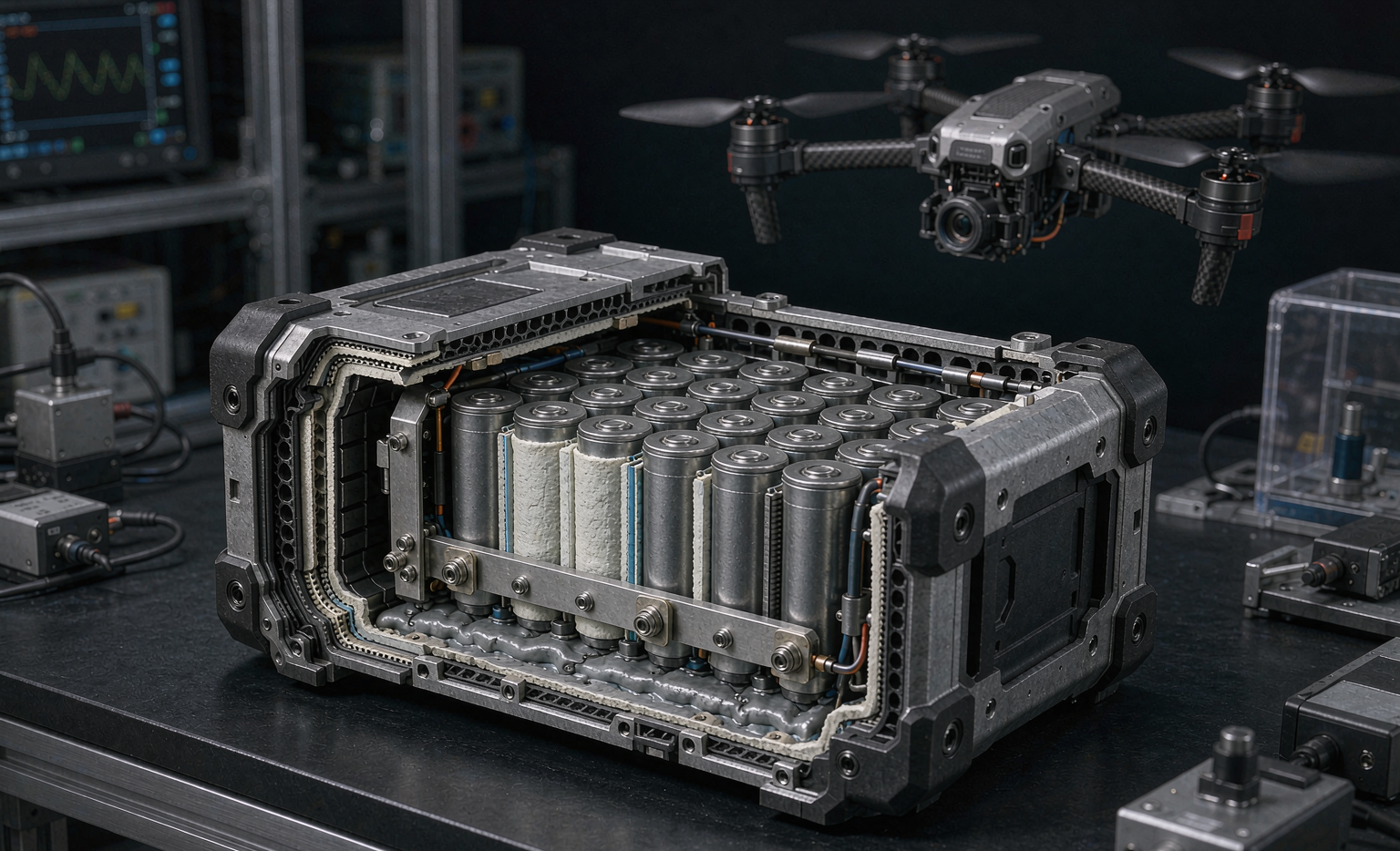
The single most useful idea in impact-resistant pack design is borrowed from automotive crumple zones: decide in advance where the energy goes, and make sure it is nowhere near a live cell. I build a drone lithium battery bay as two concentric structures. Outboard is a soft crumple layer — 3 to 5 mm of energy-absorbing PU foam or an elastomer — that deforms first. Inboard is a rigid cell cradle machined from 6061-T6 aluminium or molded 30% glass-filled nylon that holds each cell fixed.
Between them I place peripheral crush cans and bulkheads: thin-walled standoffs that buckle at a predictable load and absorb the impulse before it reaches the cells. Just as important is spacing — I keep a minimum 1.5 mm air gap with standoffs on every cell face so that even if one cell is crushed, it cannot mechanically short its neighbor. In a worked 6S3P 21700 bay, adding an 8 mm perimeter crush zone dropped the peak cell-face load from ~9 kN under a simulated edge impact to under 2 kN — comfortably below the T.6 threshold that the cell itself is rated to survive. The load path is directional: the pack is weakest to absorb exactly where the airframe is strongest to transmit, and vice versa.
Cell-Level Containment and Busbar Shear Protection
Even with a good crush zone, a hard enough hit will reach a cell. The next line of defense is containment. I specify ceramic-coated separators that shut down at ~130 °C, and I wire the BMS to trip on a dT/dt rate-of-rise signal — not just on an absolute temperature — because an impact-induced internal short shows up as a sudden thermal slope long before the bulk cell warms. That early trip is what keeps a single compromised cell from cascading.
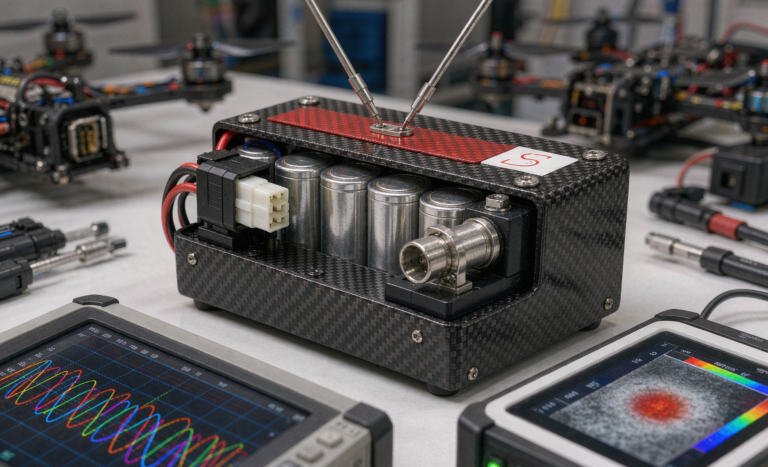
Busbars are the quiet failure point nobody talks about. On impact, a rigid busbar can shear and whip across the pack, shorting positive to negative. I embed every busbar in a potted channel with anti-short standoffs, and where a connection must break I use a clean shear pin rather than a brittle fracture that throws debris. Potting the cell stack in PU or epoxy — something we also use for sealing and vibration damping — locks the cells in place so they cannot shift and internally short during the microsecond of the impact. And the welds have to hold: I qualify every laser weld to >25 N pull and verify it survives a 1500 g shock without a milliohm of resistance drift.
Case Materials and Structural Hardening
The housing is the last barrier, and the material choice is a genuine trade. Die-cast aluminium is the most crush-resistant but heaviest; carbon-fibre is light and stiff but can shatter into sharp edges that themselves become penetrators; 30% glass-filled nylon is my default for inspection packs because it crushes in a controlled, non-sharp way and is easy to rib and gusset. I add bulkheads at the bay perimeter and gusseted corners so a corner drop loads the structure, not the cells.
We qualify the finished lithium battery pack to MIL-STD-810H 516.8 shock (peak 1500 g, 0.5 ms half-sine), MIL-STD-810H 514.8 random vibration, and RTCA DO-160 Category C/D crash-safety drop profiles. Crucially, the IP67 housing I design for coastal and underground inspection sites (water and dust ingress) doubles as an impact shell — the two requirements reinforce each other, which is why a coherent custom battery solution treats sealing and crash-hardening as one problem rather than two.
A Field Drop-and-Penetration Protocol Beyond the Certificate
Certification is a floor; my field protocol is the real test. For every new inspection pack variant we run six 1.2 m drops onto bare concrete — one per face plus corners — with a hard pass criterion of no fire, no venting, and no cell-to-cell contact. We then apply a 50 J pendulum penetration directly onto the cell bay while thermal probes watch every cell for a slope anomaly. After impact, the pack must clear a post-incident SoH gate: less than 5% capacity loss, no DCIR jump greater than 2 mΩ, and no change in cell-to-cell contact resistance.
Every pack carries a DataMatrix genealogy code, so when one survives — or fails — an incident, I can trace it back to the lot, the weld parameters, and the cell grade. That closed loop is what lets a drone battery program improve month over month instead of repeating the same failure. It is also the data backbone of a real custom battery solution: the pack is not a commodity, it is a measured, traced, improving product.
Fleet Economics — Crash Survival Pays Back
The business case is blunt. A hardened inspection pack might cost $30 to $60 more than a bare-bones equivalent. The airframe it protects — airframe, gimbal, LiDAR, or thermal payload — is often $5,000 to $12,000. In our fleet data, crush-zone and busbar-shear design avoided roughly two thermal events per 1,000 flights, each of which would have destroyed the aircraft. Even at one avoided incident per 2,000 flights, the payback on the hardening is under a year, before you count the liability and downtime costs of a mid-site battery fire during a regulated inspection.
For BVLOS and beyond-visual-line-of-sight inspection — pipelines, rail, long power corridors — crash-survivability is also a regulatory story. A pack that fails gracefully is far easier to defend in a safety case than one that turns an incident into an emergency. That is the difference between a drone lithium battery that is merely certified and one that is genuinely trustworthy in the field.
Frequently Asked Questions
How much crush can a drone battery survive?
A certified cell passes a 13 kN static UN38.3 T.6 crush, but a well-designed pack absorbs most of a real crash in its crush zone before load reaches the cells. In our 6S3P inspection bay, an 8 mm perimeter crush zone keeps peak cell-face load under 2 kN even in a simulated edge impact — well inside the cell’s own rating.
Does UN38.3 certification guarantee crash safety?
No. UN38.3 is a transport-screening standard using static, single-axis tests. A tower strike is dynamic and multi-axis. Certification is the floor; a dedicated drop-and-penetration protocol is what actually proves field survival.
What materials best resist impact in inspection packs?
I default to 30% glass-filled nylon for controlled, non-sharp crushing and easy ribbing; die-cast aluminium is most crush-resistant but heaviest; CFRP is light but can shatter into penetrators. The right choice balances mass against the threat model.
How do you test a pack beyond certification?
Six orientations of 1.2 m concrete drops, a 50 J pendulum penetration on the cell bay with thermal monitoring, and a post-impact SoH gate (<5% capacity loss, no DCIR jump >2 mΩ). Every unit is traceable via DataMatrix genealogy.
Can a crashed pack be safely reused?
Only after it clears the post-impact SoH gate and a full internal-resistance and capacity re-grade. If any cell shows a DCIR jump, a capacity loss beyond threshold, or a thermal slope anomaly during the impact test, the pack is retired — never quietly returned to flight.
Designing a crash-survivable drone battery for inspection UAVs is less glamorous than chasing grams or extra minutes of flight, but it is where a lithium battery either earns its keep or becomes a liability. Build the crush zone on purpose, contain the cell, protect the busbar, harden the case, and test past the certificate — and the pack will still be intact when the airframe is not. That is the kind of custom battery solution inspection fleets actually need.