Battery Solution Manufacturing for Robotics
I have spent the better part of fifteen years standing next to pack assembly lines, and the pattern in robotics is always the same: the electrical design passes review in three weeks, then manufacturing takes nine months to become boring. A robotics battery solution is rarely a high-volume consumer product. It is a 40-to-300-unit-per-month build, often three or four variants sharing one line, with mechanical loads and service expectations closer to industrial equipment than to a laptop. Battery solution manufacturing for robotics is therefore a process engineering problem long before it is a cost problem. In this article I walk through how we industrialise a robotics pack at Horizon Power: how we lock the design before tooling, how we grade incoming cells, how we develop and defend a laser weld window, and how we keep yield and traceability under control while ramping.
Why Robotics Packs Break Standard Pack Manufacturing Assumptions
Most pack lines are designed for one product at high volume. Robotics is the opposite: high mix, low-to-medium volume, long field life. Three consequences follow.
- Changeover dominates. If a variant runs 60 units and changeover takes two hours, changeover is 15-20% of your available capacity. Fixture design becomes a yield issue, not a convenience.
- Mechanical duty is real. AMRs and mobile manipulators see continuous 0.02-0.05 g²/Hz random vibration and repeated 15-25 g dock impacts. Joints that survive a benchtop pull test can still fatigue in eight months.
- Field service is expected. Customers want module-level replacement after 1500 cycles, which means the pack must be manufacturable and disassemblable. Fully potted designs quietly kill that.
A lithium battery for a cleaning robot and one for a warehouse tugger may share the same cell, but their manufacturing routings differ enough that we treat them as separate process families with a shared cell grading front end.
Design for Manufacture: Freeze the Pack Before You Cut Tooling
We run two formal DFM gates. The first is at electrical freeze, the second before fixture tooling release. What we look for is not elegance but repeatability.
- Tolerance stack-up on cell height. Cylindrical cells vary 0.3-0.5 mm across lots. If the busbar sits on a rigid plane, that variation lands entirely on the weld gap. We design nickel tabs with a 0.6-0.8 mm compliant loop so the gap stays inside the weld window.
- NTC placement. Thermistors must sit on the cell body at the mid-height hot spot, not on the busbar. We specify an adhesive pad and a fixture-located pocket, because free-hand placement drifts 8-12 mm and produces 3-6 °C of reported temperature error.
- Fastener access. Every screw needs a straight driver path with a torque-verified socket. Angled access is the single most common cause of cross-threading on the line.
- Serialisation surfaces. Flat, non-curved, non-painted areas for 2D data matrix labels on the enclosure, module and BMS board.
Skipping these gates is how a custom battery solution ends up with a 92% first-pass yield that nobody can explain.
Incoming Cells: Grading, Storage and the Dry-Room Question
Cell quality is bought, not inspected in, but grading still pays for itself. Our incoming routine on every lot is:
- 100% OCV and AC internal resistance at 1 kHz, sorted into bins of ±10 mV and ±0.5 mΩ. Parallel groups are built from a single bin; series strings from a single lot.
- Sample capacity check on 5-10 cells per lot at 0.5C to confirm the datasheet within 3%.
- Dimensional and surface check for can dents, insulator damage and terminal contamination, which is the most common cause of weld spatter.
- Storage at 30-50% SoC, 15-25 °C, 35-55% RH with FIFO by lot. Cells older than 12 months are re-graded before release.
A full dry room is unnecessary for cylindrical and prismatic pack assembly, since the cells arrive sealed. What we do control is humidity for adhesive cure, potting and any hipot testing, where 60%+ RH visibly shifts leakage current readings.
Joining: Developing a Laser Weld Window You Can Defend
Joining is where most robotics battery solution programmes lose their yield. We develop the window with a small design of experiments rather than a supplier default recipe.
- Variables: laser power, pulse duration, spot overlap, focal offset, gap, and tab material state. We run a 3-level DOE on power and duration at fixed gap, then confirm at gap extremes.
- Acceptance: destructive pull ≥ 30 N per weld nugget on nickel tab to steel can, joint resistance ≤ 0.05 mΩ with lot-to-lot spread under 0.02 mΩ, and no can penetration on cross-section.
- Monitoring: in-process weld energy logging plus a 100% four-wire resistance check at the busbar. We do not rely on visual inspection alone; a cosmetically perfect weld can sit at 0.15 mΩ.
- No rework rule. A failed weld on a cell terminal is not re-welded. The group is scrapped or the cell is replaced. Re-welding heat-affects the can and creates a latent failure we cannot screen.
The same discipline applies to ultrasonic bonding on pouch tabs and to resistance welding on lower-current variants.
Process Validation: IQ/OQ/PQ, First Article and SPC With Real Cpk
Validation is the difference between a process and a habit. We follow an installation, operational and performance qualification sequence for every station that touches a joint, a torque or a seal.
- IQ: calibration certificates, utilities, safety interlocks per ISO 13849 category, and software version lock.
- OQ: run at window edges, not just nominal, to prove the process survives drift.
- PQ: 30 consecutive packs at production takt with the production operator, not the engineer.
- First article inspection covering every dimension and every electrical node on the drawing, with the report retained for the programme life.
- SPC on the four things that move: weld resistance, screw torque, cell group voltage delta and enclosure leak rate. Target Cpk ≥ 1.33; below 1.0 the station stops.
Under ISO 9001 and, for automotive-adjacent robotics, IATF 16949 thinking, this evidence package is what lets a customer audit you in a day instead of a week.
Line Layout, Takt Time and Poka-Yoke
For a 200-unit-per-month robotics pack running one shift, takt is roughly six minutes. We balance to five stations plus a curing buffer:
- Station 1: cell grading release, holder loading in a keyed fixture that physically cannot accept a reversed cell.
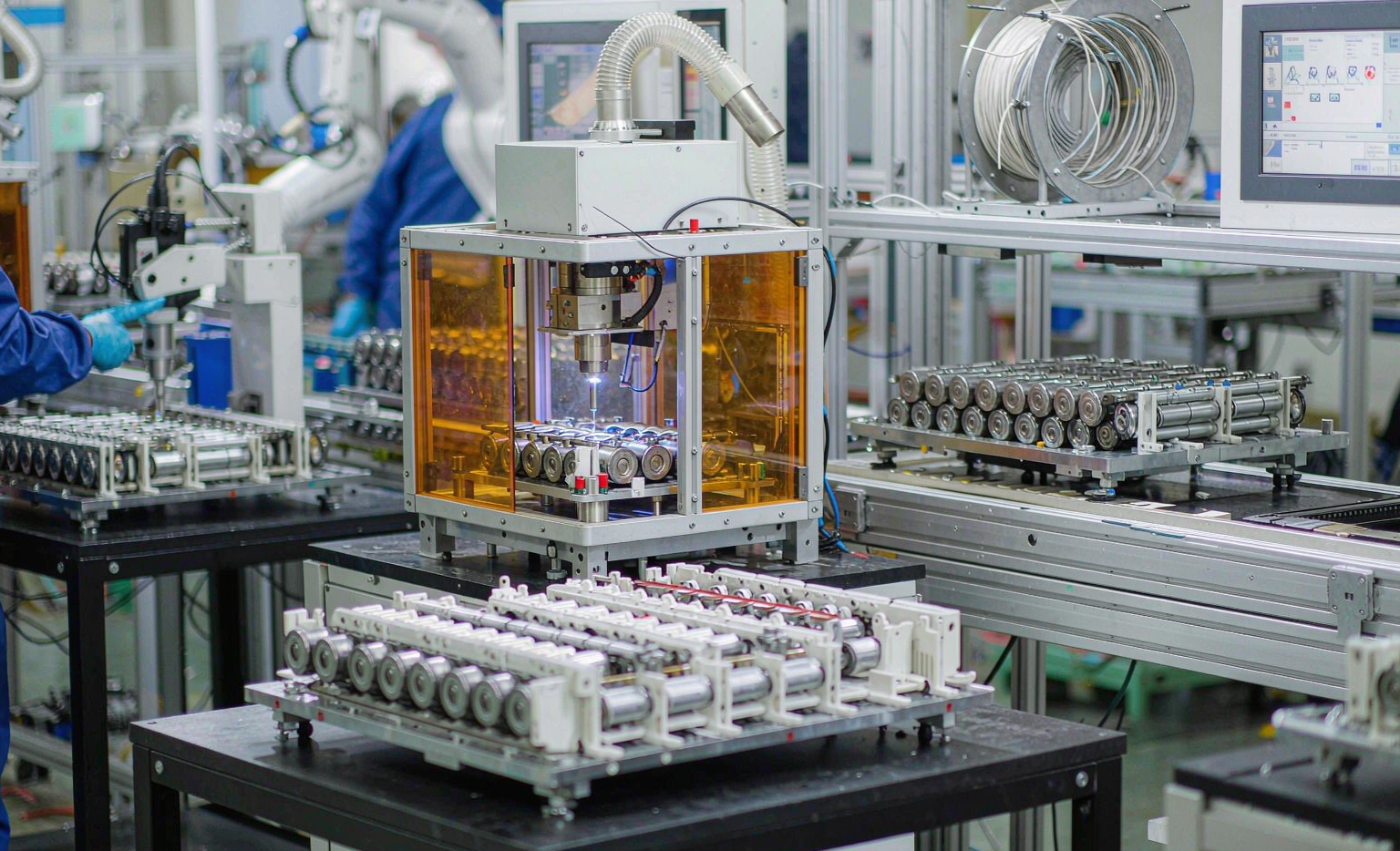
- Station 2: busbar placement and laser welding inside a class-1 enclosure with fume extraction.
- Station 3: sense wire routing, NTC bonding, BMS mounting with data-logging torque drivers set to 1.2 N·m ± 10%.
- Station 4: enclosure close, gasket seating, IP65 verification per IEC 60529 after mechanical stress, connector potting.
- Station 5: end-of-line electrical acceptance and label printing gated on a pass result.
Every fixture is mechanically poka-yoked. Electrostatic discharge control follows a 1 MΩ-to-10 GΩ grounded path at each bench. Operators are certified per station, and certification expires after 90 days of not running that station, which we learned the hard way after a six-week gap produced a cluster of loose sense wires.
Traceability: Cell Lot to Robot Serial for Ten Years
Robotics fleets get recalled by serial range, not by guesswork. Our genealogy record links, for every pack: cell manufacturer lot and grading bin, busbar and tab lot, BMS board serial and firmware hash, weld energy and resistance per joint, torque values, leak test result, end-of-line capacity and impedance, plus operator and station identity with timestamps.
This is captured by a manufacturing execution system with barcode gating: a station will not release a unit whose upstream record is incomplete. We retain the data for ten years, matching the service life expectation of most industrial robots. When a field issue appears, the difference between recalling 40 units and recalling 4000 is entirely this database. It also supports transport documentation, since UN38.3 test summaries must be traceable to the specific cell and pack design being shipped.
Yield Pareto and the Cost of Poor Quality
Mature robotics pack lines run 96-99% first-pass yield. When a new programme starts at 88-93%, the Pareto is remarkably consistent:
- Weld resistance out of spec – 30-40% of defects, usually terminal contamination or gap drift.
- Sense wire and connector faults – 20-25%, driven by routing ambiguity in the work instruction.
- Cell group voltage delta > 20 mV – 10-15%, almost always a grading discipline breakdown.
- Seal and leak failures – 10%, gasket seating and fastener sequence.
- Cosmetic and labelling – the remainder.
We cost each defect fully: scrapped cells, technician time, retest, and schedule impact. On a typical industrial pack, a single scrapped 13S4P group is worth 40-60 minutes of line output. That number is what justifies fixture spend, and it is the same argument we use with drone battery programmes where cell cost per pack is even higher.
Ramping Pilot to Volume Without Losing Control
We ramp in three stages: pilot of 10-20 units built by engineering with full instrumentation, bridge build of 50-100 units by production with engineering present, then volume with engineering on call only. Two rules protect the ramp. First, formal change control: any change to cell source, tab material, weld parameter, adhesive, firmware or fastener triggers a documented requalification, ranging from a 10-unit confirmation run to full safety retest under IEC 62133-2 or IEC 62619 for larger systems. Second, second-source qualification runs in parallel rather than after a shortage. Qualifying an alternate cell takes 12-20 weeks including abuse testing, and doing it under pressure is how safety margin gets negotiated away. A battery solution that cannot be re-qualified calmly is not really industrialised.
Frequently Asked Questions
How long does it take to industrialise a new robotics battery pack?
From frozen electrical design to stable volume production, plan on 16-24 weeks. Roughly four weeks for DFM and fixture design, six to eight for tooling and weld window development, four for validation and first article, then four to six weeks of ramp. Safety and transport certification runs in parallel and is usually the long pole at 8-12 weeks.
Do you need a dry room to build lithium battery packs?
Not for pack assembly using sealed cylindrical, prismatic or pouch cells. Dry rooms are needed for cell manufacturing, where exposed electrode and electrolyte handling demands very low dew point. For pack lines we control humidity to 35-55% RH for adhesive cure, potting and stable high-potential test readings.
What first-pass yield should I expect on a low-volume robotics pack?
A well-controlled line reaches 96-99% after validation. New programmes commonly start at 88-93%. If yield sits below 95% after the bridge build, the root cause is nearly always weld window robustness or ambiguous work instructions rather than cell quality.
Can a manufacturer support a 200-unit-per-month build without dedicated tooling?
Yes, but only with modular fixtures. We use a common base plate with variant-specific inserts, which cuts changeover from two hours to under twenty minutes. Fully manual assembly without keyed fixtures is possible at that volume, but the defect rate typically runs three to five times higher.
What manufacturing evidence should I request from a battery supplier?
Ask for the DFM report, weld window DOE with pull and resistance data, IQ/OQ/PQ records, first article inspection, SPC charts with Cpk for weld resistance and torque, the traceability data model with retention period, change control procedure, and UN38.3 plus IEC 62133-2 or IEC 62619 reports matching the exact build configuration.
Closing Note From the Bench
The best robotics packs I have shipped were not the cleverest designs. They were the ones where the weld window was wide, the fixtures made mistakes impossible, and every unit could be traced back to a cell lot years later. If you are specifying a custom battery solution for a robotics platform, spend your review time on manufacturing evidence rather than on the datasheet. The datasheet describes one good pack; the process describes the next two thousand.