Battery Solution Performance for Vessels
Why Vessels Need a Different Battery Performance Profile
After fifteen years designing lithium packs for drones, forklifts, and home storage, I was surprised by how different the battery duty cycle is once you move the pack onto a boat. A vessel battery does not just sit in a climate-controlled cabinet. It lives in a vibrating, salt-laden, heat-soaked engine room where the load can swing from a quiet hotel load of a few hundred watts to a bow thruster pulling several kilowatts in a single pulse. At Horizon Power we have built custom battery solutions for offshore service vessels, fishing boats, pilot craft, and crew transfer vessels, and the performance envelope is unlike anything on land.
The core challenge is not energy density. It is reliability under a duty profile that combines deep daily cycling with brutal transient peaks, all while the pack must survive a marine environment that would destroy a standard industrial battery in a single season. A lithium battery built for a warehouse rack simply is not qualified for the combination of moisture, motion, and load shape found on a working boat. This article walks through the performance factors we engineer for, and the certifications a vessel battery must clear before it ever leaves the dock.
Deep Cycling and Hotel Load Demands
On a modern vessel the battery often carries the hotel load: lighting, navigation electronics, galley equipment, and HVAC when the main generator is shut down for noise or fuel reasons. In hybrid and diesel-electric designs the pack may also provide the low-speed propulsion energy. That means one full discharge and recharge cycle every day, sometimes two on long transits.
For this duty we specify lithium iron phosphate cells rated for at least 3,000 cycles to 80 percent state of health at 25 degrees Celsius, and we de-rate that to roughly 2,000 cycles when the average cell temperature climbs to 45 degrees Celsius in a poorly ventilated compartment. A custom battery solution for a 40-foot pilot boat might use a 10 kWh pack sized so the daily hotel draw never exceeds 60 percent depth of discharge. Keeping depth of discharge in the 40 to 60 percent band is the single biggest lever for cycle life on the water.
High Pulse Discharge for Thrusters and Winches
The load that breaks a poorly designed marine pack is the pulse. A bow thruster or anchor winch can demand 3 to 5 times the continuous rating for 10 to 30 seconds. If the pack busbar, fuse, and cell internal resistance are not matched to that pulse, voltage sag trips the inverter or, worse, overheats a connection.
We model the pulse with the cell DC internal resistance measured at 50 percent state of charge and 0 degrees Celsius, because that is the worst case a vessel operator will actually see at dawn in cold water. For a 48V system we keep the pulse voltage above 40V at 3C for 20 seconds. That number comes straight from the inverter undervoltage cut-off, not from a marketing sheet. A lithium battery that looks fine on a continuous discharge table will fail the moment the thruster spins up unless the pulse rating is designed in from the first schematic.
Thermal and Vibration Challenges in the Engine Room
Engine rooms run hot. Ambient temperatures of 50 degrees Celsius next to a generator are normal, and a pack mounted there sees sustained heat that accelerates calendar aging. We locate the battery as far from exhaust runs as the hull allows and add forced airflow only when passive cooling cannot hold cell temperature below 45 degrees Celsius.
Vibration is the quieter killer. Continuous low-frequency shaking from the propeller shaft and sharp transients from wave slamming loosen terminals and crack busbar welds over a season. Every Horizon Power vessel pack is built on a floating internal frame with anti-vibration mounts rated to 5G random vibration per IEC 60068-2-64, and we torque-check every connection after a 50-hour shake test before the pack is approved for production. I have opened competitor packs after one season at sea to find stress fractures at the cell-to-busbar joint; that failure mode is entirely preventable with the right mounting design.
Salt Spray, IP Rating, and Corrosion Defense
Salt is the enemy of every electrical system on a boat. A pack that is only IP54 will fail in an exposed deck locker within a year. For engine-room installation we require a minimum of IP65 on the enclosure, and for any pack in an open or semi-open location we move to IP67 with a breather valve that equalizes pressure without letting moisture in.
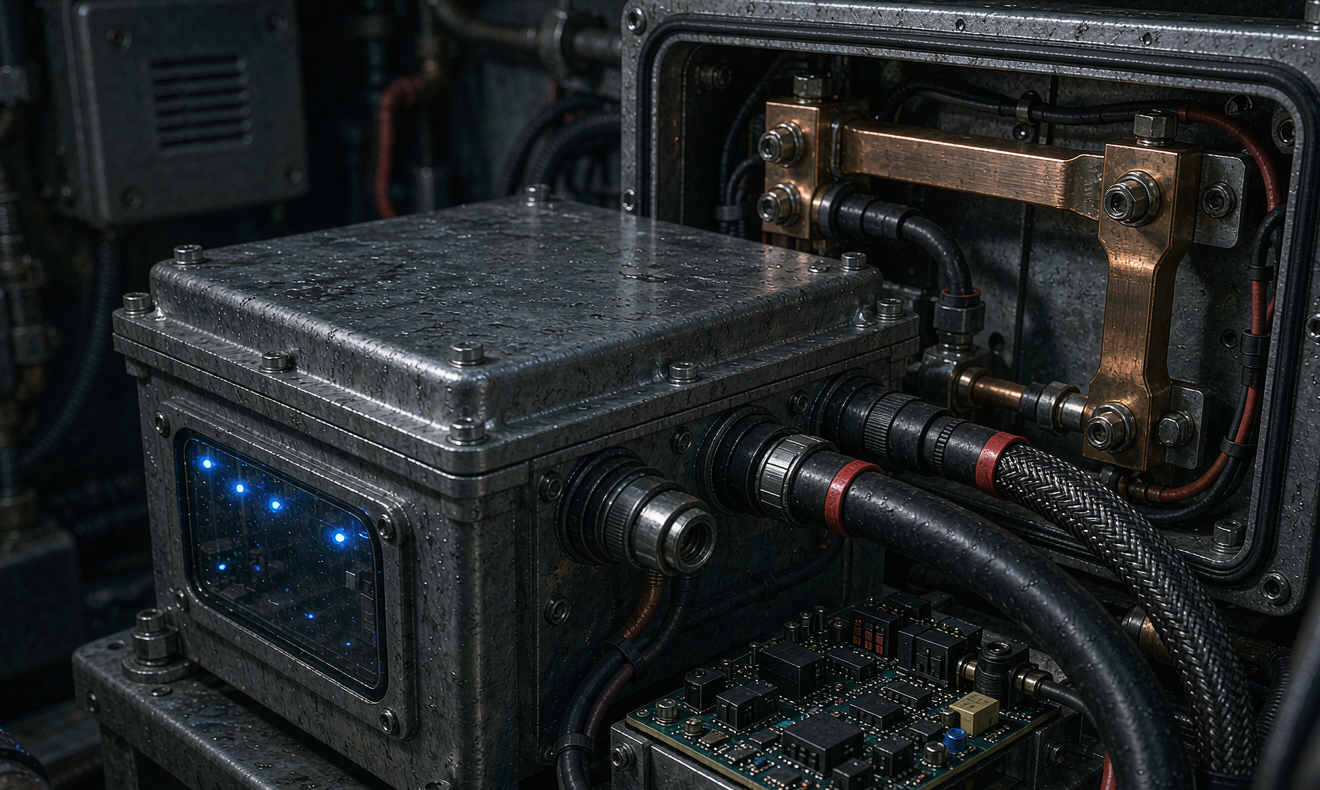
Beyond the enclosure we specify tinned copper busbars and stainless hardware, and we conformal-coat the battery management system board to resist the conductive film that salt spray leaves behind. In one offshore service vessel project we measured a 0.4 ohm rise in ground resistance after six months on a non-coated control board; coating the replacement brought that to near zero. The battery management system itself must be isolated from the vessel 12V or 24V house supply with a DC-DC converter, because a shared ground path is the fastest route to a corrosion-driven fault.
Hybrid Propulsion and Peak Shaving
The most valuable role a vessel battery plays is peak shaving. A diesel generator is most efficient near 70 to 80 percent load, but real vessel loads swing wildly. By letting the battery absorb the peaks and fill the troughs, the generator can be run in its sweet spot or shut off entirely in port. This is the foundation of cold ironing, where a berthed vessel draws zero shore or generator power for hotel loads and avoids both fuel burn and port emissions limits.
In a typical hybrid retrofit we size the pack so it can carry the full hotel load plus one thruster pulse for at least 20 minutes, which covers most maneuvering in a harbor. The battery management system talks to the generator controller over CAN bus, and we set the state of charge window to 20 to 90 percent to protect both cycle life and instant reserve. A custom battery solution built around this window lets a 60-foot crew transfer vessel cut generator runtime by roughly 40 percent on a normal day.
Compliance and Certification Path
A vessel battery cannot be a generic industrial pack with a marine paint job. The cells must pass UN38.3 for transport, which covers altitude simulation, thermal test, vibration, shock, external short circuit, impact, and overcharge. For stationary and mobile marine energy storage we build to IEC 62619 for the cell and pack safety requirements, and we design the thermal runaway propagation resistance to the expectations of classification societies.
Depending on the flag state and vessel class, the installation may need DNV, ABS, or Lloyd’s Register type approval, and the system must meet the relevant IMO and IEC 60332 and IEC 60092 wiring and fire standards for the marine environment. We prepare the test dossier during design, not after, because a missing vibration report can delay a certification by months. In my experience the projects that sail through approval are the ones where compliance was a design input from day one, not a final hurdle. The cost of rework after a failed inspection is always higher than the cost of getting the documentation right the first time.
Frequently Asked Questions
What battery chemistry works best for vessel performance?
Lithium iron phosphate is the default for most vessel packs because its thermal stability, long cycle life, and tolerance to partial state of charge suit the deep daily cycling and safety expectations of a marine installation. Nickel-based chemistries offer more energy density but add thermal and certification burden that most operators do not need.
How long does a vessel battery last in real service?
A properly sized lithium iron phosphate pack on a vessel typically delivers 2,000 to 3,000 cycles before reaching 80 percent state of health. In practice that is four to seven years of daily cycling, with the lower end applying to packs that run hot or are discharged below 20 percent state of charge on a regular basis.
Can a vessel battery replace the diesel generator completely?
For most working vessels a full replacement is not yet practical, but a well-designed hybrid with a custom battery solution can cut generator runtime by 30 to 50 percent. Fully electric operation is realistic for short harbor maneuvering, hotel load in port, and low-speed transit, while the generator covers long transits and heavy thrust.
What IP rating does a marine battery enclosure need?
IP65 is the minimum we accept for an engine-room pack, and IP67 is required for any location exposed to spray or condensation. The enclosure rating means little without tinned copper wiring and a coated battery management system board, since corrosion attacks the internals long before water enters the box.
Do vessel batteries need special transport certification?
Yes. The cells and packs must pass UN38.3 before they can be shipped, and the installed system should be built to IEC 62619 with documentation ready for DNV, ABS, or Lloyd’s Register review depending on the vessel class and flag state.
Further Reading
References