Battery Solution Testing for Equipment
When a piece of industrial equipment goes dark because its battery failed in the field, the root cause is almost never the chemistry. In my fifteen years validating packs at Horizon Power, the failures I investigate trace back to one thing: the battery solution was never tested the way the equipment actually uses it. A battery solution testing equipment program is not a box-ticking exercise before shipment — it is the engineering discipline that separates a pack that survives a datasheet from a pack that survives a harsh, real-world duty cycle. Whether we are building a drone battery for aerial inspection or a stationary lithium battery bank for remote telemetry, the validation logic is the same: prove it under stress before the customer ever sees it.
Why Equipment Demands a Different Testing Regimen
Off-the-shelf cells are characterized by manufacturers under idealized laboratory conditions: 25°C, a steady 0.2C discharge, and a clean single-axis load. Equipment does none of that. A custom battery solution mounted on agricultural machinery sees vibration, temperature swings from −20°C to +60°C, and pulsed loads that can swing from near-idle to 5C in milliseconds. A battery application on a robotic floor cleaner endures hundreds of shallow charge/discharge micro-cycles per day. If your test plan only replicates the cell vendor’s calm conditions, you will certify a pack that dies in month three of deployment.
At Horizon Power we therefore design the test regimen around the equipment’s duty profile, not the cell’s marketing sheet. For every program we capture the load signature first — current vs. time, temperature vs. time, state-of-charge windows — and then we replay that signature in the lab until the pack has nothing left to hide. This is the core of any credible battery solution testing equipment workflow.
The Compliance Baseline: UN38.3, IEC 62133, and Transport Rules
Before any performance testing begins, every pack must clear the safety and transport baseline. The two standards I reference most are UN38.3 for air and ground transport of lithium cells, and IEC 62133 (the current edition, IEC 62133-2 for lithium systems) for portable secondary-cell safety. UN38.3 requires eight tests — altitude simulation, thermal test, vibration, shock, external short circuit, impact/crush, overcharge, and forced discharge — and a pack that cannot pass these simply cannot leave the building legally.
For customers who fly their equipment, transport authority rules matter. Both the FAA (under OSHA/PHMSA 49 CFR and ICAO Annex 18) and EASA in Europe govern how lithium batteries move as cargo and as installed power in aircraft. I keep a compliance matrix for each program so that a drone battery destined for a European operator and one for a U.S. operator are both documented against the right authority. Skipping this step is how otherwise good products get held at customs.
Electrical Characterization: Capacity, IR, and Load Profiles
Once compliance is cleared, we move to electrical truth. The first measurement is actual usable capacity at the equipment’s working temperature — not the 0.2C number. We measure internal resistance (DC-IR and AC-impedance) because a cell that reads 95% capacity but has climbed 40% in IR will drop voltage under load and trip the equipment’s under-voltage protection prematurely.
- Capacity verification: full charge to 4.20–4.35V/cell (chemistry dependent), then discharge at the application’s peak C-rate to cut-off.
- Load-profile replay: we script the exact pulsed current signature from the equipment’s controller and measure end-of-discharge voltage sag.
- Cycle-life screening: a shortened accelerated cycle (typically 100–300 representative cycles) to expose early capacity fade.
- Self-discharge: 24–72h open-circuit monitoring to catch micro-defects in welds and seals.
For a custom battery solution, these four measurements let me tell a customer exactly how the pack will behave at month one and at month eighteen — with numbers, not promises.
Environmental and Mechanical Stress Screening
Electrical behavior only matters if the pack stays mechanically intact. Our battery solution testing equipment lineup includes a thermal chamber (−40°C to +85°C), a random-vibration table (per IEC 60068-2-64), and a shock fixture. A typical equipment program runs:
- Thermal cycling: 5 cycles between −20°C and +65°C with the pack under a representative load, watching for BMS resets.
- Vibration: 3-axis random vibration for 2 hours per axis at the equipment’s service spectrum, then a leak-check on every weld.
- Humidity and salt-mist: for marine or agricultural equipment, 96h at 93% RH followed by a corrosion inspection of terminals.
I have caught more latent failures in the vibration step than anywhere else. A cold-weld on a nickel strip that passes a continuity check at rest will often open under 2g RMS random vibration — exactly the condition the equipment meets on a dirt road.
Building a Traceable Test Record for Every Custom Battery Solution
E-E-A-T in our world is not a marketing claim; it is a paper trail. Every pack leaving Horizon Power is tied to a test record that includes the cell lot, the weld energy parameters, the IR spread across parallel groups, and the cycle-count of the specific fixture used. When a customer asks why their battery application outperformed a competitor’s, I can hand them the traceable data rather than a brochure.
This traceability is what lets us stand behind a custom battery solution with confidence. If a field failure occurs, the record tells us within minutes whether it was a process drift, a cell-lot issue, or an application mismatch — and that feedback loop is what improves the next design.
Common Failure Modes We Catch Before Shipment
After thousands of validation runs, the same culprits reappear. The top three I brief new engineers on:
- Imbalance across parallel groups: a single weak parallel string drags the whole pack; we catch it with per-group IR mapping before it becomes a field return.
- BMS setpoint errors: over-current trips set too low shut equipment down under legitimate pulses; we validate trip points against the real load profile.
- Thermal runaway margins: we run nail-penetration and external-short screening on prototypes to confirm the separator and venting design contain a single-cell fault.
Catching these in the lab costs a few days. Letting them reach a customer’s equipment costs a relationship. For a drone battery especially, where a mid-air failure is unrecoverable, this screening is non-negotiable.
The Test Bench Setup: What Good Battery Solution Testing Equipment Looks Like
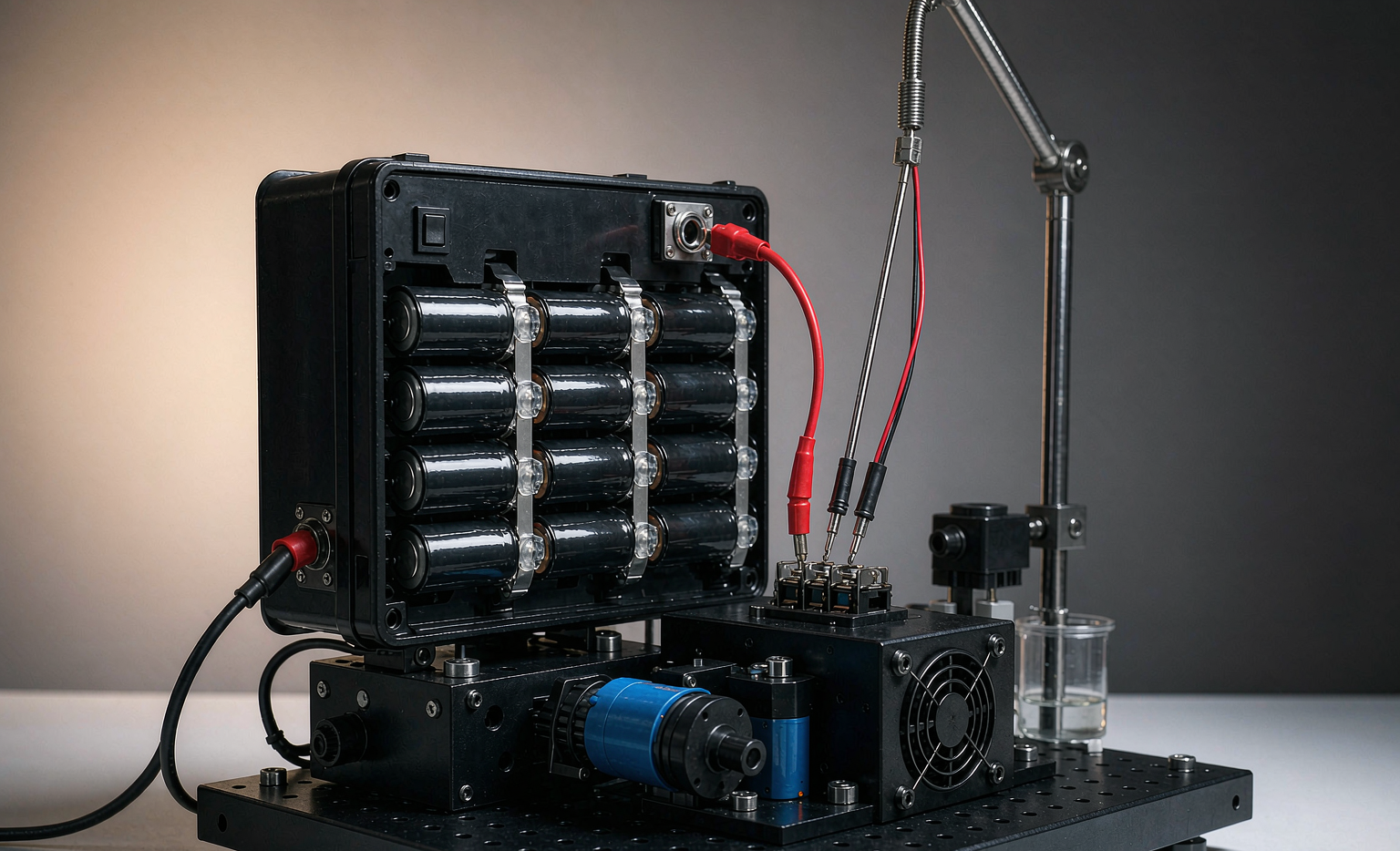
Clients sometimes ask why we do not just ship cells to a third-party lab and forward the report. The answer is iteration speed. A credible battery solution testing equipment bench lives in-house so that when a weld parameter or a BMS threshold needs tuning, we re-run the affected test the same afternoon instead of waiting three weeks for an external slot. Our core bench includes programmable DC electronic loads (up to 200A per channel), a battery cycler with 0.05% current accuracy, a thermal chamber with integrated data logging, and a vibration table slaved to a control computer that replays recorded field spectra.
The instrument that earns its keep most often is the data logger. A pack can pass every single-point measurement and still fail in the field because of a transient the point-check missed. By streaming voltage, current, and cell-temperature at 10Hz through a full duty cycle, we see the dips and spikes that averages hide. For a custom battery solution with tight voltage windows, that visibility is the difference between a clean sign-off and a surprise warranty claim.
From Prototype to Production: Validating at Scale
A prototype that passes is encouraging; a production lot that passes identically is what matters. When a design moves from bench to volume, we shift from full characterization on every unit to a layered approach: 100% of units get a capacity and IR screen, a statistical sample (typically AQL 1.0 per ANSI/ASQ Z1.4) gets the full environmental and cycle screen, and every lot retains a sealed archive sample for forensic comparison if a field issue appears months later.
This is where the lithium battery supply chain discipline shows. Cell lots vary batch to batch, and a chemistry that screened perfectly in January can drift by March. We re-qualify the incoming lot — not the design — whenever a new cell batch arrives, so the validated behavior the customer approved is the behavior they receive. A battery application that works in the lab but drifts in production is, to the customer, simply a battery that does not work.
FAQ
How long does a full equipment battery solution test cycle take?
For a standard program — compliance baseline plus electrical and environmental screening — plan on 7 to 14 working days, depending on cycle-life acceleration depth. A simple stationary lithium battery bank screens faster; a complex pulsed-load robotic pack with full thermal cycling sits at the longer end. We never compress the UN38.3 and IEC 62133 steps regardless of schedule pressure.
Do you test both drone battery and industrial packs the same way?
The safety baseline is identical — UN38.3 and IEC 62133 apply to both. The difference is in the duty-profile replay: a drone battery is validated against high-C discharge and rapid state-of-charge swings with strict weight limits, while an industrial equipment pack is validated against vibration, thermal extremes, and long shallow-cycle life. Our battery solution testing equipment setup is modular so we tune the stress profile to the actual use case.
What certificates do you provide with each battery solution?
Every shipped pack ships with its UN38.3 test summary, an IEC 62133 declaration where applicable, the transport compliance reference for the relevant authority (FAA/EASA-aligned), and the individual traceable test record covering capacity, IR, and the environmental screen. For a custom battery solution we also include the application-specific load-profile report so the customer’s engineering team can re-verify on their bench.
Testing is the quiet half of battery engineering — invisible when it works, catastrophic when skipped. A disciplined battery solution testing equipment program is how we turn a pile of cells into a pack our customers trust to power their equipment for years, not months.