Battery Solution Performance for Sensors
I have spent the better part of fifteen years on the factory floor and in the field specifying power systems for things that are meant to be forgotten. A drone battery gets swapped every twenty minutes and scrutinized before every flight. A sensor node, by contrast, is bolted to a pipeline in the Gobi Desert or welded inside a water-meter pit and then left alone for a decade. When a client at Horizon Power asks me for a battery solution for a sensor network, the word “performance” means something completely different from what it means for a vehicle or a drone. It is not about peak watts per kilo. It is about not dying quietly in year seven.
In this article I will walk through how my team engineers battery solution performance for sensors: the metrics that actually matter, the chemistry trade-offs, and the validation gates we use before a pack is allowed into a ten-year deployment.
What “Performance” Means for a Sensor Battery
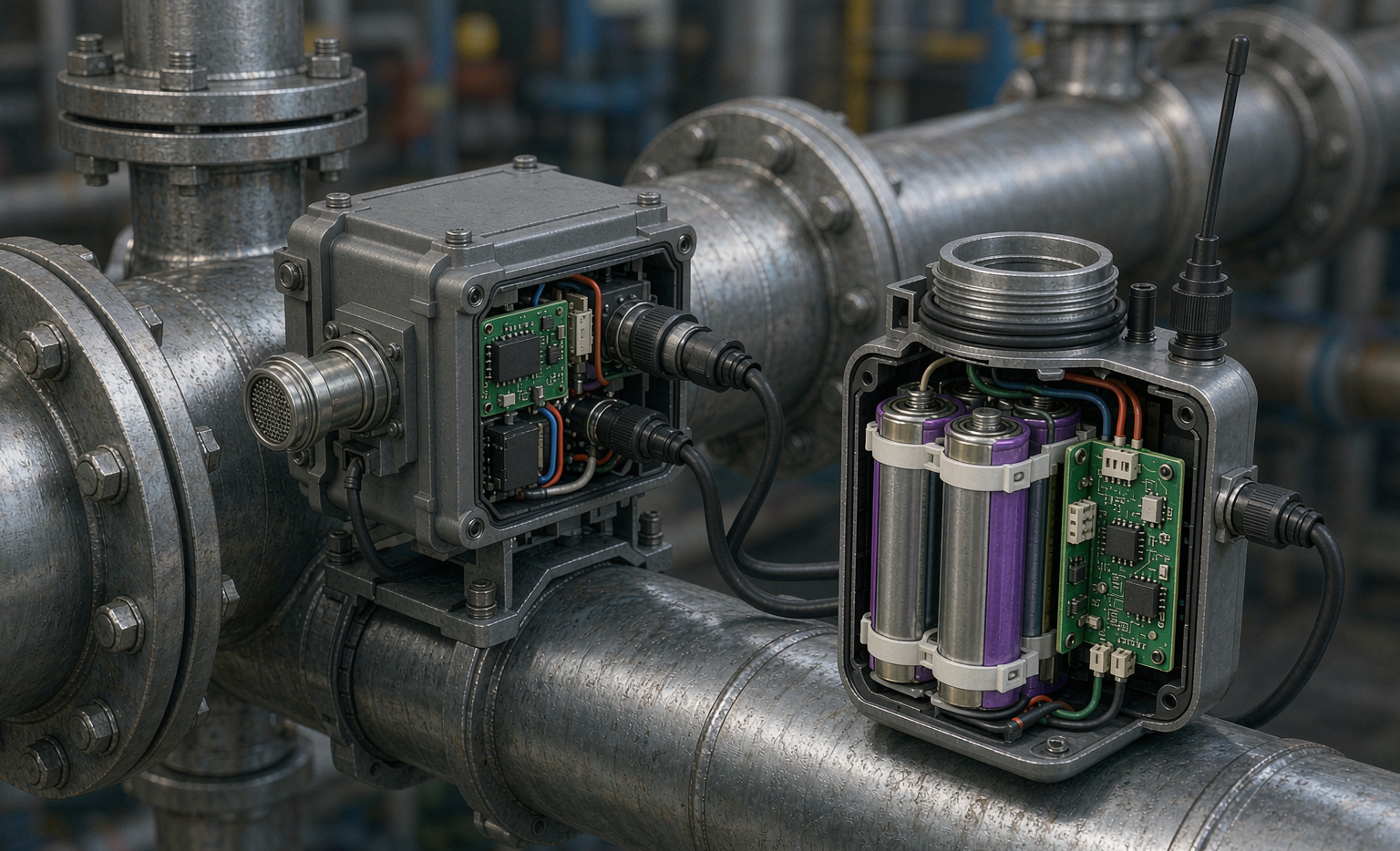
For a moving platform you optimize energy density and discharge rate. For a sensor, the governing numbers are self-discharge, calendar life, pulse capability, and temperature window. A lithium battery that draws 30 microamps still loses more to internal leakage over ten years than to the load itself, so the leakage number is the product, not a footnote.
We never quote a sensor pack from a one-line spec. Before engineering begins we ask for the current profile as a CSV, the enclosure’s worst-case internal temperature, and the acceptable failure rate across the deployment. A battery solution that is perfect on paper but specified against the wrong duty cycle is the most common way a ten-year project becomes a five-year recall, and the cost of that mistake is measured in truck rolls to a site nobody wanted to visit.
- Self-discharge: Li-MnO2 primary cells we tested at 25°C retained above 95% capacity after 10 years; at 45°C that fell to roughly 80%. The storage environment, not the datasheet, sets the real life.
- Calendar life: A cell sitting at 90% state of charge in a hot cabinet ages far faster than one cycled gently in a cool one. We qualify on open-circuit drift, not just cycle counts.
- Pulse capability: A LoRa radio burst pulls 120 mA for 50 ms every 15 minutes. The voltage sag must stay inside the regulator’s input range or the node simply reboots and loses data.
- Temperature window: A sensor on a northern gas line sees -40°C; a rooftop unit sees +70°C in direct sun. The pack must survive both without a human ever touching it.
Primary Lithium vs Rechargeable — Choosing the Cell
The first decision in any custom battery solution for a sensor is primary versus secondary, because that single choice dictates the entire management circuit and housing.
In cost terms the comparison is not price-per-cell but price-per-service-year. A Li-SOCl2 D-cell that costs four times a Li-MnO2 cell but lasts three times as long and needs no charge circuit usually wins for a sealed node. The rechargeable LFP only becomes cheaper when the node genuinely cycles daily and the solar harvest covers the overhead of the protection and charge circuitry. I have watched procurement pick the cheaper primary cell up front and then pay for it twice in replacements, so we now show both curves in the quote.
- Li-SOCl2: 3.6V nominal, 500–1200 Wh/kg, self-discharge below 1% per year, operating -55 to +85°C. A passivation film forms on the lithium anode; after long standby the first pulse shows a voltage dip that recovers, so we specify a “formation pulse” at commissioning.
- Li-MnO2: 3.0V, 200–300 Wh/kg, better pulse behavior than Li-SOCl2, self-discharge about 1% per year, lower cost. A solid default for moderate loads.
- LFP (LiFePO4): 3.2V, 120–160 Wh/kg, 2000–5000 cycles, self-discharge 2–5% per month, requires a charge circuit. Best where the node harvests solar and cycles daily.
- NMC: Higher energy but worse safety margin and faster calendar fade. Rare in pure sensors, more common when the same enclosure also serves a drone battery class load that demands high specific power.
Self-Discharge and Calendar Life — The Real Killer
The failure mode I see most in returned warranty units is not cycle exhaustion; it is calendar death. We qualify cells by measuring open-circuit voltage drift over 90 days at 60°C as an accelerated proxy, then map to field life using an Arrhenius model. Glass-to-metal sealed cells beat crimped seals for long storage. We hold finished packs at 30–50% SoC, 15–25°C, 35–55% RH, and re-test OCV every six months in our own warehouse — the same discipline we recommend to operators who expect a decade of silence.
Pulse Load vs Micro-Trickle Architecture
A sensor’s current profile is bimodal: a near-zero trickle for the microcontroller and a sharp pulse for the radio or valve. Two engineering responses work well:
- Hybrid primary plus supercapacitor: The lithium cell handles the 30µA baseline while the cap absorbs the 1.5A, 50 ms transmit burst, so the cell never sees the sag. This extends cell life because the lithium anode’s passivation layer is not repeatedly stressed.
- Low-ACIR parallel cells: We measure AC internal resistance at 1 kHz and bin cells to ±0.5 mΩ so the pack’s pulse response is predictable rather than statistical.
I have measured a single Li-SOCl2 D-size cell delivering 1.5A pulses at 3.1V with less than 0.3V sag when backed by a 1F supercapacitor — a configuration we now standardize in our remote-monitoring battery solution.
Placement of the supercapacitor matters as much as its value. We mount it on the same local plane as the radio’s decoupling capacitors with short, wide traces, because every nanohenry of stray inductance between the cap and the load erodes the very sag we are trying to remove. On one returned design the cap sat two centimeters from the connector over a shared ground via, and the radio browned out on the third pulse until we rerouted it. The lesson stuck: hybrid architecture is a layout discipline, not just a bill of materials.
Temperature Compensation and Cold-Start
Cold is where chemistry diverges. At -20°C an LFP cell delivers only 55–70% of its room-temperature capacity, while a Li-SOCl2 primary holds 85–90% but suffers a deeper passivation dip on cold start. For arctic pipeline sensors we add a 60–80W heater gated to raise the pack above 0°C only during the transmit window — a few seconds of heat per hour costs almost nothing from a ten-year budget. Desert units need the opposite: a white reflective housing and an air gap so the cell stays below +45°C. Every custom battery solution ships with a temperature envelope graph, not just a single number.
Humidity is the quiet companion to temperature. Condensation inside a sealed enclosure can bridge cell terminals or corrode a sense resistor and shift the Coulomb count by a percent. We specify desiccant pouches sized to the internal air volume and, for high-humidity sites, a conformal coating on the sense and balancing lines so a single droplet cannot rewrite the state-of-charge math. It is a small step that prevents a large, invisible error in year eight.
Depth of Discharge and Cycle Life for Rechargeable Nodes
Where a sensor does cycle, as in solar-charged LFP, depth of discharge is the lever. Field data from forty of our deployments: packs held at 20% DOD averaged 4,200 cycles to 80% capacity, while the same cells at 80% DOD failed at 1,100 cycles. The engineering choice is to oversize the pack so the daily swing stays shallow — a boring but reliable rule. I tell procurement teams that a lithium battery sized for 30% DOD will outlive two sized for 90%.
Validation and Certification Gates
Before any sensor battery solution leaves our line, it passes a fixed set of gates:
- UN38.3 T.1–T.6 — altitude, thermal, vibration, shock, external short, and impact — mandatory for both air and ground shipment.
- IEC 62133-2 for rechargeable cells and IEC 60086 for primary lithium construction.
- UL 1642 cell safety, and where enclosed, UL 2054 battery safety.
- A 1,000-hour live telemetry soak at three temperatures with weekly pulse injections, because accelerated models lie if you never check them against reality.
For aviation-deployed sensors we also cross-reference FAA and EASA transport expectations so the same pack clears customs in Shenzhen and Hamburg without a re-test.
A Field Case — Pipeline Cathodic Monitoring Node
Last year we delivered a battery solution for 1,200 cathodic-protection monitors on a Central Asian gas line. Each node used one Li-SOCl2 D-cell (19 Ah) plus a 1F supercapacitor, with a 1.5A transmit pulse for 50 ms every ten minutes, a 45µA baseline, a designed life of 12 years, and a 15-year storage life at 50% SoC. We specified glass-to-metal seals, a formation pulse at install, and a -40 to +85°C envelope. Eighteen months in, the worst unit still reports 98.6% of design capacity. That is what “performance” means here: boring predictability, not a spec-sheet maximum.
Frequently Asked Questions
How long can a primary lithium battery power a sensor?
For a typical environmental sensor drawing 30–50µA with hourly radio bursts, a single Li-SOCl2 D-cell delivers 10–15 years of service life. The limit is almost always self-discharge and seal integrity, not the advertised capacity.
Is Li-SOCl2 safe for buried or sealed enclosures?
Yes, provided the pack passes UN38.3 and the enclosure is vented for the small amount of gas a primary cell can release at end of life. We never seal a lithium primary inside an airtight, unmonitored housing without a pressure relief path.
Can I use a drone battery chemistry for a sensor?
Sometimes. A high-energy NMC or semi-solid pack works when the sensor also drives a motor or heater, but for a pure low-load node it is the wrong tool: you pay for specific power and cycle life you will never use, and you inherit a charge circuit and a fire-safety burden a primary cell avoids.
What is the biggest mistake in sensor battery design?
Sizing to the average load. Sensor currents are bimodal, so the peak pulse and the standby leakage — not the mean — decide whether the node survives. Design for the pulse and the calendar, then confirm the mean.
How do you validate a 10-year life claim?
We combine accelerated 60°C OCV-drift testing mapped through an Arrhenius model with a 1,000-hour three-temperature telemetry soak, plus the UN38.3 and IEC certification gates. No single test proves a decade; the correlation across methods does.
If you are specifying a battery solution performance plan for a sensor network and the numbers above do not match your duty cycle, bring me the current profile and the enclosure temperature range. That is where the real design begins.