Lithium Battery for Electric Motorcycles and Mopeds
A two-wheeler punishes a battery pack in ways a car pack never has to. There is no cooling duct, no wash of air, no room for a liquid loop. The pack sits inside a swingarm, under a seat or between the frame rails, so it takes engine heat, sun load and road vibration at once. Over fourteen years of pack design I have seen more field failures on electric motorcycles and mopeds come from enclosure and thermal choices than from the cells themselves. This article covers the sizing, chemistry, thermal envelope, charging duty cycle and certification path for a lithium battery for electric motorcycles and the mopeds on the same platform.
Where the Pack Sits and Why That Decides Everything
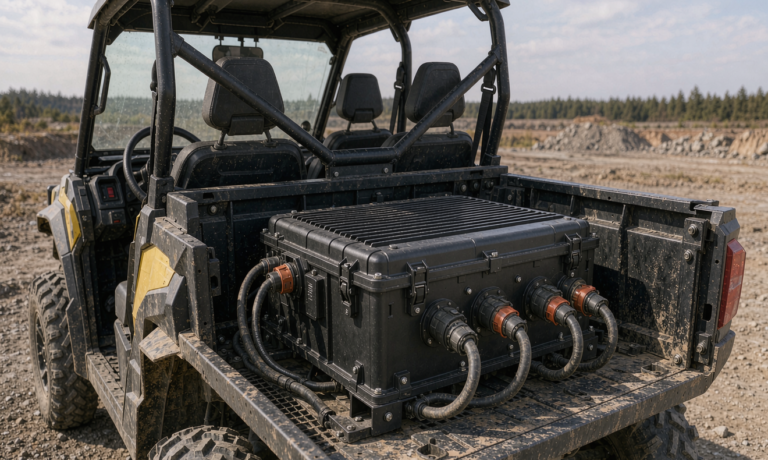
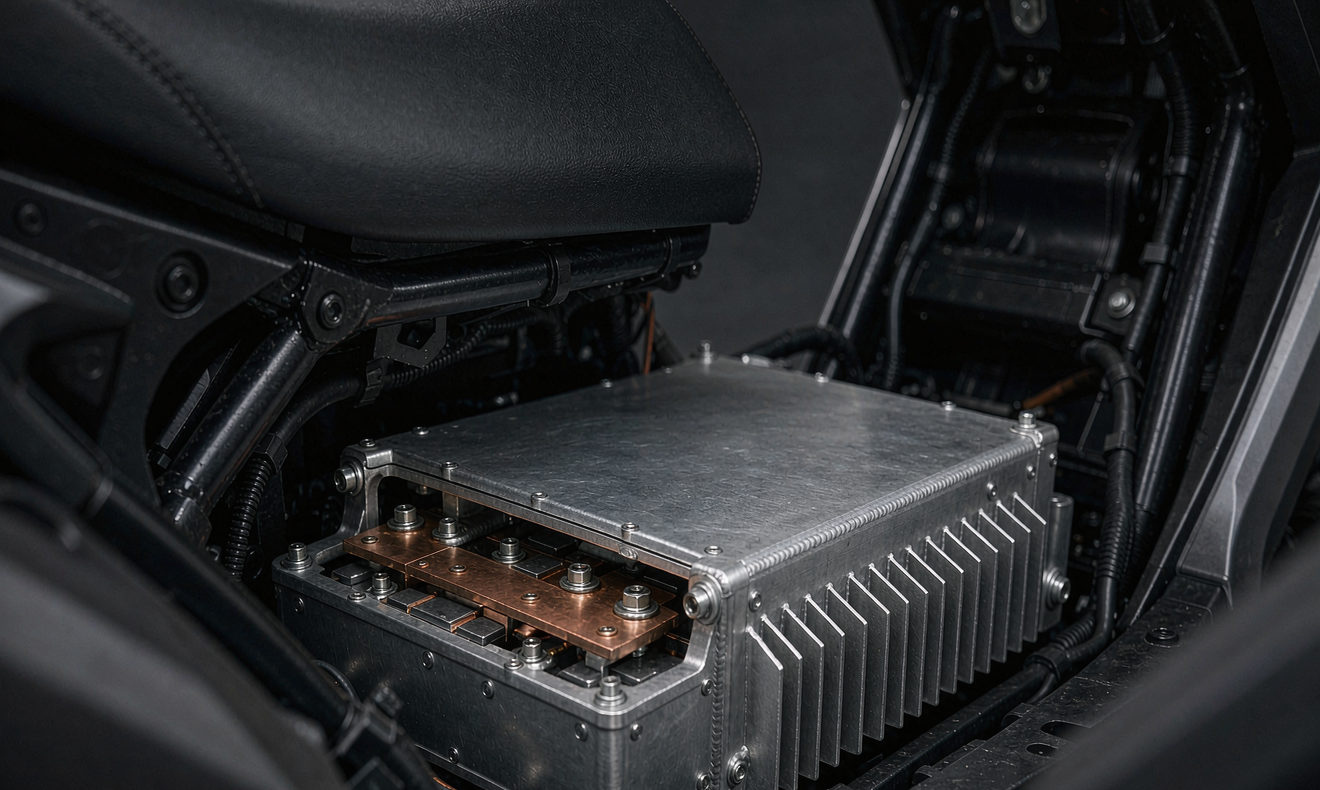
On a street legal electric motorcycle the battery is usually a structural member of the machine. It fills the down tube, clamps into the swingarm panniers, or bolts under the seat pan ahead of the rear wheel. In a moped or delivery scooter the pack lives in the floorboard, in the leg shield, or in a removable box in the underseat well. Each location moves the same heat into a different place, and each one changes how much vibration the pack sees.
Frame-mounted packs are long and thin, fine for capacity but bad for stiffness. A swingarm pack bridges a rotating member, so the cell holders flex every time the rider shifts weight. In a rental moped covering 150 kilometres a day that is roughly a million load cycles a year on the end plates, which is why I specify glass filled polypropylene or aluminium end plates with elastomer grommets.
What the Mounting Point Does to the Case
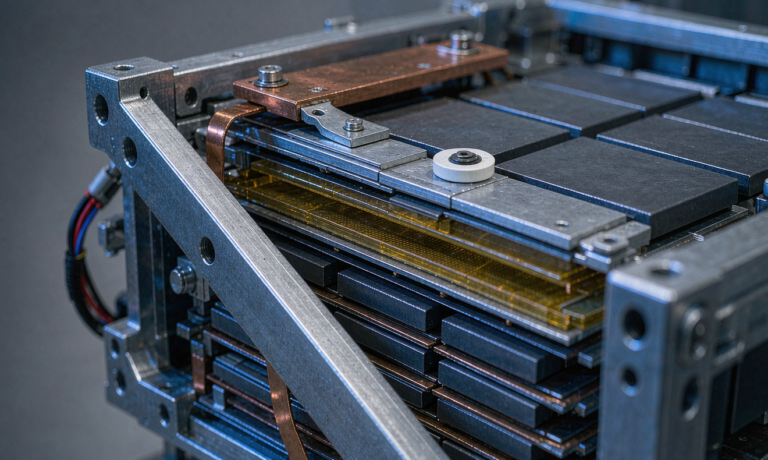
Three constraints follow from the mounting point. The case must carry the load, usually 1.5 to 2.5 millimetres of aluminium or glass filled polymer with M6 inserts. It must seal, because a floorboard pack sits in puddles and a leg shield pack sits in road spray. It must also conduct heat out of the cells, since there is no fan, which means a conduction plate between the module and the wall, radiating at 6 to 12 watts per degree Celsius.
Sizing Voltage and Capacity
Two-wheeler systems run at four nominal levels. A light moped and urban scooter uses 48 volts, a common upgrade is 60, a sport electric motorcycle uses 72 or 96, and heavy trikes and delivery triples run 120. The controller sets the battery requirement, not the other way round: a 96 volt controller drawing 250 amperes needs a pack that holds above 85 percent of nominal voltage at 250 amperes, or the rider sees sag and the controller cuts power early.
Capacity follows the range target. A commuter electric motorcycle needs 4.0 to 6.5 kilowatt hours, a moped 1.2 to 2.4, a heavy delivery scooter 3.0 to 5.0. Real world consumption is 6 to 8 watt hours per kilometre on flat roads, 10 to 14 with a loaded rider and headwind. A 96 volt 45 ampere hour pack holds 4.3 kilowatt hours, which at 7 watt hours per kilometre is 610 kilometres of theory and 400 to 460 of practice.
I size and publish the practical number because a rider planning for theory will drain the pack on a hill and blame the chemistry.
Cells, Chemistry and Continuous Versus Peak Current
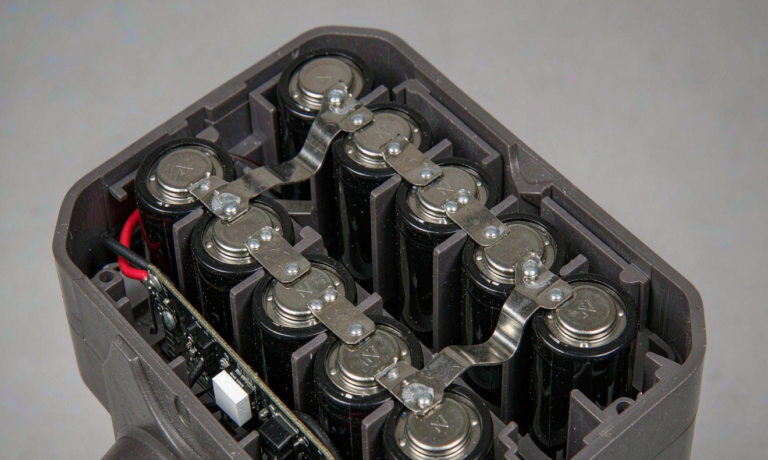
Street electric motorcycles mostly use high rate cylindrical cells, 18650 or 21700 NMC at 3C to 5C continuous. Energy density is the reason: a 21700 high power cell manages 180 to 200 watt hours per kilogram, so a 4.3 kilowatt hour pack weighs 26 to 32 kilograms instead of the 45 to 55 a prismatic LFP pack of the same size would.
Priced per cycle the picture flips. NMC in a two-wheeler gives 600 to 1,200 cycles to 80 percent of original capacity, LFP 3,000 to 6,000. For a fleet moped plugged in 350 nights a year, LFP wins on ownership cost; for a private rider doing 8,000 kilometres a year, NMC wins on weight for the same money.
Peak Power Is the Real Filter
Peak current decides the cell format more often than capacity does. A 0 to 100 kilometre per hour run in 3.5 seconds at 96 volts needs 25 to 40 kilowatts, or 280 to 440 amperes of pack current at 90 percent efficiency, 60 to 90 per cell in a 5S arrangement. A cell at 18 milliohms then drops 1.1 to 1.6 volts, a 10 to 15 percent loss. Sustained 5C also adds 0.02 to 0.04 degrees Celsius per second of internal heating, so a 30 second launch adds 20 to 30. I write the cell spec around the peak, then size the heat path around the average.
Thermal Behavior Without a Cooling Duct
Two-wheeler packs are air cooled by accident rather than design. A swingarm pack gets some airflow from speed, a floorboard pack almost none, an underseat pack gets exhaust gas on one side. My rule is that continuous load must not push the cell surface past 45 degrees Celsius and peak load must not pass 60, with the controller reducing current near either limit.
Sensor Placement and Soak
One NTC per module on the cell surface plus one at the case wall is enough for most machines. The surface sensor reads the real cell temperature, the wall sensor reads what the case sheds, and the delta tells the cooling story: a healthy pack at a steady 30 kilometre per hour urban ride shows 4 to 9 degrees Celsius of spread, and one showing more than 15 degrees at the same load is either losing contact through the conduction plate or suffocating in its own case.
Charging is where thermal design pays off. I allow 0.5C to 1C between 10 and 40 degrees Celsius, derate to 0.05C at 0 degrees, and stop above 45. A moped rack in a tropical depot hits 45 degrees on an afternoon, so a temperature compensated cutoff is the difference between a four year pack and an eight year one.
Charging, Swapping and Fleet Duty Cycles
A moped charger is a small unit on board the vehicle or in the depot wall box. Continuous current runs 3 to 6 amperes on a low voltage moped and 6 to 16 on a 96 volt motorcycle, so a full charge takes 4 to 8 hours at the low end and 1 to 3 at the high end. Fleet planners normally accept a 0.5C top up to 80 percent in 30 to 45 minutes, which protects the cells and turns a moped around between shifts.
Swapping changes the whole electrical architecture. A swappable pack needs a keyed locked connector rated for 250 to 400 amperes, a shrouded DC bus with an interlock that breaks before the contacts part, an RFID or NFC tag so the depot can trace cycles, and mechanical anti rotation. Done properly a swap takes 90 seconds and is the entire business case for a rental moped; done badly it is a spark and a burned connector, which I have seen twice.
Storage is the third duty cycle variable. A moped sitting a month in a winter depot should rest at 30 to 50 percent state of charge, not 100. Calendar fade at full charge and 30 degrees Celsius costs 3 to 5 percent capacity a year that you cannot get back, while self discharge is only 1 to 3 percent a month, so a parked pack loses far more on the bench than on the road.
Certification, Shipping and Warranty
A two-wheeler pack ships as a battery alone or as part of a vehicle, and the paperwork differs. The test baseline is UN38.3, with UN3480 for cells in equipment and UN3481 for packs shipped with the machine, and the design code is IEC 62133-2 for small portable batteries. UL 2271 is the common North American claim for light electric vehicle batteries; spare packs travelling by air fall under IATA Packaging Instruction 965, where a standalone pack must ship at 30 percent state of charge or less. Horizon Power packs ship with the UN38.3 report and a state of charge under 30 percent for freight.
Environment and In Service Checks
Ingress protection is specified against the actual ride, not a marketing number. An under seat motorcycle pack needs IP67 minimum because it will see a pressure washer and a wet road; a floorboard pack needs IP66 at the connector and IP67 at the case; a shielded swingarm pack survives on IP54. Vibration is tested to ISO 16750-3 with random profiles from 10 to 2,000 hertz on three axes, and salt spray to ISO 9227 for 480 to 1,000 hours on exposed metal.
Service practice is short. Torque the busbar bolts to spec and re torque after 50 hours, check insulation resistance to the frame, log capacity yearly, and retire a pack at 70 percent of original capacity or a 30 percent internal resistance rise. A fleet that does that gets 6 to 8 years from NMC and 10 from LFP, which is the number I write into the quotation.
What cell chemistry should a moped fleet choose?
LFP for a fleet charging nightly and running 300 days a year, because 3,000 to 6,000 cycles beats NMC three to five times on cost per kilometre even though the pack weighs 40 to 60 percent more. Choose NMC when the machine must carry 5 kilowatt hours and cannot carry 8, or when acceleration matters more, where the weight saving returns itself as range.
Can I put a 72 volt pack on a 60 volt scooter?
Not safely. A 60 volt controller expects a pack that never exceeds about 75 volts, and a 72 volt pack reaches 84 to 86 volts fully charged, which over voltages the controller and motor. The fix is a pack matched to the controller, never a pack oversized for one.
How long does a lithium motorcycle pack last?
For a private rider doing 10,000 kilometres a year, 5 to 8 years and 800 to 1,500 charge cycles on NMC. For a delivery moped covering the same distance in two years, 4 to 6 years, because deep discharge and daily fast top ups halve the cycle count. The dominant wear factor is not distance, it is how often you charge and how hot the pack runs while charging.
Should a rental moped pack be fixed or swappable?
Swappable if you sell minutes of riding and cannot afford a 4 hour charge window, fixed if you rent by the day and want the pack physically tied to the asset. Swapping adds connector cost, interlock logic and cycle tracking, and it adds a theft target, so the economics only work when turnaround time is the binding constraint.
How should I ship a spare motorcycle pack by air?
Under IATA Packaging Instruction 965 at 30 percent state of charge or less, in a box that prevents movement, with terminals covered and the state of charge marked on the outer package. For a commercial shipment ask the carrier for the lithium battery declaration, since a pack at full charge is refused on a passenger aircraft.
What ingress rating does an under seat pack need?
IP67 as a minimum, because an under seat well collects water from a wet helmet, condensation and road spray, and the case must survive a jet wash at end of life. The pack sits inside the vehicle, so the rating covers splash rather than immersion.
Further Reading
References