Home Battery Insurance and Homeowner Policies
I get the same call every few months. A homeowner has a wall of batteries installed, the crew has gone home, and only then do they think to ask whether the policy still covers the house. The short answer is that a home battery changes how an insurer prices your risk, but it almost never makes the property uninsurable. What it does is move the conversation from generic dwelling coverage to a specific set of questions about listing, placement, and documentation. In this guide I walk through what underwriters actually look at, drawn from the commissioning files and claim reviews I have been involved in over the past decade.
I am Karl Huang, a senior lithium battery engineer. I specify and qualify residential storage systems, and I have sat on both sides of this table: producing the test data an underwriter wants, and helping a customer reconstruct it after an incident. The figures and standards below are the ones that appear in real files, not marketing copies. Treat them as a working checklist rather than legal advice, because rules differ by state and by carrier.
Why Home Battery Insurance Is a Different Conversation
To an insurer, a battery is not another appliance. It is an energy source that can release heat on its own, sit idle for months, and interact with the electrical service and the structure around it. Three risk questions dominate the review. First, fire: can a cell enter thermal runaway and propagate to its neighbors, and will the enclosure contain the event? Second, property: is the unit mounted where a leak, flood, or falling object could damage it or the wall behind it? Third, liability: if the system causes a loss that spreads beyond your property, does the policy respond?
This is why carriers lean on product listings and installation codes instead of taking a installer at their word. Underwriters want to see that the system was tested as an assembly, installed to a recognized code, and inspected afterward. A pack that has never been evaluated as a complete system is a unknowns, and unknowns either raise the premium or trigger an exclusion. My advice to homeowners is simple: decide which documents you can produce before you ask for coverage, not after a loss.
The Paperwork Underwriters Actually Ask For
In the files I have reviewed, the request list is remarkably consistent. Having these in a single folder turns a slow underwriting cycle into a short one.
- System listing. A UL 9540 listing for the complete energy storage system, and ideally the underlying UL 9540A thermal runaway test report that shows fire propagation, flame spread, and off-gas behavior. UL 9540A is the test method carriers reference most when they assess a lithium installation.
- Cell and pack safety certificates. IEC 62619 for industrial and stationary cells, plus UN 38.3 transport test summaries. These do not replace a system listing, but they establish that the cells were qualified rather than assembled from surplus stock.
- Code compliance statement. Evidence the installation follows NFPA 855 for stationary storage and NFPA 70 Article 706, along with any local permit and inspection sign-off.
- As-built documentation. A single-line diagram, equipment serial numbers, the approved site plan, and the commissioning report with measured values.
One practical note. Carriers care far more about a clean, complete folder than about the brand on the door. I have seen a well-documented system from a smaller manufacturer approved quickly, while a premium-brand installation with no permit record stalled for weeks. If your installer will not hand over the commissioning report, that is a warning sign worth taking seriously.
Installation Choices That Change Your Premium
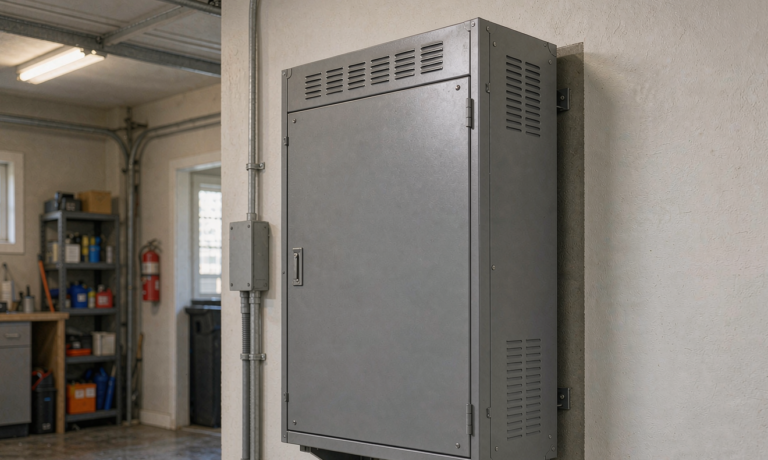
Underwriting is a spatial exercise. Where the unit sits, how much air surrounds it, and what protects it matter as much as the cells inside. Systems placed in an attached garage or a dedicated outdoor enclosure are generally viewed more favorably than units inside living space or a bedroom wall, because a fire has a clearer path to the outside and occupants are not sleeping next to it. Keep the clearances specified by NFPA 855 and the manufacturer, typically including a working aisle and separation from combustible storage. Never box a unit into a closet to hide it.
Detection and suppression help. A listed smoke or heat detector in the room, and in some jurisdictions a UL 9540A-informed suppression or ventilation design, signals that the hazard was engineered rather than ignored. Mechanical ventilation and clear access to the disconnect let a responder isolate the system, which underwriters factor into severity estimates.
Electrical discipline counts too. Correct wire sizing, torque-verified DC terminals, surge protection, and a documented rapid shutdown path reduce arc-fault risk, one of the more common ignition sources in field incidents. Grid-tied systems should follow IEEE 1547 for interconnection. I also tell clients to avoid modifying the enclosure, adding third-party modules, or reconfiguring the battery management system after installation. A field modification can void both the listing and the coverage that depends on it.
What a Claim Requires: Records That Survive the Event
Here is the part homeowners underestimate. After a fire, the physical evidence is often gone. What remains is the paperwork you kept. When I assist with a claim review, the questions are always the same: was the system listed, was it installed to code, and was it maintained? A commissioning report that records measured values answers all three better than a stack of brochures.
A thorough commissioning file includes insulation resistance measured with a 500 volt megger between each polarity and chassis, with a result above 1 megaohm and preferably above 10; a torque log for every DC terminal; a cell-balance reading after a two-hour rest; a capacity check by discharging at 0.2C to the battery management system cutoff and confirming at least 95 percent of nameplate; and a transfer test that opens the main breaker under load and confirms transfer within about 20 milliseconds. I keep a dated photo set of the installation and a simple maintenance log of visual inspections and any firmware updates.
Why does this level of detail matter to home battery insurance? Because it lets an adjuster distinguish a sudden manufacturing failure from gradual neglect or an unauthorized modification. Insurers distinguish those scenarios sharply, and the difference decides whether a claim is paid, reduced, or denied. A dated record protects you in a way that an invoice alone cannot.
Common Coverage Gaps in Homeowner Policies
Most standard policies were written before residential storage was common, so the gaps are predictable. Flood and earthquake damage to the battery are frequently excluded, even when the structure has some coverage, which matters if your unit sits in a basement or a low garage. Some policies treat the battery as a detached structure with a lower sub-limit, leaving you underinsured after a total loss.
Usage changes are another trap. A system installed for backup in an owner-occupied home may be reclassified if you rent the property, run a home business, or add a second rented unit. Second-life or rebuilt packs are a third problem: carriers may decline coverage because the original listing no longer describes what is on the wall. And if you added solar and storage under separate contractors, confirm that both are named and that the policy addresses the interconnection, not just the panels.
Finally, read the deductible and the valuation basis. Replacement cost coverage on a battery that is no longer manufactured may still pay out, while actual cash value will reflect age and depreciation. Ask your broker to put the answer in writing as an endorsement rather than relying on a phone call.
A Practical Checklist Before You Call Your Broker
Work through these steps in order. They are the same ones I give to clients preparing for underwriting.
- Photograph the installed system, the nameplate, the serial number, and the disconnect path, then store the files off-site.
- Request the UL 9540 listing, the permit and inspection record, and the signed commissioning report from your installer.
- Write down the exact model, usable capacity, chemistry, and installer, and keep the firmware version current with a change log.
- Confirm clearances and that no combustible storage has been added near the unit since installation.
- Ask your broker in writing whether the battery is covered for fire, flood, and liability, and whether a business or rental use changes the answer.
None of this is expensive. It is simply the difference between owning a documented system and owning a box on a wall that nobody can verify.
Frequently Asked Questions
Does a home battery void my homeowners insurance?
No. A listed, code-compliant installation rarely causes a policy to be cancelled. The problems arise when the system is unlisted, installed without a permit, or modified after installation. Notify your carrier, provide the documentation, and get the change endorsed in writing.
Do I need UL 9540 to get coverage?
Most carriers strongly prefer it and some require it. UL 9540 evaluates the complete storage system, while UL 9540A supplies the thermal runaway and fire propagation data behind it. A system lacking both is harder to insure and may carry an exclusion.
Does insurance cover a battery that catches fire?
It can, provided the system was listed, installed to code, and maintained. Coverage depends on the policy language and on the evidence you can produce. A commissioning report and inspection record are the strongest support for a claim.
How much does a home battery raise premiums?
There is no universal figure. Insurers respond to the hazard profile, so a listed unit in a ventilated garage with clearances and detection may add little, while an unlisted unit indoors can add substantially or be excluded. Ask for a written quote before you buy.
Are second-life or used batteries insurable?
Often not on standard terms. A rebuilt pack no longer matches its original listing, so carriers may decline or exclude it. If you already own one, disclose it honestly and ask for a specific endorsement rather than assuming it is covered.
What records should I keep after installation?
Keep the listing and cell certificates, the permit and inspection sign-off, the single-line diagram, serial numbers, the signed commissioning report, dated photos, and a short maintenance and firmware log. Store copies off-site or in the cloud so they survive a loss.
The Bottom Line
A home battery is insurable, and usually insurable at a reasonable cost, when you treat documentation as part of the installation. Buy a listed system, install it to code, keep the records, and tell your carrier before you need them. That is the whole strategy, and it costs far less than discovering the gaps after a claim.
Further Reading
References