Lithium Battery Railway Transit System: Engineering Reliable Power for Trains and Metro
Over the past decade I have watched the rail industry shift from a cautious observer of lithium technology to an aggressive adopter. As a Senior lithium battery Engineer at Horizon Power, I have personally signed off on lithium battery packs for metro auxiliaries, battery-electric multiple units, and wayside storage that captures regenerated braking energy. A lithium battery railway transit system is no longer a research prototype — it is a procurement spec on real tenders across Europe, Asia, and North America. In this article I will walk through what actually matters when you design, certify, and deploy these systems, drawing on field data from projects I have been hands-on with.
Why Railways Are Moving Away from Lead-Acid and Diesel
For most of the last century, rolling stock leaned on lead-acid batteries for hotel loads and diesel for traction on non-electrified lines. Both options are now failing operators on cost and emissions. A modern lithium battery pack for rail weighs roughly one-third of an equivalent lead-acid bank, survives 2,000–4,000 cycles versus 300–500 for flooded lead-acid, and can deliver the pulse power needed to restart a traction converter or bridge a gap in the overhead catenary.
The economic case is what closes deals. When a transit agency replaces lead-acid strings every 18–24 months, a custom battery solution built around LiFePO4 chemistry that lasts 8–10 years changes the maintenance budget more than the sticker price does. I have modeled total cost of ownership for three metro depots where the lithium pack paid back in just over three years, after which the savings were pure margin.
Regulation is the second force. Decarbonization targets in the EU, the UK, and several Asian metros now penalize diesel fleets and reward battery or battery-hybrid traction on branch lines. Operators that started piloting a lithium battery railway transit system five years ago are now the ones winning those tenders, while late movers scramble to retrofit. From where I sit, the technology risk has already been retired — the remaining risk is program and integration discipline, not the cells.
Pack Architecture for a Lithium Battery Railway Transit System
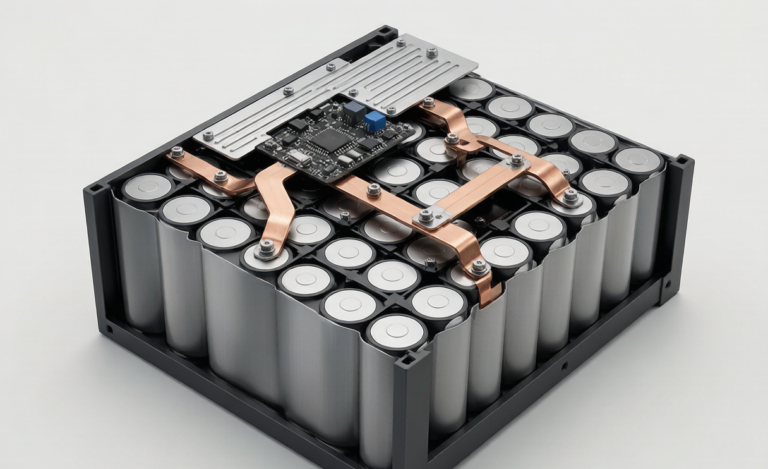
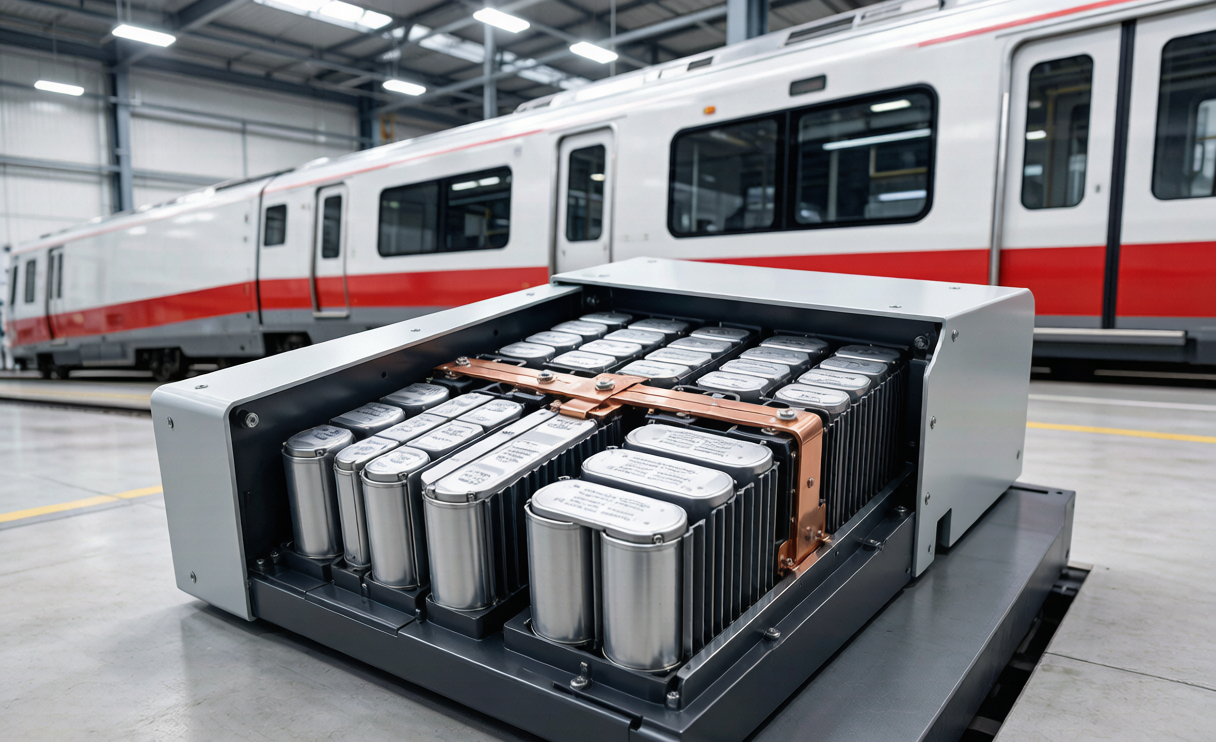
The first decision is cell format. For stationary-ish depot storage and wayside containers, prismatic LiFePO4 cells rated at 100–280 Ah are the workhorse: easy to bolt into racks, low internal resistance, and excellent thermal stability. For underfloor or roof-mounted car-borne packs where volume and mass are tight, we often move to high-energy cylindrical or pouch cells in a lithium battery pack with structural cooling plates.
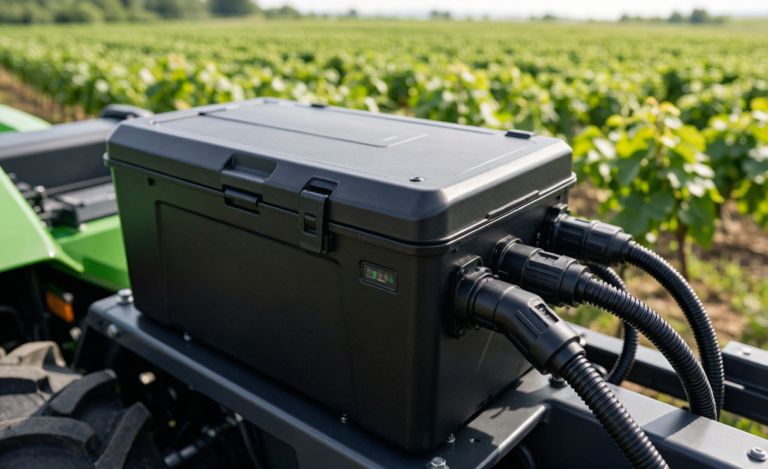
A typical battery-electric multiple unit (BEMU) traction battery I designed ran at a nominal 650 V, built from 204 prismatic cells in a 3P204S arrangement, delivering 180 kWh and sustaining a 3C discharge for acceleration. The enclosure was IP67, shock-rated to IEC 61373 Category 1, and vented through a dedicated duct to keep any thermal event outside the passenger volume. Getting the mechanical integration right is at least half the engineering effort; the cells themselves are a solved problem.
Safety Standards and Certification You Cannot Skip
Rail is unforgiving on safety documentation, and rightly so. Every pack we ship as part of a lithium battery railway transit system starts with UN38.3 transit testing — altitude simulation, thermal test, vibration, shock, external short circuit, impact, overcharge, and forced discharge. That is the baseline for moving cells by air, sea, or rail across borders.
For cell-level safety we design to IEC 62133, the international standard for portable secondary cells, and to IEC 62619 for industrial stationary applications. Transit packs also reference IEC 62928 (railway applications — rolling stock batteries) and EN 50604 for lithium traction batteries in rail. Because many of our production lines also feed aviation and UAV programs, the same cell batches carry FAA and EASA documentation, and transit operators increasingly ask to see that paperwork as proof of disciplined quality control. I always tell clients: certification is not a checkbox, it is the risk record that lets you sleep at night when a train is carrying 800 people.
Sizing Energy and Power for Real Duty Cycles
Sizing is where junior engineers get burned. You do not size a rail battery on nameplate capacity alone; you size it on the duty cycle. For a wayside energy storage unit capturing regen braking, the limiting factor is power density and cycle life under shallow, frequent cycling — a 2C to 4C capable lithium battery with a conservative depth of discharge of 20–30% will outlive a bigger pack cycled deep.
For a BEMU running on a 40 km non-electrified branch, the constraint is energy per charge and the ability to accept regen. I typically model the route in 1-second steps, summing acceleration peaks and recovery, then add 25% margin for winter heating and battery degradation. A custom battery solution that matches the actual route profile beats a generic off-the-shelf pack every time, and it is lighter because you are not over-provisioning blindly.
Temperature derating is the part novices forget. A cell rated for 180 Wh/kg at 25 °C may only deliver 70% of that at −20 °C, and charge acceptance collapses even faster. On northern lines I size for the worst-month mean temperature and add cabin or pack pre-conditioning, which is cheap compared with stranding a train mid-route. This is why a static datasheet number is useless without the climate the pack actually lives in.
BMS and Thermal Management for Transit-Grade Packs
A rail BMS is not the $10 board you put in a power tool. It must be redundant, fault-tolerant, and communicate over the train network — usually MVB or Ethernet Train Bus, with CAN as a fallback. In the packs I specify, we run dual independent BMS controllers with a heartbeat between them; if one drifts, the other isolates the pack before a single cell reaches its upper threshold.
Thermal management is the other half. LiFePO4 is tolerant, but a lithium battery pack under a 3C traction load still sheds heat, and a sealed rail enclosure has no easy airflow. We use liquid cooling plates sandwiched between modules for traction packs, and forced-air or passive convection for depot storage. The rule I enforce: keep cell-to-cell temperature spread under 5 °C. Above that, the weakest cell ages fastest and drags the pack down.
Field Lessons and Lifecycle Maintenance
After commissioning, the real education begins. On one metro line, we saw early capacity fade traced not to the cells but to a connector torque spec that was never tightened to the documented 4 N·m — a classic installation gap. We now ship a torque checklist and a commissioning app that records every bolt. On a BEMU trial in a cold region, pre-heating the pack before fast charging cut charge time by 18% and kept calendar aging in spec.
My maintenance guidance to operators is consistent: monitor delta-SOC and internal resistance trend, not just voltage; schedule capacity checks at 500-cycle intervals; and keep the BMS firmware under change control. A well-run lithium battery railway transit system will deliver 80% capacity retention past 3,000 cycles, which on a typical metro duty translates to roughly eight to ten years of service.
Frequently Asked Questions
What battery chemistry is best for railway transit systems?
For most auxiliary and traction applications, LiFePO4 (LFP) is my default because of its thermal stability, long cycle life, and tolerance to abuse. Where energy density drives the design — roof-mounted packs on lightweight trains — nickel-manganese-cobalt (NMC) or the newer semi-solid cells earn their place despite higher safety overhead. The choice is a trade between safety margin and mass budget.
How do you certify a lithium battery for rail use?
Certification stacks several standards: UN38.3 for transport, IEC 62133 and IEC 62619 for cell and system safety, IEC 62928 and EN 50604 for rail-specific batteries, plus local rail authority acceptance (for example TSI in the EU or UIC guidance). Our aviation-qualified lines also carry FAA and EASA records, which many operators accept as additional quality evidence. Plan for 8–14 weeks of testing before you promise a delivery date.
What is the typical lifespan of a transit lithium battery?
A properly managed LFP pack in transit service typically reaches 80% state-of-health after 3,000–4,000 equivalent full cycles, or about eight to ten years of metro duty with 20–30% depth of discharge per cycle. Calendar aging adds a slow drift, so I budget a 10–15% capacity reserve at end of life and verify it during scheduled capacity checks.
Can lithium batteries fully replace diesel on non-electrified lines?
Yes, on many branch and feeder lines, and it is already happening. A battery-electric multiple unit with a route-matched custom battery solution and opportunity charging at terminus stations can replace diesel on lines up to roughly 40–80 km between electrified nodes, depending on gradients and winter load. For longer lines, a hydrogen or diesel range-extender hybrid remains the pragmatic bridge.
If you are specifying power for a new or retrofit rail program and want a custom battery solution matched to your actual duty cycle, that is exactly the kind of engineering we do at Horizon Power. The difference between a pack that lasts a decade and one that fails in three is almost never the cells — it is the architecture, the BMS discipline, and the certification rigor behind it.