Sodium-Ion Battery Water-Based Electrode Processing
Water-based electrode processing keeps coming up because it removes the most expensive and most regulated fluid on the coating line. I have run NMP and aqueous coating on the same pilot coater, and my first attempt to move a hard carbon anode to water produced an electrode that looked perfect under the microscope and delaminated in the calender. The chemistry is simple. The water is not. This guide covers what actually changes when sodium-ion battery water-based electrode processing replaces solvent coating: binder system, foil corrosion, drying energy and the traps that simply do not exist on a lithium graphite line.
What Actually Changes When You Replace NMP With Water
N-methyl-2-pyrrolidone boils at 202 degrees Celsius with a surface tension near 40 mN/m. Deionised water boils at 100 degrees Celsius and sits near 72 mN/m. Those two numbers explain most of the surprises on a converted line, because they change how the slurry wets the foil and how much energy it takes to remove the carrier afterwards.
Surface tension and wetting
Aqueous slurries resist spreading on low-energy surfaces. Bare aluminium and copper foil are oxide-terminated and generally wet well, but carbon-coated foil, primer layers and oily residue from slitting behave badly. We measure contact angle on incoming foil and reject above roughly 30 degrees, where coating shows pinholes and cratering that survive calendering. A 0.1 to 0.3 weight percent wetting agent fixes most cases, but raises the foam tendency, so pair it with vacuum mixing and a short degassing hold before the slot die.
Evaporation energy is not the whole story
Water has a latent heat of 2257 kJ/kg against 533 kJ/kg for NMP, and an aqueous slurry carries far more carrier per kilo of dry coating, because solids content runs 40 to 55 percent instead of 65 to 70. Per kilo of dry electrode we therefore evaporate roughly ten times the latent heat. The saving comes from deleting the recovery train: an NMP line needs condensers, a distillation reboiler and recovered-solvent storage, while a water line vents water vapour and recovers sensible heat only. On our pilot line total coating energy fell 18 percent after conversion, even though the dryer grew by one zone and runs 20 to 25 percent longer.
Binder Chemistry: CMC, SBR and the Adhesion Window
Sodium-ion electrodes in water almost always use a two-component binder: sodium carboxymethyl cellulose as thickener and styrene-butadiene rubber emulsion as the elastic component. CMC grades with a degree of substitution between 0.7 and 1.2 give a 1 percent solution viscosity of 2000 to 6000 millipascal seconds, the workable band for slot die coating.
Loadings that have held up on hard carbon anodes are 1.0 to 1.8 percent CMC and 2.0 to 4.0 percent SBR by dry weight, so 3 to 8 percent total binder. CMC alone dries into a brittle film that cracks at the drying zone exit. Excess SBR raises adhesion at first and then costs you twice: it insulates particle-to-particle contacts, raising direct current internal resistance, and it blocks pores enough to hurt rate capability.
Read a peel test, not a certificate
We run a 180 degree peel on a 25 mm strip every shift, on coated and calendered samples separately. For hard carbon on copper we require 15 N/m minimum after calendering, with anything below 10 N/m as a stop condition. Adhesion often looks fine before the calender and fails after it, because compaction closes the interparticle gaps that were carrying the peel load. Test calendered samples, not green coating.
Foil Corrosion: pH Is the Number Nobody Logs
CMC is a sodium salt and aqueous slurries made with it land between pH 8 and pH 10. That is fine for copper in most cases, but it moves aluminium toward the top of its passive window, roughly pH 4 to 9 for an oxide-protected surface. Above pH 9 the oxide layer dissolves, and the failure appears as pitting under the coating that surfaces weeks later as a soft short or a capacity step.
For layered oxide cathodes the problem is worse and comes from the material, not the binder. Sodium layered oxides are hygroscopic and their surfaces carry residual sodium hydroxide and sodium carbonate from synthesis. We have measured pH above 12 when an uncoated layered oxide powder was dispersed in pure water. That is a corrosion environment and a structural problem at the same time, because the same residual alkali keeps reacting with water and carbon dioxide at the particle surface.
Slurry pH and dwell time limits
We control three things on every batch: slurry pH to 7 to 9 with a weak organic acid addition, mixing and holding time below four hours, and the interval between coating and entering the first drying zone under two minutes. Longer dwell means more time for oxygen-driven copper corrosion and for aluminium dissolution, and the defect is not recoverable by drying.
Drying Profile and Binder Migration
Water-soluble CMC moves during drying. As water leaves the wet film, convective flow carries dissolved binder toward the evaporating surface, leaving the interface next to the foil binder-poor. On our first aqueous hard carbon run we started the dryer at 110 degrees Celsius and watched peel strength fall from 18 N/m on green coating to 9 N/m after calendering, with a visible binder-rich skin. A four-zone profile starting at 60 to 70 degrees Celsius with low air velocity, stepping to 95 to 110 degrees Celsius, brought the same formulation back to 20 N/m.
Humidity control in the later zones matters as much as temperature. If the drying air is not dehumidified, the final zone delivers moist air onto a nearly dry film and re-wets it. We hold supply air dew point below minus 20 degrees Celsius in the last two zones and measure residual moisture by Karl Fischer titration with furnace extraction at 150 to 180 degrees Celsius. The specification is 300 ppm maximum, with 500 ppm accepted only for cells that get a post-assembly vacuum dry.
Sodium-Ion Specific Traps
Hard carbon brings two quirks. Its surface chemistry makes slurry pH drift upward during mixing, and its angular, hard particles wear slot die lips faster than graphite does, so we shorten die inspection intervals and check the coating weight profile every shift. Volume change on cycling is modest, 2 to 5 percent, which is why the adhesion requirement can be met with less SBR than a silicon-blended anode needs.
Prussian blue analogue cathodes are the opposite case. They are made in aqueous solution, which makes them sound like a natural fit, but the lattice water that survives synthesis is what degrades low-temperature behaviour, and the framework is not stable at high pH. Dispersing one in a CMC system at pH 10 dissolves surface iron and shifts the counter-ion balance. For these cathodes we either buffer to near neutral with a low-pH binder system or keep them on solvent processing.
Where aqueous processing must stop
Water-based electrode processing applies to the liquid-electrolyte sodium-ion battery. It does not belong near sulfide solid electrolytes, sodium metal or semi-solid chemistry lines, all of which live behind dry room boundaries for good reason. Sharing a mixer or transfer line between an aqueous cathode line and a sulfide line is the fastest way to destroy a solid-state electrolyte, and no cleaning protocol makes that safe in my experience.
Line Conversion: What Has to Change on the Coater
Two material changes are non-negotiable. First, replace the solvent hardware: NMP-rated seals and pump parts give way to alkaline-resistant elastomers, and the recovery condenser skid is replaced by an exhaust heat exchanger that preheats make-up air. Second, add a deionised water supply at 10 to 18 megohm-cm resistivity with a closed loop back to the mixer, because tap water carries calcium and chloride straight into your electrode and your corrosion budget.
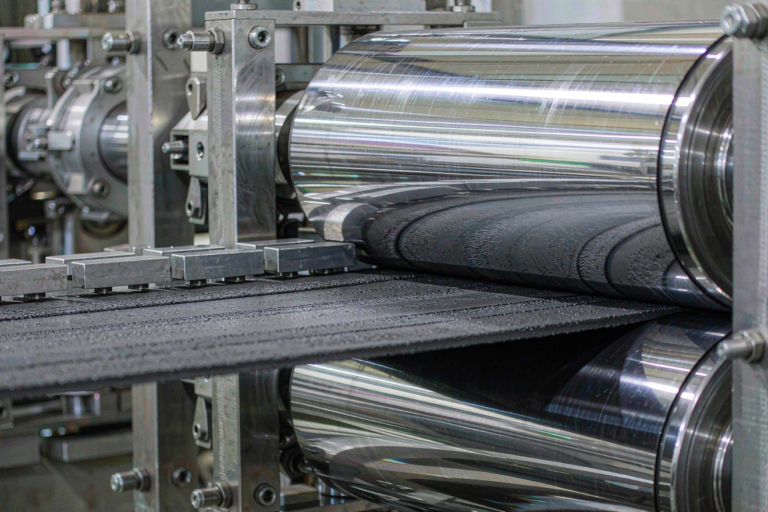
Then expect to rework the dryer. Water vapour removal needs higher air volume than solvent vapour removal, so ducts, fans and the exhaust stack usually grow even when total heat input falls. Slot die geometry also changes, because the meniscus at a water-based coating bead is not the same as a solvent bead; most suppliers will reshim rather than replace the die.
One capex item disappears entirely. NMP drying must be managed as a combustible vapour hazard inside the dryer enclosure. An aqueous line does not, so the area classification and instrumentation on the converted dryer are simpler and cheaper.
Commissioning checklist
- Slurry solids, viscosity and pH recorded for every batch, with a pH specification of 7 to 9 and a corrective acid addition procedure.
- Coating weight profile within plus or minus 1.5 percent across the web, verified on a first-article run and every shift afterwards.
- Peel strength on green and calendered samples, 15 N/m minimum for hard carbon on copper.
- Residual moisture by Karl Fischer titration, 300 ppm target, 500 ppm absolute maximum.
- Pinhole and defect inspection after calendering, with a scrap rule for any pinhole that spans the electrode width.
- Dwell time from coating head to first zone logged per roll, under two minutes.
- Exhaust dew point trend in the final two zones, with an alarm at minus 15 degrees Celsius.
None of this is exotic equipment, but the discipline differs from solvent processing, where a small pH drift or a slower line speed rarely matters. In water, a two hour delay in a holding tank is a corrosion test you never asked to run. For anyone planning a sodium-ion battery water-based electrode processing line, my advice is to convert one pilot coater completely and generate twelve months of adhesion and moisture data before committing a production line, because the failure modes appear on the calendar, not on the coater.
Frequently Asked Questions
Can sodium-ion layered oxide cathodes be processed in water?
Only with a coated, moisture-resistant grade and controlled pH. Residual sodium hydroxide and carbonate on the powder surface can push slurry pH above 12, corroding aluminium foil and damaging the active material. If your supplier has no grade qualified for aqueous processing, keep layered oxides on solvent processing.
Why does my water-based hard carbon anode lose adhesion after calendering?
Two causes dominate. Binder migration during drying leaves the foil interface binder-poor, so green peel looks acceptable until compaction closes the interparticle gaps, and an over-aggressive first drying zone accelerates that migration. Rebuild a warm first zone at 60 to 70 degrees Celsius and confirm on calendered samples.
Is water-based processing cheaper than NMP for sodium-ion cells?
On our pilot line, total coating area energy dropped 18 percent even though the dryer grew by a zone, because the solvent recovery train disappears. The larger saving is regulatory and operational. NMP is a reproductive toxicant subject to workplace exposure limits, while water needs no recovery, no distillation and no combustible vapour classification inside the dryer.
Do I still need a dry room for aqueous electrode processing?
No for the coating line, because you are deliberately adding water. Yes for everything downstream that touches water-sensitive sodium-ion chemistry, including cell assembly and electrolyte filling, and absolutely for sulfide solid electrolytes or sodium metal, which must never share a room, a mixer or a transfer line with an aqueous process.
How do I control slurry pH in a CMC system?
Measure on every batch, not on exceptions. Hold the mix between pH 7 and pH 9 with a small weak organic acid addition, cap mixing and holding time at four hours, and keep coated web flowing into the first drying zone within two minutes. Logging pH alongside viscosity is the single cheapest corrosion control available on an aqueous line.
What residual moisture should a water-processed sodium-ion electrode have?
Target 300 ppm by Karl Fischer titration with furnace extraction at 150 to 180 degrees Celsius, and treat 500 ppm as the ceiling. Water-processed electrodes start from a higher moisture baseline than solvent-processed ones, so the dehumidified final drying zones and the post-assembly vacuum dry both have to be specified before you run the first cell.
Further Reading
References