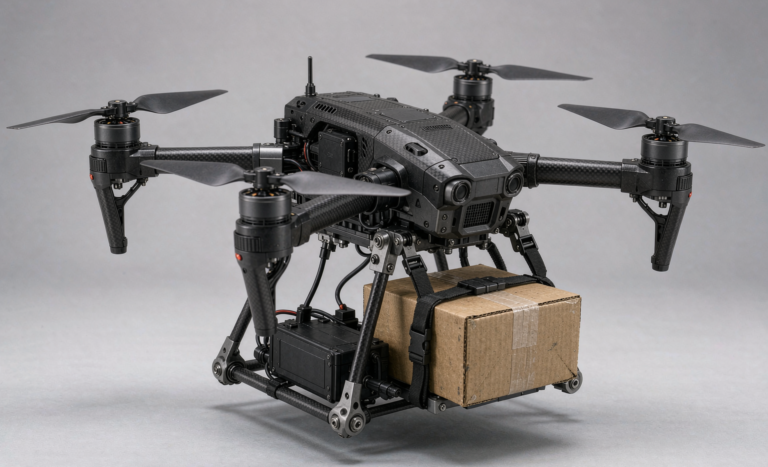
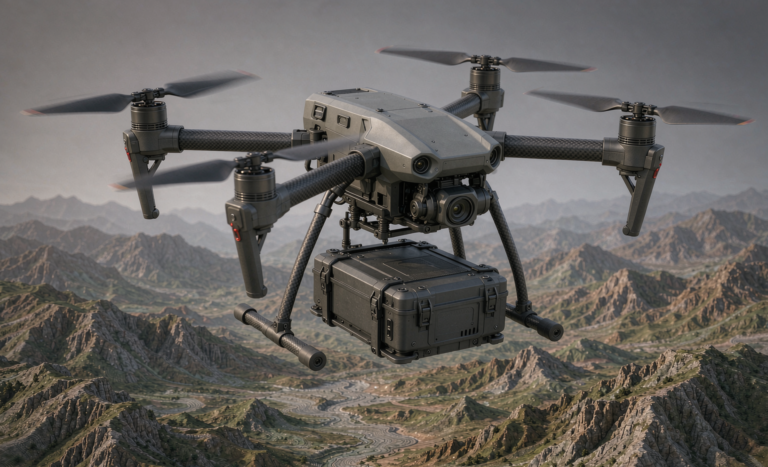
Custom Drone Battery for Defense and Industrial UAV Programs
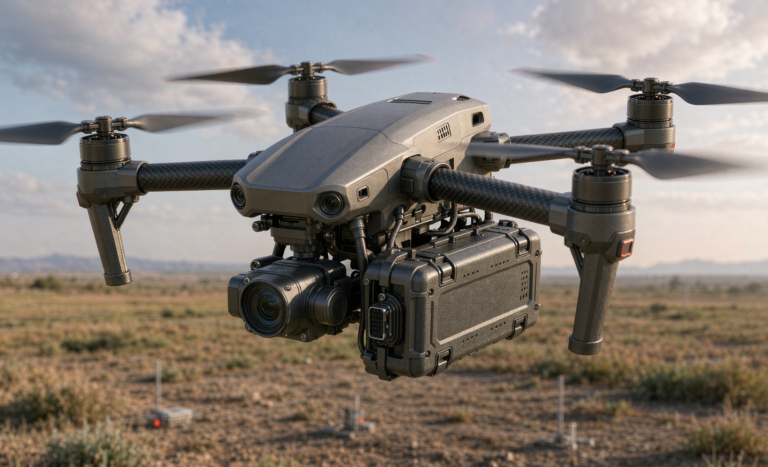
When a procurement officer at a defense agency or an operations lead at an energy utility asks me to specify power for a new unmanned aircraft, the conversation never starts with a catalog number. Off-the-shelf packs are built for consumer quadcopters that fly for twenty minutes over a park. Defense and industrial UAV programs operate in a different universe: EMTAR-certified borders, offshore wind farms, pipeline corridors, and disaster zones where a single battery failure is not an inconvenience, it is a mission loss. In my fifteen years designing lithium packs at Horizon Power, the lesson repeats itself — a custom drone battery is not a luxury, it is the only way to meet the duty cycle, the thermal envelope, and the certification burden these programs demand. This guide walks through how I approach a defense or industrial UAV power specification from the first RFQ line to the final flight-qualified pack.
Why Off-the-Shelf Packs Fall Short for Mission-Critical UAVs
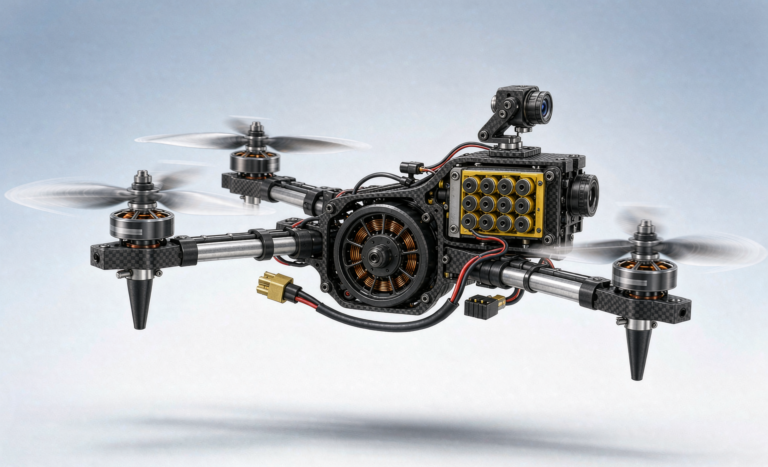
A standard drone battery is optimized for three things: low cost, light weight, and a respectable marketing flight time on a calm day. Industrial and defense programs break all three assumptions. A pipeline-inspection fixed wing may need to loiter for ninety minutes in a temperature swing from minus ten to plus forty degrees Celsius. A counter-UAS interceptor may need a sustained 15C discharge that would melt a consumer pack’s interconnects within two flights. A naval reconnaissance UAV may need conformal sealing against salt fog and pressure cycling that no shrink-wrapped pack will survive.
The core problem is that consumer packs are a compromise product. They trade cycle life, abuse tolerance, and connector quality for price. When I brief a new program, I tell the customer plainly: if the aircraft carries sensors worth more than the airframe, or if a lost link means a lost mission, you do not buy a pack off a shelf — you commission a custom battery solution where every cell, busbar, and firmware parameter is chosen for your flight profile.
Locking Down the Performance Spec in the RFQ
The single most common failure I see in early programs is a vague requirement. “Make it fly longer” is not a specification. A workable RFQ for a defense or industrial drone lithium battery must state, at minimum:
- Nominal voltage and configuration. 6S (22.2V), 12S (44.4V), or higher for heavy-lift airframes. The BMS and motor controller must agree before we build a single prototype.
- Usable capacity in watt-hours, not just amp-hours. I always size to the depth-of-discharge the chemistry can sustain — typically 80% for NMC, 90% for LFP — and I discount for cold-temperature capacity fade.
- Peak and sustained discharge rate. Heavy-lift and high-g maneuvering need a stated C-rating with a thermal limit, not a best case from a cell datasheet.
- Operating temperature range. Define the cold-start floor and the maximum pack temperature under sustained load.
- Cycle-life target. Industrial fleets budget on cost per flight hour, so I price the pack against a 500 to 1,000-cycle expectation at the stated DoD.
At Horizon Power we translate these lines into a cell shortlist — usually high-rate NMC for endurance-and-power blends, or LFP where safety and cycle life dominate over energy density. The right lithium battery chemistry choice here sets the ceiling for everything that follows.
Thermal Management and Environmental Sealing
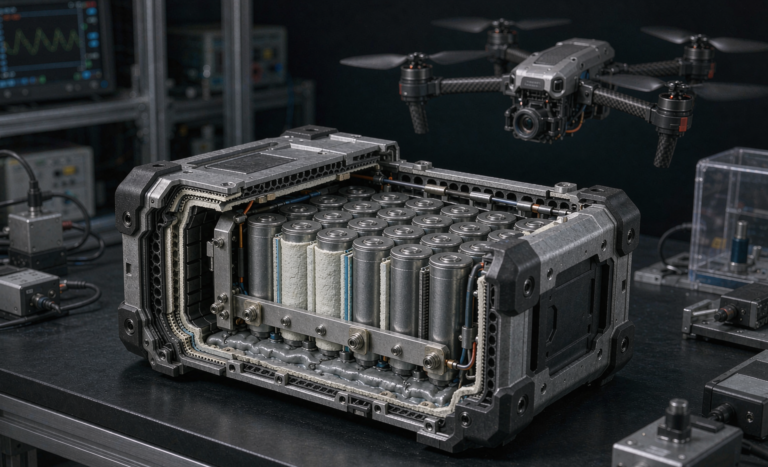
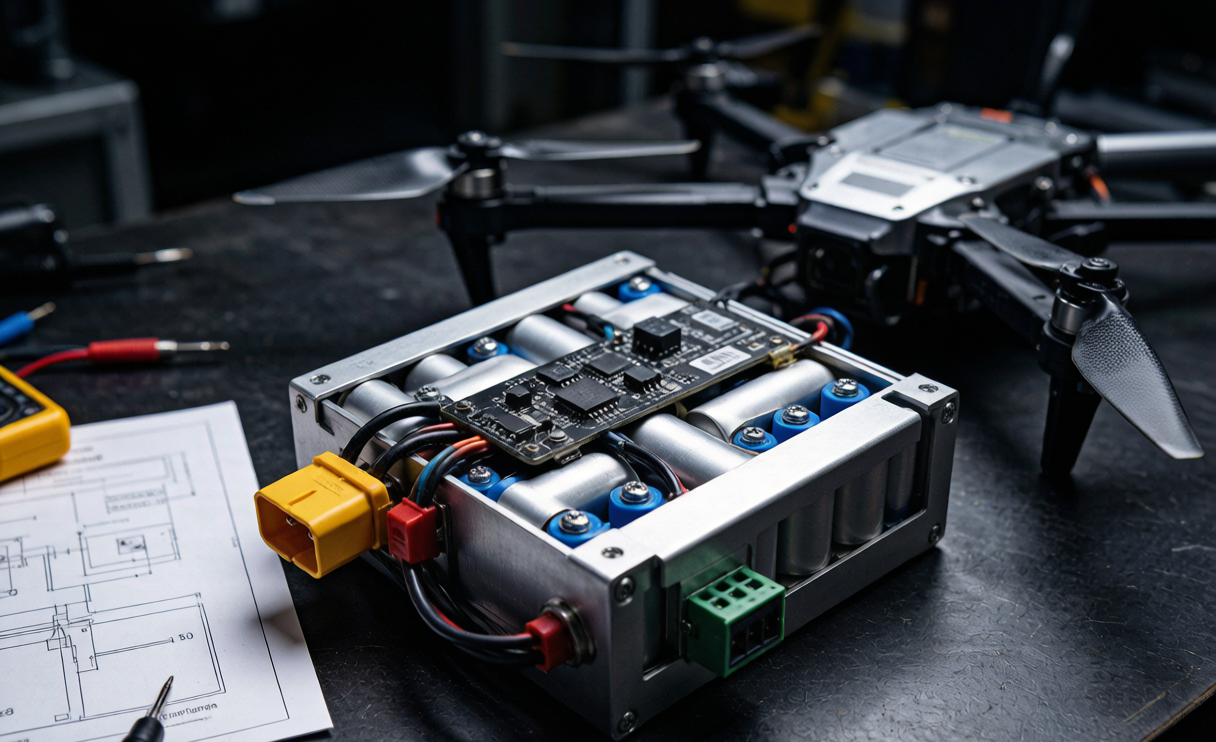
Defense and industrial UAVs rarely fly in a lab. Desert operations push pack temperature toward the cell’s thermal knee; alpine and maritime missions push the other way. For any program that leaves the tarmac, I specify at least one of three mitigations: a passive aluminum housing with calculated fin area, a soft-start discharge curve in the BMS that limits C-rate until the pack warms, and for sealed airframes, a conformal potting grade rated for the service environment.
Environmental sealing deserves its own engineering note. IP ratings on a custom drone battery are not decorative. For ground-handling robustness I target IP54 as a floor; for maritime or wash-down industrial use I push to IP67 with pressure-equalized vents. We validate sealing with a dunk and a temperature-cycling test before the pack ever sees an aircraft. A leaking pack in a defense program is a security and safety incident, not a warranty claim.
Certifications: UN38.3, IEC 62133, and the Program-Specific Layer
Every lithium aviation pack I ship carries UN38.3 test documentation — altitude simulation, thermal test, vibration, shock, external short circuit, impact, overcharge, and forced discharge. For programs sold or operated in Europe, IEC 62133 is the baseline for portable cell safety. These are non-negotiable for air transport under IATA and for civil aviation authority acceptance.
Defense programs add a layer the consumer world never sees. Depending on the customer, we support MIL-STD-810 environmental qualification, EMI/EMC limits for onboard electronics, and country-specific airworthiness evidence for fixed-wing ISR aircraft. Civil industrial UAVs in the EU fall under EASA operational rules; in the US, FAA Part 107 and Part 137 (for agricultural) shape what battery documentation the operator must carry. I treat these as design inputs from day one, not as paperwork bolted on at delivery. A custom battery solution that ignores the certification path costs the program months at the worst possible moment.
BMS and Telemetry for Mission-Critical Fleets
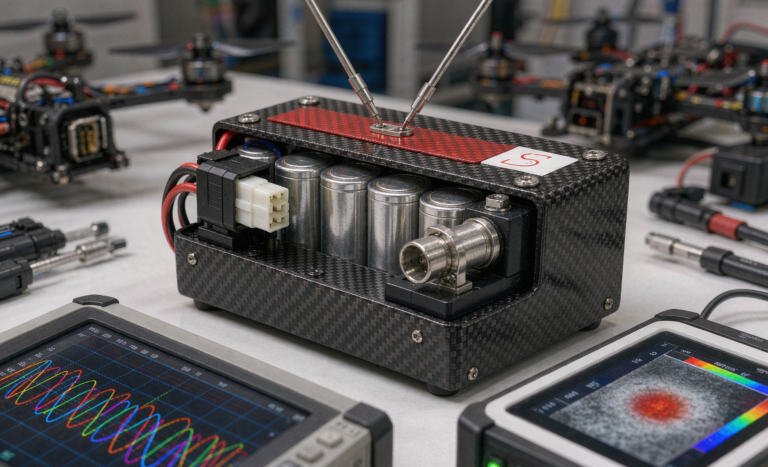
A defense or industrial drone lithium battery is only as trustworthy as the brain watching it. For these programs I never ship a passive protection circuit module alone; a full BMS with gas gauging, cell balancing, and a documented SMBus or CAN bus telemetry stream is the standard. The operator’s ground control station should see state-of-charge, cell-level voltage spread, pack temperature, and cycle count in real time.
Two features pay for themselves quickly. First, a flight-termination-safe disconnect that isolates the pack on a fault without dropping the airframe uncontrolled. Second, a tamper-evident firmware signature so the pack’s logic cannot be reflashed in the field — a real requirement for defense custody chains. We log every charge and discharge event to non-volatile memory so fleet managers can pull state-of-health before a mission, not after a failure.
Sourcing the Build and Validating the Program
Selecting a manufacturer for a defense or industrial UAV pack is a qualification exercise, not a purchase. I look for documented cell grading and sorting (so pack-to-pack variance stays under 10 millivolts at rest), a formation and aging process that screens weak cells before assembly, and a traceability system that ties every pack back to its cell lot and test record. For programs with supply-chain sensitivity, I map the bill of materials to dual-sourceable cell lines so a single vendor disruption cannot ground the fleet.
Validation follows a staged path: EVT to prove the electrical design, DVT to prove it survives the environment, and PVT to prove it can be built consistently at volume. A typical custom drone battery program from signed RFQ to flight-qualified production runs twelve to twenty weeks, faster when the airframe is already in service and we are replacing an underperforming pack. I always budget a pilot batch of ten to twenty units for field trials before committing to a production order — the field finds what the lab misses.
Frequently Asked Questions
What capacity drone battery do defense UAVs typically need?
It depends entirely on the mission profile, but most medium fixed-wing ISR airframes I support run between 10,000 and 30,000 mAh at 6S to 12S, which translates to roughly 250 to 1,300 watt-hours. The right number comes from your endurance requirement divided by your airframe’s power curve, discounted for cold-weather fade — never from a catalog default.
How do you size a custom drone battery for industrial inspection?
I start from the loiter time and payload, then add margin for wind and a defined reserve — usually 20% remaining capacity at planned landing. For a 60-minute pipeline survey I typically specify an LFP or blended NMC pack sized to 90% depth-of-discharge at the expected average discharge rate, with the BMS capped to protect cycle life.
Are custom drone batteries allowed on certified or regulated aircraft?
Yes, provided they carry the required evidence: UN38.3 for transport, IEC 62133 for cell safety, and any program-specific airworthiness or EASA/FAA documentation the operator’s regulator requires. A properly documented lithium battery pack is fully compatible with civil and defense UAV operations.
What certifications matter most for a defense UAV battery?
UN38.3 and IEC 62133 are the universal baseline. Defense programs usually add MIL-STD-810 environmental testing, EMI/EMC compliance, and a documented custody and firmware-integrity chain. I treat all of these as design inputs from the first prototype, not late-stage paperwork.
How long does a custom drone battery program take?
From a signed, detailed RFQ to flight-qualified production, plan on twelve to twenty weeks across EVT, DVT, and PVT, plus a pilot field batch. Programs replacing an existing underperforming pack on a flying airframe move faster because the integration risk is already understood.
How do you extend the cycle life of an industrial UAV battery?
Three levers do most of the work: cap depth-of-discharge around 80 to 90% depending on chemistry, keep the pack within its specified temperature window with active or passive thermal management, and use a BMS with accurate balancing and state-of-health logging so weak cells are caught before they cascade. A well-managed custom battery solution routinely reaches 800 to 1,000 cycles in fleet service.