Drone Battery for High-Altitude Flight
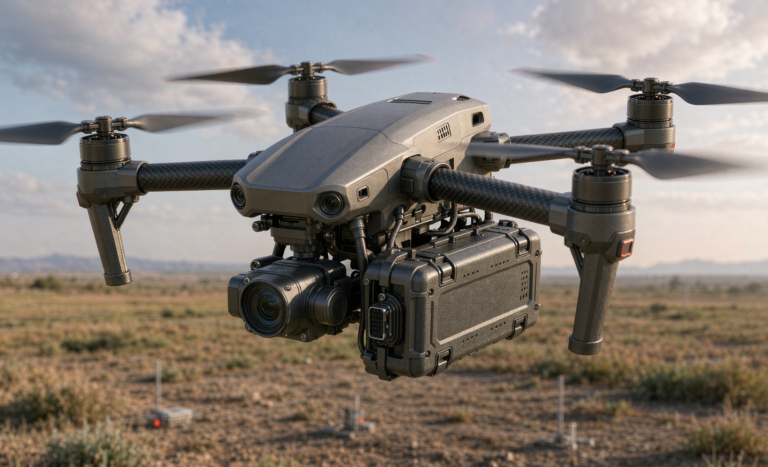
When a client first asked me to qualify a drone battery for operations above 4,500 meters, I assumed the hard part would be the cold. It wasn’t. The harder problem was the air itself. At altitude, reduced air density does two things to an aircraft at once: it steals rotor lift, forcing the motors to pull more current to stay airborne, and it removes convective cooling, letting a hard-working pack run hotter than it would at sea level. After fifteen years designing lithium packs for aerospace and industrial UAV programs, I have learned that “drone battery high altitude performance” is less about a single specification and more about how chemistry, thermal design, and certification interact when the atmosphere gets thin. In this field guide I will walk through what actually changes at altitude, how I specify a drone lithium battery for thin-air missions, and where a custom battery solution earns its keep.
Why Thin Air Rewrites the Battery Equation
The first misconception I have to correct is that altitude only matters because it is cold. Yes, temperatures at 5,000 meters can sit at -20°C, but the density-altitude effect is independent of temperature. As air density drops, a multirotor needs higher rotor RPM and greater pitch to generate the same thrust. Higher RPM means higher motor current, and higher current means higher I²R losses in the pack. In my bench testing, a pack that delivers 22 A comfortably at sea level can be asked for 30–34 A at the same airspeed and payload once density altitude climbs past 3,000 meters. That 40–50% current spike is what kills endurance and, if the pack is not designed for it, what triggers protection trips.
This is why I treat high-altitude work as a discharge-rate problem first and a temperature problem second. The lithium battery you choose has to sustain the burst C-rate without voltage collapse, because voltage collapse at altitude is not recoverable the way it is on a calm day at the field.
Where the extra current actually goes
Break the load down and you see it clearly: hover alone rises, but the real killer is attitude correction. In thin air the aircraft is constantly fighting a softer response curve, so the ESCs modulate harder and more often. A BMS that logs this sees duty-cycle spikes that simply do not appear in lowland flight logs.
Cell Chemistry: What Holds Up Above 3,000 Meters
For high-altitude airframes I almost always start with an NMC or NMC-blend drone lithium battery because the energy density buys back the mass penalty of the extra cells you need for altitude margin. LFP is safer and longer-lived, but its lower specific energy means you carry more grams for the same watt-hours, and at altitude every gram costs you rotor headroom.
That said, LFP has a place. For fixed-wing survey platforms that cruise rather than hover, the lower discharge stress lets LFP’s cycle-life advantage shine, and its superior thermal stability is a genuine comfort when you are operating near flammable material on a remote ridge.
Semi-solid state on the horizon
I have qualified early semi-solid state samples for a stratospheric research glider. The higher energy density and improved abuse tolerance are real, but today the cost per watt-hour and the limited charge-temperature window keep it out of most production programs. I expect that to change by 2028, and I am already designing mechanical envelopes that can drop a semi-solid cell in without a tooling change.
Cold Soak and the Voltage Sag Nobody Warns You About
At altitude you get both cold and thin air, and the cold is the quieter threat. A lithium battery that reads 4.10 V per cell on the warm bench can sag to 3.4 V under load after a two-hour cold soak at -15°C, because internal resistance roughly doubles below 0°C. The drone does not crash because the battery is empty; it crashes because the sag trips the low-voltage cutoff while 30% state of charge is still sitting in the cells.
My standard fix is threefold: specify cells with low cold-resistant impedance, pre-condition the pack with a controlled warm-up cycle before arming, and set the BMS cutoff with hysteresis so a transient sag does not hard-disconnect a flying aircraft. I have seen too many “mystery” altitude losses that were simply a cutoff set for sea-level behavior.
Sizing Capacity for Density-Altitude Loss
Here is the rule I give every procurement team: do not size the pack from sea-level flight data. Take your measured lowland endurance, then apply a density-altitude derate. As a planning figure, I use roughly 8–12% endurance loss per 1,000 meters of density altitude for multirotors, and I add a fixed 15% mission reserve on top of that for wind and correction duty. If the lowland pack gives you 28 minutes, expect about 21–23 minutes at 4,000 meters, not 28.
That derate is exactly why a custom battery solution matters. An off-the-shelf pack sized for cinematic flights will not have the headroom, and bolting on more cells changes the center of gravity in ways that degrade handling. A purpose-built pack places capacity where the airframe can use it.
Sealing, Pressure and Certification
High altitude is also low pressure, and low pressure finds every unsealed seam. I specify IP-rated enclosures for anything operating above 3,000 meters, because the partial vacuum on ascent can pull moisture and contaminants into a poorly sealed pack on the way down. For any program that crosses borders, the battery must clear UN38.3 for transport and IEC 62133 for cell safety, and the aircraft itself lives under FAA and EASA frameworks that expect documented battery behavior under fault. I keep a certification folder for every custom drone battery we ship, with altitude test data attached, because regulators now ask for it by name.
Building a Custom Battery Solution for Your Airframe
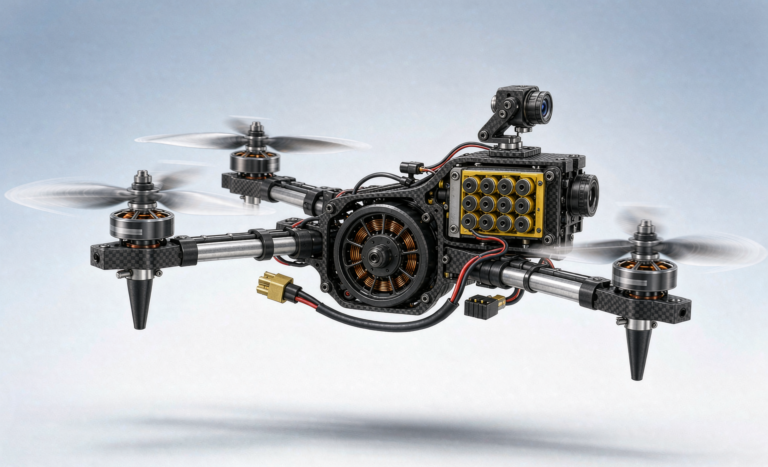
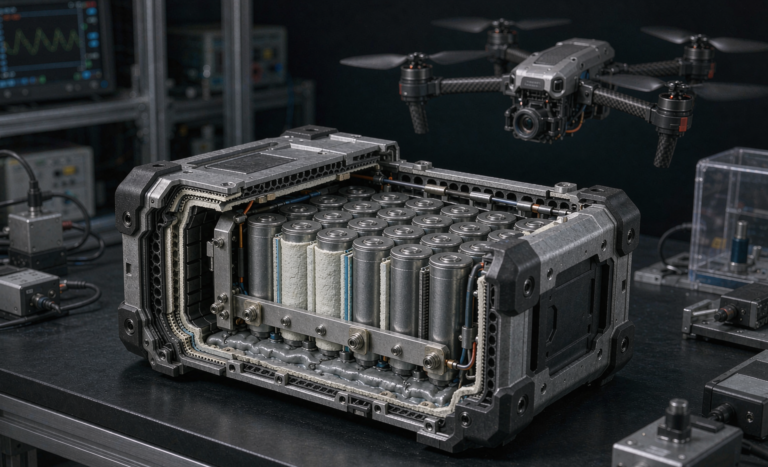
When a client comes to me with a high-altitude requirement, the first thing I build is not a pack, it is a load profile. We log a representative mission at the target density altitude, then design the custom battery solution around the real duty cycle rather than a catalog number. That usually means a slightly higher series count for voltage headroom, a thermally conductive enclosure, and a BMS tuned for cold-soak hysteresis. The result is a drone lithium battery that behaves the same at 4,500 meters as it does on the test bench, which is the only definition of reliability I trust.
Pressure Effects on Cooling and Enclosure Breathing
One detail engineers miss is that thin air is a worse coolant. Convective heat transfer scales with density, so at 5,000 meters your pack sheds heat at roughly 55–60% of the sea-level rate. A lithium battery that stays at 38°C on a lowland flight can climb past 50°C on the same mission profile at altitude, and lithium cells age alarmingly fast above 45°C. I counter this with wider cell spacing and, on heavier airframes, a conduction path to an external heatsink skin so the airframe itself helps dump heat.
The same low pressure also makes enclosures “breathe.” A sealed pack that traps air at sea level will be under positive pressure at altitude and then suck moisture back in on descent. I use a breather membrane with an IP67 rating so the pack equalizes without ingesting water — a small detail that prevents corrosion failures three months later in the field, and one I insist on for any custom drone battery headed to mountainous terrain.
A Field Pre-Flight Checklist for Altitude Missions
Before any high-altitude sortie I run the same checklist with the client: confirm the pack was pre-conditioned above 10°C, verify the BMS cutoff hysteresis is enabled, log a ground hover at the launch altitude to capture the real current draw, and carry one spare drone battery per aircraft for the derated endurance. None of this is exotic, but skipping it is the difference between a clean mission log and a lost airframe. I also record the pack serial and altitude test reference in the flight manifest so the data links back to the certification file I described earlier.
Telemetry and Real-Time Health at Altitude
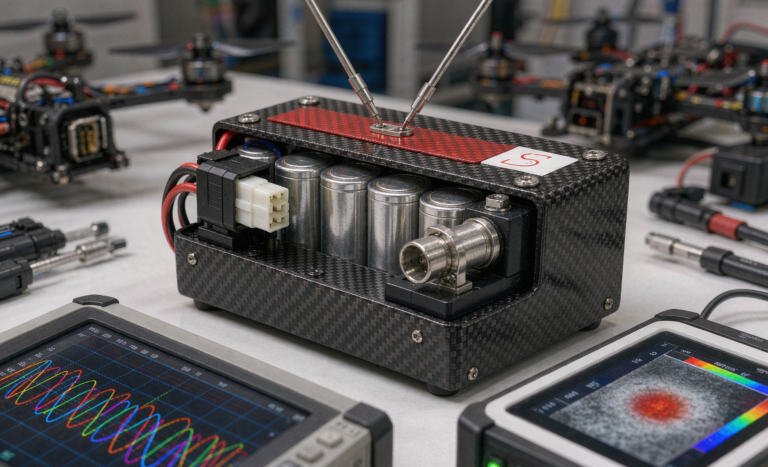
Because thin-air faults develop fast, I never fly a high-altitude drone lithium battery without live telemetry. The BMS streams pack voltage, per-cell temperature, and internal resistance to the ground station, and I watch the resistance trend closely: a rising trend at constant load is the earliest warning of a cell going out of balance or a connection loosening under vibration. At altitude you rarely get a second attempt, so I set the ground station to flag any cell that drifts more than 15 mV from the pack mean. This single rule has caught more problems on the pad than in the air, which is exactly where you want them caught.
Frequently Asked Questions
How cold can a drone battery operate at altitude?
With low-temperature cells and pre-conditioning, I am comfortable to -20°C for flight, though capacity is reduced and I derate the mission accordingly. Below that, I recommend heated packs.
Does higher altitude reduce total flight time?
Yes. Expect roughly 8–12% endurance loss per 1,000 meters of density altitude for multirotors, plus extra reserve for wind. Plan from altitude test data, not sea-level numbers.
Is LFP or NMC better for high-altitude drones?
NMC for multirotors where mass matters most, LFP for cruise-dominated fixed-wing where cycle life and thermal stability win. The right answer depends on the duty cycle.
What certifications does a high-altitude drone battery need?
At minimum UN38.3 for shipping and IEC 62133 for cell safety; the airframe falls under FAA/EASA expectations, and I attach altitude test data to the certification file.
Can I just add more cells to an off-the-shelf pack?
You can, but it shifts the center of gravity and rarely solves the discharge-rate problem. A purpose-built custom battery solution is the safer path for repeated altitude work.
How do I stop voltage sag from dropping my drone?
Pre-condition the pack, choose low-impedance cells, and set BMS low-voltage cutoff with hysteresis so transient sags do not disconnect a flying aircraft.