Semi-Solid State Battery Gel Polymer Electrolyte
Why the Electrolyte Is the Real Story in Semi-Solid State Batteries
When buyers ask me about a semi-solid state battery, they almost always fixate on the cathode or the energy density number on the spec sheet. After fifteen years on the lithium cell line, I tell them the honest truth: in a semi-solid cell, the electrolyte is where the magic — and most of the risk — actually lives. The defining feature of this chemistry is a gel polymer electrolyte that partially replaces the flammable liquid we have been pouring into lithium batteries for three decades. Get the gel right and you get a safer, higher-rate, longer-lived cell. Get it wrong and you get delamination, bubbles, and a warranty claim.
In this article I want to walk you through what a gel polymer electrolyte is, why it matters for a semi-solid state battery, how it changes ion transport and abuse tolerance, and what we verify before a cell ever ships under UN38.3 or IEC 62133-2. I will also flag where a custom battery solution team like ours earns its fee — because the gel is not a catalog part, it is an engineered formulation.
What a Gel Polymer Electrolyte Actually Is
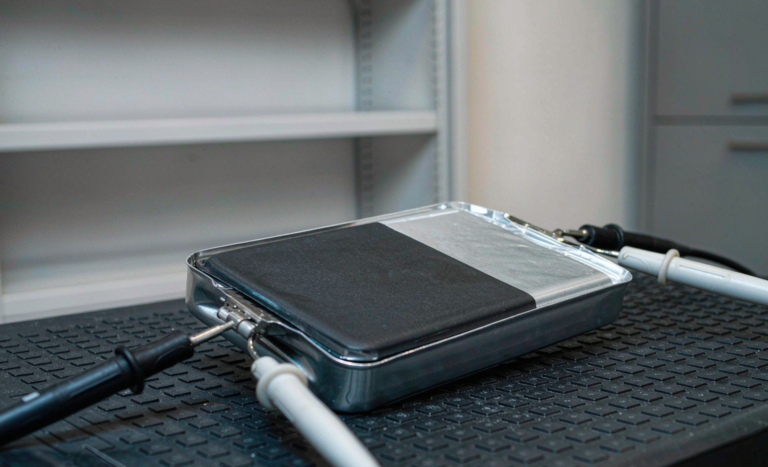
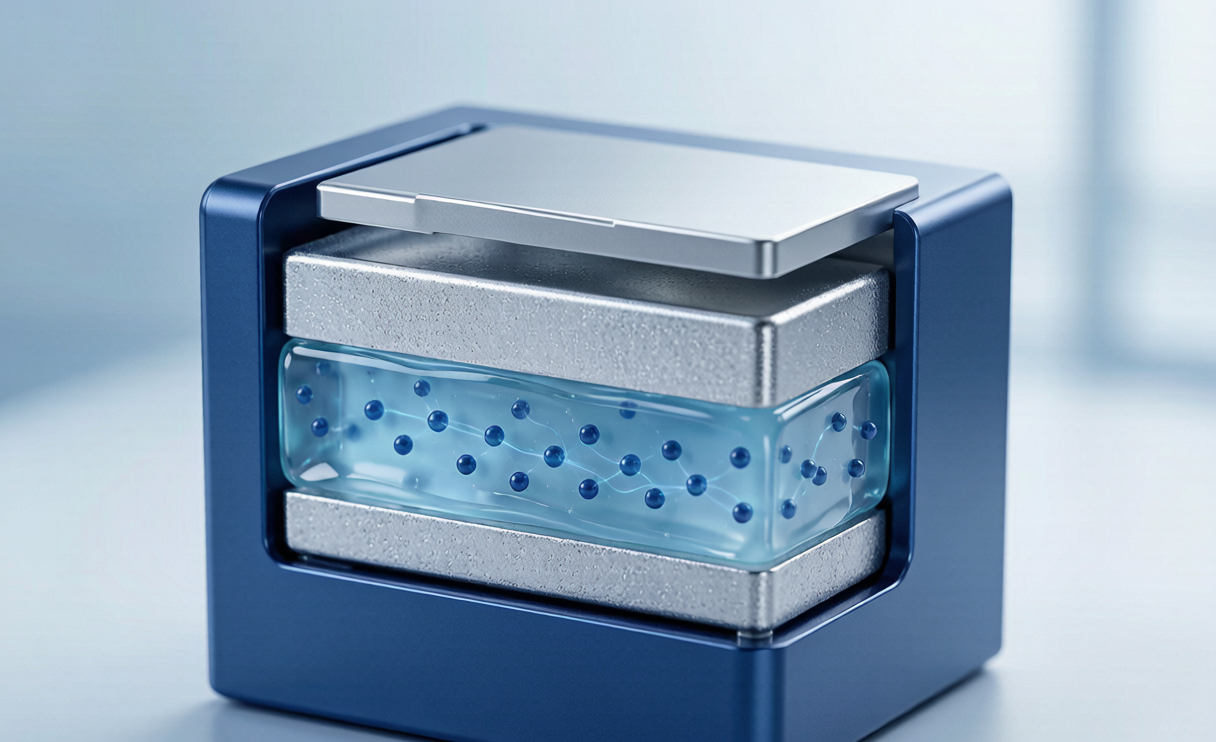
A true gel polymer electrolyte is not simply “liquid electrolyte mixed with goo.” It is a three-dimensional polymer host — often polyvinylidene fluoride (PVDF), poly(methyl methacrylate), or a poly(ethylene oxide) blend — that is swollen with a lithium salt solution (typically LiPF6 in an EC/DEC solvent mix). The polymer network traps the liquid, so the material behaves mechanically like a soft solid while still conducting lithium ions through the entrained solvent.
The key design parameter is the liquid-to-polymer ratio. In a conventional lithium battery, you are at roughly 100% liquid. In a fully solid-state battery, you are at 0% liquid and depend on the solid ion conductor alone. A semi-solid state battery sits deliberately in the middle — we usually run a gel with 30% to 60% retained liquid by weight, depending on whether the cell is optimized for rate capability or for maximum safety margin.
From an engineering standpoint, that middle ground is the whole point. The polymer gives you dimensional stability and reduced free liquid; the entrained solvent keeps ionic conductivity high enough that the cell does not need to be heated to 60 °C to work, the way many pure solid electrolytes do.
Why a Semi-Solid Cell Beats a Fully Liquid Cell
The single biggest improvement a gel brings is the reduction of free, mobile electrolyte. Free liquid is what leaks, what wicks into a short circuit, and what feeds a thermal event. By immobilizing most of the solvent inside a polymer matrix, a semi-solid state battery dramatically lowers the cell’s propensity to vent.
In abuse testing I have run, a cell built on a well-formulated gel shows a noticeably higher onset temperature for exothermic reaction than an equivalent liquid-electrolyte lithium battery of the same chemistry. That does not make it immune — no lithium cell is — but it widens the safety margin that downstream certification bodies (UN38.3 T.1–T.8, IEC 62133-2, UL 1642) probe for. For an OEM specifying a pack that has to pass transport and end-product safety in one shot, that wider margin is worth real money.
Ion Transport and the Role of the Polymer Matrix
The performance question every engineer asks is simple: if we immobilize the solvent, do we choke ion conductivity? The answer is “it depends on morphology.” A poorly crosslinked gel with big polymer domains raises tortuosity and you lose rate capability. A well-tuned gel with a fine, continuous polymer network keeps the effective ionic conductivity in the range of 1–3 mS/cm at room temperature — roughly an order of magnitude better than most pure solid polymer electrolytes at the same temperature.
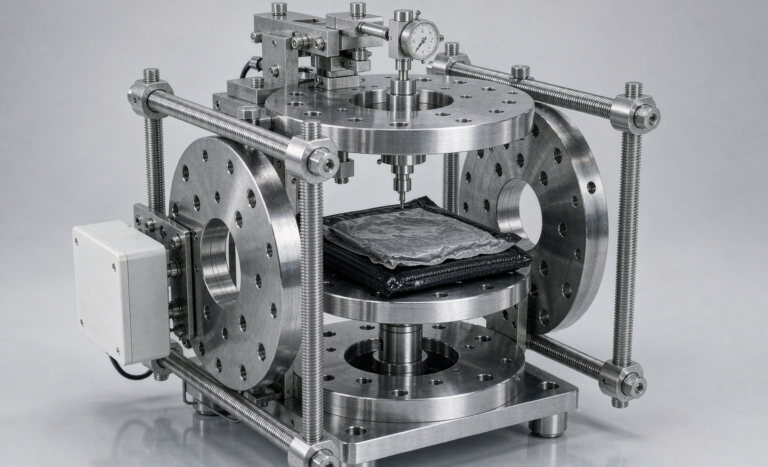
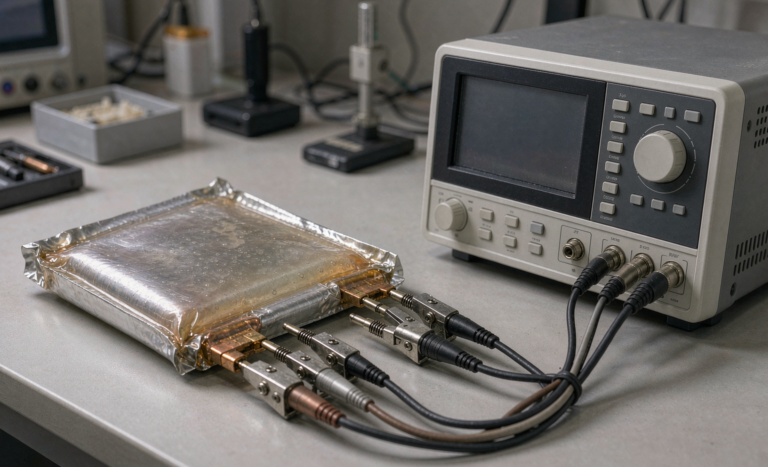
We verify this with electrochemical impedance spectroscopy (EIS) on fresh and cycled cells. The goal is a stable bulk resistance curve over the first 100 cycles; a creeping interfacial resistance usually means the gel is slowly de-wetting from the electrode, which is the early warning sign of a cell that will fail at month 18, not month 60.
Thermal Stability and Abuse Tolerance
For a semi-solid state battery intended for aviation or industrial use, abuse tolerance is non-negotiable. The gel’s higher decomposition temperature matters because it delays the onset of thermal runaway. In nail-penetration and overcharge tests, the immobilized electrolyte reduces the “fuel load” available to propagate a chain reaction.
That is why we see genuine interest from drone and aerospace programs: a lighter pack that is also harder to ignite is a double win. Cells built on a gel polymer electrolyte are increasingly referenced in programs that must satisfy both FAA and EASA transport and airworthiness expectations, where the cell-level UN38.3 pass is only the entry ticket.
Manufacturing: Coating the Gel Without Bubbles
Here is where a custom battery solution provider earns the engagement fee. Coating a gel onto a cathode or separator looks easy until you try to do it at scale. The gel’s viscosity changes with temperature, it skins over quickly, and trapped air becomes a defect that shows up as a hot spot 2,000 cycles later.
Our pilot line uses a comma-bar or slot-die coater with tight humidity control (we hold the dry room below 1% RH) and a vacuum degassing step before coating. After coating, the electrode undergoes formation — a slow first charge that builds the stable SEI layer — under UN38.3-aligned handling. We sample gel uniformity with laser profilometry; a thickness variation above ±3 microns triggers a re-coat rather than a field failure.
Where the Gel Shows Up in Real Products
You will find gel polymer electrolytes in premium cells today: high-end consumer electronics chasing thinner, safer packs; e-mobility and two-wheeler programs where puncture resistance matters; and increasingly in semi-solid state battery prototypes heading toward volume production. The chemistry is not science fiction — it is shipping in limited volume now, with capacity expansion planned through 2026 and 2027.
For an OEM, the practical move is to engage a custom battery solution partner early, during the chemistry screen, not after the pack is drawn. The gel formulation has to match your rate profile, your temperature range, and your certification target as one integrated decision.
Frequently Asked Questions
Is a gel polymer electrolyte the same as a solid-state electrolyte?
No. A solid-state electrolyte contains essentially no liquid and relies on a ceramic or solid polymer to move ions; a gel polymer electrolyte in a semi-solid state battery retains a meaningful fraction of liquid solvent trapped in the polymer. The gel is easier to manufacture and works at room temperature, but it is not as thermally robust as a true solid electrolyte. Think of semi-solid as the pragmatic bridge chemistry.
Does a gel electrolyte actually improve safety versus a conventional liquid lithium battery?
Yes, measurably. By immobilizing most of the solvent, the gel reduces free electrolyte that can leak or feed a thermal event, raising the onset temperature for exothermic reaction in our testing. It still must pass UN38.3 T.1–T.8 and IEC 62133-2, but it does so with a wider safety margin than an equivalent liquid cell.
Can a gel polymer electrolyte be used in high-rate drone battery packs?
It can, with the right formulation. High-rate packs need a gel tuned for ionic conductivity (closer to 50–60% retained liquid), which trades a bit of the safety margin for discharge capability. We specify the gel ratio against the actual C-rate and thermal envelope of the drone mission, which is exactly why a one-size gel does not exist.
What standards apply to a semi-solid state battery cell with a gel electrolyte?
The same core battery safety standards as any lithium cell: UN38.3 for transport, IEC 62133-2 for portable cells, IEC 62619 for industrial stationary use, UL 1642 and UL 1973 for cell and system safety. Aviation programs also track FAA and EASA expectations. The gel changes the test margins, not the standards themselves.