Drone Battery Cycle Counting and Fleet Rotation Strategy: An Engineer’s Field Guide
As a senior lithium battery engineer who has spent the better part of a decade managing commercial drone fleets for surveying, inspection, and logistics operators, I can tell you the single biggest lever on total cost of ownership is not the sticker price of a pack — it is how well you count cycles and rotate packs through the fleet. A disciplined drone battery cycle counting fleet rotation program can deliver 600–800 full-equivalent cycles before capacity falls to 80% of rated; a sloppy one collapses to 200 cycles and leaves you grounded at the worst possible moment. In this field guide I will walk through the cycle-counting and fleet-rotation methods I use on the shop floor, the safety standards that keep us compliant, and the data discipline that turns a drawer of packs into a predictable, swappable asset.
Why Cycle Counting Is the Foundation of Fleet Health
Every drone battery in your fleet is a consumable with a known, finite fatigue budget. A “cycle” in our world is one full charge–discharge excursion referenced to rated capacity, but most real missions are partial. What we actually track is the full-equivalent cycle (FEC): if a pack is discharged to 40% depth of discharge (DoD) twice, that is 0.8 FEC, not two cycles. Capacity fade tracks FEC far more tightly than calendar age, which is why counting matters more than the date printed on the label.
In my lab I have watched near-identical cells diverge by 300 cycles of real life purely because one operator logged every flight and the other guessed. When you cannot answer “how many FEC has pack #47 absorbed?” in under ten seconds, you are flying blind on the one number that predicts failure. Cycle counting is also what protects your warranty argument: most manufacturers define end-of-life as 80% retained capacity at a stated cycle count, and you cannot claim that protection without a log.
How I Count Cycles in the Field
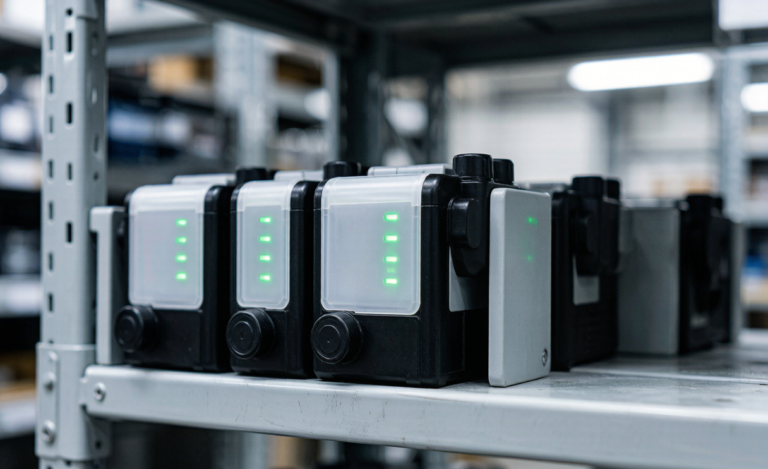
The gold standard is coulomb counting inside a competent battery management system (BMS). The BMS integrates charge in and charge out, so a modern drone lithium battery can report both state of charge (SoC) and accumulated FEC directly to your ground station. For fleets running packs without smart logging, I fall back to a manual ledger: record start SoC, end SoC, and flight time for every sortie, then convert to FEC at week’s end.
My rule is one serial per pack, etched or labeled, never handwritten on tape that falls off. I pair that serial with a QR tag scanned at the charging rack so the count is captured at the wall, not remembered later. The math is simple but unforgiving: FEC added = (Ah discharged) ÷ (rated Ah). A survey mission pulling 3.2 Ah from a 16 Ah pack adds 0.20 FEC. Do that daily and you are at 73 FEC a year — and that single number tells you exactly when to expect the 80% cliff.
For transport and handling discipline I keep every pack inside the limits of UN38.3 and IEC 62133-2; those standards govern how a lithium battery must behave under crush, short-circuit, and overcharge abuse, and they are the baseline my counting data is measured against. A pack that passes cycle counting but fails the safety envelope still gets pulled.
Building a Fleet Rotation Strategy Around State of Health
Cycle count is the input; state of health (SoH) is the decision. I band every pack into three tiers. Above 90% SoH, it flies frontline missions where payload and range matter. Between 80% and 90%, it moves to training, shorter hops, or as a cold-spare. Below 80% retained capacity — the industry-accepted end-of-life line — it is retired or routed to a second-life storage bank, never flown on a paying job.
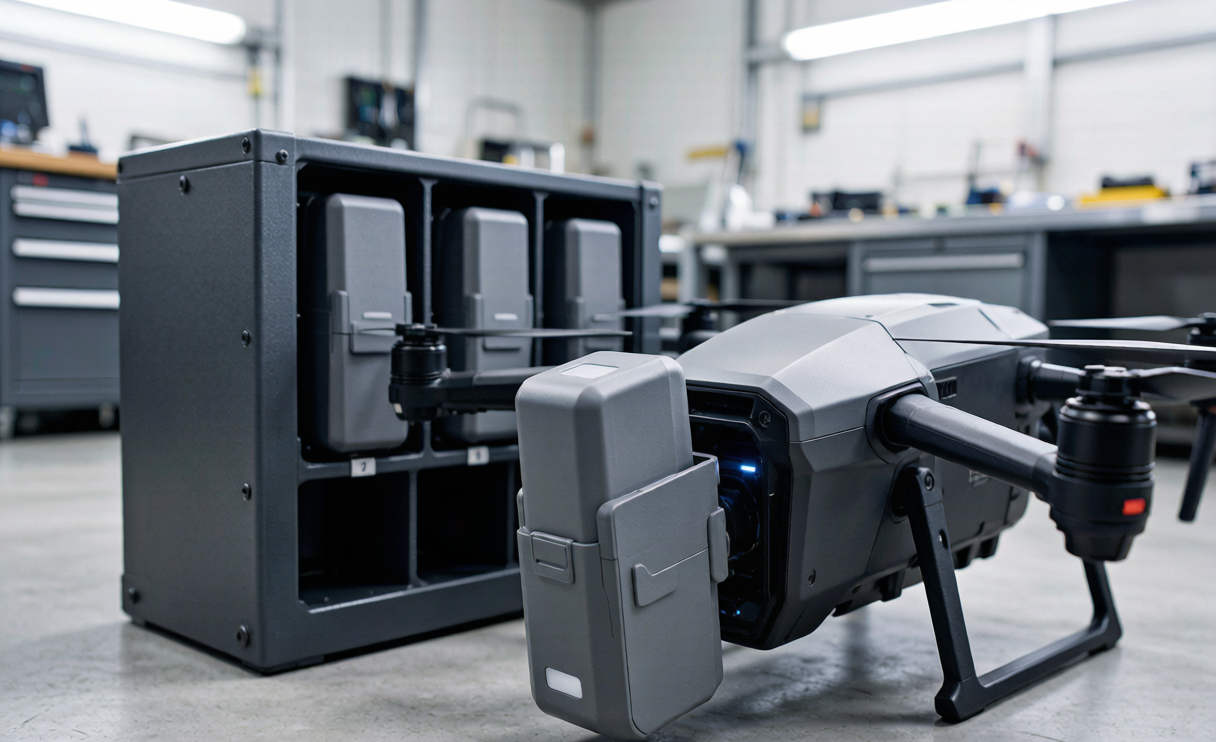
The rotation matrix is what keeps usage fair. I sort packs by accumulated FEC and internal resistance (IR), then push the highest-FEC, highest-IR packs toward rest first. This equalizes wear so no single drone battery gets hammered while its siblings sit idle. I run a “pool, don’t assign” model for most clients: packs are drawn from a common rack by serial, not glued to one airframe. Pooling lifts average pack life because it smooths the duty cycle across the whole inventory instead of burning the same four packs on the busy aircraft.
Matching Duty Cycles to Battery Chemistries
Rotation strategy only works if the chemistry fits the mission rhythm. A high-energy NMC pack is light and powerful but typically caps near 500–700 cycles. A lithium iron phosphate (LFP) pack is heavier for the same watt-hours yet can clear 2,000 cycles. For a client flying six sorties a day, seven days a week, LFP’s cycle economy wins even after you pay the weight penalty in lift efficiency.
This is where a custom battery solution earns its keep. When the off-the-shelf form factor forces you into the wrong chemistry for your duty cycle, we design the pack around the flight profile: cell selection, parallel grouping, and thermal path sized so the FEC budget matches the contracted flight hours. I have replaced “cheaper” standard packs with a custom LFP build and cut annual pack purchases by more than 40% on a daily-inspection contract, purely by aligning chemistry to cycle demand.
Charging, Storage, and Calibration Discipline
Counting is useless if your charging habits quietly destroy the packs you are tracking. I charge at 0.5C–1C and never float at 100% SoC for long; holding a drone lithium battery at full charge accelerates cathode stress. For storage between campaigns I settle packs to 30–60% SoC and top them up monthly, exactly the regime IEC 62133 and UN38.3 transport guidance expect for stable cells.
Calibration is the other half. Every 30–50 FEC I run a controlled capacity check — full charge, timed discharge at 0.2C — so the BMS coulomb count is re-anchored to true capacity. Without it, SoC drift compounds and your rotation bands drift with it. I log the calibration result against the serial so the SoH band is always grounded in measured capacity, not a guess.
Common Mistakes That Ground Fleets Early
The failures I see most are boring and preventable. First, not counting at all — operators who “just swap when it feels weak” lose packs to sudden IR spikes mid-mission. Second, deep discharges below 10% SoC, which costs far more cycle life than the convenience is worth. Third, hot charging straight after landing, when cell temperature is still climbing; I enforce a cool-down to below 40°C before the charger engages.
The fourth mistake is mixing aged and fresh packs on one aircraft. A weak pack drags the parallel group and the stronger cells overcompensate, aging them prematurely. The fifth is having no retirement rule: a pack at 78% SoH flown on a long-range job is a grounded-drone incident waiting to happen. My clients who survive fleet audits are the ones with a hard line and a log that proves they hold it.
Frequently Asked Questions
How many cycles should a drone battery last?
A quality drone battery built on NMC cells typically delivers 500–800 full-equivalent cycles to 80% capacity; LFP builds can exceed 2,000. Real life depends on DoD, charge rate, and operating temperature, which is exactly why cycle counting — not the calendar — should drive your replacement plan.
What is the difference between a cycle and a full-equivalent cycle?
A cycle is one complete charge–discharge event, but most flights are partial. A full-equivalent cycle normalizes that: two 40% DoD flights equal 0.8 FEC. Tracking FEC is the only way to compare wear across missions with different depths of discharge.
Should I assign batteries to specific drones or pool them?
For most commercial fleets, pool them. Drawing by serial from a common rack equalizes wear across the inventory, lifts average pack life, and makes rotation-by-FEC straightforward. Assignment only makes sense for regulatory traceability on a single certified airframe.
When should a drone battery be retired?
Retire at 80% retained capacity (SoH), or earlier if internal resistance climbs past your threshold or the pack fails a UN38.3/IEC 62133 safety check. Below that line, range margin and failure risk rise sharply — keep those packs out of revenue flights.
Get the counting and rotation right and a lithium battery fleet stops being a mystery cost and becomes a managed asset with a known, predictable end of life. If your duty cycle does not fit a standard pack, a custom battery solution tuned to your flight profile will usually pay for itself in cycle economy alone. That is the whole game: measure the cycles, rotate by the data, and let the fleet tell you when it is done.