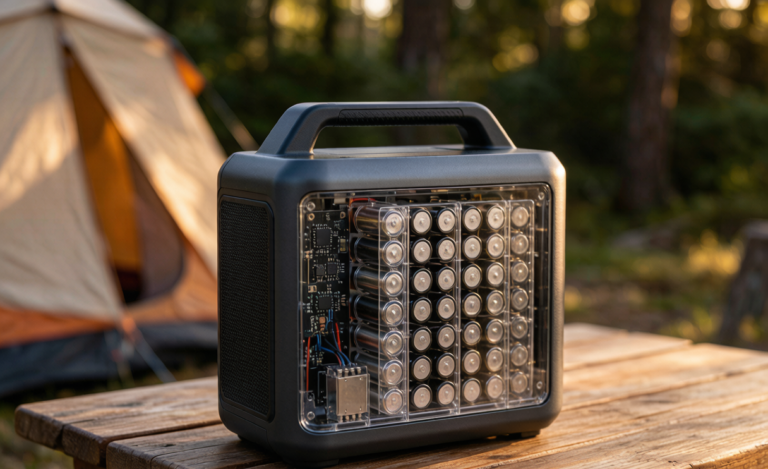
Lithium Battery for Agricultural Machinery: Engineering Field-Tested Power Systems for Modern Farms
Why Farms Are Leaving Lead-Acid Behind
For most of my career as a lithium battery engineer, the typical tractor or sprayer still rolled onto the farm with a pair of flooded lead-acid blocks under the hood. They were cheap, familiar, and forgiving. But over the last four seasons I have watched that assumption collapse on real fields. A lithium battery for agricultural machinery is no longer a premium experiment — it is becoming the default for any operator who tracks fuel, labor, and downtime. When I helped a 1,200-hectare arable operation in eastern Europe convert its autonomous weeding robots and a 75 kW orchard tractor, the difference was not subtle: daily energy cost dropped by roughly 60%, and the machines stopped needing midday battery swaps that used to idle two workers.
The physics is straightforward. A good LiFePO4 (LFP) pack delivers 150–160 Wh/kg, versus 30–40 Wh/kg for lead-acid. More importantly, you can actually use 80–90% of that capacity every cycle. With lead-acid, drawing past 50% depth of discharge (DoD) permanently damages the plates. On a 12-hour planting day, that single fact decides whether your machinery finishes the field or calls for a tow.
Pack Architecture: Cells, Modules, and the Real World
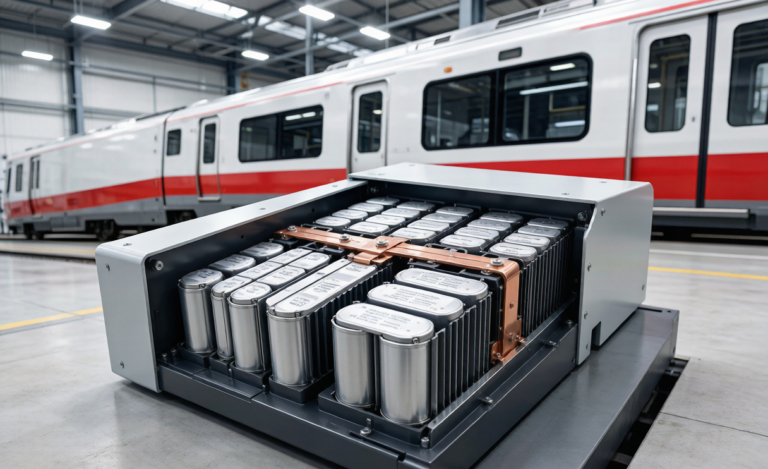
Designing a lithium battery pack for a farm is not the same as designing one for a warehouse forklift. Agricultural machinery lives in dust, vibration, temperature swings, and the occasional pressure-wash. In my builds I start from the cell up.
Cell chemistry choice
For most ground machinery I specify LFP 3.2 V prismatic cells. They tolerate abuse, run cool, and pass thermal runaway thresholds that nickel-rich NMC cells simply cannot match near dry straw and diesel. Where weight is the binding constraint — light autonomous drones and handheld sprayers — I will move to NMC or a high-energy pouch cell. Interestingly, the same engineering discipline we apply to a drone battery carries straight over: you balance energy density against cycle life and thermal margin, then build the enclosure around the worst day of the year, not the best.
Mechanical and ingress protection
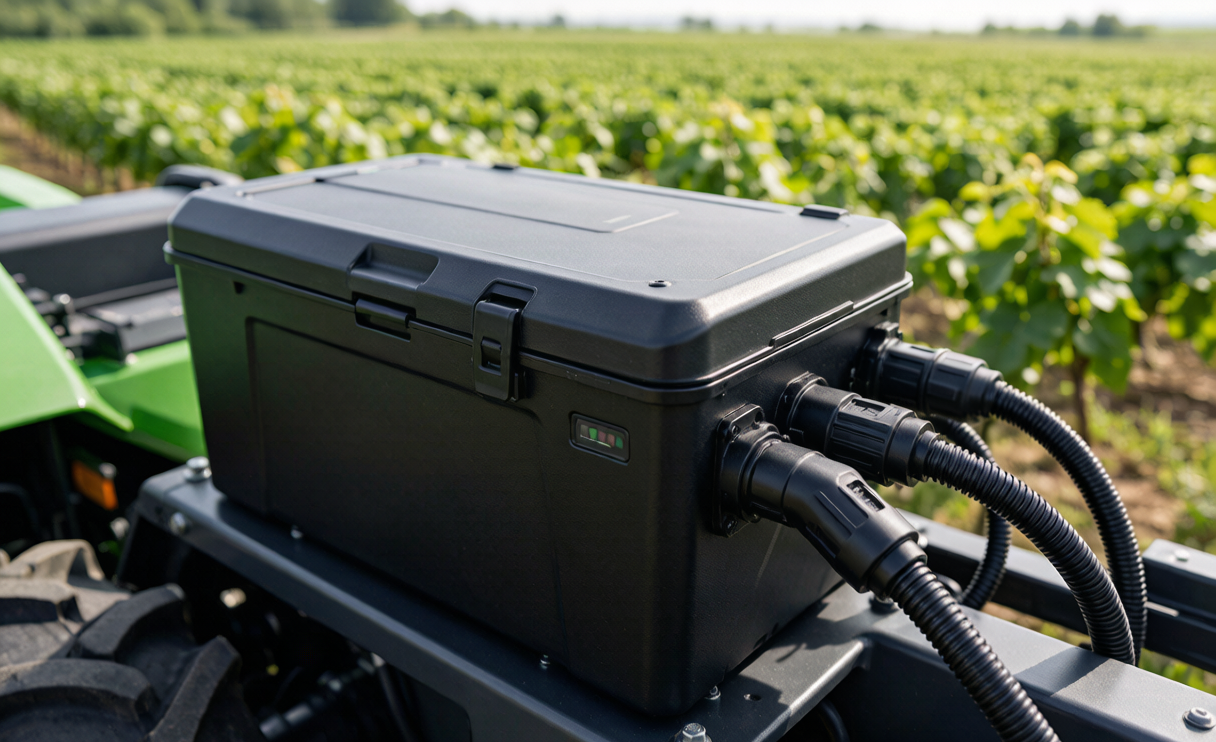
I seal every agricultural pack to IP67 as a floor, not a ceiling. Farm machinery gets hosed down, drives through mud, and sits through harvest dust storms. The module frames are 6061 aluminum with vibration isolators rated to ISO 16750-3 random-vibration profiles. In one failure I investigated, a competitor’s pack cracked its busbar solder after 400 hours of combine vibration — that is the exact failure mode IP-rated, isolated mounts prevent.
Thermal management
Below about 0 °C, lithium cells charge poorly and age faster. For cold-climate operations I add a low-power self-heating film between the cell stacks, drawing roughly 3–5% of pack capacity to bring cells into a safe 5–15 °C charging window. It is cheap insurance against a frozen-morning stall during seeding.
Sizing the Pack to the Duty Cycle
The most common mistake I see is oversizing. A grower hears “lithium lasts longer” and buys a 40 kWh pack for a machine that peaks at 9 kW. That wastes capital and adds weight that compacts soil. Instead, I size to the duty cycle:
- Continuous draw: average kW over a typical task (tilling, spraying, mowing).
- Peak draw: transient surges (PTO engagement, hill starts) — drives busbar and BMS current rating.
- Daily energy: kWh per shift, which sets usable capacity at 80–90% DoD.
- Recharge window: how many hours the machine sits between shifts.
For a 75 kW orchard tractor running two 6-hour shifts with a 2-hour charge in between, I land around 90–110 kWh usable, built as two parallel 50 kWh modules for redundancy. That is a custom battery solution, not an off-the-shelf block, because the tractor’s wheelbase and cooling tunnels dictate the exact envelope.
Charging in the Field
Farm charging is where lithium earns its keep. A lead-acid bank wants a slow, compensated charge; a lithium pack wants a fast, controlled one. I spec CCS2 or industrial Type-2 connectors with a 30–60 kW depot charger at the barn, plus a 7–11 kW mobile unit on a service trailer for remote fields. The BMS negotiates a constant-current/constant-voltage (CC-CV) profile and tapers at 90% state of charge (SoC) to protect calendar life.
One deployment I am proud of used a 20 kW solar canopy over the equipment shed. The lithium battery packs charged on midday sun, and the operation cut grid draw during peak tariff hours. Over a season, the energy arbitrage paid back a meaningful slice of the pack cost.
Safety and Certification: What I Verify Before Shipment
Agricultural packs sit next to flammable crops, diesel tanks, and people. Certification is not paperwork — it is the difference between a safe season and a recall. Every pack I release passes:
- UN38.3 (T.1–T.8): altitude simulation, thermal, vibration, shock, external short, impact, overcharge, and forced discharge. This is the baseline for any battery crossing a border or riding a truck.
- IEC 62619: the industrial cell and pack safety standard covering thermal runaway propagation and functional safety — essential for stationary and motive industrial use.
- IEC 62133-2: secondary cell safety for portable applications, relevant to handheld and lightweight units.
- UL 2580: electric-vehicle battery safety, which I apply when the machinery approaches on-road or passenger-adjacent use.
- IP and vibration validation to the ingress and ISO 16750-3 profiles above.
We also run an internal propagation test: a single cell is driven into thermal runaway and we confirm the pack does not cascade for at least 30 minutes, buying firefighters time to evacuate. That test has caught two weak separator batches before they ever reached a field.
Five-Year Cost of Ownership
Buyers fixate on the sticker. They should not. A lead-acid bank for a 50 kW machine might cost a third of an LFP pack, but it needs replacing every 18–24 months and loses capacity fast. My 5-year model for a typical operation looks like this:
- Lead-acid: 2.5 replacements, ~3,000 L of diesel-equivalent wasted on charging inefficiency, two midday-swap labor shifts per week.
- LFP (lithium battery for agricultural machinery): one pack, 2,000–4,000 cycles at 80% DoD, near-zero maintenance, and faster turns.
Across the fleet, the LFP route usually breaks even in year two and ends the five-year window thousands of euros ahead — before counting the yield gain from machines that actually finish the field on time.
Battery Management and Fleet Telemetry
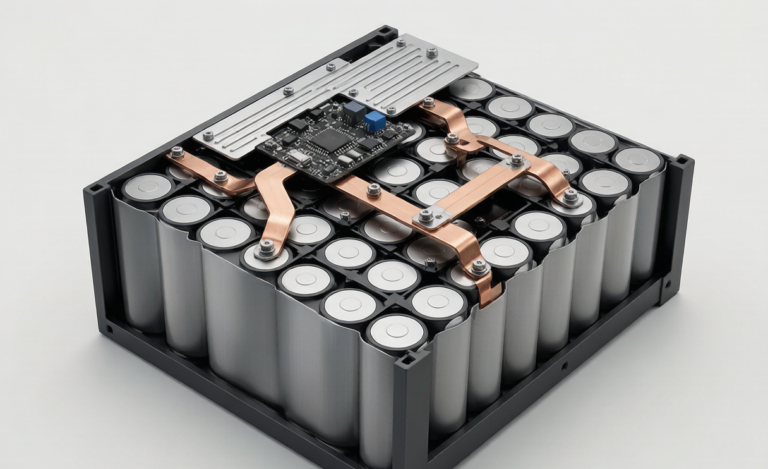
A pack is only as good as the brain watching it. The BMS in an agricultural lithium battery does more than protect cells — it is the data link between the machine and the operator’s phone. I spec a master-slave topology: each module carries a slave board measuring cell voltage and temperature to ±5 mV and ±1 °C, while the master runs Kalman-filter SoC estimation and cell balancing. On a 100 kWh pack spread across two modules, balancing keeps the weakest cell from limiting the whole string, which is the single biggest factor in hitting that 4,000-cycle target.
Telemetry matters because farms are remote. I wire the BMS to the tractor’s ISOBUS/CAN bus so fault codes appear on the cab display, and I push a lightweight MQTT feed to a cloud dashboard. Last season that feed flagged a slowly warming cell in a sprayer pack two weeks before it would have tripped — we swapped the module during a scheduled service instead of during a harvest rush. That is the difference between planned maintenance and lost yield.
Powering Agricultural Drones and Light Equipment
Not every lithium battery on a farm moves a tractor. Autonomous crop-survey drones, handheld electric sprayers, and backpack spreaders all run on the same chemistry family, just scaled down. A typical agricultural survey drone battery is a 6S or 12S LiPo/NMC pack rated 10–22 Ah, delivering the burst discharge a multirotor needs to lift a payload and fight wind. The engineering trade is the same one I described for ground packs: energy density versus cycle life and thermal margin.
When growers ask me about a lithium battery for drones versus one for a tractor, I explain the shared principles — safe chemistry, certified cells, a BMS that actually balances — while noting the drone pack lives under far harder burst loads and far tighter weight budgets. We often build both from the same cell-sourcing and qualification pipeline, which keeps certification paperwork consistent and lets a farm standardize on one supplier relationship. The result is a coherent power strategy, from a 200 g quadcopter pack to a 100 kg tractor module.
Where This Is Heading
I expect the next wave to be swappable standardized modules: a farmer carries two packs per machine, hot-swaps at lunch, and charges the spent one on solar. We are already prototyping a 15 kWh slide-in module that fits both a weeding robot and a handheld sprayer frame. The enclosure, BMS protocol, and connector are identical — only the energy envelope changes. That is the kind of custom battery solution that scales from a single drone to a 200-strong autonomous fleet without reinventing the pack each time.
Frequently Asked Questions
How long does a lithium battery last in a tractor?
A well-built LFP pack delivers 2,000–4,000 full-equivalent cycles at 80–90% DoD, which translates to roughly 5–8 years in typical seasonal agricultural use. Lead-acid rarely clears 500–800 useful cycles before capacity falls below 80%.
Can lithium batteries handle cold mornings in the field?
Yes, with design care. Discharge works down to about −20 °C; charging below 0 °C needs a self-heating film or a warmed enclosure. I always spec low-temperature charging protection in the BMS for any cold-climate farm.
Are lithium batteries safe around flammable crops and diesel?
Safe when certified and enclosed. LFP chemistry is far more stable than NMC, and a sealed IP67 pack with propagation-resistant module design keeps thermal events contained. Every pack should carry UN38.3, IEC 62619, and UL 2580 evidence before field deployment.
What certifications do agricultural lithium batteries need?
At minimum UN38.3 for transport, IEC 62619 for industrial safety, and IEC 62133-2 for lighter units, with UL 2580 for vehicle-adjacent applications. Add IP67 ingress and ISO 16750-3 vibration validation for the farm environment itself.