Lithium Battery Design for Power Tools: Engineering the
When most people think about a cordless drill, they think about torque settings and chuck size. As a senior lithium battery engineer who has spent the last fourteen years designing packs for drills, impact drivers, angle grinders, and circular saws, I think about something less visible but far more demanding: the duty cycle. A power tool is one of the harshest environments you can put a lithium battery in. It sits a few centimetres from a vibrating motor, gets dropped onto concrete, runs at full tilt for thirty seconds, then cools for ten minutes, and it does this every single day on a construction site. Good lithium battery design for power tools does not start with a cell datasheet. It starts with the load profile, and it works backwards into chemistry, configuration, and mechanical architecture.
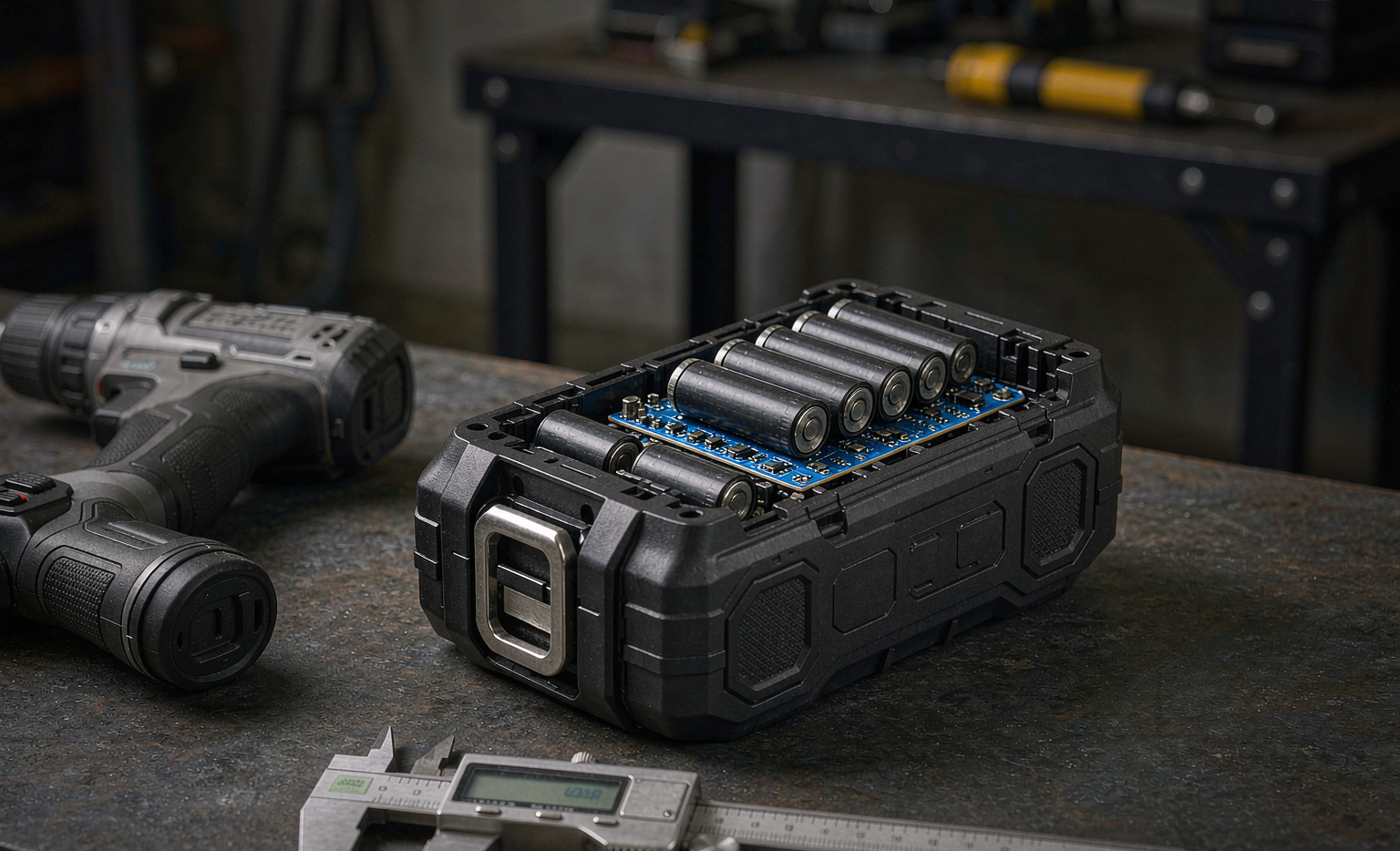
In this article I will walk through the exact design method we use at Horizon Power when we build a production lithium battery pack for a cordless tool. The same duty-cycle-first thinking also shows up in our work on high-rate cells for other platforms, and the cross-over with a drone battery is closer than most buyers expect. The engineering discipline is identical; only the form factor changes.
Start With the Duty Cycle, Not the Cell
The single biggest mistake in lithium battery design for power tools is picking a cell first. The cell is the last thing you choose, not the first. Before we touch a single 18650, we instrument the tool on a load bank and capture the real current waveform. What that waveform almost always shows is a load that is brutally peaky. Between trigger pulls the tool sits at 0 A. The instant the clutch engages or the grinder bit bites, current spikes to 30-60 A for under 100 milliseconds. During the actual cut or drive it settles to an average of 5-15 A. The duty cycle – the fraction of time the tool is actually pulling current – is often just 5-15 percent. That pattern, not the label, defines the C-rate and the internal-resistance (IR) budget the pack has to survive.
Cell Selection: NMC for Power, LFP for Endurance
Once we know the peak and average current, we pick chemistry. For high-drain tools we reach for high-rate NMC (nickel-manganese-cobalt) cells rated at 30 A continuous and 3-5C sustained discharge. For tools where runtime and cycle life matter more than raw punch – a light screwdriver or a jobsite work light – an LFP battery (lithium iron phosphate) is the smarter call: 2,000 to 4,000 cycles, a rock-stable chemistry, and a thermal-runaway onset near 270 degC. Both are lithium ion battery chemistries, but they behave nothing alike under load. We also keep NCM battery variants in the catalogue for tools that need the highest specific energy at a given weight.
Voltage platform matters as much as chemistry. Most 18V and “20V max” tools are 5S: five cells in series. Five NMC cells at 4.20 V give 21.0 V; five LFP cells at 3.65 V give 18.25 V. That is why a “20V max” tool and an “18V” tool are frequently the same cell count with different chemistry underneath. We document this trade-off in every specification we ship so the buyer is never surprised by runtime.
Sizing the Series-Parallel Matrix
The series count sets voltage; the parallel count sets capacity and shares current. Take a grinder that needs 40 A peaks at a nominal 18 V. With 5S NMC 2.5 Ah cells, a 5S2P pack delivers 5 A per cell at peak – about 1.6C, comfortably inside the cell’s 30 A (12C) rating with enormous headroom for IR rise as the pack warms. Capacity drives runtime: a 5S2P 2.5 Ah pack is 5.0 Ah, enough for roughly 20-30 minutes of intermittent cutting. We never size a lithium battery pack to the marketing C-rating on the wrap. We size it to the measured load line with at least 40 percent margin so voltage sag stays under 8 percent at peak – the point where most tools trip their under-voltage lockout.
Busbar and Weld Design for High Pulse Current
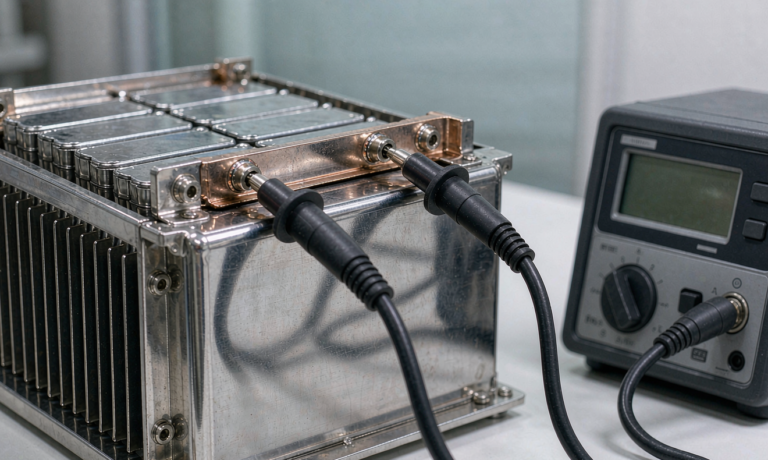
At 40-60 A, the busbar and weld joints are where packs live or die. We use pure-nickel strip sized so the cross-section keeps joint current density below 20 A/mm2, and we spot-weld with a profile that yields under 0.15 mΩ per joint and a pull strength above 25 N. Every joint is verified with a four-wire Kelvin measurement, not a multimeter beep. The total pack IR budget – cells plus welds plus strip – has to hold sag under the 8 percent target; a sloppy weld that adds 2 mΩ can drop a 21 V pack to 19 V mid-cut and shut the tool down. This is exactly where a lot of cheap packs fail in the field, and where a disciplined custom battery solution earns its money.
Mechanical Shock and Vibration Isolation
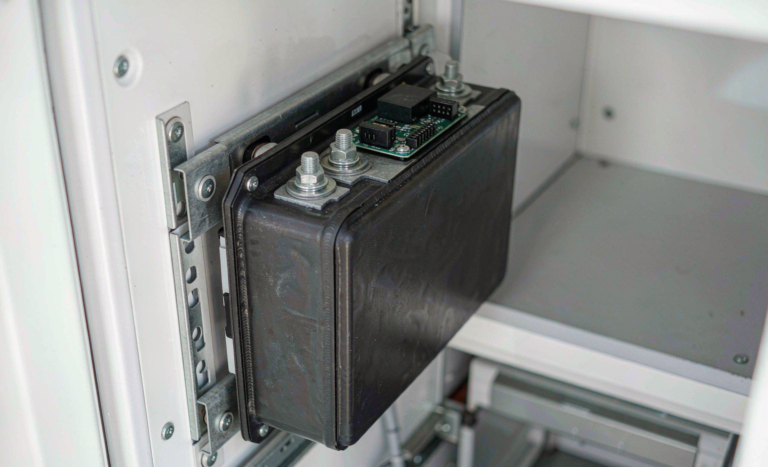
A drill motor vibrates at 10-30 g, and the pack gets dropped onto hard surfaces on a near-daily basis. We pot the cell stack in thermally conductive epoxy or polyurethane, separated from the enclosure by a silicone or foam interlayer that absorbs shock without crushing the cells. The case is hard-anodized aluminium or glass-filled nylon, rated to IPX4 for jobsite dust and rain, and we validate to MIL-STD-810H Method 514.8 vibration. Cell-to-cell preload is held at 0.3-0.7 MPa so nothing shifts under sustained g-load. A bare lithium battery with no isolation plan will rattle its welds loose in a single season of site use.
Thermal Design for Burst Discharge
You cannot put a cooling fan in a handheld tool, so thermal design for power tools is passive and pragmatic. At 40 A a 5S2P pack dissipates several watts of I2R heat during a cut; we manage it with cell spacing, an aluminium heat spreader beneath the cell row, and a temperature-compensated charge algorithm that limits charge to 0.3C below 10 degC and tapers at the top end. The BMS steps in with a soft derate at 55 degC and a hard cutoff at 60 degC. The goal is simple: keep the pack cool enough that a grinder pack – and, for that matter, a high-rate drone battery – both survive a full day of back-to-back cuts without thermal throttling.
The BMS: Current Limit, Fuel Gauge, Protection
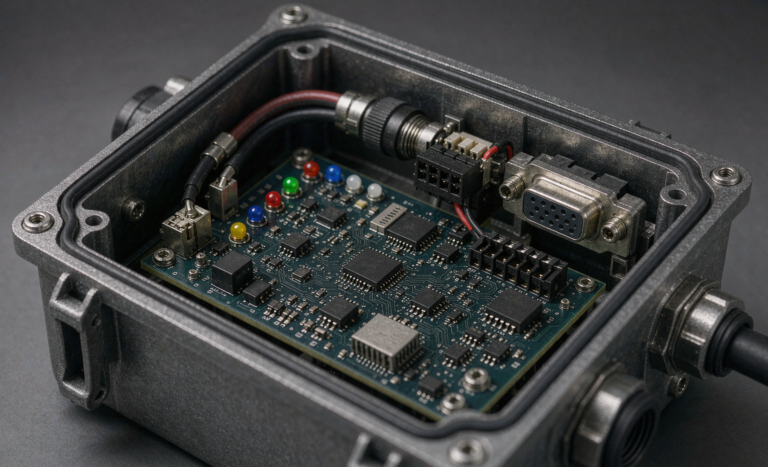
The protection circuit is the pack’s brain. For power tools we use a single-chip protector plus a coulomb-counting fuel gauge: over-current trip at the pack’s rated peak (typically 60 A for a 5S2P), short-circuit cutoff under 200 ms, and pre-charge to avoid contact welding on connect. Cell balancing keeps the series string tight, and a one-wire or SMBus telemetry line lets the tool report state-of-charge on its LED gauge. We treat the BMS as a safety device first and a feature device second – the compliance standards we design to leave no room for a weak link there.
Connector and Contact Design
The sliding contact between pack and tool is a hidden failure point that buyers never see. We specify gold-flash or hard-gold spring contacts rated for more than 1,000 insertion cycles with contact resistance under 5 mΩ even after wear, and we key the connector so a pack cannot be inserted backwards. A loose or oxidized contact adds resistance, heats up under load, and eventually welds – which is exactly the kind of field failure a well-engineered lithium battery design for power tools is built to prevent from the first prototype.
Standards Floor and Transport
Every production pack we ship is built on a hard compliance floor. Transport and baseline safety come from UN38.3 (Tests T.1-T.8: altitude, thermal, vibration, shock, external short, impact, overcharge, forced discharge), IEC 62133-2 for portable cells and batteries, IEC 62619 for industrial duty, and UL 2580 for systems. Most cordless tool packs sit under 100 Wh, which keeps them in the IATA Section II and FAA-EASA carry-on band at 30 percent state-of-charge for air transport. We print the test summary into the pack genealogy, not just the label, so a failed unit can always be traced back to its lot.
When to Move to a custom battery solution
Off-the-shelf packs cover 90 percent of tools, but when a client needs a non-standard voltage, a sealed enclosure, or a pack that has to share a charger family across a fleet, we design a custom battery solution from the same duty-cycle-first method. The same high-rate cell discipline that powers a cordless grinder is what lets a drone battery deliver 15-18C bursts without sag – the electrochemistry is the same, only the mechanical priorities change. If your tool has a load profile the catalogue packs cannot meet, that is the signal to bring in a lithium battery manufacturer early, not after three failed prototypes have burned your schedule.
Frequently Asked Questions
What voltage do most cordless power tools use?
The professional market is dominated by 18V platforms and their “20V max” siblings, both of which are usually built on a 5S lithium ion battery pack. The “20V max” number is the fully charged open-circuit voltage (5 x 4.20 V = 21 V, rounded down for marketing), while 18V is the nominal working voltage. Consumer tools also appear at 10.8V/12V and 36V/40V for light and heavy duties respectively.
NMC or LFP – which is better for power tools?
It depends on what you are optimizing. NMC wins on specific power and weight, which is why high-drain tools like grinders and saws use it. An LFP battery wins on cycle life, safety margin, and calendar stability, which makes it the better choice for lower-drain tools and for fleets that want thousands of charge cycles. Neither is universally “better”; the duty cycle decides.
How do I size cells for a 40A peak tool?
Work backwards from the load line. Pick 5S for an 18V platform, then choose the parallel count so each cell stays under roughly 2C at peak with margin – a 5S2P of 2.5 Ah cells gives 5A per cell at 40A, about 1.6C, which leaves enormous headroom. Size for the measured sag, not the label C-rating, and keep peak voltage drop under 8 percent.
Why does my battery get hot during heavy use?
I2R heating is normal during a cut, but sustained heat usually means the pack is undersized for the load or that a weld or contact joint is adding resistance. A healthy lithium battery pack warms but recovers between trigger pulls; if it stays hot or throttles, the IR budget has been exceeded and the pack should be retired before it fails.
Can the same pack design be used for drones?
The cell discipline transfers directly, but the mechanical design does not. A drone battery is built for burst C-rate and minimum weight, while a tool pack is built for vibration, drop shock, and grip ergonomics. Same electrochemistry, different priorities – which is why we design each from its own duty cycle rather than reusing one outline.