Lithium Battery Design for Solar Kits
When customers ask me to design a lithium battery for a solar kit, they usually start with the wrong question: “What capacity do I need?” After fifteen years as a senior lithium battery engineer at Horizon Power, I’ve learned the capacity is the easy part. The hard part is making a pack that survives a decade of daily charge-discharge cycling under a panel that bakes at 60 °C in summer and freezes at -20 °C in winter. A solar kit is not a phone and not a drone battery—it is a small, autonomous energy system, and the battery is its weakest link if designed poorly.
In this guide I’ll walk through how we approach lithium battery design for solar kits from the cell level up to the enclosure, the standards we certify against, and the field lessons that only show up after thousands of cycles. Whether you are an integrator building a 100 W portable kit or a distributor specifying a 5 kWh residential hybrid, the engineering principles are the same.
Why Solar Kits Need a Purpose-Built Battery
A solar kit imposes a brutal duty cycle on its storage. Unlike a drone lithium battery that flies for 20 minutes and rests for hours, a solar battery charges slowly from an intermittent source and then discharges through an inverter that can pull high current the instant a load switches on. The pack must handle asymmetric, partial-state-of-charge (PSOC) cycling every single day for 10+ years.
Generic “power bank” cells are not designed for this. We see premature capacity fade, solder-joint fatigue from thermal cycling, and BMS lockouts when the pack sees voltage dips during inverter inrush. A proper lithium battery design for solar begins by acknowledging that the battery is the system’s clock—its calendar life, not just cycle life, defines the product warranty.
Cell Chemistry: Why LFP Wins for Solar Storage
For solar kits, lithium iron phosphate (LiFePO4, or LFP) is almost always the right choice over nickel manganese cobalt (NMC). The reasons are concrete, not marketing:
- Cycle life: LFP delivers 3,000–6,000 cycles at 80% depth of discharge (DoD), versus 500–1,500 for NMC. Over a 10-year kit lifespan that is the difference between one pack and four.
- Thermal runaway threshold: LFP begins to decompose around 270 °C, compared to roughly 150–200 °C for NMC. In a sealed outdoor enclosure, that margin is a safety feature.
- Voltage plateau: The flat 3.2 V nominal curve simplifies SoC estimation and tolerates PSOC cycling without the “memory” issues you see in lead-acid.
- Cost per cycle: Even at a higher upfront cell price, LFP wins on levelized cost of storage (LCOS) by a factor of three or more.
We still use NMC where energy density is the priority—in a drone battery weight matters more than 10-year life—but for solar, LFP is the engineering default at Horizon Power.
Sizing the Battery Bank for Daily Load and Autonomy
The lithium battery design for solar kits starts with a load audit. I ask integrators for three numbers: daily watt-hours consumed, the longest expected no-sun stretch (autonomy days), and the peak inverter surge current. From there:
- Usable capacity = daily load × autonomy days ÷ target DoD. For LFP we design to 90% DoD, so a 1 kWh/day load with two autonomy days needs roughly 2.2 kWh of pack.
- Continuous current rating = inverter rated power ÷ pack voltage. A 1,000 W inverter on a 24 V pack needs ~42 A continuous; we spec cells at 1C or higher.
- Surge headroom = motor/compressor inrush, often 3–5× rated. The pack and BMS must pass this without a voltage collapse.
Because a custom battery solution lets us match cell count to the bus voltage, we routinely build 12 V, 24 V, and 48 V architectures from the same LFP cell family, simplifying procurement and spares for kit manufacturers.
BMS Architecture and PV Charge-Stage Control
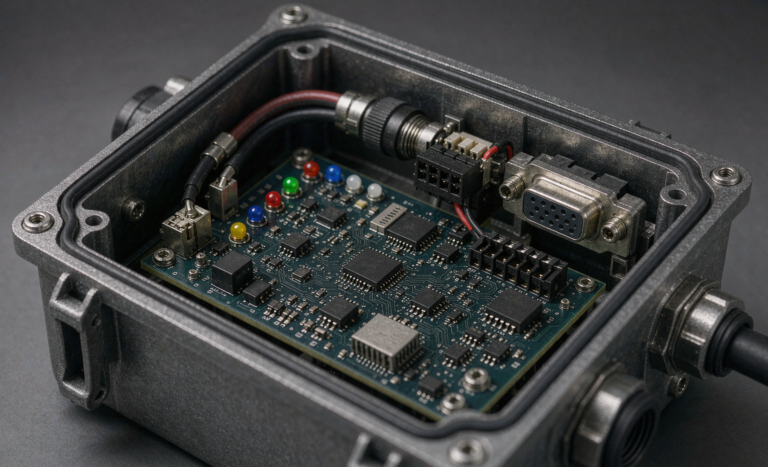
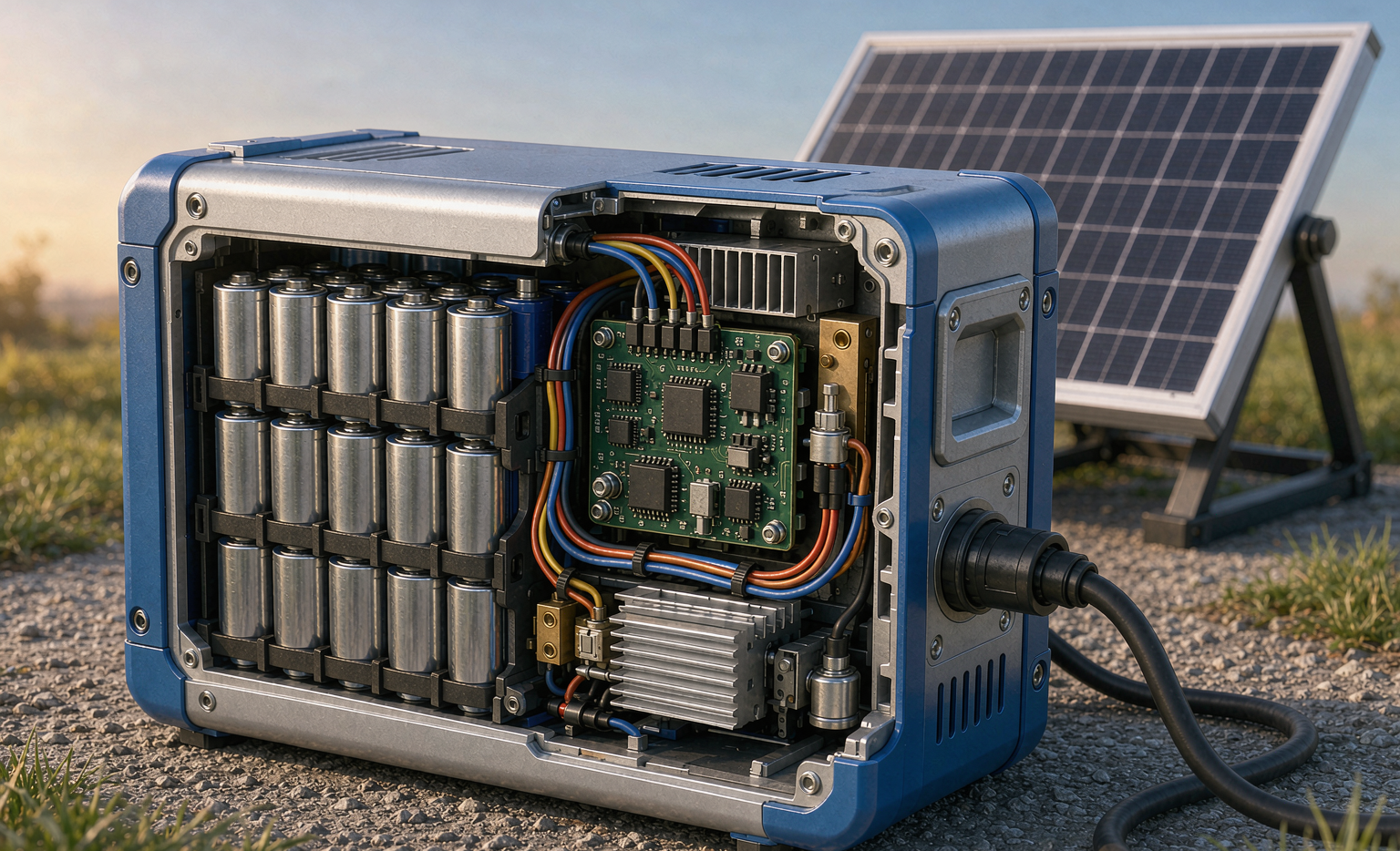
The battery management system is where most solar-kit failures originate. A good lithium battery design treats the BMS as a system controller, not just a protector. Our packs use a 16-bit cell-monitoring front end with:
- Per-cell voltage balancing at <10 mV mismatch during absorption.
- Charge-current limiting that talks to the solar charge controller via CAN or a simple PWM enable line, so the PV stage backs off before the pack hits CV taper.
- Low-temperature charge lockout below 0 °C to prevent lithium plating—critical for kits shipped to cold climates.
- Self-consumption under 1 mA so the pack doesn’t self-discharge to death during months of storage.
We also favor a top-balance strategy for solar: because the pack lives near full charge under continuous trickle, balancing at the top of the curve keeps cells uniform without the deep discharges a bottom-balance scheme would require.
Thermal Management and Outdoor Enclosure Design
A lithium battery for a solar kit lives outside, so the enclosure is part of the electrical design. We model three failure modes:
- Heat soak: Direct sun on a dark enclosure can push internal temps past 60 °C. We specify vented, light-colored housings with passive convection and, above 48 V, an active fan triggered at 45 °C.
- Condensation: Daily thermal cycling pulls moist air in and out. We use IP65 gaskets and a desiccant breather to keep the cell stack dry.
- Vibration: Kits mounted on RVs or boats need cell retention rated to 5 g random vibration per IEC 60068-2-64. Loose cells rub through insulation and short.
For cold regions, we embed a trace-heater mat controlled by the BMS; it warms cells to >5 °C only during charge windows, adding a negligible draw against the solar harvest.
Certification, Safety, and Air/Sea Shipping
Solar kits ship worldwide, so compliance is non-negotiable. Every Horizon Power lithium battery design for solar kits is built and tested to:
- UN 38.3 – the transport test suite (T.1–T.8) covering altitude simulation, thermal, vibration, shock, external short, impact, and forced discharge. This is mandatory for air and sea freight.
- IEC 62133-2 – secondary cell safety for portable applications, covering short-circuit, overcharge, and temperature abuse.
- UL 1973 – stationary and motive stationary storage, the de-facto North American certification for solar batteries.
- IEC 62619 – industrial secondary cell safety, increasingly required by European distributors.
We also run FAA/EASA-aligned thermal-runaway propagation testing internally so our integrators can certify complete kits rather than individual cells. A custom battery solution that arrives pre-certified saves a distributor six months of laboratory queue time.
Field Lessons from Real Solar Kit Deployments
Three patterns repeat across the 40,000+ solar packs we’ve shipped:
- Inverter mismatch kills more batteries than cells do. A cheap PWM controller that lets the pack sit at 100% SoC for weeks accelerates LFP aging. We now bundle a setpoint profile with every kit.
- Storage matters. Kits sitting in a warehouse at 100% SoC for a year arrive with elevated self-discharge. We ship at 50–60% SoC and label “charge before first use.”
- Communication is the silent failure. When the BMS-to-inverter link drops, users blame the battery. We standardized on a single CAN profile so any compliant inverter reads our pack correctly.
These are not theoretical—they come from warranty returns teardown, and they shape every new lithium battery design for solar kits we release.
Frequently Asked Questions
How long does a lithium battery for a solar kit last?
A well-designed LFP pack lasts 3,000–6,000 cycles, which translates to roughly 8–12 years of daily solar use at 80–90% DoD. Calendar aging from heat is the main limiter; keeping the enclosure below 45 °C roughly doubles service life versus an unvented black box.
Can I use an NMC pack instead of LFP in a solar kit?
You can, but it’s rarely wise. NMC offers higher energy density at the cost of shorter cycle life, lower thermal-runaway margin, and roughly triple the levelized cost per kWh stored. For stationary solar storage, LFP is the engineering default; reserve NMC for weight-critical roles like a drone battery.
What size lithium battery do I need for a 400W solar kit?
A 400 W panel in good sun yields about 1.6–2.0 kWh/day. To cover one evening of typical loads plus one autonomy day, spec a 12 V 200 Ah LFP pack (~2.4 kWh usable at 90% DoD). Match the inverter’s continuous current—a 1,000 W inverter on 12 V pulls ~83 A, near the limit, so 24 V is often the better custom battery solution.
How do I protect a solar kit battery in cold weather?
Disable charging below 0 °C to prevent lithium plating, and add a BMS-controlled self-heating mat for sub-freezing sites. Discharging is safe to about -20 °C, but capacity drops, so size for the worst-case temperature your kit will see.
Conclusion
Great lithium battery design for solar kits is invisible: it charges quietly, survives the weather, and outlives the panel warranty. At Horizon Power we treat every pack as a small energy system—cell chemistry chosen for cycle life, a BMS that talks to the charge controller, an enclosure rated for the real world, and certifications that let it cross any border. If you are building or sourcing a solar kit, start the battery conversation early; it is the component that decides whether your kit earns a five-star review or a warranty return.