Lithium Battery Performance for Power Tools (2)
After fourteen years of building high-drain packs for cordless tool platforms, I have learned that “performance” is the most abused word in this industry. Marketing teams quote peak watt ratings measured for 50 milliseconds on a bench; fleet buyers care about cuts per charge after two years of daily abuse. A lithium battery that delivers 3,000 W for a second and then collapses into thermal throttling is not a high-performance battery — it is a spec-sheet battery. In this article I want to walk through what lithium battery performance for power tools actually means at the cell, pack, and platform level, using measurements from our own test benches and from 18 V and 60 V tool fleets we have followed for multiple years.
The cordless tool market has consolidated around a handful of voltage classes — 12 V for compact drivers, 18 V (marketed as 20 V max) as the workhorse, and 60 V/80 V class platforms for chainsaws, mowers, and cut-off saws. Each class stresses the lithium battery differently, and each demands a different balance of cell chemistry, current capability, thermal design, and charge strategy. Whether you are an OEM sourcing a custom battery solution or a fleet manager deciding between platforms, the engineering details below should help you separate real capability from marketing numbers.
What “Performance” Really Means for a Power Tool Battery
When I evaluate a power tool lithium battery, I score it against five measurable dimensions, in this order of importance to the end user:
- Sustained current capability — how much continuous current the pack delivers without tripping protection or entering thermal derating. A circular saw under load draws 30–40 A continuous from an 18 V pack; the pack must hold that for the full duration of a rip cut, not just the first second.
- Voltage sag under load — the dip in terminal voltage when the motor stalls or starts. Excessive sag means lost torque at exactly the moment the tool needs it most.
- Thermal behavior — how fast the pack heats during heavy work and how gracefully it derates instead of simply shutting down mid-cut.
- Runtime consistency — whether the fifth cut of the day performs like the first, and whether the 300th charge cycle still delivers usable runtime.
- Fast-charge resilience — how well the cells tolerate the 4C–8C charge rates that modern jobsite chargers advertise.
Notice what is not on the list: maximum amp-hour rating. I have tested 8 Ah packs that outperform some 5 Ah packs in sustained cutting simply because they used higher-grade cells with lower internal resistance. Capacity tells you how long the tool runs at a given load; internal resistance and thermal design determine whether the tool can sustain that load at all.
High-Drain Cell Selection: Why Not All 21700 Cells Are Equal
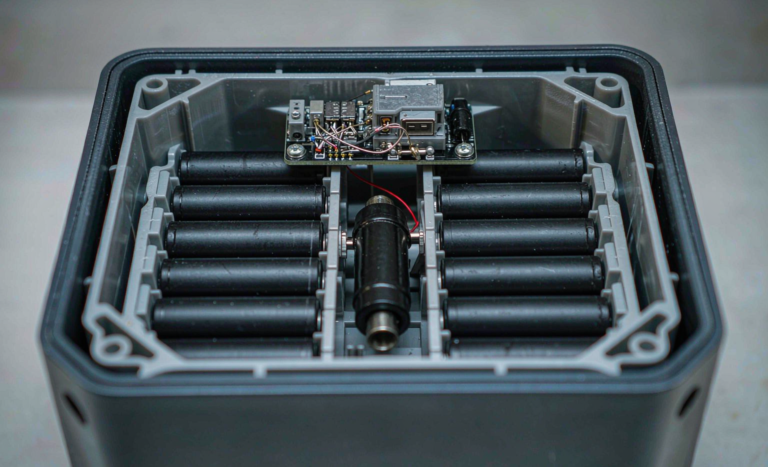
The shift from 18650 to 21700 cells transformed the power tool category. A quality 21700 high-drain cell offers roughly 30% more capacity in a similar footprint and, more importantly for tools, substantially lower internal resistance. But the spread between cells marketed as “high-drain” is enormous, and this is where most pack-level performance is won or lost.
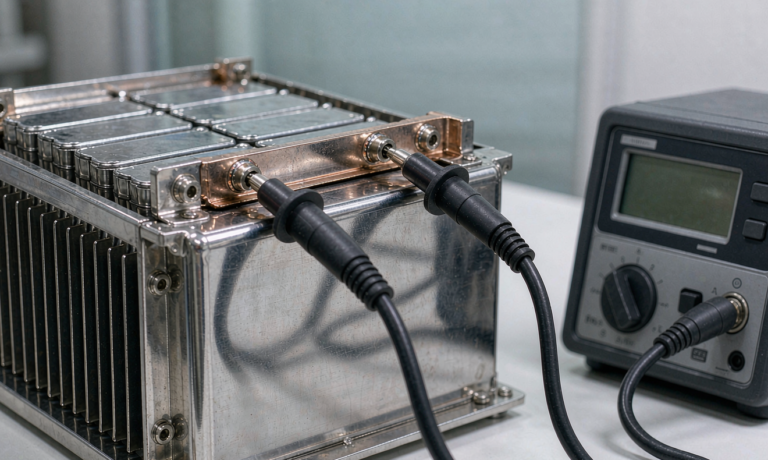
In our cell-binning process, we routinely measure DCIR (direct current internal resistance) on incoming 21700 lots. Over one recent screening of 5,000 cells from a single manufacturer lot, DCIR ranged from 14.2 mΩ to 26.8 mΩ at 25 °C — an 89% spread within nominally identical cells. For a pack delivering 40 A, that difference translates directly into additional heat generation and deeper voltage sag. We bin cells into three grades and reserve the lowest-DCIR grade for high-drain tool packs; the effect on end performance is immediate and repeatable.
Chemistry choice matters too. NMC (nickel-manganese-cobalt) cells dominate high-drain tool packs because of their superior energy density and pulse capability — a good NMC power cell sustains 15C discharge pulses. LFP (lithium iron phosphate) cells appear in professional 60 V+ platforms where cycle life and thermal stability outweigh the weight penalty, since an LFP pack may survive 2,000+ full cycles versus roughly 500–800 for NMC in the same duty. For a fleet cutting thousands of cycles per year, the LFP pack’s higher upfront cost frequently wins on total cost of ownership, which is a core consideration in any custom battery solution we design.
One caution from the field: cell datasheet pulse ratings assume 25 °C and a fresh cell. At 0 °C, the same cell’s usable pulse current can drop 40–50%, and at 45 °C the continuous rating typically derates by a third. Any pack design that ignores temperature-dependent ratings will disappoint users in winter mornings and summer roofs alike.
Voltage Sag: The Hidden Killer of Cutting Performance
Voltage sag is the difference between a saw that powers through a wet stud and one that stalls. Here is the arithmetic I use when sizing a pack. A typical 18 V circular saw under a heavy rip cut draws around 35 A. With a mediocre cell at 22 mΩ DCIR in a 5S2P configuration (ten cells), the pack’s effective internal resistance is about (5 × 22) / 2 = 55 mΩ. At 35 A, that means an I²R voltage drop of 35 × 0.055 = 1.93 V — nearly 11% of nominal voltage lost inside the pack before the motor sees anything.
Swap in binned 16 mΩ cells and the drop falls to 1.4 V. That 0.5 V difference sounds trivial until you remember that a brushless motor’s torque scales with current at a given voltage; the low-sag pack delivers measurably more torque at the blade and triggers the controller’s current limit less often. In our side-by-side bench tests, the low-DCIR pack completed a 45° bevel rip in pressure-treated lumber roughly 12–15% faster and ran 8 °C cooler at end of cut.
Sag also interacts with BMS protection. Cheap packs use a low-voltage cutoff set generously high (2.8–3.0 V per cell) to protect mediocre cells from sag-induced false lows. A well-engineered pack with low internal resistance can safely run down to 2.5 V per cell under load, extracting meaningfully more usable energy per charge — one reason two “5 Ah” packs can deliver very different real-world runtime.
Thermal Design and Derating: Sustaining the Load All Day
Heat is the ultimate constraint on lithium battery performance. Every amp flowing through internal resistance generates heat, and cell temperature directly controls both the current the cells can accept and their aging rate. A pack surface at 55 °C after heavy cutting usually means the cell cores are already at 65–75 °C — deep inside the region where SEI layer growth accelerates and cycle life collapses.
Good power tool packs manage heat through several mechanisms working together:
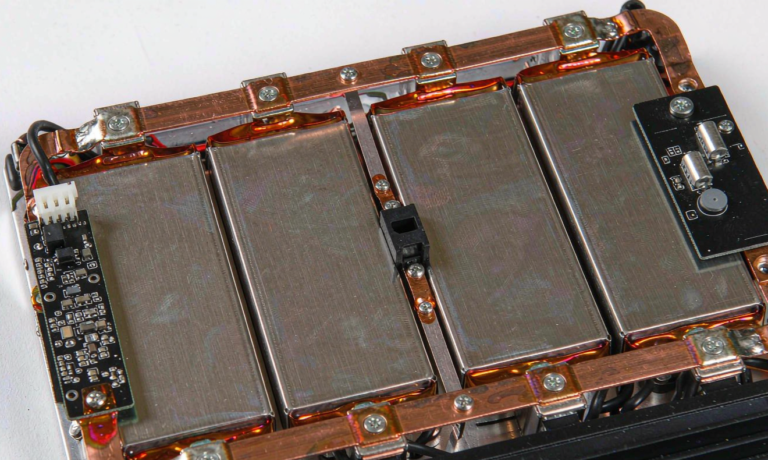
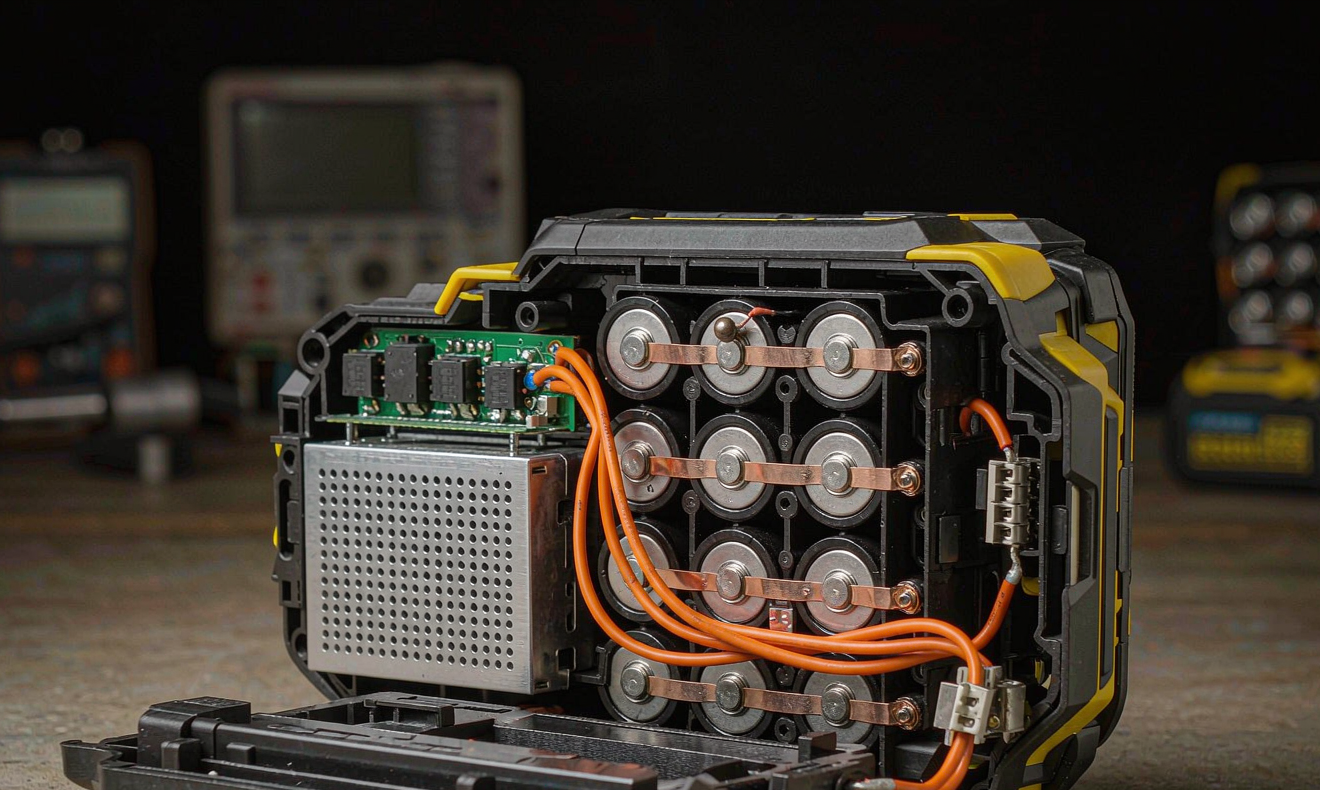
- Low-resistance cells and busbars. The best thermal strategy is generating less heat in the first place. Nickel-plated copper busbars, laser-welded interconnects, and generously sized current paths each shave milliohms that would otherwise become watts of heat.
- Thermal spreading. Aluminum heat spreader plates or phase-change interface materials move heat from cell cores toward the housing walls, where airflow during tool operation carries it away.
- Intelligent derating curves. A professional-grade BMS doesn’t just shut off at a temperature threshold — it progressively limits discharge current as temperatures climb (for example, 100% current below 50 °C, 70% at 55 °C, 40% at 60 °C). The user experiences a slightly slower tool rather than a dead tool mid-cut.
- Thermistor placement. We bond thermistors to the hottest cell in the series string, not to the housing, because housing temperature lags cell core temperature by several minutes — long enough to allow real damage in a sustained heavy cut.
In fleet telemetry from a landscaping contractor running 60 V chainsaw packs, packs with active thermal spreading and staged derating completed 31% more cuts per charge-day than early-generation packs of identical capacity, purely through better thermal management rather than more amp-hours.
Fast Charging: Balancing Convenience Against Cycle Life
Jobsite chargers now advertise 4C to 8C charge rates — a “full charge in 15 minutes” claim. The physics is unforgiving: every fast charge deposits lithium into the anode faster, and above certain rates and temperatures, metallic lithium plating begins. Plating permanently consumes cyclable lithium, raises internal resistance, and — in the worst case — creates dendrite risk.
Well-designed fast-charge systems protect the cells with three techniques. First, they charge fast only within the safe window: typically from 10% to 80% state of charge, then taper. Plating risk concentrates at high state of charge, so the last 20% intentionally slows. Second, they gate charge current on cell temperature — no fast charge below 5 °C or above 45 °C, full stop. Third, they monitor per-cell voltages and balance continuously, because a fast charge applied to an unbalanced pack drives the highest cell into overvoltage territory every cycle.
The aging cost is real and measurable. In our cycling tests on NMC tool cells, packs cycled with 1C charging retained about 88% capacity after 500 cycles; packs fast-charged at 4C for every cycle retained roughly 78–82% under identical conditions. That difference is acceptable for tradespeople who value the 20-minute turnaround, but it underlines why I advise fleet buyers to use standard-rate overnight charging as the default and reserve fast charging for genuine mid-day needs. Mixing the two strategies — for instance, fast-charge in the morning, standard charge overnight — recovers most of the convenience at a fraction of the aging cost.
BMS Protection Tuning for High-Drain Service
The battery management system is where a pack’s paper performance either survives contact with real tools or doesn’t. Three tuning decisions dominate:
- Overcurrent thresholds. A circular saw’s stall current can hit 80–100 A briefly. The BMS must distinguish a momentary stall spike (permitted, perhaps for 500 ms) from a sustained short (interrupted immediately). Poorly tuned packs nuisance-trip on hard starts; badly tuned packs fail to protect at all.
- Undervoltage behavior under sag. The cutoff must evaluate voltage with awareness of instantaneous load. A cell at 2.6 V while delivering 60 A may recover to 3.3 V at no load — a naive BMS latches off and the user loses a working pack. Sophisticated BMS firmware applies a load-compensated cutoff instead.
- Temperature gating on both charge and discharge. Charging below 0 °C is the classic lithium failure mode (plating), and discharging above 60 °C accelerates aging dramatically. Both gates are non-negotiable in a pack that will see jobsite abuse.
We validate BMS behavior against IEC 62133-2 and UL 2595 test regimes, which cover external short circuit, overcharge, over-discharge, and abnormal charging. For packs destined for professional platforms we additionally run the fault-injection scenarios the standards don’t require — stalled-tool simulation, connector mis-mating, and charger cross-compatibility — because those are precisely the situations that generate warranty claims and, occasionally, safety incidents.
Standards and Certification: What the Labels Actually Guarantee
Every legitimate power tool lithium battery ships with certifications, but understanding what each one covers matters when comparing packs. UN 38.3 is the transport prerequisite — altitude, thermal, vibration, shock, external short, impact, overcharge, and forced-discharge tests that prove the pack survives shipping; it says little about service performance. IEC 62133-2 covers safety requirements for portable lithium cells and batteries and is the baseline safety certification most markets expect. UL 2595 (or the equivalent IEC 62619 for industrial applications) extends to the pack-level risks of tools: mechanical abuse, charging system faults, and fire containment behaviors.
For OEM buyers, my practical guidance is to demand the actual test reports, not just the logos. I have reviewed “certified” packs whose internal documentation revealed that cell-level short-circuit tests passed only at 50% state of charge, or whose thermal abuse testing used thermocouples placed at room-temperature locations. Certification scope and sampling matter as much as the certificate itself.
Field Data: What 18 V and 60 V Platforms Actually Deliver
To close, here is a consolidated comparison from our bench and fleet measurements across the two dominant voltage classes:
| Metric | 18 V Pro Pack (5 Ah NMC) | 60 V Class Pack (4 Ah NMC/LFP hybrid) |
|---|---|---|
| Sustained discharge (continuous) | 35–45 A (630–810 W) | 50–70 A (3,000–4,200 W) |
| Peak sag at 100% load | 1.4–2.0 V (7–11%) | 2.5–3.5 V (7–10%) |
| Runtime, heavy cut duty | 18–25 min | 30–40 min |
| Fast charge 10–80% | 12–20 min (charger dependent) | 25–40 min |
| Capacity at 500 cycles (mixed duty) | 80–88% | 85–92% (LFP-leaning designs) |
| Usable cycles to 70% capacity | 600–900 | 1,200–2,000 |
The pattern across hundreds of packs is consistent: the 18 V class optimizes for weight, balance, and tool interchangeability, while the 60 V class buys its higher power with heavier packs and benefits disproportionately from LFP chemistry because duty cycles are long and weight matters less on wheeled or two-handed tools. Neither class is “better” — they solve different problems — but understanding the trade-offs lets you match the platform to the work instead of fighting the platform you bought.
Practical Recommendations
For OEMs specifying a custom battery solution for a tool platform: bin your cells by DCIR, design the BMS around the tool’s real stall and continuous current profile rather than generic thresholds, gate fast charging on temperature, and validate with duty-cycle testing that mirrors actual cutting loads — not just constant-current discharge. For professional users: buy packs with temperature-gated fast charge, store them between 30% and 60% state of charge when idle, avoid fast charging cold packs, and expect — and demand — that a quality pack still delivers at least 80% of its new runtime after a year of heavy trade use. Performance you can measure today is the only kind that matters on the job site.
FAQ
How many charge cycles should a power tool lithium battery last?
A quality NMC pack in professional duty delivers 600–900 usable cycles to 70% capacity; LFP-based 60 V class packs commonly reach 1,200–2,000 cycles. Real-world lifespan depends heavily on charging temperature discipline and how deeply the pack is discharged each use. Packs that are routinely fast-charged hot or stored fully charged age two to three times faster.
Is a higher amp-hour battery always better for power tools?
No. Higher capacity extends runtime, but sustained performance depends on internal resistance and thermal design. A well-engineered 5 Ah pack with low-DCIR cells can outperform a mediocre 8 Ah pack in heavy cutting, delivering more torque and running cooler. Match capacity to your runtime needs and prioritize cell quality for performance.
Why does my battery die fast on cold mornings?
Below about 5 °C, lithium cell internal resistance rises sharply and usable pulse current drops 40–50%. The BMS may also enforce low-temperature charge and discharge limits. Warm packs gradually to room temperature before heavy work, and never fast-charge a cold pack — lithium plating at low temperature permanently damages cells.
Do fast chargers ruin power tool batteries?
Not if the pack and charger are properly engineered. Temperature-gated, state-of-charge-limited fast charging (typically 10–80% at 4C+) is safe but ages cells moderately faster — roughly 78–82% capacity retention at 500 cycles versus about 88% with 1C charging. Use fast charge when turnaround matters and standard overnight charging as your default habit.
What certifications should a professional power tool battery have?
At minimum UN 38.3 for transport, IEC 62133-2 for cell and battery safety, and UL 2595 or IEC 62619 for pack-level tool safety. Professional buyers should request the underlying test reports and verify the certification scope covers the pack configuration actually being purchased, not just a representative sample.
Can I mix old and new batteries on the same tool platform?
You can physically interchange packs, but performance and runtime will differ because aged packs have higher internal resistance. Within a single pack, mixing aged and new cells is a genuine hazard — imbalanced cells cause overvoltage and over-discharge events — so never attempt to re-cell a pack with partially used cells. Tool platforms are designed for pack interchange, not pack surgery.