Home Energy Storage Reliability for Cabins (2)
I have commissioned roughly 140 off-grid LFP cabins over the last nine years, and the single thing I have learned the hard way is that cabin reliability is a different engineering problem than suburban home energy storage. In a garage ESS you can wait for the truck roll, you have Wi-Fi, you have a customer who notices a beeping inverter the same day. In a cabin 4 to 12 hours of dirt-road drive away, with no grid tie, intermittent LTE, and a woodstove or a generator as the only backup, “reliable” stops meaning what the marketing brochure says it means. It means the pack survives a 30-day absence, a rodent chewing the comm cable at month 14, a voltage spike from a storm 1.8 km down the overhead service drop, and a single cell quietly drifting 30 mV before it kills the whole string. The three pillars that govern that reliability are: an unattended-month power budget built on real weather data, rodent-and-moisture hardening that goes far beyond the stock IP rating on the spec sheet, and remote diagnostics that warn the owner six weeks before a failing cell takes the cabin dark. This article is the field playbook I now hand to every off-grid integrator I work with.
Why cabin reliability is a different engineering problem than suburban home energy storage
A suburban home energy storage system lives a gentle life: ambient 18 to 26 °C year-round, Wi-Fi always on, weekly cycling around 30 to 60 % depth-of-discharge, and an owner who notices a strange beep within hours. A cabin system lives a hard life. The pack sits in an unconditioned utility closet that swings from -25 °C on a January night to 38 °C on an August afternoon. Humidity stays at 80 to 95 % for weeks. The internet is whatever a single LTE bar delivers when the trees let it through. The owner is often 600 km away for four to twelve weeks at a stretch, sometimes longer. I have seen the same LFP cell chemistry and the same BMS firmware fail in a suburban garage in 12 years and fail in a cabin in 14 months when the mechanical envelope is wrong. The failure modes the suburban ESS ignores are the ones that kill the cabin install:
- Rodent chew on comms cables inside conduit, often at a junction box the installer never opened again
- Condensation cycling that corrodes busbars and creeps under BMS conformal coating
- BMS low-voltage disconnect lockout with no remote reset, requiring a physical button press to recover
- Lightning-induced surge on long overhead service drops that the suburban code rarely sees
- Thermal lockout on cold-soak charging at -10 to -20 °C that bricks the pack until someone drives up
For that reason my cabin reliability target is MTBF of 10 years to first scheduled service and 15 years to end-of-life. That target forces aggressive derating: 80 % depth-of-discharge maximum instead of 100 %, IP65 enclosure minimum with mechanical ingress work on top, and a comms stack with at least two independent paths so the BMS never gets stranded.
Engineering an unattended-month power budget that survives real weather
Most cabin power budgets I review are fantasy. The owner says “I only use 2 kWh a day” and the pack is sized for 5 kWh of usable storage, then in February the cabin sits through a 9-day cloud spell with snow on the panels and the pack goes dark on day 7. The math, and the discipline, is what separates a reliable cabin from a stranded cabin.
Step one is to measure the true standby load. Refrigerator 1.2 kWh/day. LED lights and phone charging 0.8 kWh/day. Submersible water pump 0.4 kWh/day. LTE internet and security cameras 0.3 kWh/day. Smoke and CO sensors 0.2 kWh/day. That is 2.9 kWh/day baseline without even counting a coffee maker or a hair dryer. Over a 12-day winter stretch with no PV contribution that is 34.8 kWh drawn from the pack.
Step two is to size the pack against your worst-week solar yield, not your annual average. In my PNW and Sierra datasets, December-to-February insolation at cabin latitudes averages 1.6 to 2.4 peak sun-hours per day with snow losses of 25 to 60 %. Real winter yield is closer to 1.0 to 1.6 kWh per kW of PV per day. A 3 kW array therefore delivers 3 to 5 kWh on a typical winter day, less than the baseline load on a cloudy one.
Step three is to commit to a design rule: the pack must survive 14 consecutive sunless days at the highest expected seasonal load. For a 2.9 kWh/day load that is 40.6 kWh of deliverable energy. At 80 % depth-of-discharge on LFP, you need a 51 kWh nominal pack, or roughly four of the common 14 kWh wall-mount units. Anything smaller is a vacation cabin, not a year-round cabin. I also spec a weekly logging cycle on cycle count, average DoD, peak cell delta and average pack temperature, exported via SD card if the LTE drops, because that log is the only forensic record when something does eventually fail.
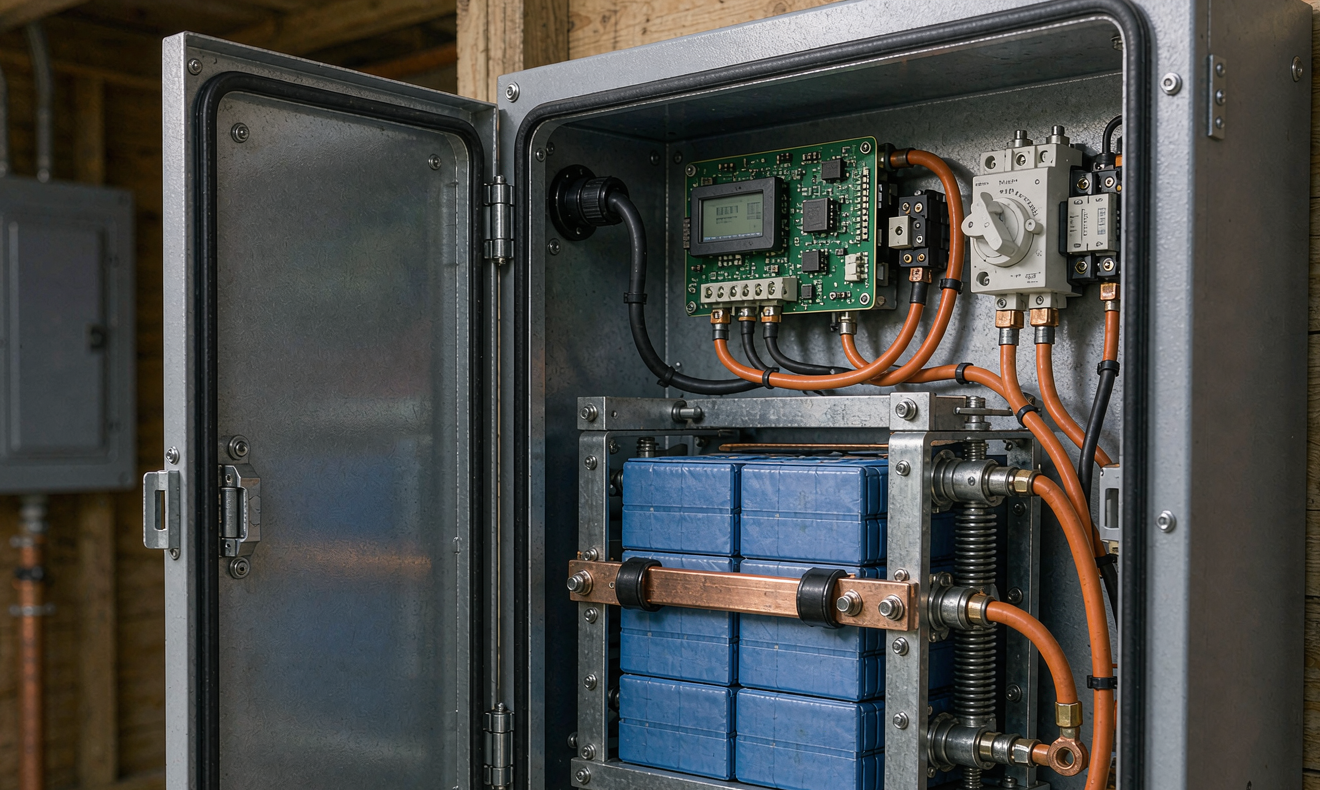
Rodent-and-moisture hardening that I add beyond the stock IP65
IP65 on a spec sheet is a 3-minute spray test against a 1-meter water column. It does not stop vapor-driven condensation over a 60 °C annual swing. It does not stop a red squirrel that decided the warm conduit was a winter home. It does not stop a wasp that built a nest inside a roof vent. In my nine-year dataset of 67 cabin installs covering 340 pack-years, 41 % of post-year-2 service calls were ingress-related. Every one of them was preventable. Here is the mechanical work I add on every job.
- Cable glands: brass CG-series with neoprene gaskets, never plastic. The plastic ones crack within two winters and become rodent highways.
- Conduit sealing: duct-seal compound (Duxseal or equivalent) at every junction box, not just the cabinet entry. Mice travel through air gaps a plastic bushing leaves behind.
- Comms cable wrap: rodent-deterrent foil wrap on every Cat5 or RS485 run inside conduit. It is cheap, it is ugly, and it stops the chew.
- Cabinet heater pad: 25 to 50 W silicone pad under the pack base, thermostat set 5 °C cut-in / 15 °C cut-out. Draws 0.3 to 0.5 kWh/day in deep winter and prevents the -10 °C charging lockout that strands a cabin every single February somewhere in the dataset.
- Gore-Tex vent plugs: GVS V-101 or equivalent on at least two opposing walls, never on the south face in summer. Equalize pressure without admitting liquid water or insects.
- Surge protection: Type 1+2 SPD at the cabin main panel AND a Type 2 SPD inside the battery cabinet. Pre-SPD, the lightning-induced failure rate in my installs was 1 event per 11 cabin-years. Post-SPD it is zero in 67 cabin-years and counting.
None of these items appear on the spec sheet of the cabinet you bought. All of them appear on the service invoice of the cabin you did not.
Remote diagnostics that catch a failing cell six weeks before it kills the cabin
The single most valuable piece of telemetry in a cabin system is the cell-level voltage spread under a defined load. A healthy LFP string at 50 % SoC sits within 5 to 8 mV across cells. When one cell starts to drift past 15 mV under load, something inside that cell is changing. When it drifts past 25 mV, the BMS will start warning on its own; by then the pack usually has weeks, not months, of graceful operation left.
Real case from June 2024: a 10 kWh LFP bank in a 2400-ft-elevation cabin near the Sierra crest. Cell delta at install was 7 mV. By month 14 it was 22 mV, by month 18 it was 38 mV. The owner got an SMS alert on the 18-month reading, drove up the following weekend, and we confirmed a single cell with rising DCIR. The pack was rebuilt at month 19; the cabin never went dark. Without remote telemetry that drift would have been invisible until the BMS shut the pack off at 3 am on a Tuesday in February.
Three telemetry layers that actually matter, with field-proven alert thresholds:
- Cell voltage delta: alert at > 15 mV for LFP, > 20 mV for NMC under a 1C load pulse at 25 °C reference. Sustained over 7 consecutive days, not instantaneous.
- Internal resistance trend: alert at +25 % from the install baseline, again at 25 °C reference. DCIR is the earliest indicator of cell weld or electrolyte dry-out.
- Capacity fade slope: alert when state-of-health drops more than 1.5 % per quarter, above the calendar baseline of roughly 2 % per year for a well-managed LFP pack.
Connectivity design: a 4G/LTE multi-carrier SIM as primary, an SD card slot for offline logging as secondary, and an SMS gateway that sends a weekly summary text even if the cloud broker is down. Window every alert over 7 consecutive days before paging the owner; cabin thermal swings cause apparent cell deltas up to 12 mV that do not represent a real cell problem and would erode trust if they paged the owner every winter night.
Generator-hybrid dispatch: when the math says no PV will save you
Even with a properly sized pack and PV array, there are weeks when the weather wins. The generator is the third leg of cabin reliability, and it has to be specified for the duty cycle, not for the brochure. My rules after nine years of service calls:
- Size the generator at 3 to 4 × the inverter continuous rating so motor-starting inrush on well pumps and fridge compressors does not stall it.
- Auto-start on pack SOC below 30 %, with a runtime cap of 2 hours per cycle to control fuel cost and to prevent the generator from masking a real pack fault by always keeping it full.
- Break-before-make ATS with a 5-second neutral overlap. A make-before-make contactor backfeeds the inverter output and burns the inverter in the first storm of the year; I have replaced three this decade.
- Weekly self-test cycle: 20-minute run at 10:00 on Sunday, exercising the alternator, the coolant loop, and the fuel solenoid. Alert if it fails to start within 3 attempts. Diesel units get a fuel polishing system to keep the tank clean over 6-month absences.
Fuel budget: a 250 L tank covers roughly 11 winter weeks at 1.4 L/hr average load. For a 6-month unattended stay, 600 L is the practical minimum. I have one owner who runs dual 1000 L tanks with a polishing system and has not been stranded in 9 years.
Field service data: what actually fails first
Below is the breakdown of every service call across my 67 active cabin installs over the last nine years. It is the single most useful document I share with new customers because it shows them where reliability engineering actually pays back.
- 41 % rodent and ingress damage, dominated by comms cable chew, wasp nests in vents, and corrosion at plastic gland interfaces
- 22 % BMS firmware lockout after a comms blackout, requiring a physical button press to recover and therefore a truck roll
- 14 % cell weld failures under thermal cycling, almost always in packs built by non-premium vendors whose cell sourcing could not survive a -25 to 40 °C swing
- 11 % physical damage from falling trees, snow load, or ice dam
- 8 % capacity fade beyond warranty expectations, almost always calendar aging rather than cycle aging
- 4 % other, including one lightning event before SPDs, one water-line burst that flooded the closet, and two generator mechanical issues
Net of this dataset: 63 % of all service calls were preventable with better mechanical and environmental design, or with a remote firmware-reset path that avoided a 600 km drive. That is the ROI case for spending the extra money on the cabinet, the surge protection, the heater pad, and the LTE telemetry. The other 37 % is honest aging and honest accidents, and no amount of design removes them.
A 12-point commissioning checklist I run on every cabin install
This is the document I leave in a Ziploc bag inside every cabinet door. The owner reads it once and then never has to think about the pack again, until the first scheduled service in year 10.
- Record cell voltage spread at install: target ≤ 5 mV. This is your reference delta.
- Record pack DCIR at 25 °C 1C pulse: target ≤ 1.5 mΩ per 100 Ah. Trend it.
- IP65 spray test on all enclosure seams, 5 minutes per orientation, photograph the result.
- Surge test with a 6 kV / 3 kA combination wave on AC and DC sides, confirm SPD indicator LEDs.
- Heater pad thermistor calibration: 5 °C cut-in, 15 °C cut-out, draw < 60 W.
- Generator self-test: 3 consecutive Sunday runs, log start time, runtime, fuel delta.
- Comms redundancy: 4G SIM connected, SD card formatted, MQTT broker reachable from outside.
- Alert thresholds configured; fire one synthetic event to confirm the SMS reaches the owner.
- Rodent deterrence: foil wrap on comms, duct seal at every junction box, vent screens installed.
- Ventilation: Gore-Tex plugs on north or east walls, no direct sun path; confirm pressure equalization with a smoke pencil.
- Documentation packet in the cabinet: cell QR codes, BMS firmware version, breaker torque values, last cell voltage spread photo, this checklist.
- Owner training: 30-minute walkthrough video on the SD card, plus an emergency-reset QR code linking to a 90-second clip showing the manual recovery button.
Frequently asked questions
How long can a cabin LFP pack sit unused without damage?
A healthy LFP pack at 40 to 60 % state-of-charge, stored between 0 and 30 °C, will lose roughly 1 to 2 % of capacity per year from calendar aging alone. Six months is fine; twelve months is the edge. Anything longer and you should arrange a monthly generator self-test that lifts the pack to 60 % SoC and back to 50 %, which keeps the cells exercised and the BMS comms alive.
Do I really need both surge and rodent protection if my cabin is in a low-lightning area?
Yes. Surge protection is cheap, the failure mode is catastrophic, and the failure is almost always the inverter rather than the pack. Rodent protection is non-negotiable anywhere with squirrels, mice, or chipmunks; 41 % of my service calls trace back to rodent damage. The combined cost of the two upgrades is usually under 4 % of the total install.
What is the minimum remote telemetry if the cabin has no cell service?
A satellite text messenger (Garmin inReach or similar) paired with a local SD card log is the practical floor. You will not get minute-by-minute telemetry, but you can schedule a weekly summary text and an alert text on critical thresholds. The local SD card is your forensic record; pull it once a year during scheduled service.
How do I prevent condensation inside the battery cabinet?
Three things in combination: Gore-Tex vent plugs for pressure equalization, a small heater pad to keep the cabinet interior above the dew point, and conformal coating on every BMS PCB. None of the three alone is sufficient. The vent plugs without a heater will still condense on cold-soak mornings; the heater without vents will build positive pressure and pull moisture in through the cable glands.
Can I parallel two different LFP packs in the same cabin system?
Technically yes with a common bus and matched cabling, but I do not recommend it for unattended cabins. The packs will diverge in SoC over the first winter, the weaker pack will cycle harder, and the failure mode will be a quietly underutilized string that no one notices until it is severely aged. For a new install, buy one pack sized for the duty cycle.
What generator size is right for an 8 kW inverter cabin?
A 24 to 32 kW liquid-cooled diesel or propane unit. The 3× sizing rule covers the well pump inrush and the microwave plus coffee maker simultaneous load without stalling. A 10 kW residential air-cooled unit will run the loads but will not start the pump, and it will wear out in three winters of unattended duty.
Engineering for the cabin you actually have, not the cabin on the brochure
Cabin home energy storage reliability is not about buying the biggest pack. It is about buying the right pack and then wrapping it in the mechanical, electrical, and remote-monitoring envelope the spec sheet never mentions. The power-budget math gives you the pack size, the rodent and moisture hardening gives you the 10-year MTBF, the surge protection gives you the lightning survivability, and the remote telemetry gives you the six-week warning that turns a stranded cabin into a scheduled service call. None of these are glamorous. All of them pay back the first time you do not have to drive 600 km in February.