Lithium Battery for Medical Carts and Hospital Equipment
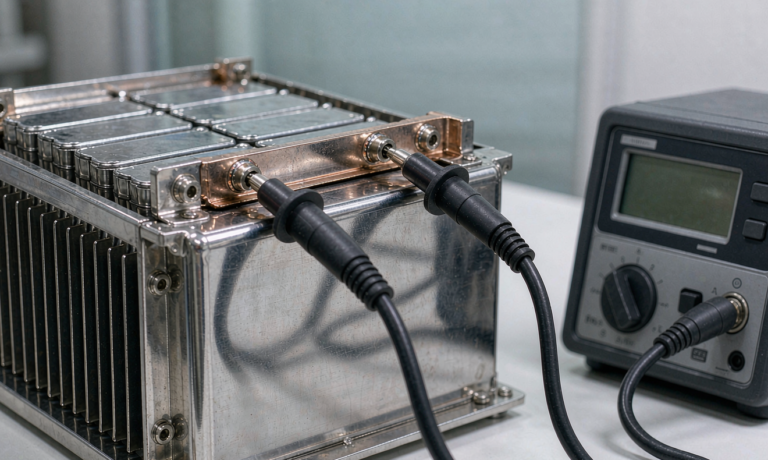
When a clinical floor manager asks me to size a lithium battery for medical carts and hospital equipment, the conversation never starts with energy density. It starts with how the cart is cleaned, who has to sign the swappable-battery hot-swap form, and which standard the infection-control auditor will reference at the next survey. After fifteen years of putting cells behind hospital-grade aluminum, here is the field-tested framework I use to specify a lithium battery pack for point-of-care carts, mobile workstations, vital-signs monitors, and the rest of the rolling equipment that runs on DC power inside a hospital.
Why hospitals are switching from SLA to lithium battery packs
The first thing I check on an existing fleet is what chemistry is currently bolted under the cart. Sealed lead-acid (SLA) still rules a lot of older nurse-server and anesthesia carts because it is cheap and the biomedical team knows how to recycle it. The problem is weight. A 12V 100Ah SLA cart battery weighs 30 to 34 kg; the equivalent lithium battery pack using LiFePO4 cells at the same 100Ah rating weighs 11 to 13 kg, roughly a third. On a 24/7 cart that gets pulled in and out of patient rooms eighty times a day, that 20 kg of weight savings translates directly into fewer push-injuries, less carpet wear, and quieter corridors.
The other reason hospitals move to lithium ion battery chemistry is the depth-of-discharge window. SLA batteries delivered into a clinical environment are typically rated for 50% depth of discharge to protect cycle life; you therefore oversize the pack to deliver the same runtime, and you still only see 300 to 500 cycles. A properly spec’d LFP pack is rated for 80% depth of discharge with a 3,000 to 6,000 cycle envelope, so a single lithium battery replacement can outlast three to five SLA replacements. For biomedical engineering teams that have to track every battery in their CMMS, that consolidation alone often pays for the upgrade.
Where a lithium battery still has to be justified is the up-front cost and the qualification paperwork. A 24V 50Ah LFP medical-cart pack will land at two to three times the price of the equivalent SLA, and it has to be supported by a UN38.3 test report, an IEC 62133-2 or IEC 62619 safety report, and a battery-specific section in the risk management file per ISO 14971. The hospitals I work with are willing to absorb both because the total-cost-of-ownership math closes once you factor labor, recycling, and lost cart uptime.
Cell chemistry choice: LFP first, NMC only when weight dominates
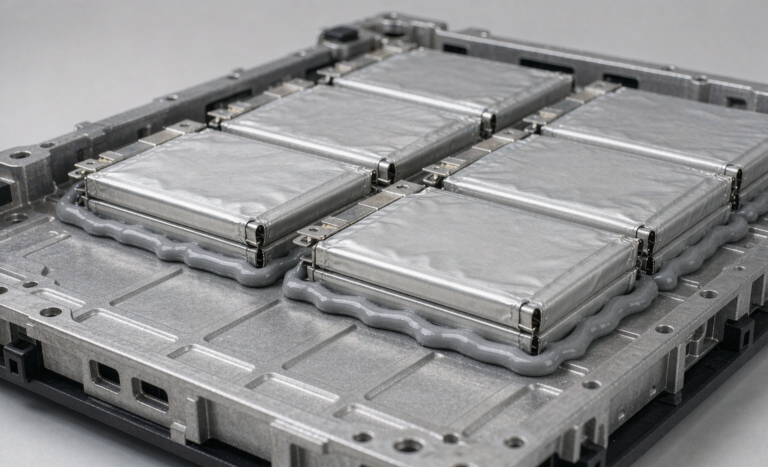
If I am starting a fresh spec, I default to LiFePO4 (LFP) prismatic cells for almost every lithium battery medical cart hospital equipment build. The reasons are simple: LFP thermal-runaway onset sits around 270 degrees C, well above the 150 to 210 degrees C range of NMC chemistries, and that margin is what infection-control and fire-safety committees will sign off on. LFP also tolerates the partial-state-of-charge storage pattern that medical carts actually live in — they sit at 60 to 80% SoC on the wall charger between shifts, not at 100% all night.
NMC still has a place on the lightest vital-signs carts where every kilogram matters, and on a few critical-care applications where the OEM has already validated NMC and does not want to re-qualify. When I have to use NMC, I push the design toward smaller capacity with a higher C-rate and add a stronger thermal-propagation barrier between modules. NMC cells in a hospital environment need cell-to-cell spacing, mica sheets, and a venting path that LFP can usually skip.
For carts that occasionally leave the building (ambulance intake, mobile clinics, parking-lot vaccination tents), I also evaluate sodium-ion at the 25 to 30 Ah scale. Sodium-ion cells ship at 0 V, which simplifies the air-transport classification, and they tolerate -20 degrees C discharge much better than LFP. They are not yet a drop-in replacement for high-current SLA replacement projects, but for a long-runtime low-power mobile workstation they are a credible option worth asking the cell vendor about.
Sizing the pack: shift length, dwell time, and margin
Hospital carts rarely have a single load profile. A point-of-care cart pulls 60 to 90 W average when running a 24-inch monitor, a scanner, a label printer, and a small pump, with 200 to 250 W peaks during print bursts. An anesthesia cart pulls 30 to 50 W most of the shift and 120 to 180 W when the monitor auto-cycles. A vital-signs cart on wheels can pull under 25 W. Before I quote a lithium battery pack, I ask the charge nurse to give me three numbers: the worst-case shift length in hours, the typical 50th-percentile shift, and the maximum number of minutes the cart sits unplugged between patient rooms.
My rule of thumb: required energy = average load (W) x shift hours (h) / 0.90 (inverter efficiency) / 0.92 (depth of discharge) / 0.85 (end-of-life margin). For a typical 80 W average point-of-care cart on a 10-hour shift, that comes out to 80 x 10 / 0.90 / 0.92 / 0.85 = roughly 1,140 Wh of nameplate energy. In a 25.6 V LFP pack, that is a 50 Ah pack, or a single 8S module of 100 Ah cells if I want to give the cart two days of headroom. The end-of-life margin matters because by year six a clinical LFP pack has typically cycled the equivalent of 80% of its rated capacity, and the cart has to still finish a shift.
For carts with a hot-swap workflow, I prefer two smaller packs over one big pack. A 24V 30Ah swappable pack is comfortable for a tech to lift at 8 kg, it fits the existing SLA battery compartment, and the cart has zero downtime if the second pack is on the charger. A 24V 60Ah single pack is heavier and harder to swap, even though it costs less per kWh. The clinical staff almost always choose the lighter swappable pack the first time they have to do a change-over at 2 a.m.
Electrical and mechanical integration
The lithium battery enclosure should be a powder-coated steel or anodized aluminum box with an IP54 rating as a baseline, and IP65 if the cart goes into an isolation room or near a bed-bath area. The medical-cart OEM will already have a battery tray, so the first mechanical question is whether the new pack fits the existing tray footprint and the existing hold-down brackets. SLA trays are usually bigger than the equivalent LFP tray, so I build a stainless adapter plate rather than try to fill the space with foam. Foam absorbs cleaning fluid and is the first thing a hospital’s infection-prevention auditor will flag.
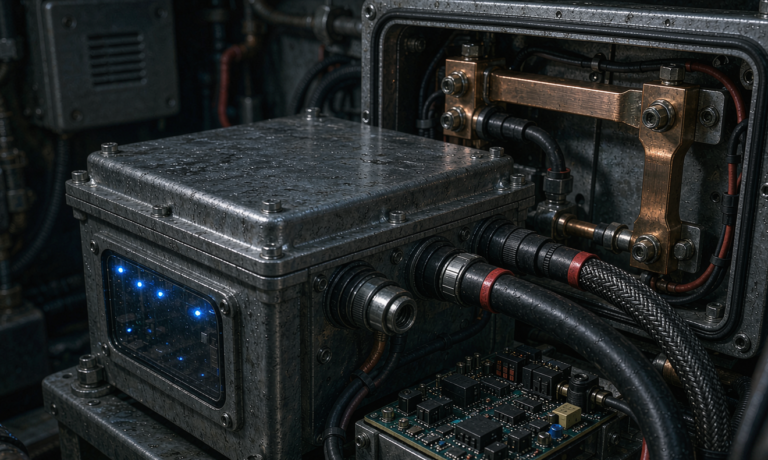
For electrical integration, I always include a hardwired service disconnect within 178 mm (7 in) of the battery positive terminal, per ABYC-style practice adapted to medical carts, and a Class T or ANL fuse sized at 125% of the continuous discharge current. The BMS handles cell balancing, but the fuse handles external faults and is the component that the hospital’s biomedical engineering team will actually know how to test. The output connector should be an Anderson SB175 or a hospital-specified locking connector; never a cigarette-lighter plug, which will arc and fail within months of daily hot-swap use.
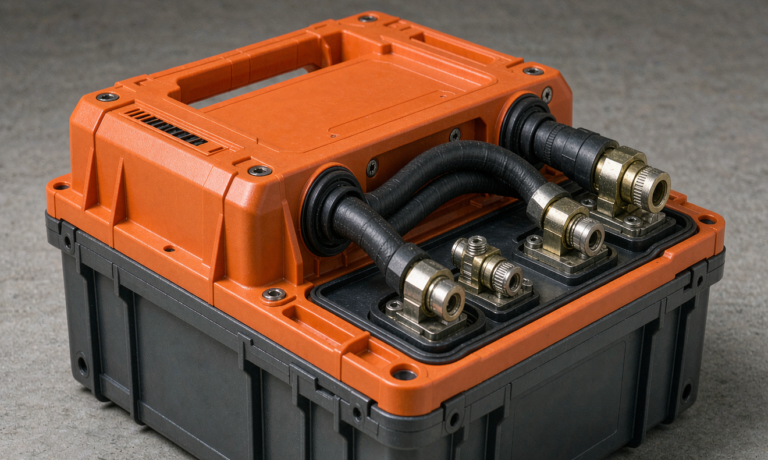
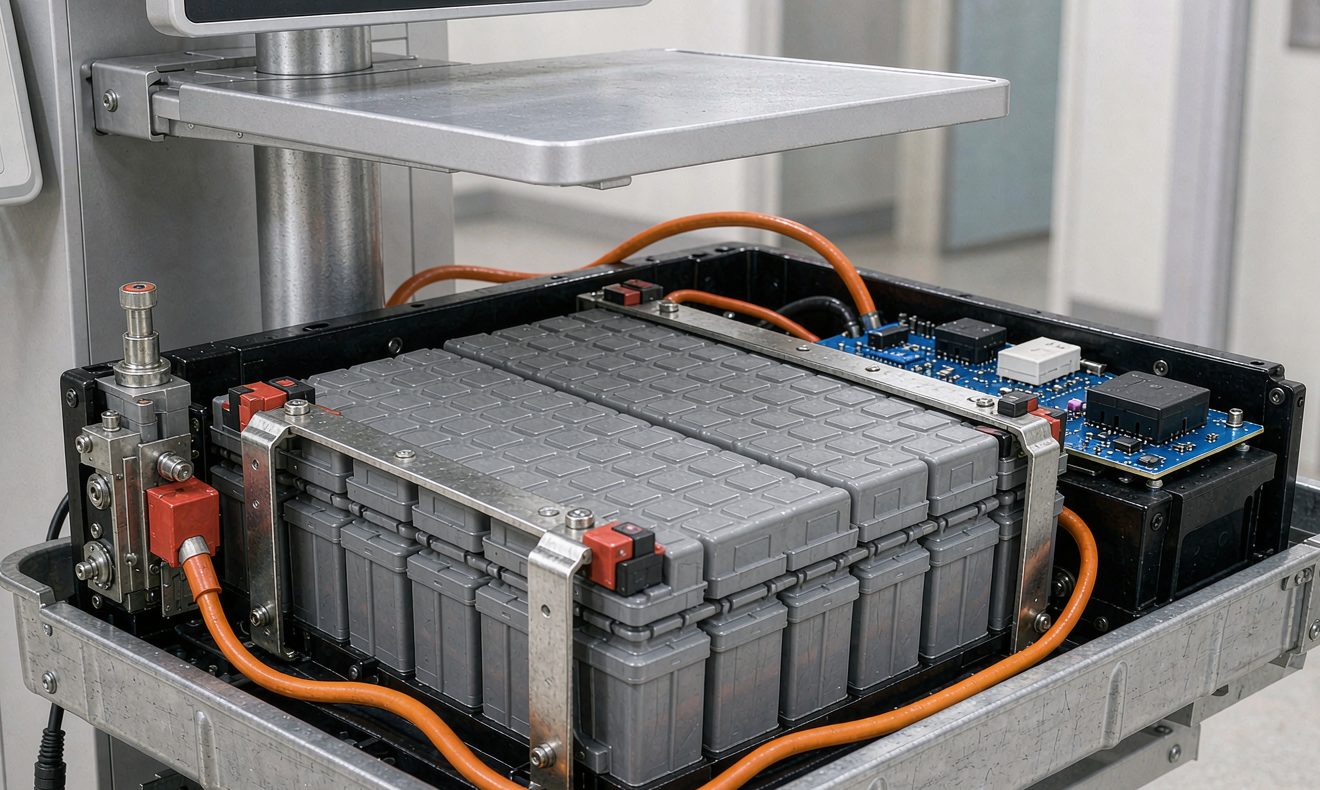
Cabling inside a hospital cart has to be silicone-jacketed and routed so that no conductor is under mechanical strain when the cart is dragged over a threshold. Orange high-voltage cables and a red service-disconnect handle are the convention I have standardized on across our builds; the color cue matters because the cleaning crew, the porter, and the nurse on night shift all interact with the cart, and they need to see at a glance that this is not a 5V USB device.
BMS, telematics, and the CMMS hand-off
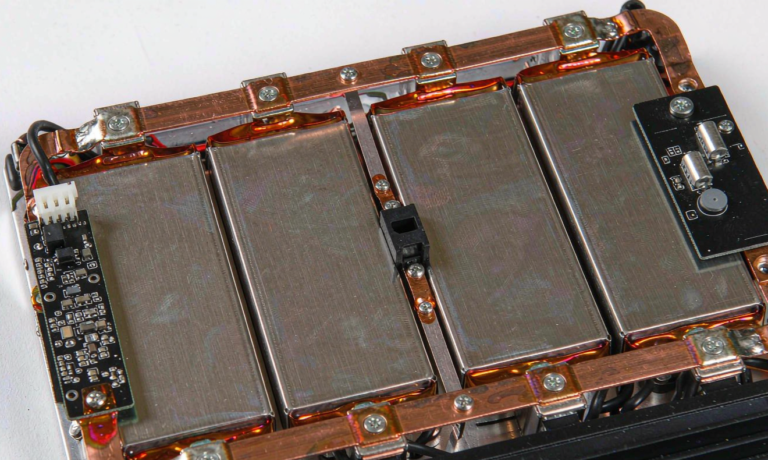
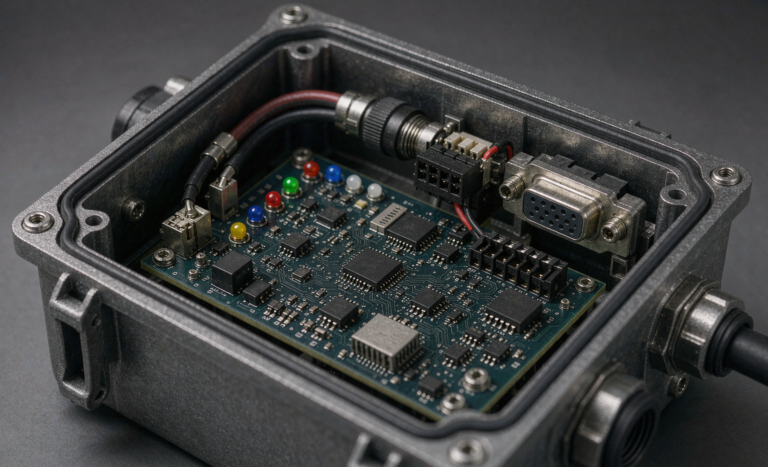
A hospital-grade lithium ion battery BMS should give the biomedical engineering team four things on its diagnostic port: state-of-charge in percent, state-of-health as a percentage of original capacity, individual cell voltages, and a fault log with timestamps. The cart OEM typically displays SoC on a 4-LED gauge, but the BMS should also expose a CAN or SMBus bus so the hospital’s CMMS can poll the pack and log cycle count, maximum cell voltage, and minimum temperature automatically. I have seen carts get retired too early because nobody was tracking the actual cycle count, and I have also seen carts kept in service long past their 80% capacity threshold for the same reason.
Telematics matter on shared mobile equipment. A Bluetooth Low Energy or Wi-Fi gateway that reports pack health to a central dashboard lets the biomedical team catch a failing pack before it leaves a cart stranded mid-shift. The same gateway can push a usage report to the CMMS at month-end and tell the director of nursing exactly how many shifts each cart was on battery, how many shifts it was on shore power, and what the average depth of discharge was. That report becomes the evidence base for right-sizing the next fleet replacement.
Charge management is the single biggest lever on cycle life. A lithium battery pack stored at 100% SoC at 35 degrees C will lose 3 to 6% of capacity per year to calendar aging, while a pack stored at 50% SoC at 20 degrees C will lose well under 1%. Modern medical-cart chargers can be configured to stop at 80 or 90% SoC when the cart is parked, and the carts that follow that protocol consistently hit six to eight years of service life instead of the four that an always-100% cart will deliver.
Cleaning, infection control, and hospital-grade compliance
Battery enclosures in a clinical space have to survive daily wipe-down with hospital-grade disinfectant — typically quaternary ammonium, accelerated hydrogen peroxide, or 70% isopropyl alcohol. The first thing I do is specify a sealed ABS or anodized aluminum enclosure with a continuous gasket, no external cooling vents, and a captive screw cover for the diagnostic port. Vented enclosures are a contamination trap and a fan failure waiting to happen.
From a compliance standpoint, the lithium battery itself is not a medical device under FDA 21 CFR 870 or the EU MDR; the cart is. The pack has to be qualified under UN38.3 for transport, IEC 62133-2 or IEC 62619 for cell safety, and the cart as a whole has to meet IEC 60601-1 (the third edition plus the AAMI ES60601-1 national deviation in the US) for general medical electrical equipment safety. If the cart is used in an oxygen-rich environment, ISO 15001 flammability testing on the enclosure becomes important. The risk-management file per ISO 14971 should reference the battery test reports and identify the residual risks: thermal runaway, electrolyte leakage, and mechanical damage from cart impacts.
For infection-control, I also ask the OEM for a cleanability validation report showing that the enclosure can be wiped to the hospital’s log-reduction target without degradation of the gasket material. This is the audit evidence that closes the loop with the infection-prevention team, and it is the document that the accreditation surveyor will ask for during the next Joint Commission visit.
Acceptance testing and field commissioning
Every lithium battery I deliver to a hospital comes with a five-step acceptance test that the biomedical team can run on the cart before it goes into service. First, a 500 V insulation resistance test on the high-voltage conductors to chassis, looking for at least 1 megohm and rejecting anything below 10 megohms. Second, a full-charge rest for two hours followed by a cell-voltage spread check; a healthy pack settles to under 30 mV, an in-service pack to under 50 mV, and anything above 120 mV on a brand-new pack is a reject. Third, a 0.2C constant-current discharge from full to cutoff with measured capacity no less than 95% of nameplate. Fourth, a peak-load step test where the cart’s worst-case accessory combination is turned on simultaneously and the BMS is observed for any cell dropping below 2.8 V under LFP chemistry. Fifth, a hot-swap dry run if the cart is configured for swappable packs, with a torque check on the output connector.
I keep the test report in the same CMMS record as the pack serial number, the cell lot, the BMS firmware version, and the shipping date. That record is what the hospital uses when the next audit asks for traceability, and it is the same record the manufacturer pulls when a field issue needs to be investigated.
Frequently asked questions
What chemistry should I pick for a hospital medical cart battery?
LiFePO4 (LFP) is the default. It has a 270 degrees C thermal-runaway onset, tolerates partial-state-of-charge storage, and delivers 3,000 to 6,000 cycles at 80% depth of discharge. NMC is only worth the extra risk when every kilogram matters on a lightweight vital-signs cart.
What compliance documents should I require from the battery vendor?
UN38.3 transport test summary, IEC 62133-2 or IEC 62619 cell safety report, UL 1973 recognition on the pack level, an IEC 62133-2 cell datasheet, and a material declaration covering RoHS 3 and REACH SVHC. The cart OEM also has to reference these in the ISO 14971 risk-management file.
How long will a lithium battery last in a hospital medical cart?
Expect six to eight years if the charger is set to 80 or 90% SoC and the cart lives in a 20 to 25 degrees C corridor. Hotter storage or always-100% charging drops the life to four years. End-of-life is typically defined as 80% of original nameplate capacity, not as a sudden failure.
Can a medical cart battery be hot-swapped safely?
Yes, if the pack has a service disconnect within 178 mm of the positive terminal, a locking output connector, and a BMS that goes to sleep below 1 A load. The technician should always swap the depleted pack into a designated charging bay, never at the bedside.
What IP rating is appropriate for a hospital medical cart battery?
IP54 is the minimum for general ward duty. Specify IP65 for isolation rooms, ICU, and any cart that gets spray-cleaned. The enclosure must also use a gasket material that survives daily quat-ammonium or hydrogen-peroxide wipe-down.
Should a medical cart battery include telematics?
Strongly recommended. A CAN or BLE gateway that reports state-of-health to the CMMS catches a failing pack before it strands a cart in service and gives the biomedical team real cycle-count data instead of a calendar-based replacement guess.
How do I right-size the pack for a 10-hour shift?
Multiply the average load in watts by the shift hours, then divide by 0.90 (inverter), 0.92 (depth of discharge), and 0.85 (end-of-life margin). For an 80 W load over 10 hours that gives roughly 1,140 Wh of nameplate, or a 24V 50Ah LFP pack with a 25.6 V nominal rail.