Lithium Battery Thermal Runaway Prevention in Storage Rooms
I am Karl Huang, Senior Lithium Battery Engineer at Horizon Power. Over the last decade I have walked through more than a hundred battery storage rooms, from a two-rack corner of a drone service hangar to a 4,000 m² bonded warehouse holding several megawatt-hours of finished goods. The rooms that worried me most were never the ones with the fanciest suppression system. They were the tidy ones where a pallet of fully charged lithium battery packs had sat untouched for eight months because “nothing was shipping that quarter”.
Thermal runaway prevention in storage is not primarily a firefighting problem. It is an inventory discipline problem, a state-of-charge problem, and a layout problem. Get those three right and your suppression system becomes the insurance policy it was meant to be instead of the only thing standing between you and a total loss. This guide is the checklist I actually use when I audit a lithium battery storage room.
What Thermal Runaway Actually Is: Four Temperature Thresholds
Every lithium ion battery cell crosses the same sequence of thresholds on its way to a fire. Knowing the numbers tells you where you still have room to intervene.
- 80–120°C — SEI decomposition. The solid electrolyte interphase on the anode breaks down and re-forms exothermically. This is slow self-heating, not yet runaway, and it is where most “it just got warm in the corner” stories begin.
- 130–140°C — separator shutdown. Polyethylene separators melt and close their pores, which actually interrupts current. It buys time, but it is not a save.
- 160–170°C — separator collapse. The polypropylene layer loses mechanical integrity, the electrodes touch, and internal short circuits begin in earnest.
- 200–300°C — cathode decomposition. An NCM battery cathode starts releasing oxygen at roughly 200–250°C; an LFP battery with its olivine phosphate structure holds together to roughly 250–300°C. Once the cathode feeds oxygen from inside the cell, no external extinguishing agent can starve the reaction.
After that, vents burst, the electrolyte (lithium hexafluorophosphate in organic carbonates) ignites, and cell surface temperatures reach 600–900°C within seconds. Cell-to-cell propagation in a densely packed lithium battery pack typically takes 10–60 seconds per layer, which is why propagation barriers matter more than the nominal chemistry rating once a single cell has gone.
One number to hold onto: a single 2170 cell carries roughly 15–20 Wh of electrical energy, and combustion of its electrolyte roughly doubles the heat it can dump into its neighbours. A 20 kg e-bike pack is already a room-scale event, not a trash-can fire.
State of Charge Is the Lever You Actually Control
Of everything in this guide, incoming state of charge is the variable with the largest effect on both storage safety and storage life, and it is the one most warehouses fail to police.
Store cells and packs at 30–50% SoC. Never park product at 100% for months. Two reasons:
- Aging. An NCM cell held at 100% SoC and 25°C typically loses 6–8% of its capacity per year, versus 2–3% at 50% SoC. Raise the room to 40°C and the 100% figure roughly doubles to 15–20% per year. Arrhenius is unforgiving: reaction rates approximately double for every 10°C.
- Severity. Accelerating-rate calorimetry on the same cell at 50% versus 100% SoC routinely shows the self-heating onset temperature dropping by 20–40°C and the peak rate of temperature rise increasing severalfold. A pack that merely vents at 50% SoC can jet-flame at 100%.
The opposite error is just as dangerous. Never store at true zero. Below roughly 1.5–2.0 V the copper current collector dissolves and re-plates as metallic dendrites, so the cell can develop an internal short the next time you charge it. Keep NCM cells in the 3.3–3.7 V band and LFP cells in the 3.2–3.4 V band during long storage.
For outbound logistics, remember that air freight under IATA DGR requires lithium ion cells and batteries shipped as UN3480 to be at no more than 30% SoC. If your storage room is also your pick-and-pack area, staging product at 30% means it is already compliant when the forwarder arrives.
Room Design: Compartmentation, Spacing and Clearances
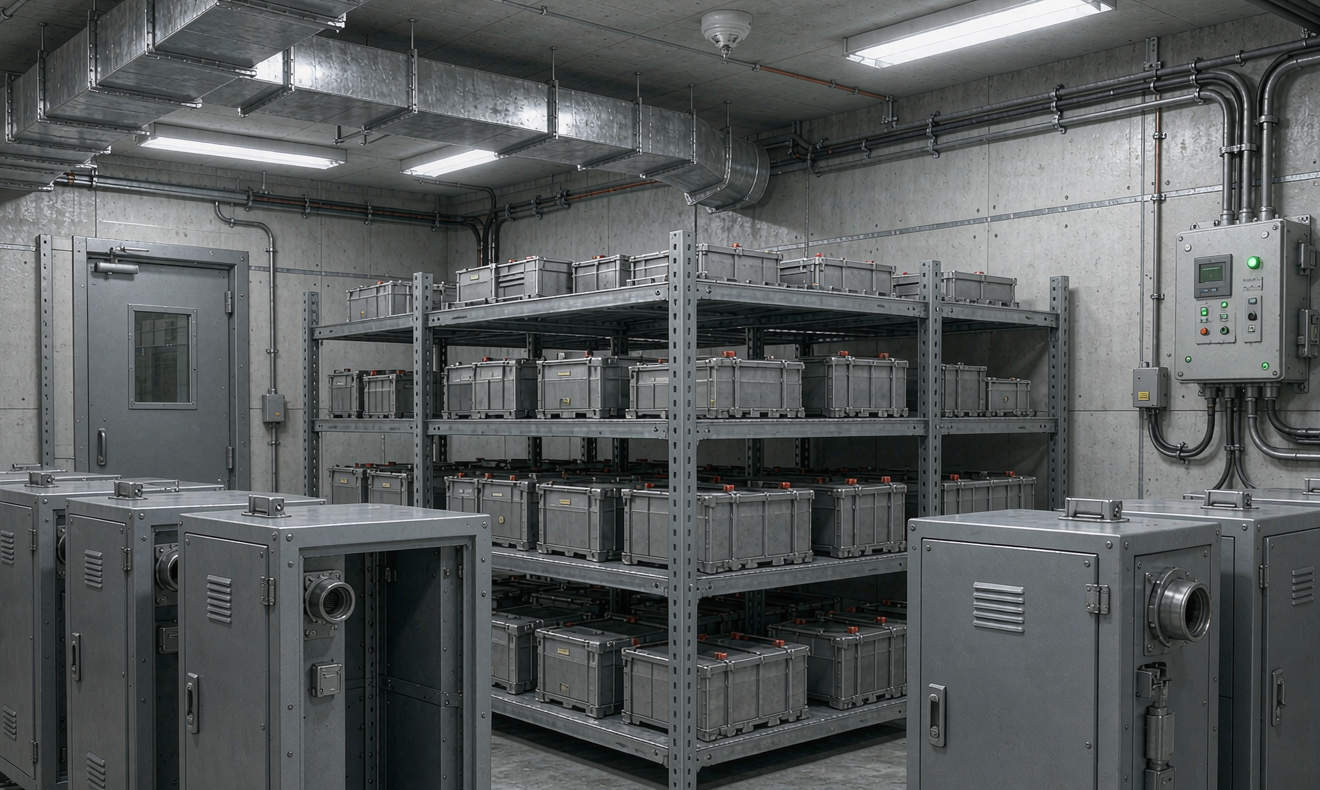
A storage room for lithium batteries should hold lithium batteries and nothing else. No cardboard, no packaging foam, no pallets of marketing material, no solvent cabinet. When I find printer paper stacked next to a rack of cells, I write it up as the highest-severity item on the report.
- Fire rating. A dedicated room separated by 1-hour construction is the practical minimum for modest quantities; anything at industrial scale should be 2-hour rated with a self-closing, latched fire door. Fire-rated battery cabinets to EN 14470-1 Type 90 are a good alternative for tens of kWh rather than hundreds.
- Spacing. I specify at least 0.9 m (3 ft) between storage piles or arrays, aisles no narrower than 2.4 m, and pallet heights capped around 1.5 m with no double-stacking. The point is not tidiness; it is giving a hose team a line of sight and a path, and slowing radiative transfer between piles.
- Sprinkler clearance. Maintain the standard 450 mm (18 in) clear space below sprinkler deflectors. I have failed more audits on pallets pushed 100 mm too high than on any electrical issue.
- Energy per compartment. Rather than trusting a single square-metre rule, I size compartments so that one fire area holds a few hundred kWh at most, and I distribute a large inventory across multiple separated rooms rather than one big one.
- Floor and drainage. Non-combustible sealed floor, no open floor drains to the storm system. Firefighting runoff from a lithium battery fire contains hydrogen fluoride and should be contained and treated, not washed into the environment.
- Environment. 15–25°C, relative humidity below 60%, no direct solar gain on the racks. A room that hits 40°C in August is accelerating calendar aging on every unit in it.
If your facility also stores a 12v lithium battery line for gate operators or backup panels, keep those in the same discipline. Small format does not mean small risk; it means people handle them casually and drop them.
Detection: Catch the Off-Gas, Not the Flame
By the time you see flame you have lost. Cells vent before they burn, and the vented gas is a diagnostic gift: carbon monoxide, carbon dioxide, hydrogen, methane, ethylene, plus hydrogen fluoride and phosphoryl fluoride from the salt. Detect gas and you buy tens of seconds to several minutes.
- Gas sensing. I install CO and H₂ sensors plus a broad VOC sensor at high level near the racks. Practical alarm set points I use: CO at 25 ppm above baseline, H₂ at 10–20% of its lower flammability limit (roughly 0.4–0.8 vol%).
- Aspirated smoke detection. Very-early-warning aspirating systems find the aerosol from a single venting cell long before a ceiling spot detector reacts.
- Rate of rise. A sustained dT/dt of 1°C/min at a cell or module is the working definition of runaway used across much of the industry, and it is a far better trigger than any absolute temperature. Wire it to the same panel as the gas sensors.
- Infrared scanning. A quarterly IR sweep of every rack costs an hour and finds the one module sitting 8°C above its neighbours, which is almost always a rising internal resistance or a partial internal short.
- Electrical trending. Log open-circuit voltage monthly. A unit that has drifted more than 2% in SoC, or more than 50 mV, from the rest of its production batch gets pulled to quarantine, not “watched next month”.
Detection should do something, not just beep. My minimum automatic actions on a gas or rate-of-rise alarm: exhaust fans to full, supply dampers closed, magnetic door holders released, and a push notification to two named people, not a generic mailbox.
Suppression: Cooling Beats Smothering
This is where a lot of procurement money is wasted. A lithium ion battery fire is an internal-oxygen, self-heating metal-and-solvent fire. Smothering it does not stop it.
- Water is the coolant of choice. Automatic sprinklers remain the primary recommended protection in FM Global Data Sheet 5-33 for stored lithium-ion commodity. Design densities in the order of 12 mm/min (0.3 gpm/ft²) over a roughly 186 m² (2,000 ft²) design area are typical for ceiling protection of stored cells, with in-rack sprinklers for high-piled storage. Confirm the current edition and the actual commodity classification with your insurer and AHJ before you build.
- Clean agents do not cool. FK-5-1-12 or HFC-227ea will knock down flaming combustion, but because they remove almost no heat, re-ignition within minutes to hours is common unless water is applied afterwards.
- Class D extinguishers are the wrong tool. Lithium-ion is not a combustible-metal fire. Dry powder and ABC extinguishers can interrupt visible flame while the cell keeps heating underneath.
- Damaged or vented units go outside. A smoking pack belongs in an outdoor quarantine zone at least 15 m from any building, on non-combustible ground, ideally submerged in water for 24–72 hours until thermography confirms it is at ambient. Never seal a venting pack in a container.
- Post-incident monitoring. After any event, hold the area under thermal observation for at least an hour. Re-ignition after the hose team leaves is the single most common secondary loss I see in incident reports.
Suppression design is also a battery pack design conversation. If you are specifying a custom battery solution for a product that will sit in a customer’s storeroom for a year before commissioning, ask for ceramic or intumescent barriers between modules, a vent path that directs gas away from adjacent cells, and a storage-mode function in the BMS solution that discharges the pack to 30% if it is not cycled for 60 days.
An Inspection Rhythm That Actually Prevents Events
Prevention is a calendar, not a poster. This is the cadence I hand over at the end of an audit:
- At goods-in: verify SoC (30–50%), record pack voltage and serial numbers, photograph any case damage, reject anything with a crushed corner or a compromised connector.
- Weekly walk: no swelling (for pouches, any visible thickness increase beyond about 3% is a quarantine trigger), no electrolyte smell, no corrosion on terminals, pallets intact, aisles and sprinkler clearance unobstructed.
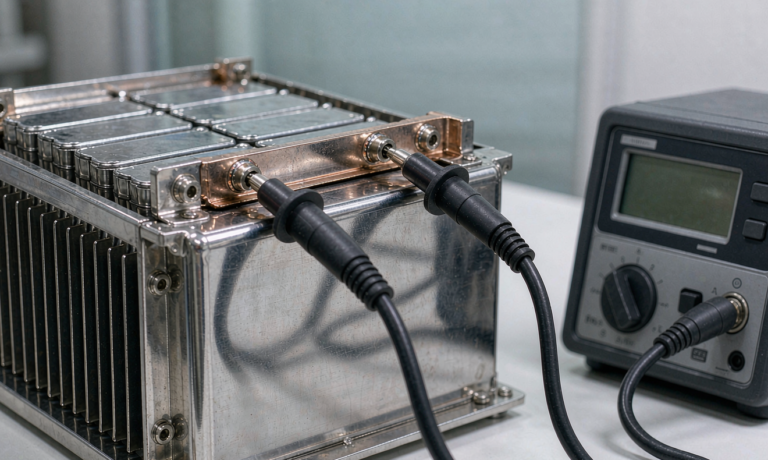
- Monthly: sample 5–10% of stored units for OCV and AC internal resistance. A resistance rise of 20–30% against the incoming baseline is the earliest reliable electrical warning of a cell going bad.
- Quarterly: top-up charge any unit whose OCV has drifted toward the bottom of the band; IR scan every rack; test the gas detection and the exhaust interlock.
- Six-month limit: I do not let finished goods sit longer than 6–12 months without a full re-check and a documented decision. Rotate stock FIFO and treat inventory age as a safety parameter.
Standards Map for a Defensible Storage Room
When something does go wrong, the first question an insurer asks is which standard you were working to. The map I build into every storage procedure:
- UN 38.3 (T1–T8) — transport qualification. Note that T6 impact/crush and T8 forced discharge are run on cells conditioned to about 50% of rated capacity, which is one more reason to store near that level.
- IEC 62133-2 — safety of portable sealed cells and batteries; IEC 62619 for industrial applications.
- UL 1973 for stationary and motive batteries, UL 9540 / UL 9540A where the storage room is attached to an energy storage system.
- NFPA 855 (installation of ESS), NFPA 1 and NFPA 13 (sprinklers), plus the locally adopted fire code.
- FM Global Data Sheet 5-33 for commodity storage protection.
Documentation matters as much as hardware: a storage log with SoC at intake, monthly OCV/IR records, IR images, training records, and an incident log. It is also what lets us, as the lithium battery manufacturer, stand behind a warranty claim with evidence rather than opinion.
Frequently Asked Questions
What state of charge should lithium batteries be stored at?
30–50% is the target for long-term storage. It minimises calendar aging and dramatically reduces the energy available if a cell does fail. Below about 20% you risk copper dissolution and latent internal shorts; at 100% you maximise both aging and event severity. Air shipment under IATA DGR caps UN3480 at 30%.
What room temperature is safe for a lithium battery storage area?
Hold 15–25°C with relative humidity under 60%. Aging rates roughly double for every 10°C increase, so a room that reaches 40°C in summer can cost you more capacity in one season than two years at 20°C. Never store below −20°C or above 60°C, and never charge a cold pack below 0°C.
Can I store damaged or swollen packs in the same room?
No. A swollen, vented, or impact-damaged unit goes to an outdoor quarantine point at least 15 m from buildings, on non-combustible ground, with thermal monitoring and ideally water immersion for 24–72 hours. It does not go back on the rack, and it does not go in a sealed container.
Is a fire-rated cabinet enough, or do I need a separate room?
For tens of kWh, an EN 14470-1 Type 90 or FM-approved cabinet with ducted vents, in a well-ventilated non-combustible area, is usually proportionate. Once you are into hundreds of kWh, or any quantity of large-format packs, you want a dedicated fire-separated room with detection, exhaust and automatic sprinklers.
Do sprinklers actually work on a lithium battery fire?
They do not extinguish the cell reaction, but they are still the recommended primary protection because water removes heat, cools neighbouring cells and limits propagation. That is why clean-agent-only designs are discouraged: they suppress flame without cooling, and re-ignition follows.
Is an LFP battery safer to store than an NCM battery?
Yes, measurably. LFP onset temperatures are typically 30–60°C higher, self-heating rates are lower, and the olivine cathode releases far less oxygen on decomposition. That said, an LFP pack at 100% SoC in an overheated, over-packed room is still a serious hazard. Chemistry lowers the probability; layout and state of charge lower the consequence.
How long can batteries sit in storage before they need attention?
I check OCV and internal resistance monthly and set a hard review at 6 months, with 12 months as the outside limit for finished goods. Self-discharge of 1–3% per month is normal for a pack with a BMS; anything faster indicates a fault and that unit should be pulled, not topped up.