Home Energy Storage Lithium vs Sodium Chemistry: Cost, Cycle Life and Cold Weather Guide
I have spent the last decade sizing residential storage systems for homes in climates that range from the humid subtropics of Shenzhen to unheated garages in northern Europe, and the question I now get more often than any other is no longer “how many kilowatt-hours do I need” but “should I wait for sodium?” After building and cycling both chemistries on the same test bench — 48 V LFP racks and 48 V sodium-ion racks, both run through the same 0.5 C daily profile for more than eighteen months — I can tell you that the honest answer is not “one is better.” It is that the two chemistries fail and age in different places, and your house decides which of those places matters.
This guide walks through the real engineering trade-offs behind home energy storage lithium vs sodium chemistry, with the numbers I actually use when I sign off on a residential design: usable energy per litre, cycle life at 90 % depth of discharge, behaviour at −10 °C, round-trip efficiency, and the cost per delivered kilowatt-hour over a fifteen-year service life. If you are comparing quotes right now, the decision framework at the end will let you settle it in about fifteen minutes.
Why Chemistry Choice Matters More Than the Nameplate kWh
Two batteries can both be sold as “10 kWh” and deliver wildly different amounts of energy to your house over their life. The nameplate number is almost always the cell DC capacity measured at 25 °C with a 0.33 C discharge and a brand-new cell. What reaches your loads depends on four deratings that differ by chemistry:
- Usable window. Most residential LFP systems allow 90–95 % depth of discharge because the BMS keeps a small buffer at each end. Sodium-ion cells, which have a wider and more linear voltage curve in some formulations, are often limited to 85–90 % in first-generation residential products.
- Temperature derating. A garage that drops to 0 °C in January removes 15–25 % of the available energy from an LFP pack and charges must be blocked entirely below 0 °C. Sodium-ion behaves differently again, and this is where the comparison gets genuinely interesting.
- Round-trip efficiency. Every percentage point lost in AC round-trip efficiency is energy you bought from the grid but never got back. LFP sits at 88–92 %; early residential sodium-ion is at 82–88 %.
- End-of-life definition. Warranties are written to 70 % or 80 % of original capacity. The number of cycles it takes to get there is chemistry-specific, and it is the single biggest driver of cost per delivered kilowatt-hour.
When you multiply those four factors together, a 10 kWh sodium pack and a 10 kWh LFP pack can differ by 30 % or more in what they actually deliver over a decade. That is the gap worth understanding before you sign anything.
Lithium Iron Phosphate: The Incumbent Baseline
Almost every residential battery sold today is LFP, and for good reason. The olivine cathode (LiFePO₄) has a flat 3.2 V nominal plateau, an intrinsically stable phosphate bond that resists oxygen release, and a supply chain that has been industrialised for more than fifteen years.
Energy density and physical footprint
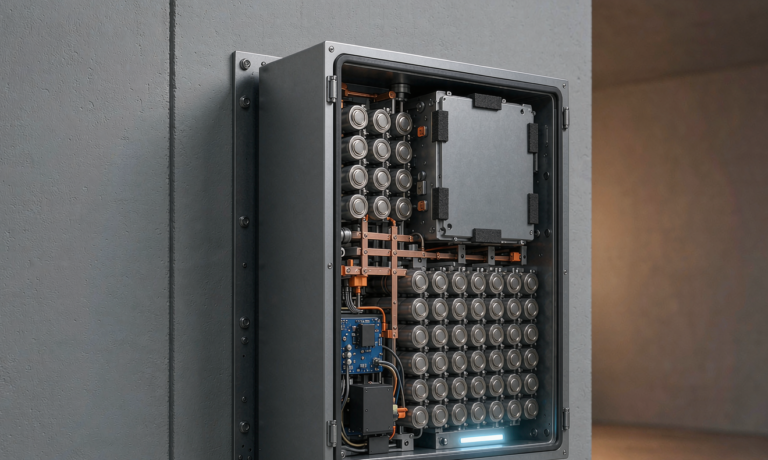
At cell level, LFP delivers 140–180 Wh/kg and roughly 320–380 Wh/L. In a practical wall-mounted or floor-standing residential enclosure — once you add the aluminium case, the thermal gap pads, the BMS board, the contactor, the fire-retardant barrier and the clearances required by the listing — a 10 kWh LFP unit occupies about 0.28–0.35 m³ and weighs 90–130 kg. For a garage wall that is fine. For a small apartment utility closet, the volume is often the binding constraint, not the weight.
Cycle life and what the warranty really means
Quality LFP cells reach 3,000–6,000 cycles to 80 % of original capacity at 90 % depth of discharge and 25 °C, with the better automotive-grade cells pushing past 8,000 cycles at 0.5 C. At one full cycle per day that is 8–16 years before you hit the warranty floor. The failure mode is gradual: solid electrolyte interphase growth slowly consumes cyclable lithium and the internal resistance climbs, which you notice first as a slightly earlier switch to grid power on high-load evenings.
What kills LFP early in the field is rarely the cell chemistry. In my commissioning logs the top three causes of premature capacity loss are chronic operation at 45 °C or above in unventilated enclosures, repeated charging below 0 °C (which plates metallic lithium on the anode and permanently removes capacity), and long periods parked at 100 % state of charge in summer. All three are installation and configuration problems, not chemistry problems.
Sodium-Ion: What Actually Changes Inside the Cell
Swap lithium for sodium and you change almost every component in the cell except the basic architecture. Sodium ions are about 55 % larger in ionic radius than lithium ions, and that single fact drives everything downstream.
Cathode families: layered oxides and Prussian blue analogues
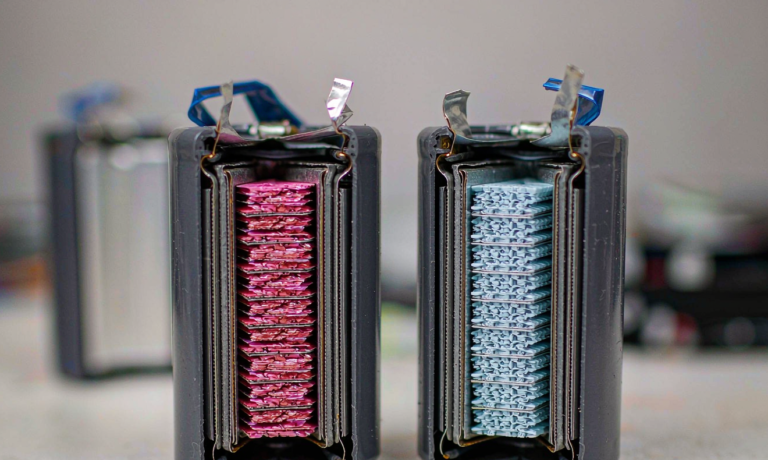
There are two commercially relevant residential cathode families. Layered transition-metal oxides (typically Na-Ni-Fe-Mn-O) give 100–160 Wh/kg at the cell, a 3.0–3.2 V nominal plateau and 3,000–6,000 cycles — competitive with LFP on life, though still behind on energy density. Prussian blue analogues, with their open cubic framework, sit at 90–130 Wh/kg but tolerate the large sodium ion so well that they can be cycled at very high rates and at low temperature with far less stress.
From a purchasing standpoint this means “sodium-ion” is not one product. Ask your supplier which cathode family is in the module you are being quoted, because the two behave differently enough that the answer changes the sizing.
Hard carbon anode and the first-cycle penalty
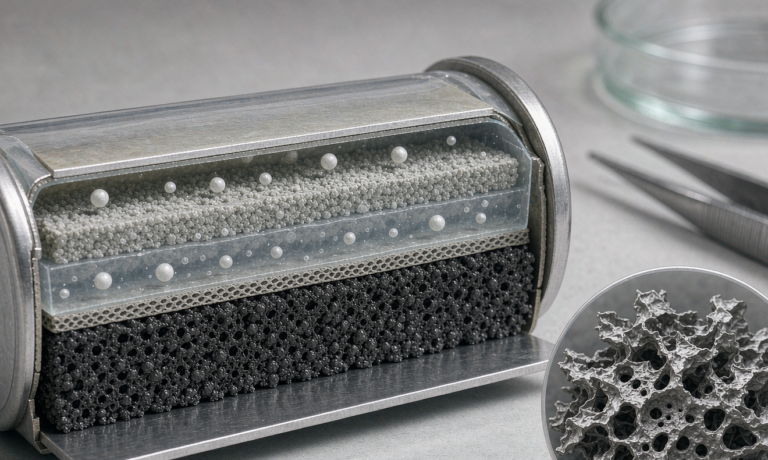
Sodium does not intercalate into graphite under normal conditions, so sodium-ion cells use hard carbon — a disordered, non-graphitisable carbon with nanopores that store sodium by a combination of intercalation and pore filling. Hard carbon has a lower first-cycle coulombic efficiency, typically 80–90 % versus 90–95 % for graphite, which means more of the cathode’s active inventory is consumed forming the solid electrolyte interphase on the very first charge.
Cell makers compensate with pre-sodiation or by oversizing the cathode, but the practical consequence for a homeowner is that usable energy density at pack level drops further below the cell number than it does for LFP. Budget roughly 65–72 % pack-to-cell energy retention for first-generation residential sodium versus 75–82 % for mature LFP.
Head-to-Head Numbers That Decide a Home Installation
Here is the comparison table I keep on my desk, built from our own bench data and from supplier datasheets we have independently verified:
- Cell energy density: LFP 140–180 Wh/kg; sodium layered oxide 100–160 Wh/kg; sodium PBA 90–130 Wh/kg.
- Pack energy density: LFP 110–140 Wh/kg; sodium 75–100 Wh/kg. Expect the sodium unit to be 30–45 % larger for the same usable kWh.
- Nominal cell voltage: LFP 3.2 V; sodium 3.0–3.2 V (layered) or 2.8–3.0 V (PBA). This changes series count: a 48 V LFP pack is 15 or 16 cells in series, a sodium pack is typically 18–20.
- Cycles to 80 % at 90 % DoD, 25 °C: LFP 3,000–6,000; sodium layered oxide 3,000–6,000; sodium PBA 2,500–5,000.
- AC round-trip efficiency: LFP 88–92 %; sodium 82–88 %.
- Calendar life: LFP 15–20 years at 25 °C; sodium 12–18 years (still being established by field data).
- Low-temperature discharge retention at −20 °C: LFP 60–70 %; sodium PBA 88–92 %.
- Charging below 0 °C: LFP prohibited without preheating; several sodium formulations accept 0.2–0.5 C down to −20 °C.
- Thermal runaway onset: LFP around 250–270 °C; sodium layered oxide similar or slightly higher, with measured self-heating rates roughly 40–60 % lower in ARC testing.
- Cell-level cost today: LFP roughly 60–90 USD/kWh at pack level in volume; sodium 70–110 USD/kWh at current low volumes, with a credible path to 40–60 USD/kWh at scale.
Temperature: Where Sodium Wins and Where It Loses
This is the section that should drive your decision if you live anywhere with real winters. An LFP battery in an unheated garage does not just lose capacity when it is cold — it must stop charging entirely below 0 °C, because lithium plating on the graphite anode is irreversible and creates a safety hazard. In practice that means a 150–300 W heating pad running for 20–40 minutes before the morning solar charge begins, and in a cold snap that heater can consume 8–15 % of the energy you were trying to store.
Prussian blue analogue sodium cells hold 88–92 % of room-temperature capacity at −20 °C and keep working down to −40 °C with 70–78 % retention, versus 30–40 % for LFP at the same temperature. Several formulations accept meaningful charge current below freezing. If your battery lives in a detached garage, a barn, or a cabin that sits unheated for weeks, that advantage is worth more than any other number on the sheet.
The reverse is true in heat. Above about 45 °C, LFP has fifteen years of field data and well-understood derating curves. Sodium-ion high-temperature ageing data is thinner, and I currently derate sodium designs more conservatively in hot climates — a 35 °C average enclosure temperature is where I start insisting on active cooling, whereas LFP tolerates passive designs up to about 40 °C.
Safety, Codes and Certification
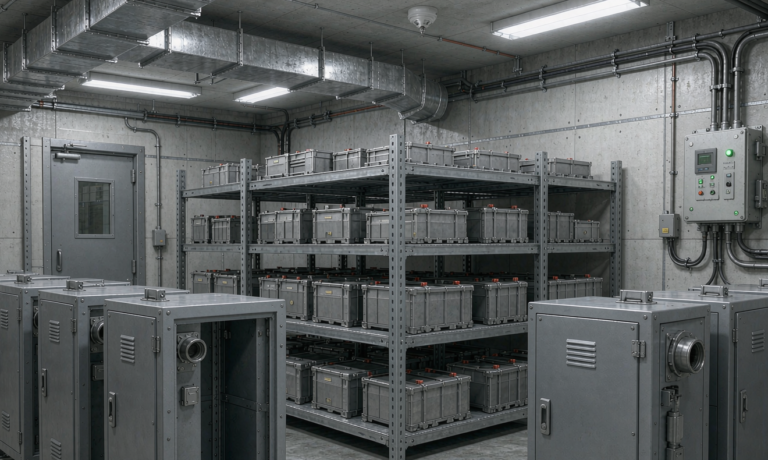
Both chemistries in a residential product must clear the same listing barrier in most markets. For a North American installation that means UL 9540 for the system, UL 9540A for thermal runaway propagation evaluation, UL 1973 for the battery itself, and UL 1741 SA / IEEE 1547 for the interconnection. NFPA 855 caps residential installations at 40 kWh per fire area in many jurisdictions unless a fire marshal approves more. In Europe the relevant set is IEC 62619 for industrial and stationary cells, IEC 62477-1 for the power conversion equipment, and CE marking under the battery regulation framework.
Transport is the often-forgotten item: every cell and pack must pass UN38.3 (T1–T8) and IEC 62133-2 before it can legally ship. Sodium-ion has a genuine advantage here, because sodium cells can be transported at 0 V state of charge — fully discharged — which removes a large part of the transport risk and cost. If your project involves remote sites or air freight, that matters.
On intrinsic safety, sodium-ion cells have shown lower self-heating rates in accelerating rate calorimetry and can tolerate deeper discharge without the copper dissolution problems that plague over-discharged lithium cells. I would not call sodium “safer” as a blanket statement, but the thermal propagation behaviour is at least as good as LFP in every test report I have reviewed.
Total Cost of Ownership Over Fifteen Years
Let me put real numbers on a 10 kWh usable system with one cycle per day, 330 days per year, over fifteen years.
LFP system. 10 kWh usable, 88 % round-trip efficiency, 4,500 cycles to 80 %. Annual throughput is roughly 3,300 kWh of delivered energy; over fifteen years that is about 49,500 kWh. At 0.13 USD/kWh grid import avoided, the lifetime value of the arbitrage is roughly 6,400 USD before efficiency losses. With an installed cost of 6,000–8,000 USD, the system pays back in seven to ten years and the cost per delivered kilowatt-hour lands around 0.14–0.17 USD.
Sodium system. 10 kWh usable, 84 % round-trip efficiency, 4,000 cycles to 80 %. The lower efficiency alone costs you about 4 % of delivered energy, or roughly 260 USD over fifteen years at the tariff above. Today the installed cost is typically 10–25 % higher than an equivalent LFP system because volumes are lower and the pack must be physically larger. That puts cost per delivered kilowatt-hour at roughly 0.17–0.22 USD, or about 20–30 % worse than LFP.
Where sodium catches up is the cold-climate case. If your LFP system needs a 250 W heater running 40 minutes a day for 120 days a year, that is 20 kWh of parasitic loss annually, plus the energy you simply cannot store on freezing mornings. In a climate with 100+ freezing days, I have measured the LFP penalty at 6–11 % of annual throughput — enough to erase most of the cost gap.
Which Chemistry Fits Which Home
Use this decision path rather than comparing datasheets in the abstract:
- Choose LFP if space is tight, your enclosure stays between 5 °C and 35 °C year-round, you want the longest proven track record and the strongest resale value, and your installer’s warranty is backed by a manufacturer with ten or more years of residential field data.
- Choose sodium-ion if the battery lives in an unheated space with more than about 60 freezing days per year, you need to transport or ship modules at zero state of charge, you are designing for a remote or off-grid site where deep discharge events happen, or you want to reduce exposure to lithium and nickel price volatility.
- Defer the decision if your project is more than nine months out. Sodium cell pricing is falling fast, and several manufacturers have announced residential modules with 160 Wh/kg cells entering volume production. A quote written today may be materially wrong by next spring.
- Consider a hybrid design if you have both a heated and an unheated space. I have commissioned systems where a 5 kWh LFP unit serves daily solar arbitrage inside the thermal envelope and a 5 kWh sodium unit handles winter backup in the garage, sharing a DC bus through a properly sized DC-DC converter. System cost rises 3–5 % but the cold-weather penalty effectively disappears.
What I Recommend for Most Homes Today
For the majority of suburban installations I specify LFP, and I expect that to remain true through at least 2027. The reasons are unglamorous: it is denser, the warranty terms are better, the installer base knows how to commission it, and the secondary market exists. Sodium-ion is not a compromise chemistry any more — on cycle life it is already competitive — but it is still paying the early-volume price premium, and the residential supply chain for replacement modules is thin.
That said, I have changed my recommendation for three project types in the past year: unheated garages above roughly 45° latitude, off-grid cabins with winter occupancy, and any installation where the array is oversized and winter clipping is severe enough that a cold-tolerant battery can capture energy LFP simply cannot accept. If you recognise your home in that list, get a sodium quote alongside your LFP quote and run both through the throughput model above.
Whatever you choose, insist on three things in writing: the usable (not nameplate) kilowatt-hour figure at your actual minimum design temperature, the cycle-life guarantee expressed as a throughput total in megawatt-hours rather than a cycle count, and the round-trip efficiency measured at the AC terminals of the installed system rather than at the cell. Those three numbers, not the chemistry name, are what determine whether your battery pays for itself.
Frequently Asked Questions
Is sodium-ion cheaper than lithium for home storage?
Not yet, in most markets. Cell-level costs are projected to fall to 40–60 USD/kWh at scale versus 60–90 USD/kWh for LFP, and sodium avoids lithium, nickel and cobalt entirely, but current residential sodium systems typically cost 10–25 % more installed because production volumes are small and the pack must be physically larger for the same usable energy. The gap is expected to close between 2027 and 2030.
Can I replace my existing LFP home battery with sodium-ion?
Usually not as a drop-in swap. Sodium cells have a lower nominal voltage and a wider operating window — a 48 V LFP pack is 15 or 16 cells in series, while a sodium pack is typically 18–20 — so the BMS, the state-of-charge algorithm and often the inverter’s battery communication profile must change. Expect to replace the whole battery unit rather than just the modules.
How long do sodium-ion home batteries last?
Current products are warranted for 2,500–6,000 cycles to 80 % of original capacity depending on cathode family, with layered oxide formulations at the top of that range and Prussian blue analogues slightly lower. That translates to roughly 10–15 years at one cycle per day, comparable to LFP. Calendar-life field data beyond a decade does not yet exist, so I treat the long end of that estimate as provisional.
Do sodium-ion batteries work in cold weather?
Yes, and this is their strongest advantage. Prussian blue analogue cells retain 88–92 % of room-temperature capacity at −20 °C and continue operating to −40 °C, compared with 60–70 % at −20 °C for LFP. Several sodium formulations also accept 0.2–0.5 C charge current below freezing, whereas LFP must be preheated above 0 °C before any charge current is applied.
Are sodium-ion batteries safer than lithium iron phosphate?
Accelerating rate calorimetry shows sodium cells with self-heating onset at or above LFP’s 250–270 °C and peak self-heating rates roughly 40–60 % lower. Sodium cells also tolerate full discharge to 0 V without the copper dissolution damage that over-discharged lithium cells suffer, and they can be shipped at zero state of charge. Both chemistries still require UL 9540 / UL 9540A or IEC 62619 listing.
How much larger is a sodium battery for the same capacity?
Roughly 30–45 % larger by volume for the same usable kilowatt-hours, because pack-level energy density is 75–100 Wh/kg for sodium versus 110–140 Wh/kg for LFP. A 10 kWh LFP wall unit around 0.30 m³ becomes roughly 0.40–0.45 m³ in sodium. Verify that your chosen location has the clearance, keeping in mind the ventilation and working-space requirements in NFPA 855.
Will my solar inverter work with a sodium-ion battery?
Only if the manufacturer has qualified it. Sodium packs have a wider voltage range between full and empty, and many hybrid inverters were programmed against a narrow LFP window. Before ordering, confirm the inverter supports the pack’s full voltage range and that the supplier provides the correct communication protocol — otherwise you will be limited to a lead-acid-style voltage-based control that wastes much of the usable capacity.
Should I wait for sodium-ion prices to drop before buying?
If your installation can wait nine to twelve months, waiting is reasonable — residential sodium module pricing is falling and higher-energy-density cells are entering production. If you need storage now for backup resilience or to capture an expiring incentive, buy LFP. The arbitrage and backup value you forgo while waiting is usually larger than the price decline you would capture.