Sodium-Ion Battery Cathode Materials: Layered Oxides vs (2)
Why Cathode Choice Defines a sodium-ion battery
When I spec a sodium-ion battery for a stationary storage or low-speed mobility customer, the conversation almost always turns to the same two words within the first ten minutes: which cathode. On the lithium side, NMC versus LFP has been settled in most buyers’ minds by now. On the sodium side, the choice is still open, and the operating envelope you can promise your customer depends almost entirely on whether you choose a layered oxide or a Prussian blue analogue. Both are real production chemistries shipping in commercial sodium-ion battery cells in 2026, but they behave differently in ways that ripple from raw-material sourcing all the way to calendar life on a sub-zero rooftop in northern China or Scandinavia.
Layered oxides (P2/P3-type NaxTMO2) are the structural descendants of the lithium NMC layered family. They offer high specific energy, good rate, and a voltage profile that most BMS chips already handle gracefully. Prussian blue analogues (PBA, AxM[Fe(CN)6]y·nH2O) are the cost play: cheap precursors, an open framework that tolerates large Na+ ions, and a manufacturing route that runs at room temperature. They are the two extremes of a much wider sodium-ion battery cathode materials landscape, and the trade-offs are what I want to walk through in this article. I will also touch on polyanion compounds (Na3V2(PO4)3, NASICON) and tunnel oxides, because they show up in the same RFQ conversation even though the volume is smaller.
Layered Oxides: High Energy, High Maintenance
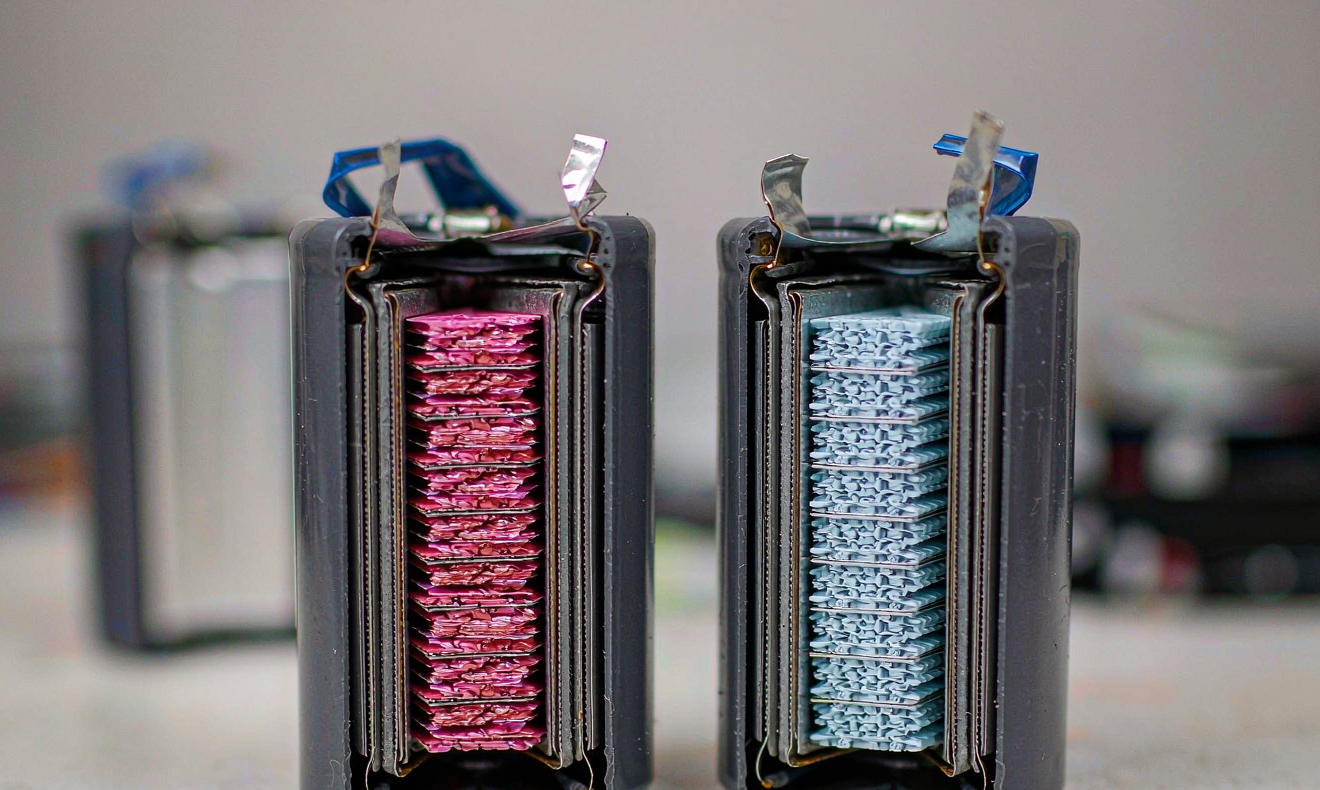
A layered oxide cathode stores sodium between transition-metal oxide slabs. The two most common structures are P2 (Na sitting in trigonal prismatic sites between MO2 layers) and O3 (octahedral sites, closer to the lithium NMC analog). Typical chemistries you will see on a sodium-ion battery data sheet are Na0.67Mn0.5Fe0.5O2 (Mn-Fe), NaNi1/3Fe1/3Mn1/3O2 (NFM), and Cu/Mg/Ti-doped variants that suppress the destructive Jahn-Teller distortion of Mn3+.
On a cell level, you should expect:
- Working voltage: 3.0-3.2 V average, charge end at 4.0-4.1 V, discharge end at 1.5-2.0 V (versus Na/Na+). Pack-level nominal is around 3.0 V, which lets you build 12 V, 24 V, 48 V and 96 V packs in straightforward series strings.
- Specific energy: 100-160 Wh/kg at the cell, 70-110 Wh/kg at the pack level. This is lower than NMC but competitive with LFP, and is the reason a sodium-ion battery is now a credible replacement for a stationary LFP rack, and in some cases an LFP traction pack on a low-speed logistics vehicle.
- Cycle life: 3,000-6,000 cycles to 80% capacity at 100% DoD, 1C/1C, 25°C. Calendar life tends to be 10-15 years at 25°C, 50% SoC average, comparable to a well-managed LFP system.
- Rate: Continuous 1-2C, peak 3-5C for 10 seconds. The layered structure breathes (3-5% reversible lattice expansion) which the BMS can mask with Coulomb counting and an OCV anchor every 7-14 days.
The pain points I see in production are humidity sensitivity, air sensitivity, and the so-called “glassy phase” at deep discharge. If you cut a layered oxide sodium-ion cell below 1.5 V, some of the P2 stacks convert irreversibly to an O2 or P’2 phase, and you lose 2-5% capacity on the very next cycle. The practical mitigation is a lower cut-off of 1.8 V and a BMS UV trip at 1.9 V, which trades a little usable energy for a long, predictable life. For humid climates (Hanoi, Mumbai, southern Japan), I always ask the cell supplier for the moisture pickup after 1,000 hours at 60°C/90% RH; the best layered cathodes lose under 0.5% capacity from storage alone, the worst lose 2-3%.
From a manufacturing perspective, layered oxides are made the same way as NMC: co-precipitation of the TM hydroxide, high-temperature sintering in air, jet-mill to a tight D50 of 4-7 μm, then water-based slurry casting onto aluminum foil. The line that runs LFP can run layered sodium oxide with only recipe changes, which is why established cell makers (CATL Hi-Na, BYD, HiNa Battery) reached the multi-GWh scale first.
Prussian Blue Analogues: The Cheap, Open-Framework Option
A Prussian blue analogue cathode is a cyanide-bridged coordination polymer with the general formula AxM[Fe(CN)6]y·nH2O, where A is an alkali (Na, K, a mix) and M is a transition metal (Fe, Mn, Ni, Co, Cu). The crystal structure is a 3D open framework with large A-site cages (about 3.6 Å wide tunnels), which is exactly what you want for a large, slow-diffusing Na+ ion.
Two production-ready families dominate:
- Fe-based PBA: NaxFe[Fe(CN)6]y. Cheap, environmentally friendly, two iron redox couples (low-spin C and high-spin N). Typical specific energy 80-130 Wh/kg at the cell, with a flat 3.0-3.2 V plateau.
- Mn-based PBA: NaxMn[Fe(CN)6]y. Higher voltage and higher specific energy (130-160 Wh/kg at the cell) but the Mn2+/3+ redox introduces Jahn-Teller strain and a faster capacity fade on cycling above 45°C.
The numbers I see in a 280-Ah prismatic PBA sodium-ion cell shipping in 2026 look like this:
- Energy density: 100-130 Wh/kg cell, 60-90 Wh/kg pack, similar to or slightly below LFP.
- Cycle life: 3,000-5,000 cycles to 80% capacity, 1C/1C, 25°C, 100% DoD. Some vendors claim 8,000-10,000 cycles at 60% DoD; I have not been able to verify that on a 25°C cycler past 4,000 cycles, so I treat it as best-case marketing.
- Low-temperature: Capacity retention at -20°C is 88-92% (versus 60-70% for LFP), and at -40°C 70-78% versus 30-40% for LFP. This is the single biggest reason I have started to specify PBA sodium-ion battery racks for substations in Inner Mongolia and for cold-chain logistics vehicles operating in Heilongjiang.
- Rate: Continuous 1C, peak 2C. The PBA framework is somewhat rate-limited by the kinetics of the cyanide-bridged lattice, but in stationary storage, that is rarely a constraint.
The famous challenges with PBA chemistry are water content and structural defects. A “good” PBA has low vacancy count (i.e. [Fe(CN)6]4- deficiency below 5%), minimal coordinated water (under 8 wt%), and high crystallinity. The “bad” PBA (high vacancy, high water) loses 10-15% capacity in the first 50 cycles as the lattice collapses, and can release HCN under abusive conditions. The manufacturing test I always run on a vendor PBA sample is TGA from 25-300°C in nitrogen: a good sample loses 4-6 wt% below 200°C, the bad sample loses 12-18 wt%. If the second peak (200-300°C) is bigger than the first, walk away.
PBA cathode synthesis is genuinely low-cost. Precursors are iron salts, sodium ferrocyanide (or its equivalent), and a small amount of the dopant metal. The reaction is aqueous, runs at room temperature in a stirred tank, and the product is filtered, washed, and dried. A 1 GWh PBA line costs roughly 60-70% of an equivalent layered oxide line in capex, and 50-60% in opex, mainly because you do not need the high-temperature sintering furnace or the dry room as clean.
Polyanion and Tunnel Compounds: The Niche Players
You will not get far in a sodium-ion battery RFQ without someone asking about NASICON (Na3V2(PO4)3), particularly for high-power applications. The 3D open-framework phosphate is structurally similar to PBA but with phosphate tetrahedra instead of cyanide bridges. Working voltage is 3.4 V (versus Na/Na+), specific energy is 90-110 Wh/kg at the cell, and rate performance is excellent (5-10C continuous). Cycle life is 4,000-8,000 cycles. The catch is vanadium cost and toxicity, and the V3+/V4+ redox makes it environmentally a step above PBA in regulation-heavy markets (EU, California).
Tunnel oxides (Na0.44MnO2) are the oldest sodium-ion cathode chemistry in the literature and the most rate-capable (10-20C). They have never been commercialized at scale because the average voltage is only 2.5-2.7 V, which makes the pack-level energy density too low to compete. I mention them only because a few academic papers still propose them for high-power drone battery cells; in production, the drone battery world has settled on lithium chemistries (LFP for high-endurance, NMC for racing) and sodium is still a stationary-only play.
Choosing a Cathode for a Real Product
When a customer asks for a sodium-ion battery quotation, I run a 10-line decision matrix that is more or less the same regardless of whether the end product is a home energy storage cabinet, a telecom backup rack, or a small logistics vehicle:
- Operating temperature window. If the pack will see -20°C or below for more than 200 hours per year, PBA wins on first principles. If the pack will see 50°C or above for long stretches, layered oxide with Mn-Fe (no Co, no Ni) is more stable than PBA at high SoC and high temperature.
- Energy density target. If the customer needs more than 130 Wh/kg at the cell, layered NFM or Mn-Fe is the only realistic option. PBA tops out near 130 Wh/kg in mass production today.
- Cycle target at deep DoD. If the customer expects 100% DoD daily cycling and a 10-year warranty, layered oxide with a tight lower cut-off (1.8 V) and a controlled upper cut-off (4.0 V) is what I would sign for. PBA at 100% DoD is fine to 3,500-4,000 cycles in my field data; beyond that, capacity fade accelerates on the cells I have aged.
- Cost ceiling. If the customer’s bill-of-materials target is below $80/kWh at the cell, PBA is the only sodium chemistry that can get there in 2026. Layered oxide is closer to $90-100/kWh today, similar to LFP.
- Supply chain risk. Layered oxides need lithium, manganese, nickel, and iron. PBA needs iron, sodium ferrocyanide, and a small amount of a dopant (Mn, Cu, Ni). On raw material scarcity, PBA is more robust.
- Regulatory environment. The EU Battery Regulation (2023/1542) requires recycled content and a CO2 footprint declaration starting 2027. PBA’s room-temperature synthesis and iron-rich chemistry gives a 20-30% lower product carbon footprint than layered oxide, and the recycling loop (recover the iron and the cyanide framework, re-dissolve) is well understood.
What I have started doing, on customer request, is to quote a hybrid pack: a PBA module for the cold months and a layered oxide module for the warm months, both managed by the same BMS through a small DC-DC balancer. It adds 3-5% to the system cost but gives the best of both chemistries. For most customers, though, the simpler answer is one chemistry, and for 2026 the most defensible default is PBA for stationary and Mn-Fe layered for traction.
Manufacturing, QA and What to Test in an Incoming Lot
Whether you are integrating a sodium-ion battery into a drone battery charging dock, a home energy storage cabinet, or a telecom backup rack, the incoming-quality tests I run on every lot are essentially the same, and they are different from what you would run on an LFP lot.
- ICP-OES composition on the cathode powder: confirm the M:Fe ratio within ±2% of nominal. PBA vendors tend to drift in Mn content because the Mn2+ precursor is sensitive to dissolved oxygen.
- TGA moisture scan from 25-300°C: any sample losing more than 12 wt% in total goes to a 60°C/24h vacuum bake before cell assembly.
- Tap density of the finished powder: 1.0-1.3 g/cm³ for PBA, 2.0-2.4 g/cm³ for layered oxide. A low tap density is usually a marker of poor crystallinity and a leading indicator of cycle fade.
- First-cycle Coulombic efficiency on a coin half-cell: 88-93% for PBA, 85-92% for layered oxide. Anything below 82% on a PBA sample is almost always a sign of high [Fe(CN)6]4- vacancy.
- DCIR at 25°C, 50% SoC, 1C pulse for 10 seconds: 2-4 mΩ for a 280 Ah prismatic PBA cell, 1.5-3 mΩ for a layered oxide cell of the same capacity. If a vendor quotes numbers much lower than that, ask for the cell geometry and the test conditions; the value is usually misleading.
What This Means for Drone Battery and Energy Storage Buyers
Drone battery buyers can safely ignore sodium-ion for another two to three years. The energy density is too low for multirotor flight, and the volumetric efficiency of a sodium-ion battery pack is roughly 180-260 Wh/L versus 350-450 Wh/L for a current-generation NMC drone battery pack. The crossover point is at sub-180 Wh/kg mission profiles, and the only commercial drone application that fits that profile today is a tethered persistent-observation drone, where the sodium-ion battery is on the ground as backup for the tether. If you are a drone lithium battery manufacturer evaluating sodium as a second chemistry for non-flight products (charging docks, ground stations, a tethered ground battery), the PBA chemistry is a strong match for cold-weather operations and for products where cost matters more than energy density.
For stationary storage, the math is already in sodium’s favor in cold climates and in markets with sodium-local supply chains (China inland, parts of India, the Middle East, North Africa). If you are a custom battery solution provider building home energy storage or telecom backup, and your customer is in a region where LFP struggles with sub-zero performance, the PBA sodium-ion battery is the chemistry I would spec in 2026. The only honest caveat is that the supplier base is still thin: a handful of credible cell makers globally, fewer cathode powder vendors, and a recycling stream that is only just starting to scale.
If you are a buyer who needs both lithium and sodium on the same production line, the practical reality is that you cannot share a coating line between the two chemistries. The water-based slurry rheology is different, the drying window is different, and the cell-format requirements (PBA prefers a thicker electrode, layered oxide prefers a thinner one for cycle life) are different. The shared equipment is upstream (precursor synthesis tanks) and downstream (formation, aging, pack assembly). The middle of the line, the part that actually makes the cathode, is chemistry-specific.
FAQ: Sodium-Ion Battery Cathode Materials
Which sodium-ion battery cathode materials give the longest cycle life?
In mass production today, layered Mn-Fe oxides and Fe-based Prussian blue analogues both reach 3,000-5,000 full cycles to 80% capacity when cycled between 1.8 V and 4.0 V, at 25°C, 1C/1C. NASICON polyanion compounds (Na3V2(PO4)3) can reach 6,000-8,000 cycles but the vanadium cost and toxicity limit them to niche high-power or premium markets.
Why is Prussian blue cheaper than layered oxide?
The precursors are iron salts and sodium ferrocyanide, both commodity chemicals, and the synthesis is an aqueous precipitation at room temperature. A layered oxide needs high-purity transition-metal sulfates, co-precipitation reactors, and a high-temperature sintering furnace. The PBA line capex is roughly 60-70% of a layered-oxide line, and the opex is 50-60%.
Can a sodium-ion battery replace LFP in a home energy storage cabinet?
Yes, with two caveats. In cold climates (below -10°C average winter temperature), PBA sodium-ion actually outperforms LFP on capacity retention. In hot climates (above 35°C average), LFP still has a longer calendar life. The Pack-level Wh price is similar in 2026, slightly cheaper for PBA in regions with local iron supply, slightly more expensive elsewhere.
Is sodium-ion battery safe for indoor installation?
Yes. Sodium-ion cells do not contain lithium, cobalt, or manganese in the metallic state. The thermal runaway onset for a PBA cell is around 200-220°C, similar to LFP and well above NMC. The cell does not release HF or POF3 in abuse tests. UL 1973, IEC 62619, and UN38.3 certification are available from the major vendors.
What is the role of cathode materials in drone battery design?
For flight drones, the cathode is still a lithium chemistry (NMC for power density, LFP for endurance and safety). For ground support equipment tied to drone operations (tethered ground batteries, charging dock energy buffers, hangar backup), PBA sodium-ion is a credible alternative to LFP, mainly because of the cost and the cold-temperature advantage.
Will sodium-ion battery replace lithium battery entirely?
No. The two chemistries will coexist for the next decade. Lithium will dominate where energy density matters (drone battery, EV traction, portable electronics). Sodium will grow in stationary storage, low-speed mobility, and cold-climate applications where its cost, safety, and low-temperature performance are the deciding factors.