Sodium-Ion vs LFP for Grid Storage: Duration and Cost
I have spent the last decade specifying battery energy storage systems for utility and commercial projects, and almost every procurement conversation now starts the same way: somebody has read that a sodium-ion battery costs less than lithium iron phosphate, and they want to know whether they can swap one for the other on a grid-scale storage project. My answer is usually a longer question: what duration are you building, how many full cycles per year do you expect, and what does your interconnection study say about footprint?
Those three answers decide the chemistry. Sodium-ion is real, it is shipping, and it has genuine advantages that matter on a grid project. It also carries a cycle-life and energy-density penalty that quietly erases the headline price advantage in a four-hour arbitrage application. In this article I walk through the arithmetic I actually use on bids: duration, degradation, round-trip efficiency, and the levelized cost of storage that comes out the other side.
Why duration sets the chemistry question, not peak power
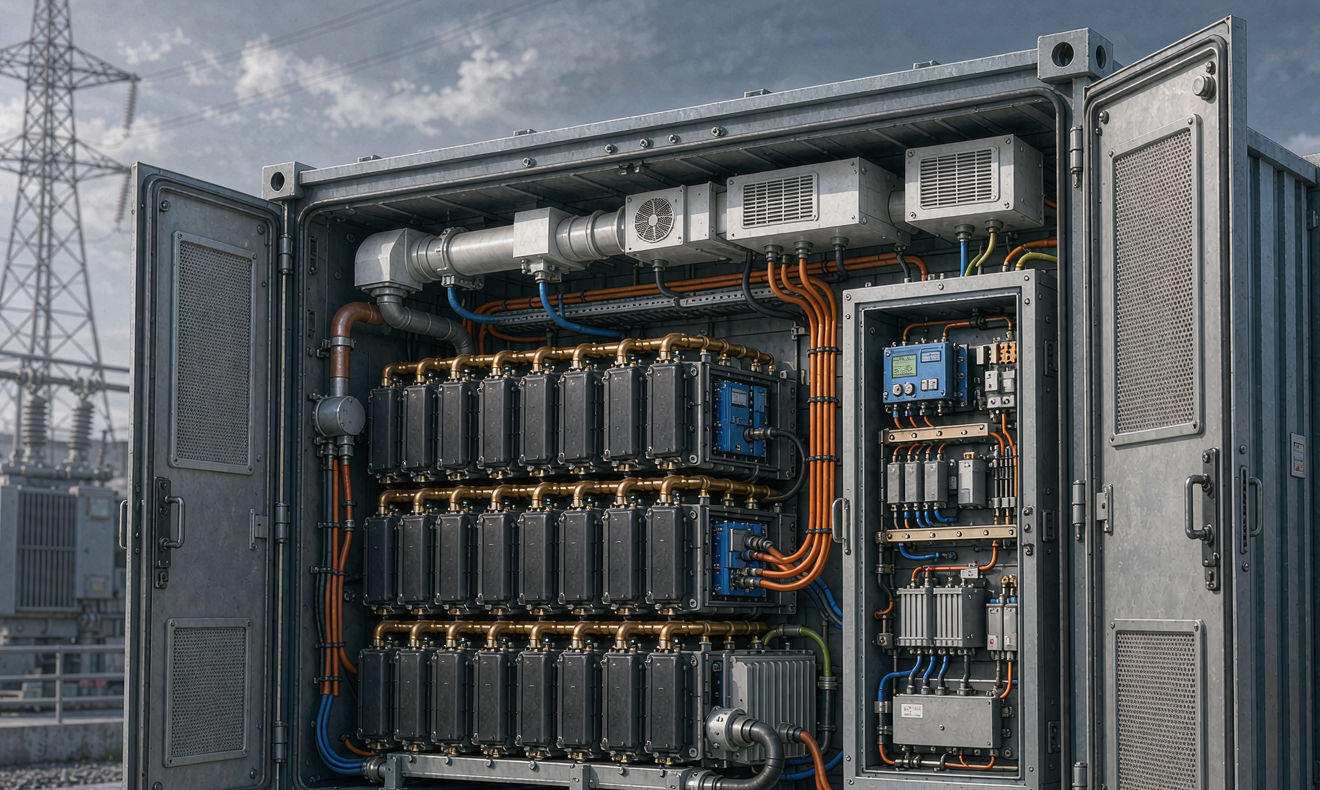
A grid-scale storage asset is bought for a duration. A 100 MW / 100 MWh system is a frequency-response and ramping machine; a 100 MW / 400 MWh system is an energy-shifting machine; a 100 MW / 800 MWh system is a capacity resource that may only cycle a few hundred times a year. The power block — the power conversion system, transformers, switchgear — is largely chemistry-agnostic. The energy block is where the sodium-ion versus LFP decision lives, and the number of cycles the asset is expected to deliver over its life is what prices it.
This matters because the two chemistries degrade on different curves. LFP fails slowly and predictably; a well-built lithium iron phosphate rack gives you 4,000 to 6,000 full equivalent cycles at 25 °C before it reaches 80 % state of health, with a fairly flat fade and a knee that arrives late. Sodium-ion cells in volume production today are typically warranted for 2,000 to 4,000 cycles to the same threshold, with the layered-oxide variants at the lower end and polyanionic (particularly vanadium- or iron-based phosphate) variants claimed at the upper end. Field data beyond about three years is thin, and that uncertainty has a price.
Energy density and footprint: counting containers, not cells
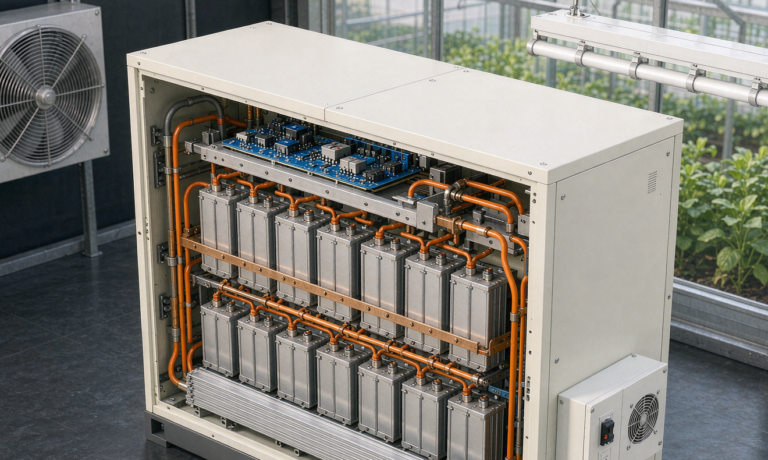
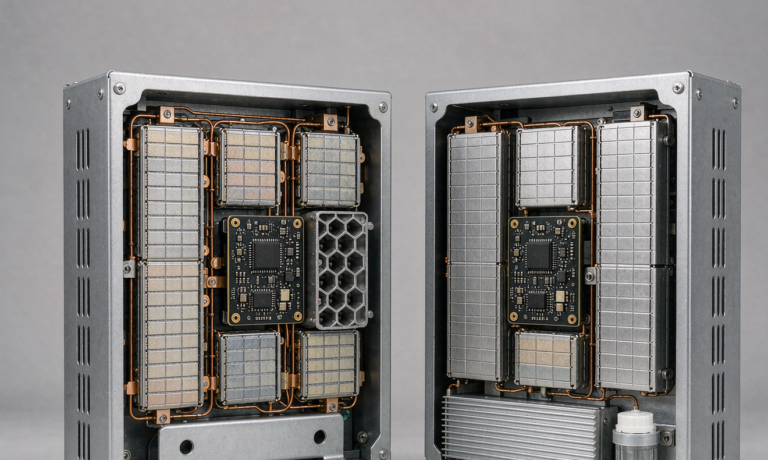
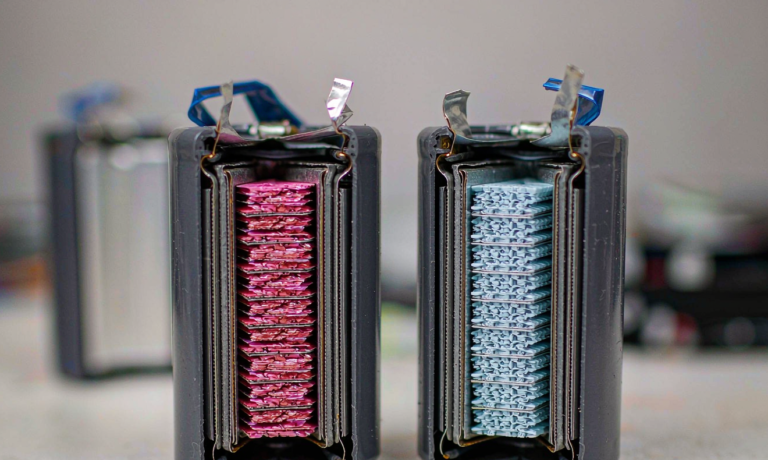
On paper the gap looks modest: a prismatic LFP cell delivers 150 to 180 Wh/kg and 350 to 400 Wh/L, while a layered-oxide sodium-ion cell lands at 130 to 160 Wh/kg and 250 to 320 Wh/L. In a container it is not modest. Once you subtract racking, cooling, fire-suppression hardware, and the aisles that UL 9540A test results and NFPA 855 separation distances force you to respect, a 20-foot LFP container holds roughly 3.7 to 5.0 MWh and the equivalent sodium-ion container holds around 2.5 to 3.4 MWh.
For a greenfield site on cheap land this is a 25 to 40 % increase in pad area and concrete — annoying, not fatal. For a substation-adjacent urban site or a repowered peaker site, it is the difference between a project that fits and one that does not. I have seen a 60 MWh sodium-ion layout require four additional containers and a second transformer pad, which added more to the EPC budget than the cell-price saving removed. Always run the site layout before you run the chemistry comparison.
Cycle life and degradation: the two fade curves
Mechanistically, LFP is a mature story. The olivine cathode barely changes volume on cycling (<7 %), the graphite anode operates on a well-understood solid-electrolyte interphase, and capacity loss is driven by lithium inventory consumption and slow iron dissolution. Temperature dominates: at 25 °C and 0.5 C we plan for 6,000 cycles; at 35 °C that becomes 3,500 to 4,000; at 45 °C it falls below 2,000. Calendar fade at 25 °C and 50 % state of charge is roughly 1.5 to 2.5 % per year.
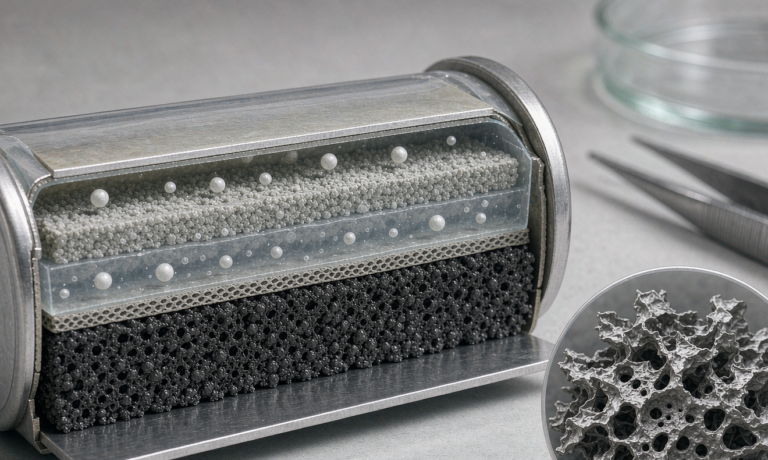
Sodium-ion layered oxides (Na-Ni-Fe-Mn and Na-Cu-Fe-Mn families) go through P2-to-O2 phase transitions and larger volume swings during desodiation, and the hard carbon anode relies on a pore-filling mechanism in the low-voltage plateau that is far more sensitive to rate and temperature than intercalation into graphite. In our own 1 C / 1 C testing at 25 °C, good layered-oxide cells reach 80 % state of health between 2,500 and 3,500 cycles; the polyanionic chemistries do better on cycle count but give up 15 to 25 % of the specific energy to get there. Sodium plating on the hard carbon surface during low-temperature or high-rate charging is the failure mode I watch most closely, and it is why I derate charge current below 5 °C.
The practical consequence: on the same duty cycle, the sodium-ion block will reach its end-of-life threshold earlier. Whether that costs you money depends entirely on how hard you cycle it.
Round-trip efficiency: the hidden cost per megawatt-hour
A lithium iron phosphate battery is a 93 to 95 % DC round-trip device; a sodium-ion battery today is 88 to 92 %. At the AC side of the plant, after the power conversion system, transformer and auxiliary loads, that becomes roughly 85 to 88 % for LFP and 80 to 84 % for sodium-ion. A four- to six-point gap sounds small until you multiply it by the annual throughput.
Take a 100 MW / 400 MWh asset doing one full cycle per day, 330 days a year: 132 GWh of discharged energy. Six percentage points of that is 7.9 GWh of energy you bought and never sold. At a $40/MWh peak-to-off-peak spread, that is about $316,000 a year of lost margin — roughly $1.9 to $2.6 million over a ten-year contract in undiscounted terms. This is the single line item that most sodium-ion economic comparisons leave out.
Levelized cost of storage: the arithmetic that decides the bid
I price storage with a simple throughput form of levelized cost of storage: LCOS equals the installed cost per kilowatt-hour divided by (cycles to end-of-life × depth of discharge × round-trip efficiency), plus an annual operations and maintenance term. Assume a turnkey LFP system at $250/kWh, 6,000 cycles, 90 % depth of discharge and 90 % AC round-trip efficiency:
- LFP: $250 / (6,000 × 0.90 × 0.90) = $0.051/kWh cycled, plus about $0.008/kWh O&M → roughly $0.059/kWh
- Sodium-ion at the same $250/kWh, 3,500 cycles, 0.90 DoD, 0.88 efficiency: $250 / (3,500 × 0.90 × 0.88) = $0.090/kWh, plus O&M → roughly $0.098/kWh
The break-even is easy to solve. For sodium-ion to match that LCOS, its installed cost has to fall to about $250 × (3,500 / 6,000) × (0.88 / 0.90) ≈ $143/kWh. That is the number I take into supplier negotiations. Where sodium-ion cell pricing is genuinely at or below that on a delivered, duty-paid, fully integrated basis, the project works. Where it is not — and in 2026, at low production volumes, it frequently is not — the LFP bid wins on economics and the sodium-ion bid wins on everything else.
Where sodium-ion genuinely wins: cold, transport, and supply chain
Three advantages are real and they are not marketing.
Cold-climate performance. Sodium-ion cells retain 85 to 92 % of room-temperature discharge capacity at −20 °C, against roughly 70 to 80 % for a comparable LFP cell, and several sodium-ion designs accept a 0.2 C charge at −20 °C where LFP must be heated above 0 °C to avoid lithium plating. In Nordic, Canadian and high-altitude projects that removes the heater load (typically 5 to 8 % of daily energy in winter) and the preheat delay that strands the asset during a cold-start event.
Zero-volt transport. A sodium-ion cell can be discharged to 0 V without copper dissolution, because both current collectors are aluminium. Shipping at 0 V instead of the 30 % state of charge that UN38.3 air and sea transport normally requires simplifies logistics, reduces the hazard classification burden, and removes a warehouse fire-load concern. The UN38.3 test series still applies, but the state-of-charge constraint largely disappears.
Supply-chain insulation. Soda ash, iron, manganese and hard carbon precursors are not traded like lithium carbonate, whose spot price has moved by a factor of eight within a single project-development cycle. Sodium-ion also drops nickel and cobalt entirely and uses no copper foil on the anode side, saving roughly 1 to 2 kg of copper per kilowatt-hour. For a utility that must defend a 20-year price forecast to a regulator, that stability has real value even when the upfront number loses.
Duration windows: one hour, four hours, eight hours and beyond
Putting the pieces together, here is how I map duty cycle to chemistry today:
- ≤1 hour (frequency response, spinning reserve): Power cost dominates, energy throughput is low, and cycle count barely matters. Sodium-ion is competitive here, particularly where the asset sits cold or cycles shallowly.
- 2 to 4 hours (peak shaving, arbitrage, renewable shifting): This is LFP territory. Cycle count and round-trip efficiency dominate the business case, and sodium-ion needs a clear capex discount of roughly 40 % to break even.
- 6 to 10 hours (capacity firming, industrial load shifting): Capital cost per kilowatt-hour and calendar fade dominate, not cycle count. Sodium-ion becomes genuinely interesting, because a chemistry that cycles 3,000 times is not the constraint when you only cycle 250 times a year.
- Seasonal or multi-day: Neither chemistry is the answer. Look at flow batteries or thermal storage before you look at any intercalation chemistry.
The crossover sits somewhere around six hours of duration and 150 equivalent full cycles per year. Below that, buy lithium iron phosphate. Above it, put sodium-ion on the bid list and price it honestly.
Procurement and acceptance checklist for grid-scale sodium-ion and LFP
Whichever chemistry you select, the acceptance protocol is nearly identical, and I insist on all of it in the contract:
- Standards: UN38.3 transport test series, IEC 62619 for industrial cells and batteries, IEC 62133 where applicable, UL 1973 for stationary battery assemblies, UL 9540 and UL 9540A thermal-runaway propagation evaluation, NFPA 855 installation separation and fire protection, IEEE 1679.2 for performance characterization, and IEC 62933-5-2 for grid-integration safety.
- Insulation: 500 V megger from the pack to chassis; above 100 MΩ to energize, below 10 MΩ to reject outright.
- Cell balance: after a full charge and a two-hour rest, cell-to-cell delta must be under 30 mV; I have rejected containers that arrived at 90 mV.
- Capacity verification: a 0.2 C full discharge must return at least 95 % of nameplate; anything lower means the modules were stored hot or aged on a shelf.
- Thermal imaging: at full rated power, any termination more than 15 K above its neighbours gets re-torqued and retested.
- Warranty structure: for LFP I expect 10 to 15 years and 6,000 cycles to 70 % state of health; for sodium-ion I currently accept 10 years and 3,000 to 4,000 cycles, with a defined capacity-test method (IEC 61427-1 style) written into the contract so the end-of-life claim is measurable rather than arguable.
- Augmentation plan: because the sodium-ion fade curve is less well documented, contract for a DC oversize of 8 to 12 % or a priced mid-life augmentation option, so the nameplate MWh holds for the full term.
One more piece of advice from the field: insist on a first-article capacity and impedance test on cells from the actual production lot, not golden samples. On the first sodium-ion container I commissioned, the lot impedance spread was 14 % against a specified 8 %, and it cost a nine-week delay to resolve. That is the kind of risk you price in rather than discover.
Frequently asked questions
Is a sodium-ion battery cheaper than LFP for grid-scale storage today?
On a cell basis it can be, in the $60 to $90/kWh range versus $55 to $85/kWh for high-volume LFP, but on an installed, fully integrated basis the advantage usually disappears because you need 25 to 40 % more containers, racking, cable and fire-suppression hardware per megawatt-hour. I treat $143/kWh installed as the break-even against a $250/kWh LFP system on a four-hour duty cycle.
How many cycles does a sodium-ion battery deliver at grid scale?
Volume-production layered-oxide cells are typically warranted for 2,000 to 3,500 cycles to 80 % state of health at 25 °C and moderate rate; polyanionic variants are claimed at 4,000 and above. Compare that with 4,000 to 6,000 for LFP, and derate both numbers for elevated operating temperature.
Can sodium-ion replace LFP in a 4-hour arbitrage project?
Only if the installed cost per kilowatt-hour is roughly 40 % below the LFP bid. Four-hour arbitrage is the application where cycle count and round-trip efficiency matter most, and those are exactly the two metrics where LFP currently leads.
Does a sodium-ion battery handle cold climates better than LFP?
Yes. Sodium-ion retains 85 to 92 % of room-temperature capacity at −20 °C against 70 to 80 % for LFP, and some designs accept a 0.2 C charge at −20 °C, eliminating the preheat cycle that LFP requires to avoid lithium plating below 0 °C.
What is the round-trip efficiency penalty of sodium-ion?
Roughly three to five points at the cell level (88 to 92 % versus 93 to 95 % for LFP) and four to six points at the AC side of the plant. On a 100 MW / 400 MWh asset cycling daily, six points is about 7.9 GWh per year of energy you purchase and never sell.
Can sodium-ion cells really be shipped at 0 V?
Yes. Because both current collectors are aluminium, a sodium-ion cell can be taken to 0 V without the copper-dissolution damage that makes deep discharge destructive in a lithium cell. The UN38.3 test series still applies, but the 30 % state-of-charge transport constraint is effectively removed, which simplifies logistics and lowers hazard classification.
How long will a grid-scale sodium-ion battery last in calendar years?
Warranties today are typically 10 years, versus 10 to 15 years for LFP. Long-duration calendar-fade data is limited because commercial deployments are young, which is why I require a DC oversize of 8 to 12 % or a priced augmentation option in the contract.
What standards apply to grid-scale sodium-ion storage?
The same framework as lithium: UN38.3 for transport, IEC 62619 for industrial cells, UL 1973 for stationary assemblies, UL 9540 and UL 9540A for system and thermal-propagation safety, NFPA 855 for installation, IEEE 1679.2 for characterization, and IEC 62933-5-2 for grid-integration safety. Do not accept a supplier who claims sodium-ion sits outside that framework.
Further Reading
References