Lithium Battery Container Fire Suppression Retest
I have walked through more than sixty containerized lithium battery installations in the last eight years, and the same conversation repeats itself almost every time. The site passed its commissioning test with a clean report, the fire suppression system has sat untouched since, and the owner assumes the paperwork will still hold up two or three years later. Then an insurer asks for an updated test report, a rack gets added, or a single off-gas alarm trips at 2 a.m., and the retest reveals that the system would no longer perform as designed.
A lithium battery container fire suppression retest is not a repeat of the original acceptance test. It is a re-verification of the entire chain: detection, signal logic, agent quantity, piping continuity, enclosure leakage, and deflagration venting. Any one of those links can drift out of specification while the panel still shows the system as fully armed. The most dangerous condition I find on site is a system that reports healthy and cannot extinguish anything.
What follows is the scope I hold inspectors to, the acceptance numbers I use, the documentation package I hand to an authority having jurisdiction (AHJ) or a risk engineer, and the scheduling approach that keeps the container earning revenue while the work is done.
Why a System That Passed Commissioning No Longer Passes
Suppression systems do not fail suddenly. They degrade along four predictable paths, and each one is invisible to a status panel.
The first is enclosure leakage. A clean agent system protects by holding a concentration inside a sealed volume, and NFPA 2001 expects the design concentration to be retained for a 10 minute hold time on a total flooding application. When the container was commissioned, that leakage was measured. Since then, someone has added a cable gland plate for a second inverter, run a condensate drain, replaced a door gasket with a generic profile, or left a ventilation damper that no longer seals. Leakage area doubles, hold time drops below the required value, and the agent is gone before the lithium battery pack inside the rack stops producing flammable gas.
The second is agent weight loss. Clean agent cylinders discharge through valve seals that are not perfectly static. A 5 percent loss of agent weight is the recharge threshold most inspectors apply, and I have seen cylinders sitting 4 percent low after eighteen months of vibration on a trailer-mounted unit. That margin disappears the moment a technician adds a short pipe run and a nozzle, because the piping volume is subtracted from the agent available for the enclosure.
The third is detection drift. Aspirating smoke detection and heat detection both lose sensitivity as filters load and sample ports accumulate dust. A detector that responded at 12 seconds during commissioning may take 30 seconds two years later, and 30 seconds is a long time inside a battery container where a single cell venting into a rack can pressurize an enclosure.
The fourth is physical obstruction. Painted nozzles, insulation batted over a pipe, a new cable tray crossing the discharge path, or a rack relocated 200 mm forward of its design position all change the coverage geometry. The system still discharges. It just discharges in the wrong places.
What Actually Triggers a Fire Suppression Retest
A retest is required, or should be required by the operator, under any of the following conditions. I treat this list as the minimum, not the maximum.
- Any change to the enclosure envelope: new penetrations, door replacement, added insulation, a new damper, or removal of an internal partition.
- Any change to the hazard inside: additional racks, higher energy density modules, a different cell chemistry, or a relocated DC bus.
- Any agent discharge, whether a real event, a false trip, or a deliberate test discharge. Piping must be verified for debris and nozzles for partial blockage.
- Any thermal event or confirmed off-gas alarm, even one that self-cleared without suppression activation.
- Relocation of the container, including transport between sites, which stresses pipe supports, conduit, and door alignment.
- Cylinder requalification intervals. Under DOT 49 CFR 180.205 most steel and aluminum agent cylinders require hydrostatic requalification on a 5 year cycle, and the retest is the natural point to schedule it.
- Changes in the venting strategy, including a replaced deflagration vent panel or a new vent path.
- A change of insurer, a new risk engineering survey, or a lease renewal that triggers fresh documentation.
- Any modification to detection firmware, alarm logic, or the BMS interface that drives the release circuit.
If an operator cannot point to a single entry on this list and the last verification is more than three years old, the honest answer is that nobody knows the current performance of that system.
The Retest Scope, in the Order I Run It
Sequence matters. Verifying a release circuit before checking enclosure integrity wastes the most expensive part of the day, so I always work from detection outward and finish with the enclosure.
Detection and Alarm Chain Verification
Every initiating device gets a calibrated input: smoke via a listed aerosol or a calibrated obscuration reference, heat via a heat gun at the listed response temperature, and off-gas detection via a certified gas challenge for the target species. I record time to alarm for each device rather than a pass or fail, because time to alarm is the number the AHJ cares about. The release circuit is then tested into a solenoid simulator or dummy load, never into the live actuator. NFPA 72 periodic testing intervals apply, and cross-zoning logic has to be proven: two independent detectors, both within the required window, before release. I also verify that the BMS signal path that can inhibit or pre-alarm the release behaves exactly as documented, including the failure state if the BMS loses communication. On a custom battery solution where the BMS, the detection loop, and the release circuit share a power source, that failure state has to be proven by opening the supply, not inferred from a wiring diagram.
Agent Quantity, Pressure, and Cylinder Status
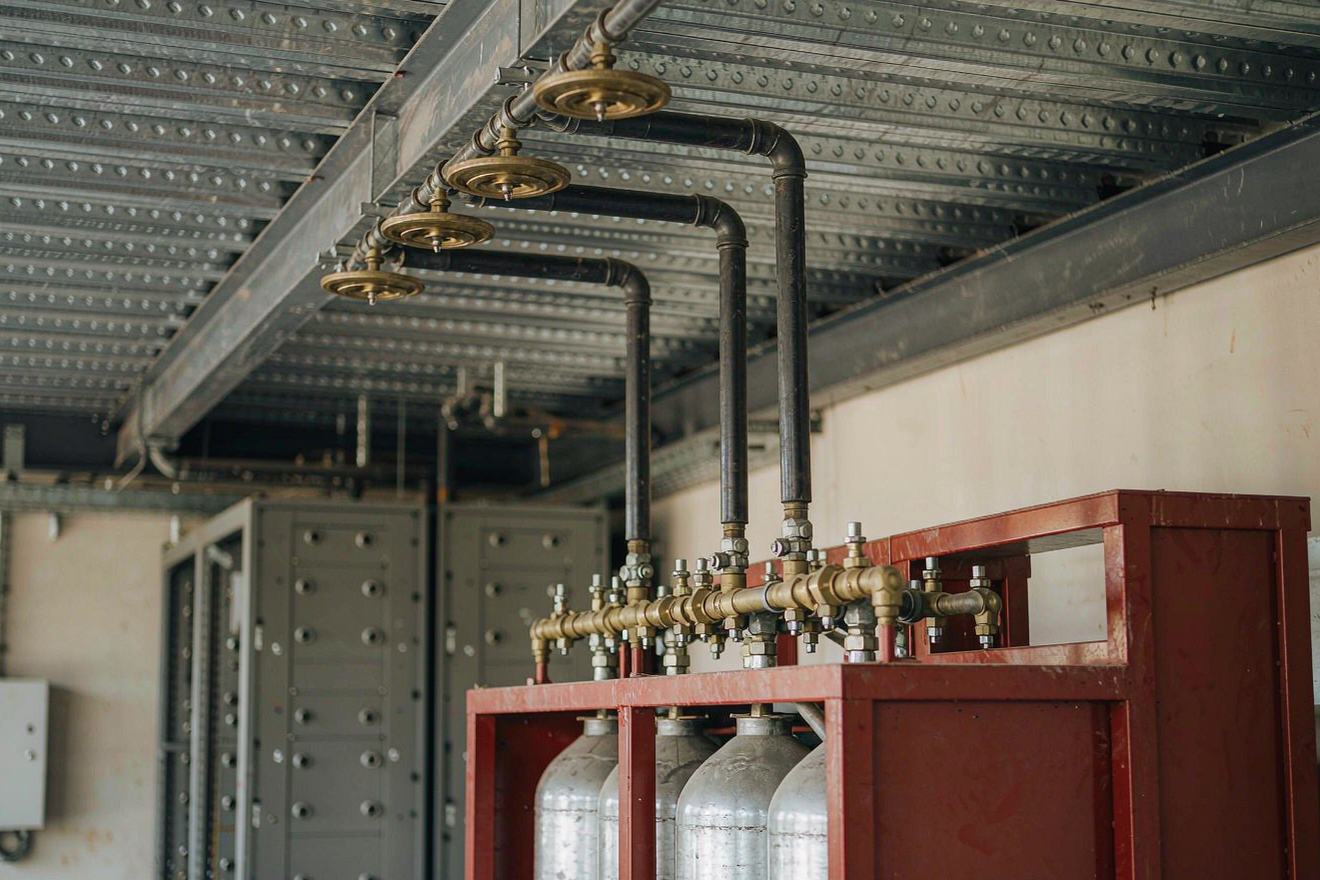
Every cylinder is weighed to the nearest 10 g and compared to the nameplate charge. Pressure is read and corrected for ambient temperature using the manufacturer curve, because a gauge reading at 5 degrees C looks alarming and is usually correct. I check the flexible discharge hose for kinks and date code, the manifold for corrosion at the brass to steel transition, the actuator for pin travel, and the pressure switch for actual electrical continuity rather than a visual inspection. Where the design uses FK-5-1-12 or heptafluoropropane, the design concentration in a battery container typically lands between 4.5 and 7 percent, comfortably below the NOAEL of roughly 10 percent for FK-5-1-12 and 9 percent for heptafluoropropane, which is why a correct calculation matters for personnel safety as much as for extinguishment.
Piping Continuity and Nozzle Coverage
Wherever the piping can be isolated, I prefer a pneumatic continuity test with dry nitrogen at design pressure, looking for pressure decay across a timed window. When the configuration allows it, a short blow-down proves the full path without consuming agent. Nozzles are inspected individually for blockage, paint, thread sealant squeeze-out, and correct orientation, then compared against the as-built isometric. Any nozzle that has been re-aimed or replaced without a recalculated coverage drawing is a finding, not a preference.
Enclosure Integrity
This is the step most owners try to skip and the one that most often fails. A door fan or blower door test pressurizes and depressurizes the enclosure and measures the equivalent leakage area at a reference pressure, then predicts the agent hold time for the actual room geometry. NFPA 2001 provides the retention calculation and ASTM E779 provides the measurement method. On a 20 ft battery container I expect an equivalent leakage area well under 0.1 square meters for a clean installation. When the predicted hold time falls under 10 minutes, the fix is sealing work, not more agent. Adding agent to compensate for leakage is the single most common wrong answer I encounter, because it satisfies a concentration calculation on paper while leaving the real hazard unprotected.
Deflagration Venting and Penetration Review
Battery containers need a designed path for pressure relief, and NFPA 68 sizing assumes the vent panel is intact and unobstructed. I check that the vent panel has not been painted, that its fasteners have not been replaced with a heavier grade, that conduit and cable tray have not been routed across the discharge face, and that internal obstructions have not increased the venting pressure beyond the design limit, which for most enclosures is 1.5 psi, or roughly 0.1 bar. A retest that verifies suppression but ignores venting leaves the enclosure capable of suppressing a fire while still failing structurally during a deflagration.
Acceptance Criteria and the Failures I See Most
I use four primary acceptance numbers and treat everything else as supporting evidence: agent weight within 5 percent of nameplate, predicted hold time at or above 10 minutes, time to alarm inside the design window for each detector type, and full piping continuity with no nozzle obstruction. Cylinder pressure, hose condition, actuator travel, and pressure switch continuity round out the pass criteria.
The failure pattern is remarkably consistent. In my own records, roughly one in six first-pass retests on containers older than two years produces at least one finding. Enclosure leakage leads the list, followed by agent weight loss on vibration-exposed units, then detection sensitivity drift where filters have not been changed, then nozzle obstruction from painting or insulation, and finally vent panels fouled by later cable work. Only the last of those is obvious from a walk-around. The other four require instruments.
Retest Documentation the AHJ and Insurer Will Ask For
A retest without a usable record is a retest that will be repeated. The package I assemble contains the as-built piping isometric with nozzle locations, the agent calculation showing enclosure volume, design concentration, and piping volume allowance, the latest door fan report with the leakage area and predicted hold time, per-device alarm time records with instrument calibration certificates, cylinder weights and pressure readings with temperature correction, the release circuit test record stating that a simulator was used, and the deflagration vent inspection with panel part numbers.
Two details decide whether that package survives review. First, calibration certificates must be current at the date of the test, not the date of the report. Second, the enclosure volume used in the agent calculation has to match the as-built enclosure after every penetration and partition change, because a risk engineer who finds a mismatch will reject the whole submission and ask for a repeat test at the operator’s expense.
Scheduling a Retest Without Losing Availability
A full retest on a single container is normally a two day scope: one day for detection, cylinder, piping, and venting verification, and one day for the door fan test and any sealing work it reveals. Cylinder requalification takes longer because the cylinders must be removed and exchanged, so I schedule that against a planned maintenance window rather than a surprise event.
The practical trick is to run the door fan test first and early, before committing to a test date. Leakage is the finding most likely to force follow-up work, and discovering it on a Tuesday is far cheaper than discovering it on the morning the inspector arrives. The second is to keep detection filters, gaskets, and one spare cylinder in the spares cabinet, so that a failing component is replaced during the visit instead of triggering a second mobilization.
Frequently Asked Questions
How often does a containerized lithium battery fire suppression system need retesting?
Annual inspection of the system is the baseline under NFPA 2001 and NFPA 25, but a performance retest that re-verifies hold time and detection response is typically on a three year cycle, or sooner if any item on the trigger list applies. Cylinder requalification follows the 5 year DOT cycle. Insurers increasingly ask for a retest every two to three years regardless of the code minimum.
Does adding one rack require a full retest?
Yes, at minimum it requires a recalculated agent concentration and a new enclosure integrity prediction, because the added rack changes both the flooded volume and the obstruction pattern. In practice the recalculated piping and nozzle coverage almost always means verifying the discharge path as well, so the marginal saving from a partial retest is small.
What is a door fan test and is it required for a battery container?
A door fan test measures how much air leaks out of the enclosure at a reference pressure, which allows the predicted agent hold time to be calculated. NFPA 2001 requires the enclosure integrity to be verified as part of the design, which makes a measured leakage value effectively mandatory for any total flooding clean agent system, including one built into a shipping container.
Can a clean agent system be retested without discharging it?
Yes, and it should be. Detection, alarm logic, and the release circuit are verified with calibrated inputs and a solenoid simulator, piping continuity is verified with dry nitrogen, and agent quantity is verified by weighing. Actual discharge testing is reserved for cases where the piping cannot be proven any other way, and it requires a full recharge afterwards.
Who is qualified to retest a containerized battery fire suppression system?
Use a contractor holding the appropriate suppression system certification and, for the enclosure test, the door fan equipment and software that produces a predicted hold time rather than a raw leakage number. The suppression contractor and the enclosure test are often separate specialties, so confirm both are covered before the visit is booked.
What happens if the retest fails?
The container is normally flagged as having a degraded protection level and should be returned to a restricted operating mode until the finding is corrected. Leakage findings are fixed by sealing and then retested, agent shortages by recharge, and detection findings by recalibration or replacement. The corrected item is re-verified and the report reissued with the original test date retained so the paper trail stays continuous.
Further Reading
References