Battery Solution for Cold Storage Room Backup
I have specified backup power for walk-in freezers, cold rooms, and chilled distribution hubs for eleven years, and the pattern never changes: the buyer asks for “eight hours of runtime,” the vendor multiplies the compressor nameplate by eight, and everybody is surprised when the first defrost cycle trips the inverter. A cold storage room is not a server rack. The refrigeration load breathes, surges, and defrosts, and the battery system has to be engineered around those events, not just around average kilowatt-hours. In this guide I will walk through how I size, place, and commission a battery solution for cold storage room backup, using the same field arithmetic I use on site, so that the system you buy holds temperature through the outage instead of holding a warning screen.
Why a Cold Room Load Is Not a UPS Load
An IT UPS load is flat and predictable. A cold room is a duty-cycled refrigeration machine with several stacked loads that switch independently:
- Condensing unit: the compressor(s), typically cycling 30 to 60 percent of the time at steady state.
- Evaporator fans: continuous, often 300 to 900 W each, running even when the compressor is off.
- Electric defrost heaters: 3 to 9 kW per evaporator, two to six cycles per day in a freezer.
- Door and anti-sweat heaters: 0.5 to 1.5 kW on freezer doors and frames.
- Controls and monitoring: a few hundred watts, always on.
A representative 40 m2 freezer might carry a 5 kW condensing unit, 1.2 kW of evaporator fans, a 4.5 kW defrost bank, and 0.8 kW of door heaters. Nameplate adds up to about 11.5 kW, yet the average draw sits near 5 kW because the compressor cycles and the defrost heaters only burn for short windows. The battery therefore faces two separate problems at once: an energy problem, measured in kilowatt-hours per day of average load, and an event problem, measured in short surges that can be four to eight times the average. Sizing for the first while ignoring the second is the single most common failure I see in cold storage backup projects.
The Four Numbers I Log on Every Site
Before I quote anything, I put a logging meter on the distribution board for seven days and extract four numbers.
Number 1: Daily Energy
Average load in kW multiplied by 24 gives daily energy. For the example above, 5 kW average is 120 kWh per day. If you already pay a time-of-use tariff, your meter data may give you this number for free, and it is usually more honest than the mechanical nameplate.
Number 2: The 15-Minute Peak
Right after a defrost ends, every evaporator fans restarts and the compressor pulls the room back down while the door heaters are still warm. This post-defrost pull-down typically runs the condensing unit at 100 percent duty with fans at full load, so plan for the sum of compressor and fan inputs, not the average.
Number 3: Locked-Rotor Surge
When a semi-hermetic compressor starts, it draws locked-rotor current, five to seven times its rated load current, for 0.3 to 0.5 seconds. A 5 hp three-phase compressor at 400 V has a rated load current near 9 A, so the inrush lands around 50 to 60 A, roughly 35 to 40 kVA. The inverter must either deliver that surge for three seconds or you must fit a soft starter.
Number 4: The Defrost Spike
Electric defrost adds 3 to 9 kW per evaporator on top of everything else that happens to be running. On a two-evaporator room without interlocks, I have measured 12 kW spikes on a room whose average is 5 kW. That single number usually dictates the inverter size.
From these four numbers the sizing follows a fixed rule. Usable energy for a four-hour autonomy at 5 kW average is 20 kWh. Applying end-of-life derating, 80 percent state of health, 90 percent usable depth of discharge, and 88 percent inverter efficiency, nameplate capacity must be about 20 divided by 0.63, or 32 kWh. I round up to the next standard 35 to 40 kWh cabinet and the arithmetic has never failed me.
Product Thermal Mass: The Cargo Is Your Biggest Battery
Here is the calculation that changes most cold room projects. Take a 10 by 6 by 4 meter freezer, 240 cubic meters, filled to 50 percent with palletized frozen goods at an effective bulk density of 300 kg per cubic meter. That is roughly 36,000 kg of product. Frozen food has a specific heat near 2.0 kJ per kilogram-kelvin, so allowing the product to warm from minus 18 to minus 12 degrees Celsius, a 6 K rise, absorbs 36,000 times 2.0 times 6, which is 432 megajoules, about 120 kWh of thermal energy.
Now compare that with the heat leaking in. A 150 mm PIR panel envelope has a U-value near 0.25 W per square meter-kelvin; walls, ceiling, and floor area come to roughly 330 square meters, and with a 43 K temperature difference the conduction load is about 3.5 kW. Add 30 to 50 percent for door openings and infiltration and the total is near 5 kW. Dividing the 120 kWh of product thermal capacity by 5 kW of leak rate gives about 24 hours of ride-through with the refrigeration completely off, before the cargo even reaches the warning threshold.
The engineering conclusion is simple: do not buy a battery to absorb the cargo heat. Buy a battery sized to run the refrigeration machine, typically four to eight hours of average load, and let the frozen product provide the long-duration buffer for free. One caution applies to chilled rooms holding fresh produce: specific heat is higher, near 3.8 kJ per kilogram-kelvin, but allowable temperature rise is only a few kelvin before shelf life degrades, and quality loss starts long before any setpoint alarm. For mixed-use facilities I keep the four-to-eight-hour electrical autonomy rule for chilled rooms and let only frozen storage rely on thermal mass.
Low-Temperature Charging: Where Cold Storage Batteries Fail
The second most common failure is not capacity, it is chemistry at temperature. If the pack is mounted inside the freezer vestibule at minus 20 degrees Celsius, an LFP battery will still discharge, but expect 60 to 70 percent of rated capacity with internal resistance four to six times higher, and voltage sag will compound with motor starting. Charging is a different matter: below 0 degrees Celsius, lithium plating forms on the anode, permanently reducing capacity and creating a latent safety risk. A properly engineered BMS simply refuses to charge below 0 degrees Celsius, and derates charge current below 5 to 10 degrees Celsius. I have walked into plants where a winter outage drained the pack and the subsequent recovery was impossible because the BMS locked out charging in a -5 degree Celsius plant room.
The fix is placement. My default is to mount the battery cabinet in the conditioned plant room or ante-room at 10 to 25 degrees Celsius and run correctly rated cable penetrations through the insulated panel with compression glands and a vapor-sealed collar. Where the only available space is genuinely cold, specify a heated enclosure: a 200 to 400 W silicone or convection heater with a thermostat, plus a scheduled preheat window of about three hours before the grid is expected to be fragile. Without the schedule, a thermostat-triggered heater only starts heating after the room is already cold, which is always later than you need. This is the same discipline I apply to home energy storage in unheated basements, and it costs far less than the capacity you lose to cold-derated operation.
Defrost Cycles and Surge Budgets
Defrost is where electrical and refrigeration engineering have to talk to each other. The cheapest surge fix in the entire project is a soft starter or variable frequency drive on the compressor: it collapses the five-to-seven-times locked-rotor surge to roughly 1.1 to 1.5 times rated current, which often lets a mid-size inverter do the job of a large one. The second cheapest fix is an interlock that staggers defrost so two evaporators never defrost simultaneously; the controller change is trivial and it can halve the worst-case spike.
Then size the inverter honestly against three limits: continuous rating must exceed the post-defrost pull-down load with fans at full speed; the three-second surge rating must cover the defrost heaters plus a compressor restart if the two can coincide; and the transfer behavior must respect the refrigeration controls. Most condensing units tolerate a restart after a few seconds of outage, but VFD-driven compressors with long deceleration profiles may fault on transfer, so I test the actual transfer sequence during commissioning rather than trusting a datasheet. Finally, if the site keeps a generator, use the battery as the first line: the battery carries 90 percent of outage events silently and instantaneously, and the generator only runs two to four hours per day to recharge, which cuts run hours by half or more and keeps the engine out of wet-stacking low-load operation.
Enclosure, Hygiene, and Placement Rules
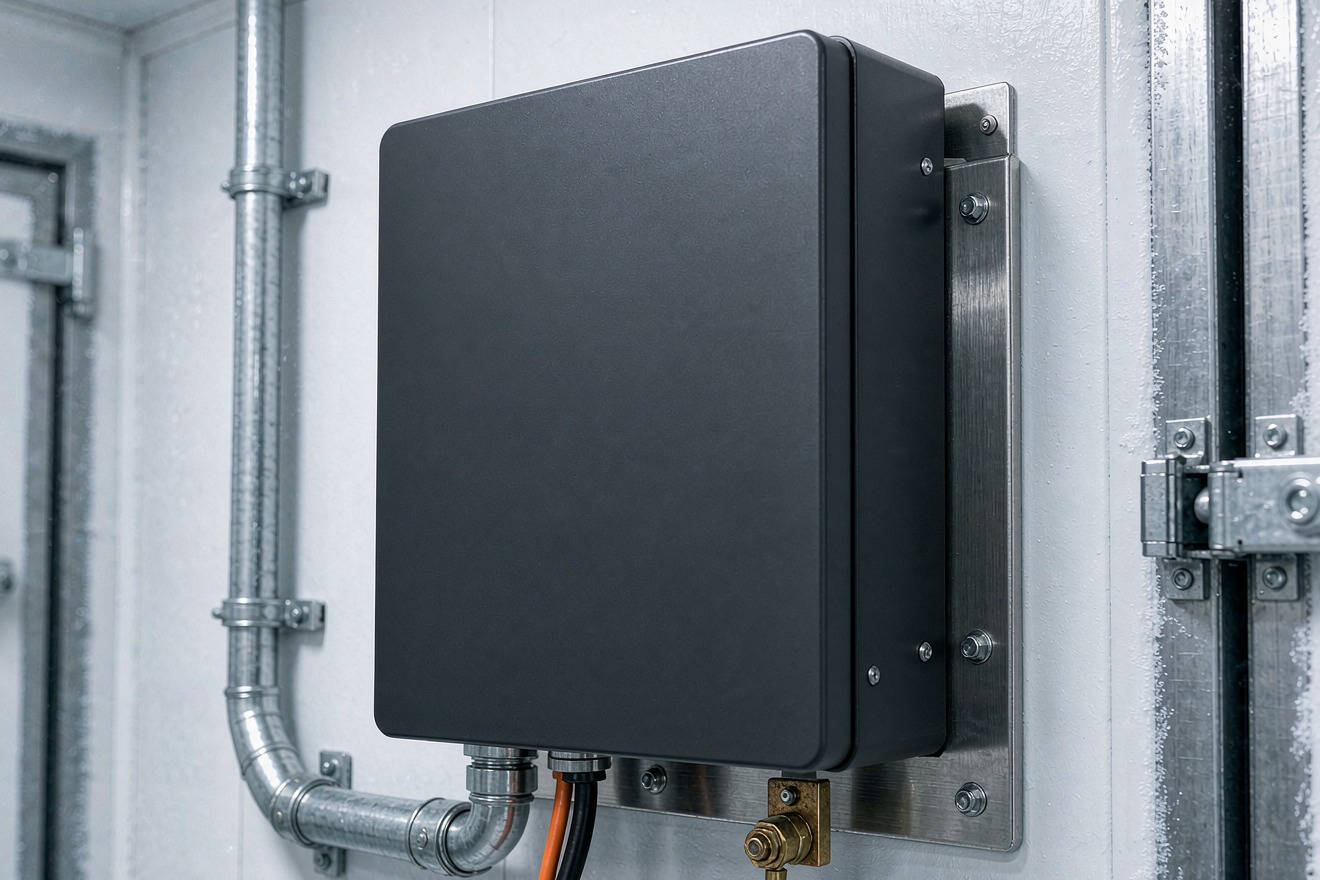
Cold storage is a washdown environment, and food safety audits do not care about your datasheet. My specification floor is IP65 for the battery and any auxiliary boxes, IP69K where hose-down reaches the mounting zone, 304 or 316 stainless brackets, and all cable entries through matched-specification cable glands, because an IP65 cabinet fed by an unrated gland is an IP44 installation. Condensate management matters as much as ingress: panel penetrations need vapor sealing, conduit runs need drip legs, and the cabinet needs a drain path so it never sits in its own melt water.
Placement follows three rules. First, respect NEC 110.26 working clearances and NFPA 855 indoor separation distances; a battery squeezed into a corridor that fails the clearance test will fail the electrical inspection. Second, never mount the cabinet above food-contact zones or across a HACCP walk path; audits treat overhead electrical gear as a contamination risk. Third, if the facility runs an ammonia machine room governed by ASHRAE 15 and IIAR standards, keep standard electrical enclosures out of the classified machinery room unless they are rated for that environment; the battery belongs in the adjacent electrical room, and the interconnection belongs in properly rated conduit.
Commissioning and Compliance Checklist
For certification I expect the system to carry UL 9540 as a system listing with UL 1973 on the battery, UL 9540A thermal runaway test data for the installation review, IEC 62619 for the international equivalent, UN 38.3 for transport, and installation per NEC Article 706 with NFPA 855 spacing. Refrigeration-side compliance is separate but interacts: machinery room classification, emergency ventilation, and refrigerant detection under ASHRAE 15 all define where electrical gear may live.
Before I sign off, five tests get executed on the live plant. One, a locked-rotor start of the largest compressor on battery power, recorded with a scope, to prove the surge claim. Two, a defrost cycle with the interlock verified so no two evaporators overlap. Three, a full post-defrost pull-down at summer ambient with door heaters energized. Four, a transfer test, grid to battery and back, watching the compressor controls for nuisance faults. Five, a BMS cold-charge lockout check by simulating a low-temperature condition, because I want to see the charge contactor refuse, not read about it in a manual. A battery solution for cold storage room duty that passes these five tests will hold temperature for years; one that skips them usually reveals its gaps during the first summer heat wave, which is exactly when the utility calls the outage.
Frequently Asked Questions
How long can a battery backup hold a walk-in freezer cold?
A well-filled frozen storage room at minus 18 degrees Celsius has substantial thermal mass: a 36-tonne load absorbs roughly 120 kWh before warming 6 K. With envelope and infiltration losses near 5 kW, that is around 24 hours of ride-through with refrigeration fully off. The battery is therefore sized to run the refrigeration, typically four to eight hours, while the cargo provides the longer thermal buffer.
What size battery do I need for a cold storage room?
Log seven days of actual consumption and work from four numbers: daily energy, post-defrost 15-minute peak, compressor locked-rotor surge, and the defrost spike. For a room averaging 5 kW, four-hour autonomy needs 20 kWh usable, which becomes roughly 32 kWh nameplate after end-of-life derating. Add soft starters and defrost interlocks before you add inverter capacity.
Can lithium batteries be installed inside a freezer?
Discharge works but is derated, and charging below 0 degrees Celsius causes lithium plating, so a proper BMS locks out charging in the cold. I mount the pack in a conditioned plant room or ante-room at 10 to 25 degrees Celsius instead. Where that is impossible, a heated enclosure with a 200 to 400 W heater and a scheduled three-hour preheat window is the fallback.
Why does defrost mode stress a backup battery?
Electric defrost adds 3 to 9 kW per evaporator for 20 to 40 minutes, two to six times daily, and without interlocks two evaporators can defrost together, doubling the spike. The worst case, defrost heaters plus a compressor restart, can reach eight times the room average. The inverter surge rating and the defrost interlock scheme must be designed around that event, not the average load.
Is LFP or NMC the better chemistry for cold storage backup?
I default to LFP for stationary cold storage duty. It offers 3,000 to 5,000 cycles at 80 percent depth of discharge, strong thermal stability, and a flat profile that pairs cleanly with a CAN-based fuel gauge. NMC saves volume, which matters in tight plant rooms, but the extra energy density buys little in a static installation and raises the thermal management burden.
Do I still need a generator if I install a battery system?
For outages beyond eight hours, or where regulations demand extended autonomy, a hybrid arrangement is the most economical answer. The battery carries short events instantly and silently, while the generator recharges it two to four hours per day during long outages. That halves generator run hours, eliminates low-load wet stacking, and keeps fuel consumption predictable.
Further Reading
References