Sodium-Ion Battery for Sailboat Auxiliary Power
Ask any cruising sailor what the auxiliary battery does and you will get two different answers. On one hand it starts the engine and feeds the saildrive when the wind dies. On the other it quietly runs the fridge, autopilot and lights for days at anchor. Those are very different jobs, and I have watched more than one owner discover the difference the hard way, halfway into a calm offshore leg. At Horizon Power I specify sodium-ion packs for both roles, but auxiliary propulsion is where the chemistry really earns its place. This guide covers sizing, voltage choice, charging, installation and the standards that matter, drawn from packs I have built and inspected on real yachts.
Why Auxiliary Propulsion Is Not a House Load
The first mistake I see is treating the engine-start and the domestic bank as one battery. A saildrive or inboard starter demands a short, heavy burst: a 40 horsepower diesel can pull 400 to 800 amps for a few seconds at cranking, then settle back. A house load is the opposite, a modest 10 to 30 amp draw spread over twelve or eighteen hours. A pack optimized for one rarely excels at the other.
Sodium-ion cells bring a useful trait here. They hold voltage well under a high current pulse and recover quickly once the load drops, so the starter motor turns over cleanly even late in the discharge. In one 24 volt, 100 amp-hour bank we tested, a 500 amp five-second crank pulled the terminals down by less than 1.2 volts per cell at 50 percent state of charge. That kind of headroom is what keeps a reluctant engine from becoming a tow.
My usual recommendation is a dedicated auxiliary pack for propulsion, sized for cranking and short motor runs, with a separate domestic bank for hotel loads. On smaller yachts a single bank with a high-current BMS and a properly rated master switch can serve both, but the cable and fuse sizing must follow the peak motor current, never the average.
Sizing the Pack from Motor Draw and Runtime
Start with the motor, not the battery. A 10 kW electric auxiliary drive running at 80 percent load draws roughly 9 kW. On a 48 volt system that is about 190 amps. One hour of motoring therefore consumes around 190 amp-hours before efficiency losses, and a sensible pack is sized for at least twice that if you expect to motor for an hour without the engine.
For traditional diesel auxiliary roles the calculation is simpler: you need reliable cranking amps and enough reserve for repeated attempts. I size these packs with a 2C to 3C continuous discharge rating and a 5C pulse capability lasting at least ten seconds. That covers a cold start after a night at anchor without the voltage collapse that plagues undersized banks.
Then apply a depth-of-discharge margin. Sodium-ion handles deep cycling well, but I still design around 80 percent usable capacity for marine service, because an unexpected calm can turn a planned thirty-minute motor run into two hours. Budget the amp-hours on the motor curve, add the hotel loads that will inevitably be left on, and round up. A pack that seems oversized on paper is cheap compared with a daysail cut short.
Why Sodium-Ion Fits This Job
Three properties matter on a boat. First, safety: sodium-ion chemistry is far more resistant to thermal runaway than conventional lithium-ion, and it can be transported and stored at zero volts. That removes the anxiety of a damaged pack in a confined, unattended bilge. Second, cold performance. Sailors in northern latitudes often start from a cold boat in spring, and sodium-ion retains usable capacity and cranking power at temperatures where other chemistries need warming first.
Third, cycle life and material cost. Coastal cruising means hundreds of shallow cycles a season. Sodium-ion cells routinely deliver 3,000 to 4,500 cycles at 80 percent depth of discharge in our qualification data, with no cobalt or nickel in the cathode. That translates to a pack that outlives several replacement cycles of a lead-acid bank, without the price volatility tied to lithium supply.
The trade-off is energy density. A sodium-ion pack is bulkier than an equivalent lithium pack, so on a performance yacht where every kilogram aft matters, the installation has to be planned early. On cruising boats, where the bank sits low and centralized for balance, that penalty is easy to absorb.
Charging Strategy on a Sailboat
A cruising boat has several charge sources and none of them are stable. Shore power is steady, solar is intermittent, and an engine alternator is only available while the motor runs. The battery must accept all three without fuss. Sodium-ion cells charge to a lower full voltage than lithium-ion, typically 3.95 to 4.0 volts per cell for layered oxide chemistry, so the charger must be configured for the correct profile rather than a default lithium preset.
I specify a charge controller with a sodium-ion or adjustable profile, a bulk and absorb stage, and a float that will not hold the cells at high voltage for weeks at a marina. For alternator charging, a DC to DC converter isolates the starter battery and gives the auxiliary bank the right absorption voltage, which also protects a long cable run from voltage drop.
One practical tip from the dock: enable low-temperature charge cutoff. If the bank drops below freezing, a solar panel on a bright winter morning will happily push current into cold cells. A BMS that inhibits charge below 0 degrees Celsius until the pack warms is worth far more than the few extra amp-hours it might cost you.
Installation, Ventilation and Corrosion
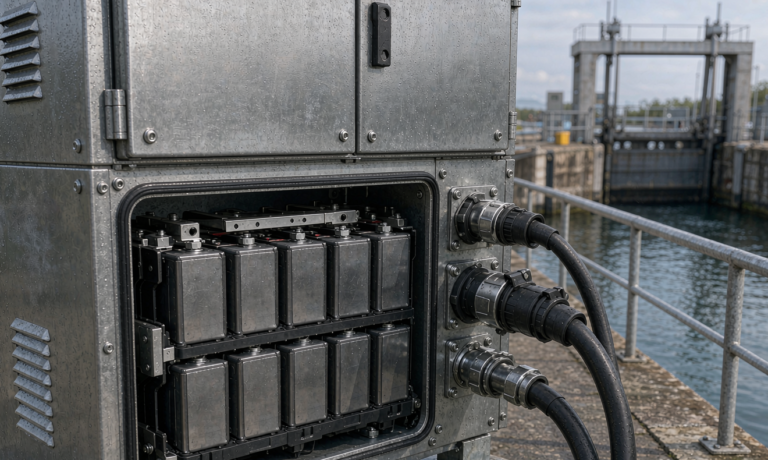
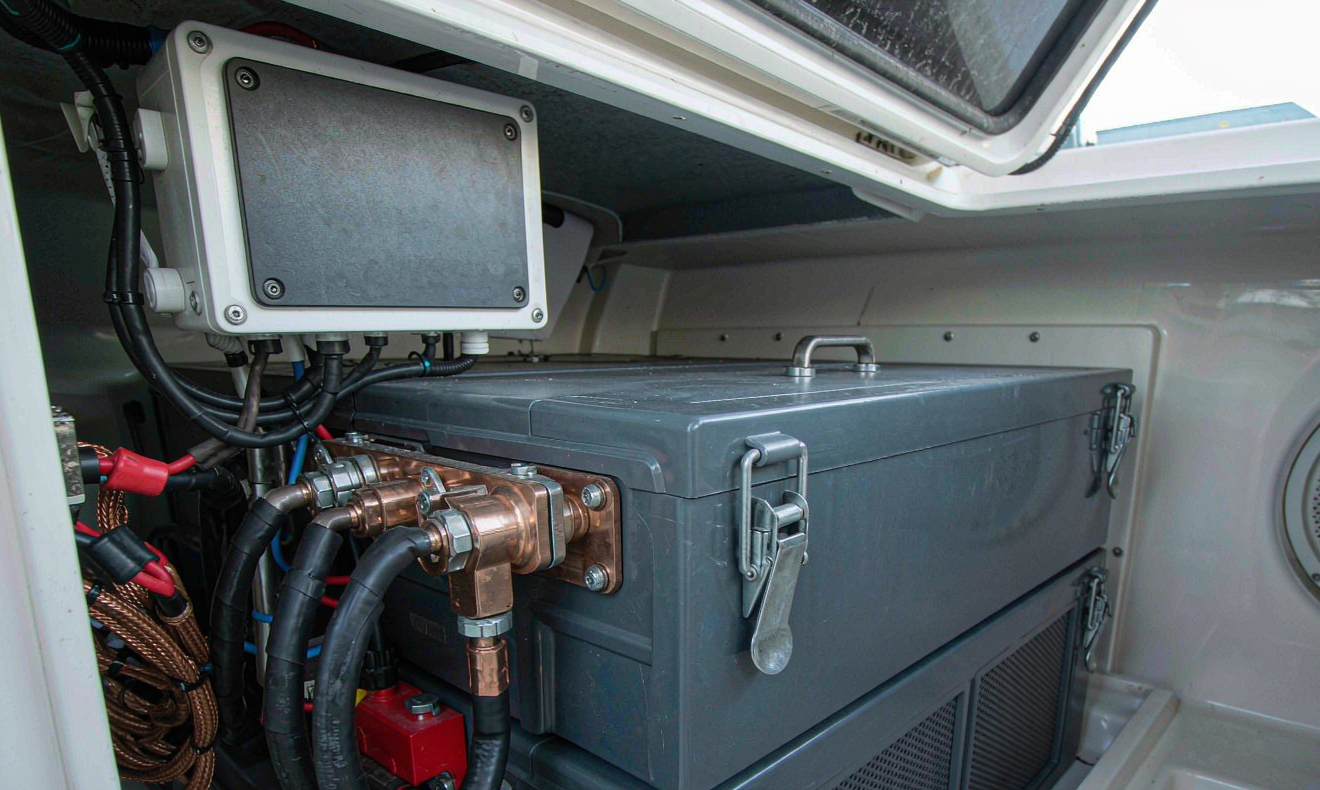
Marine installation is where good batteries go bad. Mount the pack low, central and secure: I use stainless straps with a non-conductive liner and allow at least 25 millimeters of clearance around the case for airflow. Even though sodium-ion is thermally stable, a sealed locker in a hot engine bay will shorten any battery’s life, so provide a vent path to the outside or a ventilated compartment.
Salt air is the silent enemy. Use tinned copper cable, dielectric grease on every terminal, and heat-shrink butt connectors rather than cheap crimp lugs. Keep the pack off aluminum bulkheads with an insulating pad to avoid galvanic corrosion between dissimilar metals, and bond the case to the boat’s grounding system according to the vessel’s electrical plan.
Fuse the main positive as close to the battery as possible, rated for the cable and the BMS continuous current, and fit a manual master switch within reach of the companionway. In an emergency you want to be able to kill the whole bank without diving into a locker. I also label every cable at both ends, a small habit that saves hours of fault-finding later.
Standards and Documentation to Request
Ask any supplier for the test evidence, not just a datasheet. UN 38.3 transport testing is the baseline and should cover every cell and the assembled pack. For stationary and marine-adjacent safety, IEC 62619 is the relevant industrial standard; IEC 62133 applies to portable cells and is not sufficient on its own for a propulsion bank. Note that dedicated marine battery standards are still evolving for sodium-ion, so a supplier who can explain which tests were performed and why will serve you better than one who simply quotes a certificate.
Before I sign off a marine pack I ask for the cell test reports, the BMS specification including cut-off thresholds, the enclosure IP rating, and a written warranty that states cycle life at a defined depth of discharge. IP65 or better is my minimum for a bilge-adjacent location. Keep copies onboard with the vessel’s documentation: insurers and surveyors increasingly ask for exactly this when a boat changes hands.
Frequently Asked Questions
How long will a sodium-ion auxiliary battery last on a sailboat?
Expect 3,000 to 4,500 cycles at 80 percent depth of discharge in our qualification testing, which for a typical cruising pattern of one to two cycles a day is roughly eight to twelve years. Cool temperatures, moderate state of charge and gentle charging all extend that figure.
Can one bank run both the engine and the house loads?
Yes, provided the BMS and cabling are rated for the starter’s peak current and you accept a shared reserve. For offshore boats I prefer separate banks so a flat domestic load can never leave you without cranking power.
Is sodium-ion safe in an enclosed boat compartment?
It is among the safest chemistries available, with high thermal-runaway resistance and the ability to ship and store at zero volts. Ventilation and correct fusing are still required, as with any battery.
What voltage should I choose for a sailboat auxiliary pack?
Twelve volt suits small dayboats and simple systems, but 24 or 48 volt reduces cable size and loss for larger motors. Pick the voltage from the motor and charger first, then size the pack.
Do sodium-ion batteries need a special charger?
They need the correct voltage profile, typically 3.95 to 4.0 volts per cell for layered oxide chemistry. Use a charger with an adjustable or sodium-ion profile, never an unconfigured lithium preset, and enable low-temperature cutoff.
Are sodium-ion batteries approved for marine use?
UN 38.3 transport compliance is standard, and IEC 62619 covers industrial safety. Fully dedicated marine certification is still developing, so request the specific test reports and confirm acceptance with your insurer or surveyor before installation.
Further Reading
References