Battery Selection for Multirotor vs Fixed-Wing Drones
As a senior lithium battery engineer at Horizon Power, I have spent the better part of a decade on the test bench watching the same mistake repeat itself: a procurement team picks a drone battery based on capacity alone, then discovers the airframe cannot lift it or the discharge rate collapses mid-flight. The truth is that a multirotor and a fixed-wing aircraft are fundamentally different energy problems. Choosing the right battery for multirotor vs fixed-wing platforms is not about finding the biggest pack—it is about matching chemistry, C-rating, and mass to the physics of how each airframe flies.
How Flight Profiles Dictate Energy Demand
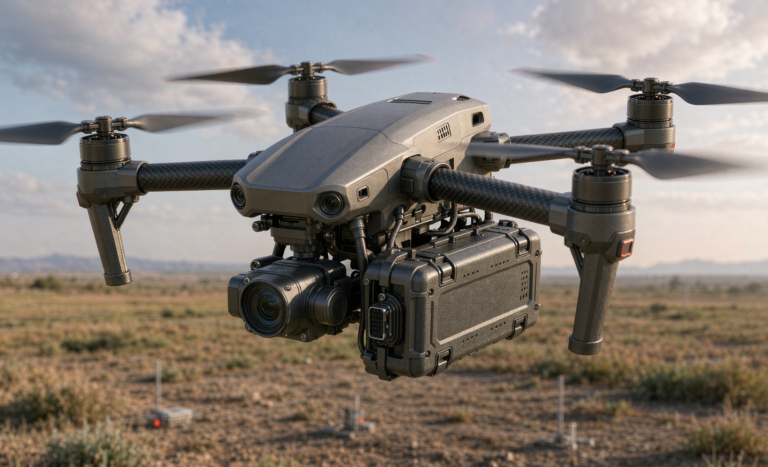
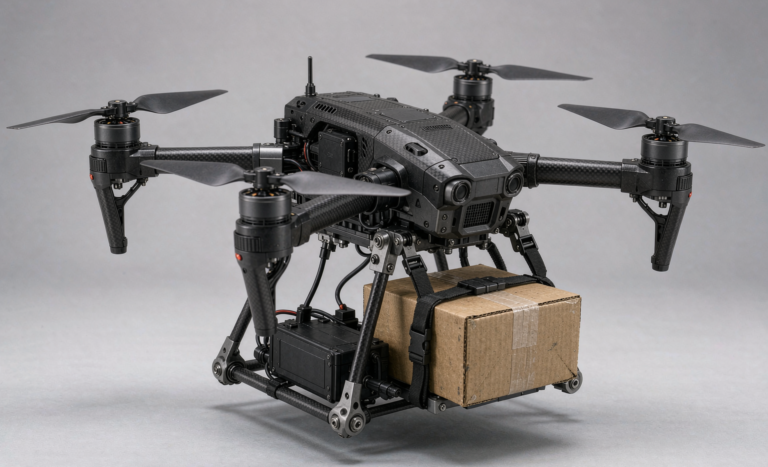
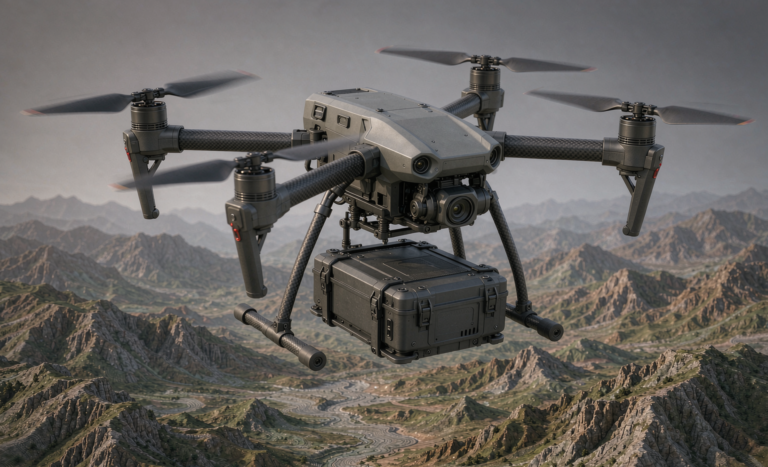
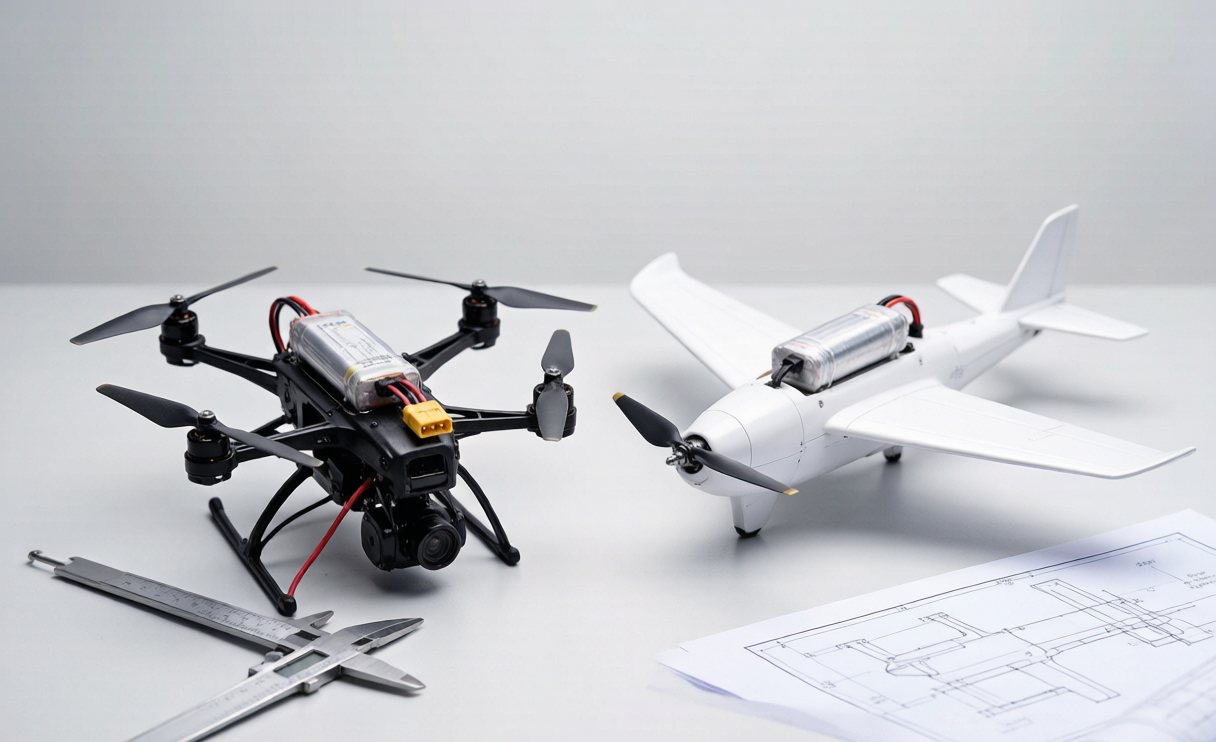
A multirotor hovers. That single fact dominates its entire energy budget. To remain airborne, a quadcopter or hexacopter must continuously push a column of air downward, and the power required scales with the square of the thrust per rotor. In steady hover a multirotor draws 60–90% of its peak power at all times, which means the pack spends most of the flight near its maximum sustained discharge. A fixed-wing aircraft, by contrast, generates lift from airflow over the wings. Once at cruise altitude it may draw only 20–35% of peak power, with the pack relaxing into a gentle discharge curve.
This difference is why a fixed-wing survey aircraft can fly for 90 minutes on a 10,000 mAh pack while a multirotor of similar mass is lucky to reach 25 minutes. When you are specifying a battery for multirotor vs fixed-wing use, you are really deciding between a high-C, always-under-load profile and a low-C, burst-then-cruise profile.
Discharge Rate (C-Rating) Is the Real Constraint
Capacity in milliampere-hours tells you how much charge a pack holds; the C-rating tells you how fast it can safely deliver that charge. A multirotor needs continuous discharge in the 10C–25C range for aggressive flight, with momentary bursts above 30C during climb or wind correction. A fixed-wing airframe is usually happy with 5C–10C continuous and only needs high bursts for takeoff.
In my lab I routinely see off-the-shelf packs that claim 30C but sag below 3.0 V per cell under a real 20C load because the manufacturer rated the number against a 10-second pulse, not a 10-minute hover. For a multirotor this voltage sag is dangerous: the flight controller reads low voltage and initiates a forced landing. For a fixed-wing it is merely annoying. That is why I treat the C-rating as the single most important specification when comparing a battery for multirotor vs fixed-wing duty.
Mass Budget and Energy Density Trade-offs
Every gram of battery you add reduces the payload a multirotor can carry. A heavy pack also raises the hover power required, which compounds the penalty—a classic negative feedback loop. This is where energy density (Wh/kg) becomes decisive. A high-energy-density lithium polymer or semi-solid cell lets a multirotor carry more flight time in the same mass envelope.
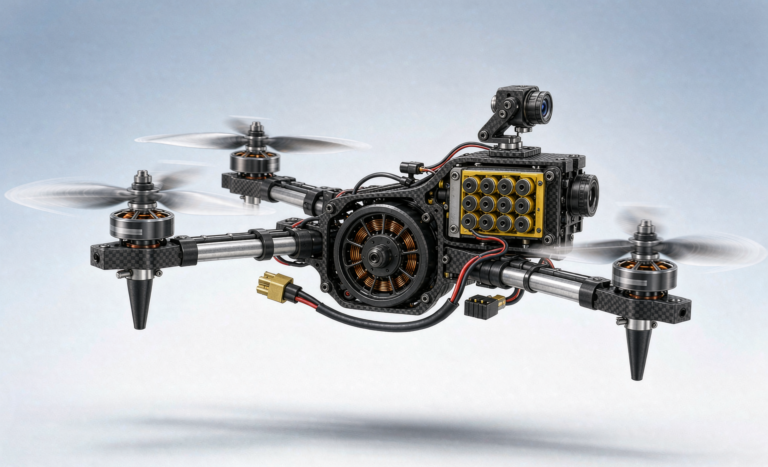
Fixed-wing platforms are more forgiving because lift scales with wing area, not thrust. They can absorb a heavier pack and convert it into longer endurance. I often work with clients who want a custom drone battery shaped to fill an awkward fuselage bay; for fixed-wing that custom form factor is easy to exploit, while for multirotors we have to be ruthless about keeping the pack centralized and low to protect the center of gravity.
Voltage Platform and Cell Configuration
Most commercial drones run on 3S to 6S lithium polymer platforms (11.1 V to 22.2 V nominal). Multirotors lean toward higher cell counts for cleaner ESC efficiency at high current, while many fixed-wing systems still use 2S–4S to keep weight and BMS complexity down. The cell configuration also affects balancing: a 6S pack needs a more capable battery management system to keep individual cells within tolerance across hundreds of cycles.
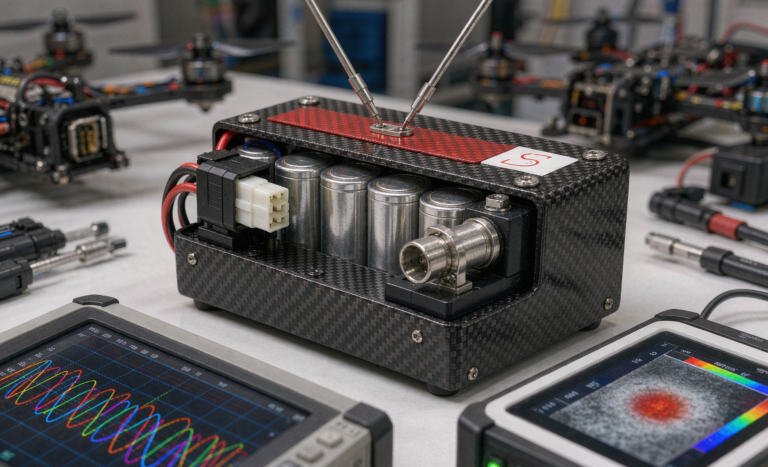
When a project outgrows standard form factors, a custom drone battery built around the exact voltage and footprint of the airframe is the right move. As a drone battery manufacturer, we frequently design 4S and 6S packs with bespoke discharge connectors, embedded fuel gauges, and conformal-coated PCBs for humidity resistance.
Temperature and Environmental Factors
Cold is the silent killer of flight time. Below –10 °C the internal resistance of a conventional lithium polymer cell climbs sharply, and the available capacity can fall by 20–30%. For a multirotor that already runs near its limit, the effect is a shorter, weaker hover. For a fixed-wing doing a slow climb at dawn, it means a longer takeoff roll and reduced climb rate. I specify cells with low internal resistance at temperature and, where the mission demands it, add trace heating or insulated enclosures for sub-zero operations.
Heat is the opposite problem on a hot tarmac: a pack left in direct sun before flight starts the mission already at 40 °C, which accelerates calendar aging. The right battery for multirotor vs fixed-wing work in the field is one whose thermal envelope matches the operating climate, not just the spec sheet.
Cycle Life and Total Cost of Ownership
Procurement teams love to compare pack price per watt-hour, but that number hides the real economics. A cheap pack that loses 20% capacity after 150 cycles costs more per flight-hour than a premium pack rated for 500 cycles. Multirotors cycle their packs hard and hot, so cycle life matters even more for them; fixed-wing packs age more gently. I build a simple model for every client: cost per flight-hour = pack price ÷ (usable cycles × flight minutes ÷ 60). It almost always reframes the buying decision toward higher-quality cells.
What I Specify for Airworthiness and Shipping
No battery leaves my bench without clearing the regulatory baseline. For air transport every pack must pass UN38.3, the international test standard covering altitude simulation, thermal, vibration, shock, external short circuit, impact, overcharge, and forced discharge. I also design to IEC 62133 for cell-level safety and document compliance for both FAA and EASA carriage rules.
On the engineering side I insist on a BMS with over-voltage, under-voltage, over-current, and short-circuit protection, plus a hard current interrupt device on the cell itself. For cold-weather operators I specify cells with low internal resistance at –20 °C so the pack does not limp on the first climb of the day.
The Horizon Power Outlook: Higher Energy Density Is Coming
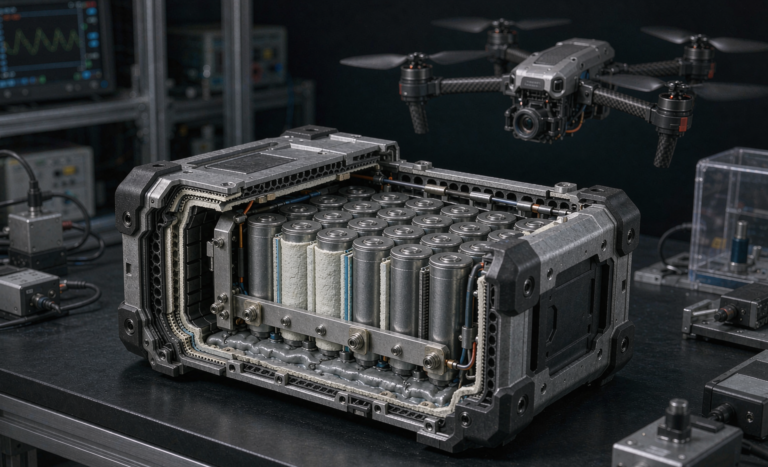
The most exciting shift I am tracking is the arrival of the solid state drone battery. By replacing the liquid electrolyte with a solid separator, these cells push energy density past 400 Wh/kg while improving thermal stability. For multirotors the implication is enormous: the same mass budget could deliver 40–60% more flight time. We are already running pilot builds, and while cost is still higher than conventional lithium polymer, the endurance gain is compelling for inspection and mapping operators who fly all day.
Final Recommendation
If you are choosing a battery for multirotor vs fixed-wing aircraft, start from the flight profile, not the catalog. Multirotors want high-C, high-energy-density packs with robust BMS protection; fixed-wing platforms want lighter, lower-C packs shaped to the fuselage. Get those two variables right and the rest of the specification—connectors, voltage, certification—falls into place.
Sizing the Pack: A Worked Example
Numbers make the trade-off concrete. Take a 2 kg multirotor with a 4S 5,000 mAh pack at 14.8 V—that is 74 Wh. At a realistic hover draw of 40 A (roughly 590 W), the pack delivers about 7.5 minutes of flight, and I budget 80% depth of discharge, so usable time is closer to six minutes. Now imagine the same payload on a fixed-wing airframe drawing 12 A cruise (about 178 W). The same 74 Wh pack yields over 20 minutes. The battery did not change; the flight profile did. When clients ask me to “just make it fly longer,” the first question is always which airframe they are actually flying, because the answer changes the entire specification.
A Pre-Flight Procurement Checklist
Before any order is placed, I run through a short list with the client: confirmed flight profile (hover-heavy or cruise-heavy), required continuous and surge C-rating, total mass budget including the pack, operating temperature range, target endurance per charge, and the certification package needed for transport. Getting these six variables on paper before sourcing prevents the costly mismatch where a beautiful drone battery arrives and simply cannot do the job. A disciplined checklist is the cheapest insurance in the whole procurement process.
Frequently Asked Questions
Can I use the same drone battery for both multirotor and fixed-wing aircraft?
Technically yes, if the voltage and connector match, but it is rarely optimal. A multirotor pack is built for sustained high discharge and tends to be heavier; a fixed-wing airframe would carry that mass without needing the C-rating, sacrificing endurance. Matching the pack to the flight profile is almost always the better engineering choice.
Why does my multirotor land early even with a high-capacity battery?
The usual culprit is voltage sag under continuous load. A pack that looks large on paper may not sustain the 15C–25C a multirotor demands, so the flight controller reads a low-cell condition and forces a landing. Check the continuous C-rating and the per-cell voltage under your real hover current, not just the mAh number.
Is a solid state drone battery worth it for my fleet today?
For most operators the cost is still higher than lithium polymer, but if endurance directly drives revenue—long-range inspection, mapping, or delivery—a solid state drone battery can pay back through extra flight time per charge. I recommend piloting a small batch before a full fleet conversion.
What certifications must my battery clear before air shipping?
At minimum UN38.3 for transport, with IEC 62133 for cell safety and supporting documentation for FAA and EASA carriage. A qualified drone battery manufacturer will supply the test reports and a lithium battery handling declaration with every shipment.