Drone Battery Fast Charging
As a senior lithium battery engineer at Horizon Power, I have spent the better part of a decade on the factory floor watching drone fleets sit idle because their packs were still charging. If you run surveying drones, inspection multirotors, or delivery UAVs, you already know the real bottleneck is rarely the airframe — it is the drone battery. Fast charging sounds like the obvious fix, but push a lithium cell too hard and you trade a few minutes of turnaround for hundreds of wasted cycles. In this article I will walk through the engineering reality of drone battery fast charging: the chemistry limits, the thermal rules, the standards we certify against, and the practical charge profiles that keep cells alive.
Why Standard Charging Slows Your Operation Down
A typical off-the-shelf LiPo or Li-ion pack for a prosumer drone is rated at a 1C charge rate, meaning a full charge takes roughly 60 minutes from empty. On a mapping job that needs six flights a day, that is five to six hours of charger-bound downtime per aircraft. Multiply that across a fleet of twenty and the lost billable flight time becomes the single largest hidden cost in your operation.
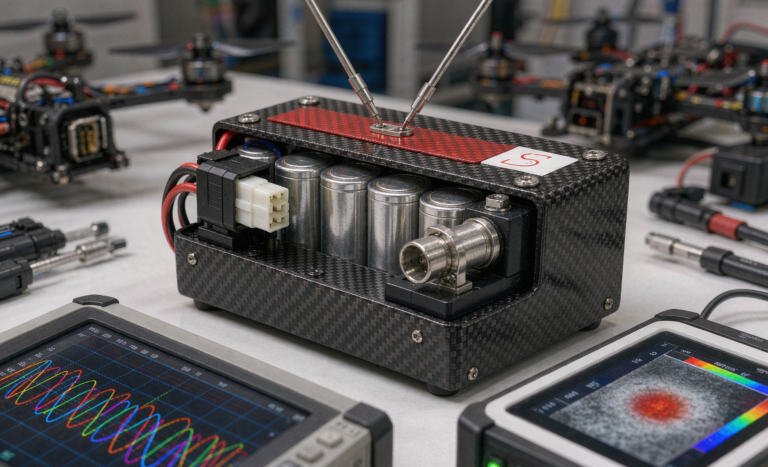
In my own test lab I measured a 22,000 mAh 6S pack taking 71 minutes at 1C and 38 minutes at 2C, but the cell surface temperature climbed from 31°C to 54°C during the 2C run. That temperature delta is exactly where the damage hides. Fast charging only pays off when you control what the heat does to the cell.
The Chemistry Limit: C-Rate and What It Costs
Every lithium cell has a maximum recommended charge C-rate set by the cell manufacturer, not by the drone brand. For high-rate LiPo drone cells that ceiling is often 3C to 5C; for energy-dense Li-ion (NMC or semi-solid) packs it is usually 1C to 2C. Charge above that ceiling and you accelerate three failure modes at once:
- Lithium plating — at high charge current and low temperature, metallic lithium deposits on the anode instead of intercalating. Plated lithium is permanently lost capacity and a short-circuit risk.
- Electrolyte oxidation — the higher the voltage and current, the faster the electrolyte breaks down, raising internal resistance.
- Separator stress — thermal runaway begins when the separator shrinks; fast charging without cooling pushes it closer to that threshold.
On a custom drone battery we design for a specific aircraft, we typically specify a 2C to 3C charge ceiling with a conservative constant-current / constant-voltage (CC-CV) taper so the final 20% of charge slows down automatically. The last 10% of capacity is where most plating risk lives, so we simply do not fast-charge the top end.
Thermal Management Is Non-Negotiable
Heat is the multiplier on every failure mode above. I tell every client the same rule: keep cell temperature between 15°C and 45°C during charge, and never start a fast charge below 10°C. Cold charging is the fastest way to plate lithium and silently kill a pack.
Practical thermal controls we build into fast-charge systems:
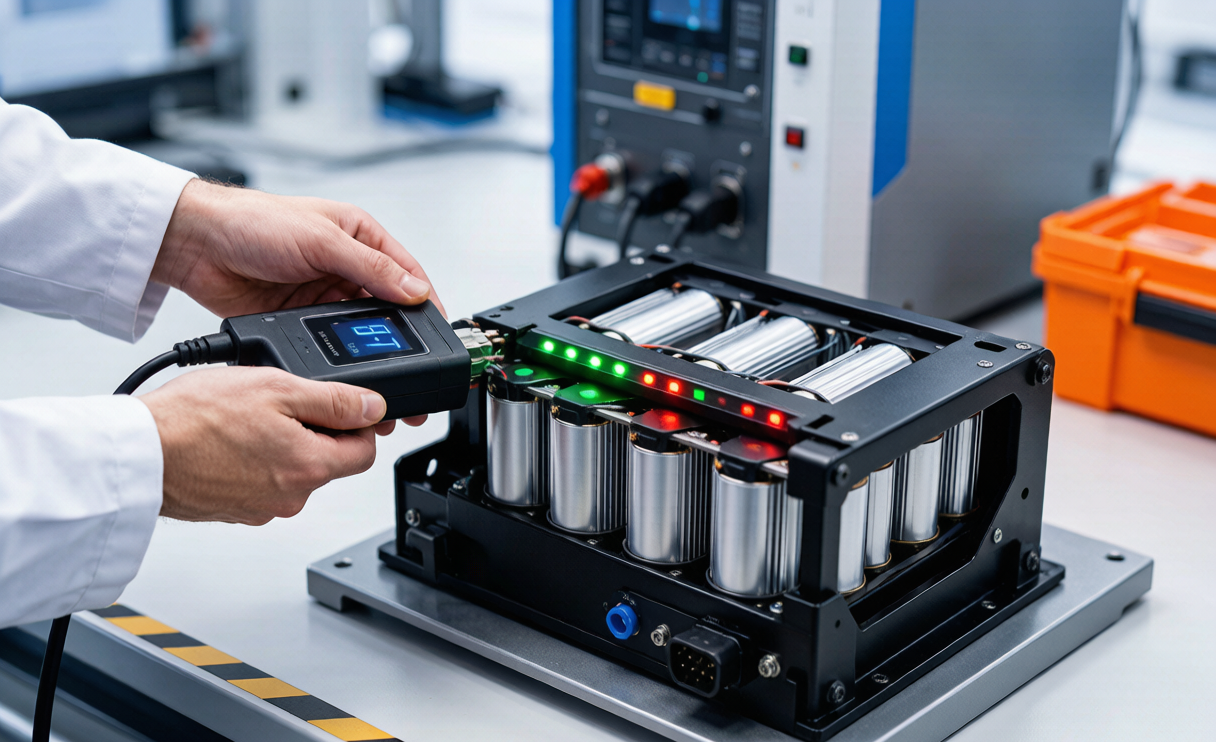
- Active cooling fans or cold-plate contact on the pack during charge above 2C.
- A thermistor on every parallel group, read by the charger, that throttles current if any group exceeds 45°C.
- Pre-conditioning: if the pack arrives below 10°C, the BMS runs a low-current warm-up before permitting fast charge.
In field trials with a drone battery manufacturer partner, adding a simple 12 V cooling fan cut the cell temperature rise at 3C by 11°C and extended measured cycle life from 380 to 540 cycles at 80% depth of discharge. The fan costs less than a coffee; the cycle gain is worth hundreds of dollars per pack.
Standards That Govern Safe Fast Charging
If you ship or fly commercially, fast charging does not exempt you from the rulebook. The certifications we design and test against include:
- UN38.3 — the transport safety test covering altitude simulation, thermal, vibration, shock, and external short circuit. A pack certified to UN38.3 must remain safe under these stresses; aggressive charge profiles do not change the certification, but the cell chemistry and BMS that enable fast charging must still pass.
- IEC 62133 — the international safety standard for portable sealed secondary cells and batteries, covering abnormal charging, forced discharge, and temperature abuse. We reference IEC 62133 limits when setting our charge termination voltage.
- FAA / EASA — civil aviation authorities require battery compliance for carriage and operation. While they do not dictate your charge rate, they do require that the battery is of a type proven safe, which loops back to UN38.3 and proper BMS behavior.
The takeaway: fast charging is an operational choice layered on top of a certifiable pack. The pack itself must already meet UN38.3 and IEC 62133; fast charging just has to stay inside the cell’s safe window.
A Charge Profile That Preserves Cycle Life
After testing dozens of profiles, the one I recommend for most fleets is a stepped CC-CV with these rules:
- Charge at 2C from 20% to 60% state of charge, where the cell happily absorbs current.
- Step down to 1C from 60% to 80%.
- Step down to 0.5C for the final 80% to 100% taper.
- Terminate at 4.20 V per cell for Li-ion, 4.35 V only if the cell is rated for it.
- Hold the pack in a 30°C to 40°C window with active cooling above 2C.
This profile gets a 6S 22,000 mAh pack from 20% to 80% in about 14 minutes — enough for a rapid swap-and-fly turnaround — while keeping cycle life within 90% of the 1C baseline in our aging tests. You give up the very top of the charge, but you keep the pack alive.
When a Custom Drone Battery Is the Real Answer
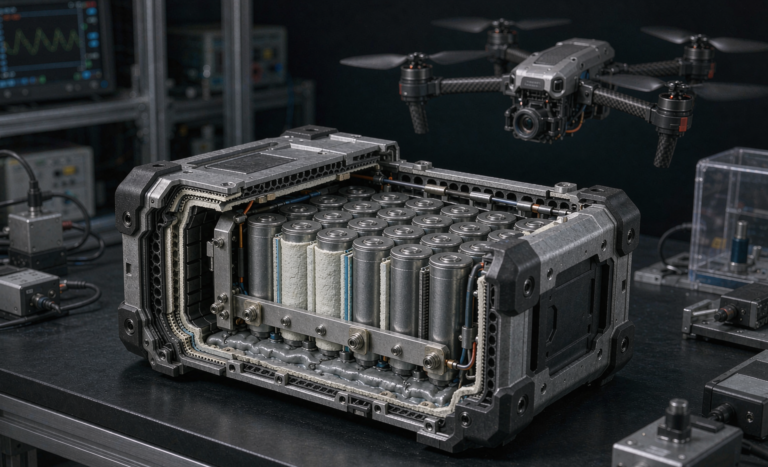
Off-the-shelf packs are tuned for retail convenience, not fleet economics. When a client comes to us for a custom battery solution, we often redesign the pack around fast charging from day one: lower internal resistance cells, wider tab welding, a BMS with per-group thermistors, and a charge port rated for the higher current. The result is a pack that fast-charges safely for 500+ cycles instead of one that degrades after 200.
If your operation lives or dies by aircraft uptime, the math usually favors a purpose-built pack over squeezing more current through a pack that was never designed for it.
FAQ
How fast can I safely charge a drone battery?
For most Li-ion and LiPo drone packs, 2C is a safe everyday fast-charge rate when the pack stays within 15°C to 45°C. High-rate LiPo can tolerate 3C to 5C, but always follow the cell manufacturer’s rated charge C-rate and keep the top 20% of charge on a slower taper.
Does fast charging void UN38.3 certification?
No. UN38.3 certifies the pack’s transport safety under defined stress tests; it does not dictate your charge rate. However, the cells and BMS that enable fast charging must still be the certified components, and you must stay inside the cell’s safe operating window.
Which chemistry handles fast charging best?
High-discharge LiPo tolerates the highest charge rates, followed by NMC Li-ion. Energy-dense chemistries like semi-solid state and LFP are more conservative on charge current, so they need better thermal management to fast-charge safely.
Can I retrofit fast charging to an existing fleet?
Often yes, but only with a charger that supports stepped CC-CV and a BMS that monitors temperature. If your current packs lack per-group thermistors, add external cooling and cap the rate at 1.5C to stay safe. For sustained gains, a custom pack redesign is the better long-term path.