Understanding Drone Battery C-Rating and Discharge (3)
Why C-Rating Is the Number You Actually Fly By
When a customer calls our engineering desk asking why their new multirotor loses altitude in the last 90 seconds of a flight, the answer almost never lies in capacity. It lies in drone battery C-rating — the single specification that decides whether a pack can deliver the current your motors demand at the moment you need it. I am Karl Huang, Senior lithium battery Engineer at Horizon Power, and over the past twelve years I have put well over two thousand lithium packs through discharge cyclers. In this article I will walk you through exactly what C-rating means, how it translates into real-world discharge performance, and how we validate it before a single pack ships.
If you design, source, or operate unmanned aircraft, understanding C-rating is not optional. It is the difference between a clean, repeatable flight envelope and a pack that sags, heats, and swells under load. Everything below comes from bench data we collect on our own equipment, not from marketing sheets.
What Does C-Rating Actually Mean?
The C-rating is a multiplier applied to a cell’s nominal capacity. In plain terms, 1C means the pack can deliver a current equal to its capacity in amp-hours within one hour. A 5000 mAh (5.0 Ah) cell at 1C supplies 5.0 A; at 20C it supplies 100 A; at 50C it supplies 250 A.
The relationship is linear and easy to compute:
- Discharge current (A) = C-rating × Capacity (Ah)
- A 6S 22.2 V, 5000 mAh drone lithium battery rated at 50C can theoretically output 250 A continuous and peaks well above that for short pulses.
- The “C” itself is simply a rate, not a unit — it scales with capacity, which is why a small 1500 mAh racing pack at 100C and a large 30000 mAh industrial pack at 15C can serve very different airframes.
One point I always stress to procurement teams: the printed C-rating is a claim. The verified C-rating is a measurement. The gap between the two is where most field failures live.
How C-Rating Drives Real Discharge Performance
A high C-rating does not change how much energy a pack stores — it changes how fast that energy can be pulled out before the voltage collapses. Two packs with identical 5000 mAh capacity but different C-ratings behave completely differently under the same 150 A load.
Consider a 4S pack built on 18650 high-energy cells versus one built on pouch high-power cells:
- The high-energy pack (rated ~10C) sags to roughly 12.8 V under a 150 A draw because its internal resistance is high.
- The high-power pack (rated ~45C) holds near 14.0 V under the same load, keeping the motors in their efficient band.
This voltage platform stability is the practical meaning of discharge performance. Propulsive thrust scales with the square of available voltage at the ESC, so a 1 V sag across a 4S pack can cut usable thrust by double digits. For a drone battery, that sag is the difference between holding a hover and dropping.
Power delivered (W) = Pack voltage (V) × Current (A). A 6S 22.2 V pack at 200 A is moving 4.4 kW. Only a cell chemistry and construction tuned for high C-rate discharge sustains that without runaway heat.
The Hidden Cost: Internal Resistance and Temperature Rise
C-rating and internal resistance (IR) are two sides of the same coin. For a high-discharge drone lithium battery, cell IR typically lands between 8 mΩ and 18 mΩ depending on chemistry and format. The heat generated is I²R: at 200 A through a 12 mΩ pack, you are dissipating 480 W of pure loss as heat inside the cells.
In our thermal chamber tests we see a clear pattern:
- At a continuous 20C discharge, a well-built 6S pack rises from 25 °C ambient to about 42 °C at the cell surface.
- At a sustained 35C discharge, surface temperature climbs to 55–60 °C, and we begin to see capacity fade above 45 °C.
- Above 60 °C, LiPo chemistry risks venting; we set a hard derating line and recommend active cooling for any mission exceeding 30C continuous.
Temperature also feeds back into C-rating. Cold cells (0 °C) show roughly 2× the internal resistance of warm cells (25 °C), so the effective usable C-rating in winter flight can halve. This is why our cold-weather industrial packs use lower IR constructions and pre-heat protocols.
Choosing the Right C-Rating for Your Drone Platform
You do not always want the highest C-rating. Higher C cells trade energy density for power density, so an overspecified pack is heavier and shorter-ranged for no benefit. Match the rating to the duty cycle:
- FPV racing drones: 80C–150C bursts, short flights, weight-tolerant. Peak current dominates.
- Consumer camera drones: 15C–30C continuous, smooth throttle, range-priority. Energy density wins.
- Industrial inspection and agriculture drones: 20C–40C with sustained hover loads; thermal stability matters more than peak.
- Heavy-lift cargo platforms: 30C–60C continuous, where voltage sag directly reduces payload ceiling.
As a rule of thumb I give customers: size the pack so your expected continuous current sits at roughly 60–70% of the rated C current, leaving headroom for gusts, altitude holds, and battery aging. A pack run at its absolute limit every flight ages 3–4× faster.
How We Validate C-Rating in the Lab
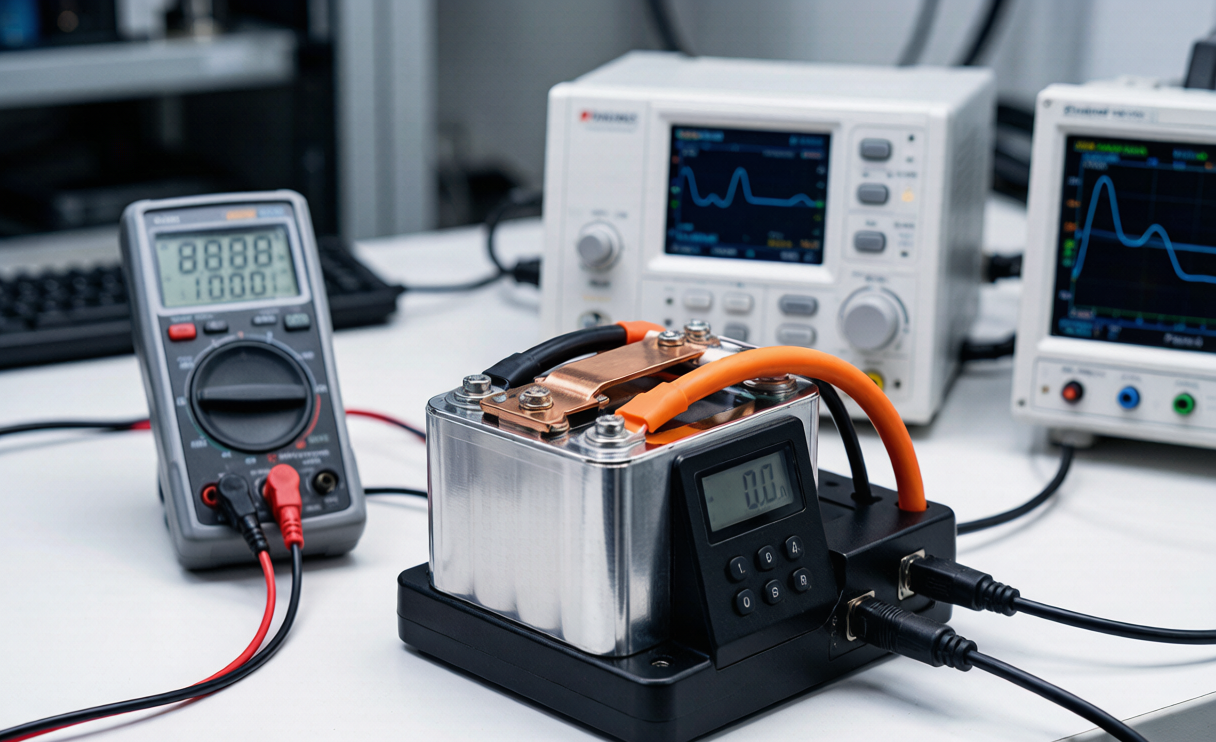
At Horizon Power every custom battery solution goes through a multi-stage discharge validation before release. Our standard protocol:
- Capacity check at 0.5C to confirm the pack meets its Ah label within ±3%.
- Steady-state discharge at the rated C for the full curve, logging pack voltage, per-cell voltage, and surface temperature every second.
- Pulse test: 10-second bursts at 2× rated C with 30-second rests, repeated 20 times, to measure recovery and voltage rebound.
- IR trending across 50 cycles to confirm the pack does not drift past our 20% internal-resistance growth limit.
Only packs that hold their rated C without exceeding 55 °C surface and without dropping below the 3.0 V/cell cutoff under load earn the rating we print. This is the engineering discipline behind a number you can actually fly by.
Designing for Discharge Performance: A Custom battery solution Perspective
When a client brings us an airframe, we do not start from a catalog cell — we start from the flight profile. We model the current draw across a representative mission, size the busbars and silicone wiring for the peak amps, and select a cell whose verified C-rating covers the worst-case second with margin. For a recent agriculture drone we moved the customer from a 25C pack to a 40C low-IR construction; hover sag dropped from 1.4 V to 0.5 V and flight time actually improved because the ESCs spent less energy fighting voltage collapse.
That is the real lesson of drone battery C-rating: it is not a bigger number for the brochure, it is the foundation of stable, safe, repeatable flight. Choose it on data, verify it on the bench, and your drones will fly the way the simulation promised.
Frequently Asked Questions
What C-rating do I need for my drone?
Estimate your worst-case continuous current from the motor/ESC specs, divide by your pack capacity in Ah, and add 30–40% headroom. A 6S 5000 mAh pack pulling 120 A needs at least 24C; we recommend a verified 35C pack so aging and gusts stay covered.
Does a higher C-rating always mean a better battery?
No. Higher C cells usually sacrifice energy density and add weight. If your current draw never approaches the limit, you carry dead mass. Match the rating to the actual load rather than maximizing it.
How does temperature affect my battery’s C-rating?
Cold cells roughly double their internal resistance near 0 °C, halving effective usable C-rating. Hot cells above 55 °C risk venting and permanent capacity loss. Keep packs in the 20–40 °C window for best discharge performance.
Can I mix batteries of different C-ratings?
Never in the same circuit. Different C-ratings have different IR and sag profiles; paralleling them forces uneven current sharing, overheats the weaker pack, and can cause thermal runaway. Always fly matched sets.