Battery Solution for Warehouse Automation and AMRs
Over the past three years I have watched the warehouse change shape. As a senior lithium battery engineer at Horizon Power, I have spent more hours than I can count on the floor of fulfillment centers, clipboards in hand, watching autonomous mobile robots (AMRs) glide between racks. The mechanical arms and LIDAR modules get the attention, but the real constraint on a 24/7 automated warehouse is something quieter: the battery. A modern battery solution for warehouse automation is not a repurposed power-tool pack. It is a carefully engineered energy system that has to survive thousands of partial cycles, tolerate the ambient heat thrown off by servers and chargers, and report its own health in real time so the fleet never dies mid-shift.

Why Warehouse Automation Needs a Purpose-Built Battery Solution
When a logistics manager first asks me about powering their robots, they usually start from the consumer world: “We’ll just use laptop cells, right?” Wrong. A warehouse runs a fundamentally different duty cycle. A consumer device might see one charge per day. An AMR in a busy distribution center can complete 60 to 120 pick-and-drop missions in a single shift, each one a shallow discharge followed by an opportunity charge. That is a fundamentally different stress profile, and it demands a custom battery solution rather than an off-the-shelf pack.
The failure mode is also different. If your phone battery swells, you buy a new phone. If an AMR battery fails on the line, you lose throughput across the whole zone, and a thermal event near cardboard and shrink-wrap is a facility-level hazard. That is why every battery application solution we ship for warehouse automation is built around cycle life, thermal headroom, and telemetry — not just raw capacity.
Reading the AMR Duty Cycle Before You Spec a Cell
Before I recommend a single cell, I ask for the robot’s duty cycle, not its marketing brochure. A mid-size AMR weighing 80–150 kg and carrying a 30–60 kg payload typically draws 200–500 W while cruising on flat concrete. But during acceleration, lifting, and ramp climbing, peak demand spikes to 1.5–2.0 kW for a few seconds. That C-rate, not the average, governs cell selection.
In practice we size most AMR packs at 48 V nominal with 20–40 Ah of capacity, which translates to roughly 1–1.9 kWh. A robot that genuinely runs 18–22 hours per day needs either a swappable second pack or an opportunity-charging strategy where it tops up during idle minutes at a docking station. Both are valid, and both change the battery pack design in ways I will cover below.
LFP vs NMC for Autonomous Mobile Robots
For warehouse fleets, lithium iron phosphate (LFP) has become the default chemistry, and for good engineering reasons. LFP offers 3,000–6,000 full-equivalent cycles, excellent thermal stability, and a chemistry that is far more forgiving if a single cell is abused. Nickel-manganese-cobalt (NMC) still wins on energy density — roughly 160–220 Wh/kg versus 120–160 Wh/kg for LFP — which matters when every kilogram of payload counts.
But in a warehouse, mass is less constrained than uptime and safety. An LFP lithium battery pack that limps through five years of daily cycling is worth more than a lighter NMC pack that needs replacement in two. For cold-chain or freezer-adjacent zones, we sometimes move to NMC or a heated enclosure, but the baseline recommendation for 90% of AMR fleets is LFP.
Battery Pack Design and the Thermal Reality of the Floor
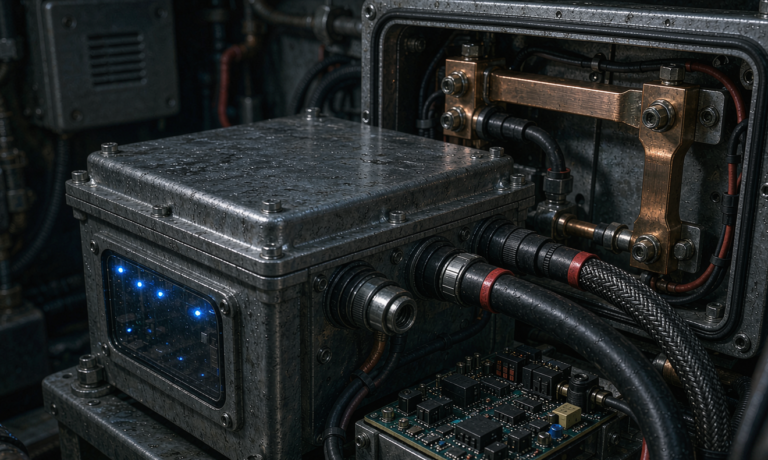
The floor is a hostile environment. Ambient temperatures near battery chargers and server racks routinely sit at 35–45°C, and a pack buried inside a robot chassis has limited airflow. Good battery pack design starts with spacing and thermal interface material, not just cell selection.
- Operating window: we design for 0–45°C charging and −10 to 55°C discharging, with the BMS enforcing a hard cutoff outside those bands.
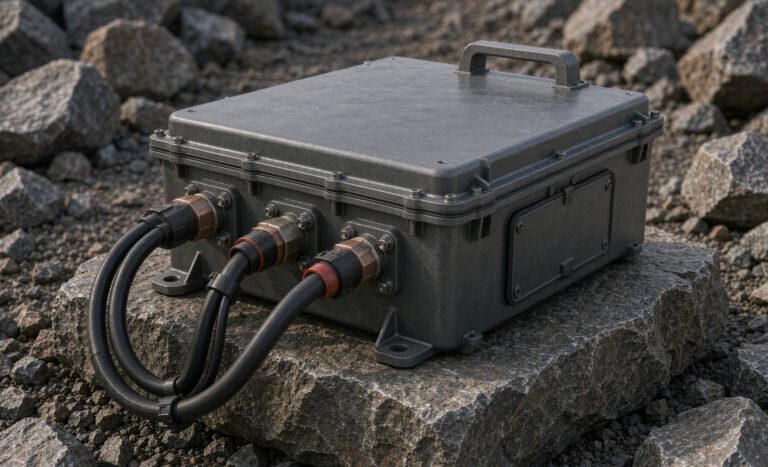
- Sealing: dust from cardboard and plastic film is constant, so an IP54 to IP65 enclosure is standard depending on whether the robot can be hosed down.
- Vibration: continuous floor travel at 1–2 m/s induces fatigue; cell welds and busbars must be validated against the robot’s vibration spectrum, not a generic spec.
- Mechanical retention: a pack that shifts inside the chassis will break its own interconnects within weeks. We tie it down with the same discipline we use for an automotive module.
None of this is glamorous, but it is the difference between a pack that lasts and one that comes back as a warranty claim.
The BMS Solution: Telemetry, Safety and Fleet Health
The battery management system is where a warehouse battery solution earns its keep. A dumb pack just stores energy. A smart one tells you when it is about to fail. Our BMS solution for AMRs does three things that matter operationally.
First, it estimates state of charge (SOC) and state of health (SOH) using coulomb counting cross-checked against an impedance model, so the fleet scheduler knows which robots to pull for charging before they strand themselves. Second, it enforces cell balancing and protects against over-voltage, under-voltage, over-current, and over-temperature. Third, it talks to the robot controller over CAN bus or RS-485 and pushes telemetry to the facility’s dashboard.
For a fleet of 50 or 500 robots, that telemetry is the entire game. We have caught packs trending toward early degradation weeks before they would have caused a line stoppage, purely because the BMS flagged a slowly rising internal resistance. That is the kind of battery application solution that pays for itself in prevented downtime.
Certification and Compliance You Cannot Skip
Warehouse batteries are not exempt from the rules that govern every large lithium pack. The two standards I insist on for any AMR program are UN38.3 and IEC 62133. UN38.3 covers the battery’s ability to survive the altitude, thermal, vibration, shock, and short-circuit abuse tests required for transport. IEC 62133 governs the safety of portable cells and packs, including the mandatory protective circuit requirements.
On top of those, CE marking is effectively mandatory for equipment entering the European market, and the relevant EMC and low-voltage directives apply to the BMS electronics. For spare packs that travel by air — say a replacement shipment to a regional hub — the FAA and EASA rules on lithium battery air transport kick in, and the UN38.3 test summary is the document customs and carriers will ask for. I have seen otherwise good products sit in a freight warehouse for weeks because the test summary was missing. Build the compliance file before you build the pack.
Sizing, Swappable Packs or Autonomous Charging?
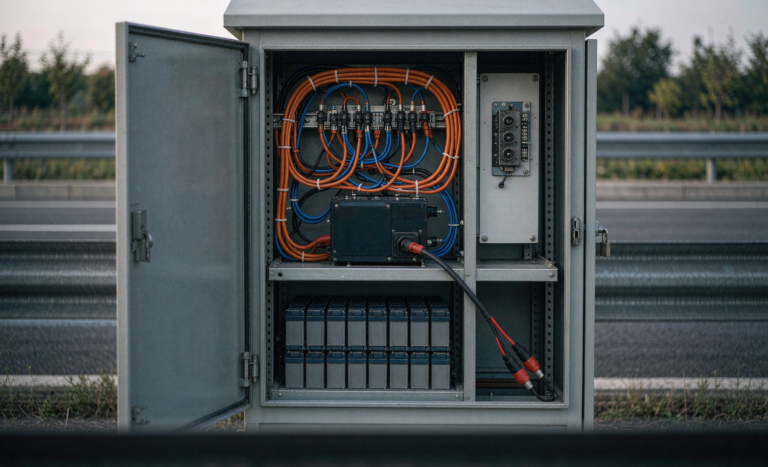
The last design decision is the operating model. A swappable custom battery solution lets a robot hand off a depleted pack and get back to work in under two minutes, which is ideal for three-shift operations where charger density is limited. The trade-off is that you now manage a pool of packs and a swapping station.
Opportunity or autonomous charging is simpler to operate — the robot docks itself during idle windows — but it demands enough charger ports and a charging curve the battery can tolerate hundreds of times per week. Either way, I size for the worst-case shift, not the average. A pack that ends the day at 20% state of charge on paper will, in the messy reality of peak season, end it at 4% and someone will get blamed. Leave headroom.
Total Cost of Ownership: Why the Cheap Pack Costs More
Procurement teams naturally focus on unit price, but for a fleet the number that matters is cost per delivered watt-hour over the pack’s life. An LFP pack that costs 30% more up front but lasts three times as long usually wins by a wide margin once you add the labor for swaps, the value of avoided downtime, and end-of-life recycling. I walk every client through a simple five-year model: pack price, expected cycles, replacement labor, and the residual value of the cells. In warehouse deployments the LFP battery solution almost always comes out ahead, and the gap widens as fleet size grows because the failure rate multiplies with every added robot.
There is also the hidden cost of a thermal incident. A single pack fire can take down a picking zone for days and trigger an insurance review across the whole site. Spending a little more on a conservative battery application solution with a proven BMS is the cheapest insurance a fulfillment center can buy, and it is a line item I refuse to trim.
FAQ
How long does an AMR battery last per shift?
With a properly sized LFP pack and opportunity charging, most AMRs run 8–12 hours of active duty before needing a full recharge, and a swappable configuration effectively removes the limit. The constraint is usually charger availability, not pack capacity.
Can I use the same battery solution for different robot models?
Sometimes, but I would not assume it. Voltage, connector, communication protocol, and mechanical envelope differ between platforms. A well-designed custom battery solution can share cells and BMS firmware across models while using different mechanical housings and connectors.
What certifications does a warehouse battery need?
At minimum UN38.3 and IEC 62133, plus CE for the European market. If spares ship by air, keep the UN38.3 test summary ready for FAA and EASA compliance checks.
How do I size capacity for a fleet?
Start from a single robot’s duty cycle: average watts multiplied by active hours, divided by usable pack voltage, with a 20–30% headroom for peaks and degradation. Multiply by fleet count and add spare packs for swap programs.
Is LFP always better than NMC for AMRs?
For most warehouses, yes, because cycle life and safety outweigh the density penalty. NMC earns its place only when mass is tightly constrained or the robots operate in sustained cold where heating an LFP pack is inefficient.