Battery Solution for Film and Broadcasting Equipment
On a professional film set, the camera is only as good as the power behind it. I am Karl Huang, Senior lithium battery Engineer at Horizon Power, and over the past decade I have spec’d battery packs for documentaries shot in desert heat, live broadcast trucks parked outside stadiums, and LED-volume stages that draw kilowatts of continuous load. A reliable battery solution for film and broadcasting equipment is not a consumer power bank with a logo slapped on it — it is an engineered power system where uptime, thermal behavior, and hot-swap capability decide whether a take makes it to the editor or gets lost to a black screen.
Why Film and Broadcasting Gear Needs a Purpose-Built Battery Solution
Cinema cameras such as ARRI, RED, and Sony Venice bodies pull 40–120 W steady, and when you add external monitors, wireless video transmitters, focus motors, and onboard recorders the total draw can exceed 250 W. LED panels used for interviews often run 150–600 W. Unlike a phone that sips power, broadcast gear is a sustained high-drain load, and that is exactly the regime where cheap cells sag, heat up, and trip protection. A purpose-built battery solution is designed around continuous C-rate, not peak marketing numbers.
Set realism also matters. Crews move fast, swap packs between setups, and sometimes run gear in rain covers or sub-zero mountain shoots. The pack must survive mechanical shock from being dropped into a case, resist dust, and still deliver rated capacity when the thermometer drops. That is why we treat broadcast power as a system, not a cell.
Common Power Challenges On Set
The failures I see most often are predictable. First is voltage sag: a pack built with low-grade cells drops below the camera’s cutoff under load, forcing an unexpected shutdown mid-take. Second is imbalance between paralleled packs in a power distributor, which causes one pack to over-discharge while another sits full. Third is thermal runaway risk when a pack is chained to a hot LED fixture inside a sealed enclosure with no airflow.
A fourth, subtler problem is runtime mismatch. A DP plans a 90-minute sunset sequence, but the battery reporting 30% over Bluetooth is actually at 12% because the state-of-charge algorithm was never calibrated to the load profile. Accurate runtime prediction is an engineering deliverable, not a nice-to-have.
Chemistry Choices: Li-ion, LFP, and High-Drain Cells
For handheld camera batteries and V-mount / Gold-mount style packs, high-energy 18650 or 21700 NMC (lithium nickel manganese cobalt) cells remain the default because they offer 200–260 Wh/kg, letting a compact pack deliver 98–150 Wh without breaching airline carry-on limits. For cart-based broadcast systems and base-station power, LFP (lithium iron phosphate) wins on cycle life — 3,000–6,000 cycles vs 500–1,000 for NMC — and on thermal stability, which matters when a pack lives inside a hot equipment van all day.
The wrong move is specifying a single chemistry across every product. We routinely mix: NMC for the lightest on-camera pack, LFP for the always-on distribution cart. A good custom battery solution starts from the load curve, not from a catalog.
Sizing the Pack for Continuous Shoot Days
Sizing is straightforward arithmetic that too many buyers skip. Take total load in watts, divide by pack voltage to get amps, then multiply by desired runtime. A camera rig drawing 180 W from a 14.4 V pack needs 12.5 A; for a 3-hour continuous shoot that is 37.5 Ah. Round up for the 80% depth-of-discharge rule we apply to protect cycle life, and you land near a 48 Wh-class or larger pack depending on cell count.
For live broadcast, I add a redundancy factor: two parallel packs with independent BMS so a single fault never kills the feed. At an outdoor concert or sports event, losing power means losing the live signal, and there is no second take.
BMS and Safety for On-Set Reliability
The battery management system is the difference between a pack and a product. For broadcast we specify a BMS with cell-level voltage monitoring, pack current limiting, overtemperature cutoff at 60 °C, and balanced charge. A proper BMS solution also handles coulomb counting for accurate runtime display and supports SMBus or CAN communication so the camera or a crew tablet can read remaining minutes.
Safety standards are non-negotiable. Every pack we ship passes UN38.3 for transport, and we design to IEC 62133 for portable cell safety. For broadcast crews flying gear internationally, that certification is what gets the batteries past an airline counter without a fight.
When a production scales to dozens of packs across multiple units, the BMS stops being a silent guardian and becomes a data source. A modern BMS solution logs every charge cycle, flagging cells that drift out of tolerance before they cause an on-set failure. For rental houses especially, that telemetry turns battery management from guesswork into scheduled maintenance.
Connectors, Hot-Swap, and Power Distribution
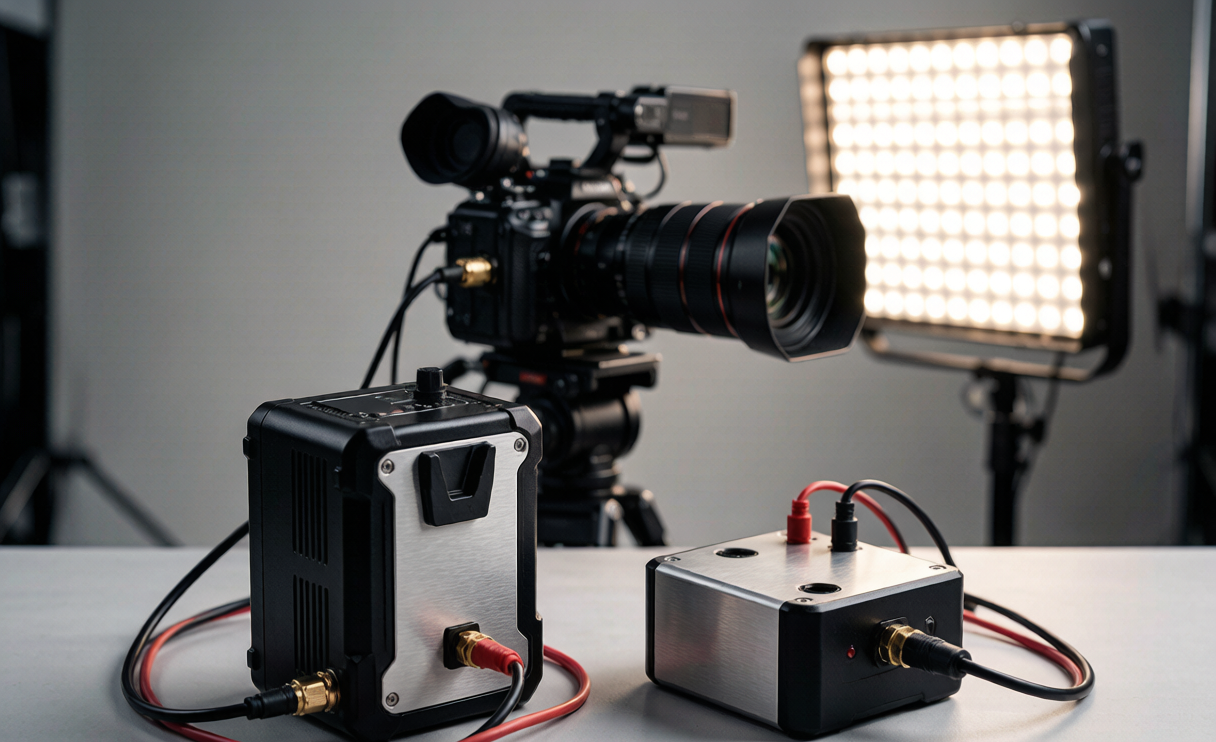
On set, the connector is the daily interface. We standardize on locking D-tap, 2-pin LEMO-style, and XLR for broadcast, plus USB-C PD for monitors and wireless units. Hot-swap matters: a well-designed battery application solution lets a technician pull a depleted pack and seat a fresh one in under ten seconds without rebooting the camera, using a small supercapacitor bridge to hold rail voltage during the swap.
Power distribution boxes deserve the same attention as the packs. A clean broadcast cart routes regulated 12 V, 24 V, and USB from a single LFP bank through individually fused outputs, so one shorted monitor cannot brown out the camera.
Certifications and Transport for Broadcast Crews
Film crews are mobile. A pack above 100 Wh requires declared dangerous-goods handling on most carriers, while packs at 95–100 Wh sit in a gray zone that varies by airline. We engineer broadcast packs at 98 Wh per module precisely so a documentary team can carry a dozen through normal checked-and-carry procedures. MSDS documentation and UN38.3 test summaries travel with every shipment, and we advise crews on IATA packing rules so a border inspection never stalls a shoot.
Custom Battery Solution vs Off-the-Shelf
Off-the-shelf V-mount batteries are fine for small crews. But when a broadcaster needs a 48 V cart battery, a 24 V drone-light pack, and a 14.4 V camera pack all sharing one charger ecosystem, a custom battery solution pays for itself in logistics alone. We have built unified platforms where one smart charger services every pack on the truck, and a single fleet dashboard tracks state-of-health across the whole inventory.
The engineering work is in the details: mechanical mounting that survives a jolt, firmware that reports health to the rental house, and a form factor that actually fits the rig. That is the gap between a battery and a broadcast-ready power system.
Runtime Prediction and Fleet Health Tracking
Accurate runtime is the feature directors notice first. We model the pack against the actual load curve of the specific rig — not a generic average — so the on-screen percentage reflects real minutes left. In practice that means calibrating the coulomb counter at the factory against a representative 200 W broadcast profile, then re-validating every few hundred cycles as cells age.
For broadcasters running fleets, a battery application solution that reports state-of-health to a central dashboard pays back fast. A coordinator can see that cart battery #14 has dropped to 82% capacity and route it to lighter duty before it ever lets a crew down. This predictive approach is what separates a professional power system from a box of cells.
Environmental Sealing and Field Durability
Film work happens outdoors. We specify enclosures with IP54 to IP67 rating depending on whether the pack lives on a rain-covered documentary or inside a climate-controlled studio cart. Gaskets, potted BMS boards, and conformal-coated cells keep humidity and fine dust from quietly killing a pack over a multi-week location shoot. I have seen more packs fail from slow moisture ingress than from outright abuse, so sealing is an engineering priority, not an afterthought.
FAQ
What battery capacity do I need for a cinema camera?
Total your rig’s watt draw, divide by pack voltage, then multiply by target runtime and divide by 0.8 for safe depth-of-discharge. A 180 W rig on 14.4 V for three hours needs roughly a 48 Wh-class pack or larger.
Is LFP or NMC better for film equipment?
NMC for light on-camera packs where energy density matters; LFP for cart-based and always-on broadcast systems where cycle life and heat tolerance dominate. Many productions run both.
How do I hot-swap a broadcast battery without losing the shot?
Use a BMS with a supercapacitor hold-up bridge so rail voltage stays stable during the swap, and standardize connectors so a fresh pack seats in under ten seconds.
Can I fly with film batteries internationally?
Packs at or below 100 Wh generally travel as carry-on with declared handling; above 100 Wh needs dangerous-goods procedures. We build modules at 98 Wh to stay in the practical zone, always with UN38.3 and MSDS papers.
Why does my battery show 30% but die at 12%?
The state-of-charge algorithm was not calibrated to your load profile. A proper BMS solution uses coulomb counting and load-aware modeling to report remaining minutes accurately.
Should a rental house standardize on one battery platform?
Yes. A unified custom battery solution with one charger type and fleet health tracking cuts downtime, simplifies training, and lowers total cost across the inventory.