Battery Solution Performance for Vehicles
Why Vehicle Battery Performance Is a System Problem, Not a Cell Problem
When a customer asks me to improve battery solution performance for vehicles, the first thing I tell them is that we are not shopping for a better cell. We are engineering a system. After 14 years designing lithium packs for drones, ground robots, and light electric vehicles, I have learned that the gap between a datasheet and a vehicle that actually works in the field is almost never the cell chemistry alone. It is the enclosure, the thermal path, the battery management system (BMS), and the validation discipline behind all three.
This article walks through how my team at Horizon Power approaches vehicle battery programs from the first requirement meeting to the final UN38.3 test report. I will use real numbers from programs we have shipped, and I will be honest about where the trade-offs hurt.
What “Battery Solution Performance for Vehicles” Actually Means
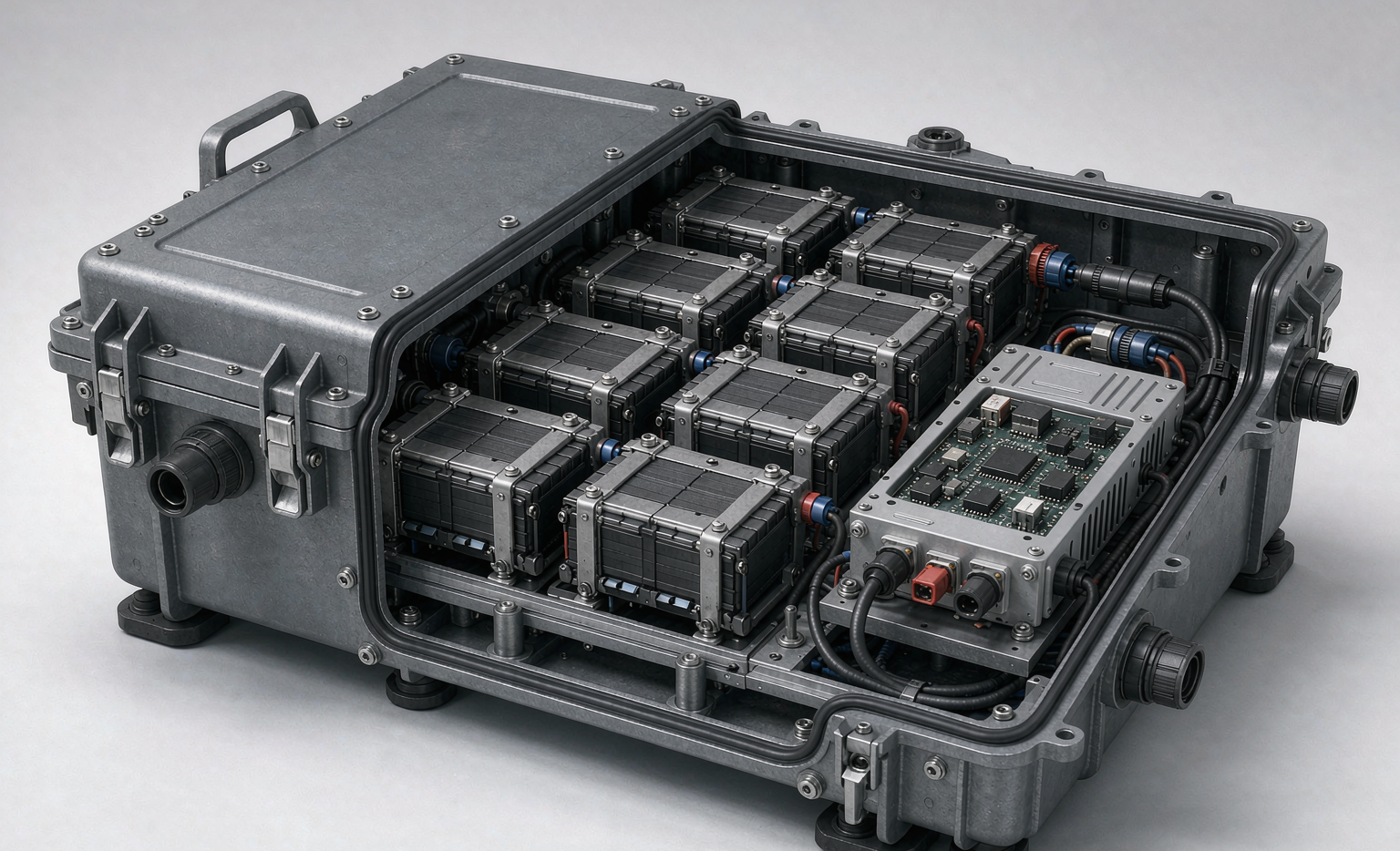
A battery solution for vehicles is the complete energy subsystem: cells, modules, busbars, sensing, cooling, mechanical housing, firmware, and the certification package that lets it legally ship and operate. “Performance” is then a bundle of metrics, not one number. For a delivery robot the dominant metric might be cycle life. For an aerial vehicle it is energy density and discharge pulse capability. For a warehouse tug it is total cost per kilowatt-hour over five years.
I push clients to rank their metrics before we pick a chemistry. A custom battery solution optimized for the wrong metric is worse than a commodity pack, because it costs more and still misses the target. We typically score five dimensions: energy density (Wh/kg), power density (W/kg), cycle life, operating temperature window, and safety margin under abuse.
The Five Metrics I Track on Every Vehicle Program
These are the numbers that show up in every acceptance test we run. They are also the numbers that decide whether a vehicle meets its duty cycle.
- Usable energy (Wh) – not nameplate, but energy between 20% and 80% state of charge for long-life programs, or 5% to 95% for cost-driven ones. We derate explicitly and document it.
- Continuous and peak discharge current (A) – peak matters most for vehicles with hard acceleration or climb events. A 10-second 5C pulse is common in our light EV packs.
- Cycle life at intended depth of discharge – we test to 80% capacity retention, not 70%, because fleet operators plan replacements on the 80% line.
- Self-discharge and balance drift – a pack that drifts 30 mV per month forces costly rebalancing in the field.
- Thermal rise under load – we measure cell surface temperature at 1C, 2C, and peak, because that single curve drives the entire enclosure and cooling decision.
On a recent three-wheeled logistics vehicle, the client originally specced a 48V 40Ah pack. Our testing showed their real duty cycle needed 60A continuous and 120A peak for 8 seconds during ramp climbs. We re-architected to a 14S configuration with 30A continuous rated cells in a 2P layout, which gave 60A continuous and headroom for peaks without exceeding 55°C cell surface. Performance is meeting the spec because we measured the real load, not the brochure load.
Cell Chemistry: Lithium-Ion, LFP, and Where Sodium Fits
For most vehicle battery solutions, the choice is between NMC (nickel manganese cobalt) lithium-ion and LFP (lithium iron phosphate). NMC wins on energy density: we routinely see 200–250 Wh/kg in 21700-format NMC packs. LFP trades 15–20% lower energy density for dramatically better cycle life (2,000–4,000 cycles) and superior thermal stability. For a vehicle that charges every shift and runs for years, LFP is usually the lower total-cost option even with the weight penalty.
Sodium-ion is the newcomer I am most excited about for specific vehicle segments. Its energy density (120–160 Wh/kg today) is below LFP, but its cold-weather behavior is excellent and its raw-material supply chain is far less volatile than lithium and cobalt. For stationary-adjacent vehicle roles – airport ground equipment, slow warehouse movers, cold-climate range extenders – a lithium battery alternative in sodium is now a serious engineering choice rather than a lab curiosity.
Thermal Management and the UN38.3 / IEC 62133 Reality
Thermal design is where most vehicle battery programs succeed or fail. We design the thermal path before we finalize the enclosure. Forced-air cooling handles up to roughly 2C continuous in our mid-size packs; beyond that we move to aluminum cold-plate liquid cooling. The goal is to keep every cell within a 5°C spread across the module, because imbalance accelerates the weakest cell’s aging.
Certification is non-negotiable. Every vehicle pack we ship is built to pass UN38.3, the transport safety test covering altitude simulation, thermal test, vibration, shock, external short circuit, impact, and overcharge. For the cell and pack construction we apply IEC 62133 as the baseline safety standard, which governs internal short-circuit behavior and temperature limits. I have seen too many importers discover at the port that their “compatible” pack never had a valid UN38.3 report. That is a vehicle program killer.
Our internal abuse testing goes beyond the minimum. We run nail penetration and thermal runaway propagation tests on representative modules so we understand how a single cell failure cascades – or does not – through the pack. For a vehicle carrying people or valuable cargo, propagation resistance is the difference between an incident and a recall.
BMS and Real-World Validation Beyond the Lab
The BMS is the brain, and I treat it as a safety device first and a performance device second. A good BMS for vehicles must do accurate state-of-charge and state-of-health estimation, cell-level voltage and temperature monitoring, and controlled contactor control. We validate the BMS against the actual load profile, not a constant current, because real vehicle loads are pulsed and asymmetric.
For aviation-adjacent and heavy vehicles we also align our documentation with FAA and EASA expectations where applicable – not because every ground vehicle needs aviation certification, but because the discipline of traceable design controls, fault-tree analysis, and documented verification makes the whole program safer and easier to insure. EASA’s Special Condition VTOL and FAA’s powered-lift guidance have shaped how we structure our failure-mode reviews even on terrestrial vehicles.
Field validation is the step clients skip at their peril. We deploy a small pilot fleet, log every charge and discharge, and watch for the patterns that never show up in a lab: connector corrosion at the charge port, vibration loosening a sense wire, a BMS that reads fine at 25°C but drifts at −10°C. On one agricultural vehicle program, pilot data revealed a 4% capacity loss after 200 cycles that lab testing had missed because the lab never replicated the vehicle’s deep-discharge-to-empty habit. We added a bottom-end cutoff and the field loss dropped to under 1%.
How We Engineer a Custom Battery Solution for a Specific Vehicle
When a standard pack will not meet the duty cycle, we build a custom battery solution. The process is disciplined and repeatable:
- Load profiling – we instrument the actual vehicle for at least one full duty cycle and extract real current, voltage, and temperature traces.
- Chemistry and topology selection – series-parallel count set by pack voltage and peak current, chemistry set by energy vs. life vs. cost ranking.
- Thermal and mechanical design – enclosure, cooling, IP rating, and mounting derived from the environment, not a catalog.
- BMS and firmware – tuned thresholds, communication (CAN bus is standard on our vehicle packs), and logging.
- Validation and certification – UN38.3 and IEC 62133 test reports, plus pilot fleet validation before volume production.
The payoff of this method is predictable battery solution performance for vehicles that survives the warranty period and the second life. A pack we designed for a last-mile delivery vehicle has now passed 1,800 cycles at 90% depth of discharge with 84% capacity retained – because the thermal path and BMS were specified for the real load, not the optimistic one.
Frequently Asked Questions
What is the most important factor in vehicle battery solution performance?
In my experience it is matching the chemistry and thermal design to the actual duty cycle. A pack with great cells but poor thermal management will degrade fast, while a correctly engineered LFP or sodium pack often outlasts a higher-density pack that was specced on paper alone.
Do vehicle battery packs need UN38.3 and IEC 62133 certification?
Yes. UN38.3 is required for safe and legal transport of lithium cells and batteries, and IEC 62133 is the baseline safety standard we build every pack to. Without valid test reports, a vehicle program can be stopped at the port or rejected by an insurer.
When should I choose a custom battery solution over an off-the-shelf pack?
Choose custom when your vehicle has an unusual voltage, a high peak-current event, a tight space envelope, or a duty cycle that off-the-shelf packs cannot meet for the required cycle life. If a commodity pack already fits the load with margin, use it and save the engineering budget.
Is sodium-ion ready for vehicle battery applications?
For lower-energy-density, cold-weather, or supply-chain-sensitive roles, yes. Sodium-ion will not replace high-energy NMC packs in range-critical vehicles soon, but it is a legitimate option for ground equipment, slow movers, and cold-climate range extenders today.
How do FAA and EASA standards affect ground vehicle battery design?
Directly, only for aircraft and powered-lift vehicles. Indirectly, their structured failure-mode and verification discipline improves every program we apply it to, which is why we use aviation-aligned review methods even on terrestrial vehicles.