Drone Battery Capacity Drop and Retirement Thresholds: An Engineer’s Field Guide
Over the past eleven years designing packs for commercial UAV fleets, I have fielded more questions about capacity fade than almost anything else. Every operator eventually asks the same thing: my drone battery started at 16,000 mAh, the BMS now reports 13,400 mAh after eight months, and I am not sure whether that pack is safe to keep flying. I am Karl Huang, Senior lithium battery Engineer at Horizon Power, and capacity drop is one of the most misunderstood topics in our industry. This guide explains why it happens, how I measure it in the field, and the retirement thresholds I use to decide when a pack should leave active service.
Why Capacity Drop Happens Inside a Drone Lithium Battery
A drone lithium battery loses usable capacity because of irreversible chemistry, not because the cells suddenly forget their charge. The dominant mechanism is growth of the solid-electrolyte interphase (SEI) layer on the graphite anode. Every charge cycle consumes a small amount of active lithium to heal that film, and the lithium is gone for good. Secondary contributors include lithium plating during fast charging at low temperature, cathode particle cracking from mechanical strain, and electrolyte oxidation at high voltage. In my lab data across thousands of NMC and LFP cells, packs kept between 20 percent and 80 percent state of charge (SOC) and at 25 degrees Celsius typically lose about 2 to 3 percent of capacity per 100 cycles, while packs routinely deep-cycled and stored at full charge can lose 8 to 12 percent over the same interval.
How I Measure Real Capacity in the Field
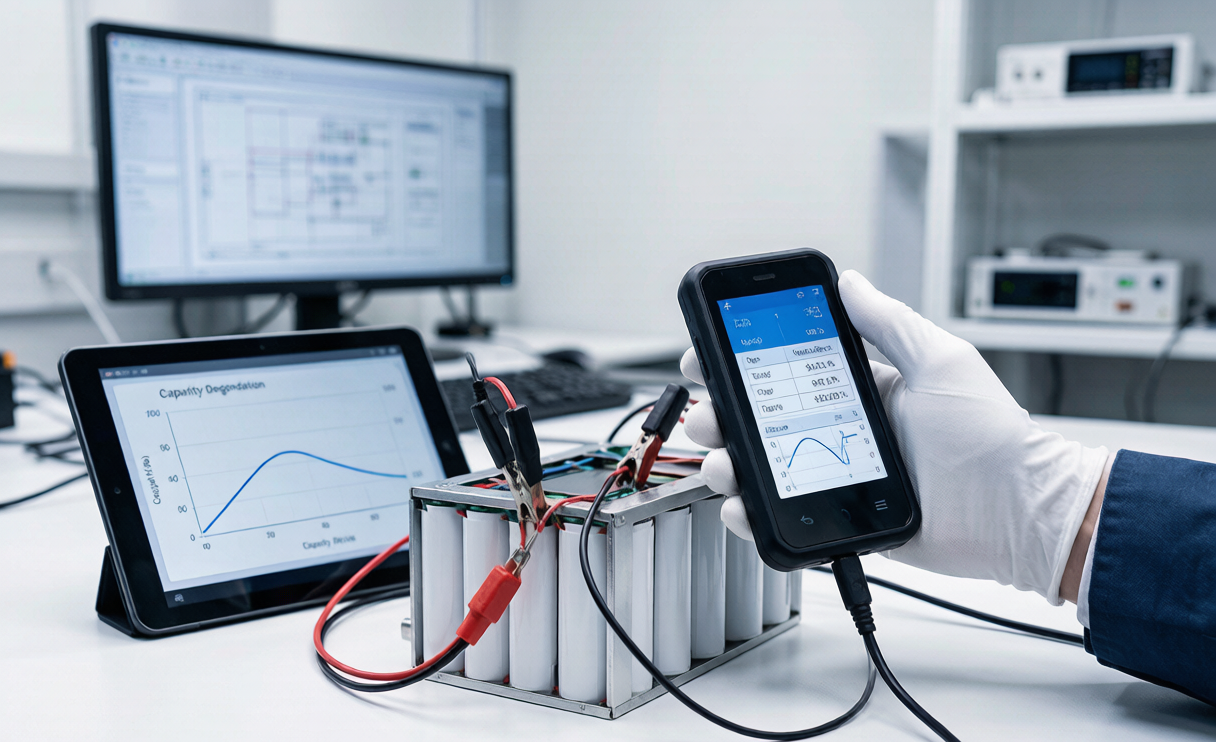
The BMS percentage is a model, not a measurement, so when a customer reports a suspicious drone battery capacity drop I always verify with a controlled discharge. My standard field procedure is simple and repeatable:
- Charge the pack to 100 percent at 0.5C under 30 degrees Celsius and let it rest one hour.
- Discharge at a constant 0.2C rate to the pack cutoff voltage (commonly 3.0 V per cell for a LiPo or 2.5 V for an LFP drone battery).
- Integrate the current over time to compute true ampere-hours, then compare against the rated label capacity.
- Repeat the measurement at the same temperature so the result is comparable month to month.
Temperature matters more than most pilots expect. A pack rated at 16,000 mAh may deliver only about 14,200 mAh at 0 degrees Celsius because of slowed ion diffusion, not because it has degraded. I always record ambient temperature alongside the number, otherwise you end up retiring healthy packs.
The 80 Percent Rule and Other Retirement Thresholds
The most common drone battery capacity drop retirement threshold in commercial aviation is the 80 percent line: once a pack delivers less than 80 percent of its original rated capacity, it is retired from flight duty. That threshold is borrowed from aviation battery practice and from IEC 62619 guidance for industrial cells, where a fixed usable-energy floor protects against sudden end-of-life surprises. In my own fleet programs I use a layered approach:
- Below 80 percent of rated capacity: remove from primary flight missions, reassign to ground test or training only.
- Below 70 percent: retire from all powered use.
- Any single measurement dropping more than 5 percent versus the previous month: quarantine and inspect, because sharp nonlinear fade usually signals internal damage rather than normal aging.
Insurers and aviation authorities such as the FAA and EASA increasingly expect operators to document a capacity-based retirement policy. A written threshold is not paperwork; it is what lets you prove airworthiness of your power system during an audit. We align our internal limits with UN38.3 transport-safety expectations and IEC 62133-2 safety requirements so a retired pack is also safe to handle and ship.
Reading the Signals Beyond Raw Capacity
Capacity alone does not tell the whole story, and I have seen packs cross the 80 percent line while still flying fine, and others fail in flight while still above it. Two extra signals matter:
- Internal resistance. A lithium battery near end of life shows rising DCIR. When internal resistance climbs more than 30 percent above its fresh baseline, voltage sag under load becomes severe and the pack heats unevenly.
- Voltage sag and heat. If a pack that once held 22.2 V under a 10 A load now sags to 19 V, the drone’s electronic speed controllers work harder and the aircraft behaves sluggish on takeoff.
My rule is that retirement is triggered by the first of the capacity threshold, the resistance threshold, or a visible physical defect such as swelling. Customers who want a custom battery solution for harsh duty often ask me to set the resistance trip point tighter, because their missions cannot tolerate surprise sag.
Building a Retirement Policy for a Drone Fleet
A reliable program treats capacity drop as a managed data stream, not a surprise. For a mixed fleet I recommend this standard operating procedure:
- Baseline every new drone lithium battery on arrival, stamping its measured fresh capacity and internal resistance into the asset record.
- Re-test a random sample of 10 percent of the fleet every 60 days, and every pack at 150 cycles regardless.
- Flag any pack crossing the 80 percent capacity threshold or 30 percent resistance threshold.
- Quarantine, discharge to a safe storage SOC near 30 to 40 percent, and route retired packs to a certified recycler.
This discipline is exactly what we build into our custom battery solution programs for logistics and inspection operators. The hardware is only half the product; the retirement data and traceability are what keep a fleet legal and safe under FAA and EASA expectations.
What I Tell New Operators About Capacity Drop
The single most useful mindset shift is to stop treating capacity as a fixed number and start treating it as a declining curve you sample on a schedule. A normal, well cared for drone battery capacity drop of 2 to 4 percent per year is not a defect; it is chemistry. The dangerous case is the pack that falls off a cliff, and that is precisely the pack a simple monthly capacity check will catch long before it ever leaves the ground. Spend your effort on measurement discipline and a clear retirement threshold, and capacity fade stops being a mystery.
Capacity Drop Across Chemistries: LiPo, LFP, and Solid-State
Not all packs age the same way, and the right retirement threshold depends on the cell chemistry inside your drone battery. Traditional LiPo packs based on NMC or LCO cathodes offer high energy density but fade fastest once their SEI layer is mature, typically settling into a steady 3 to 5 percent drop per 100 cycles. LFP packs trade some energy density for a much flatter curve; I routinely see LFP drone lithium battery units hold above 85 percent capacity past 600 cycles, which is why inspection and agriculture operators increasingly choose them for total-cost-of-ownership reasons. Emerging semi-solid and solid-state formats aim to suppress lithium plating and SEI growth, pushing the knee of the curve further out, but they still obey the same physics: every cycle consumes a little active lithium. When I spec a custom battery solution, chemistry choice is the first lever that determines how aggressive the retirement schedule must be.
Temperature and Storage: The Two Levers That Control Fade
If I could give operators only two rules to slow drone battery capacity drop, they would be about heat and state of charge. Storage at 100 percent SOC accelerates cathode stress and SEI growth, so I keep idle packs between 30 and 50 percent. Operating and charging above 45 degrees Celsius, or fast-charging below 10 degrees Celsius, triggers lithium plating that permanently removes capacity in a single bad cycle. In the field I tell crews to charge in the shade, never charge a cold pack straight off a winter flight, and let a hot pack cool to ambient before balancing. These habits routinely double the usable life I measure in a fleet, and they are far cheaper than buying replacements. Combined with the monthly capacity measurement described earlier, temperature and SOC discipline is what separates a fleet that retires packs at 400 cycles from one that retires them at 150.
Frequently Asked Questions
What is a normal annual capacity drop for a drone battery?
For a pack stored at 30 to 60 percent SOC, kept near 25 degrees Celsius, and not deep-cycled daily, expect roughly 2 to 4 percent loss per year. Aggressive use, full-charge storage, and hot environments can push that to 10 percent or more annually. The rate of drop matters as much as the absolute number.
Can a battery at 80 percent capacity still fly safely?
Often yes for light missions, which is why my policy moves an 80 percent pack to training rather than scrapping it. But the margin is thin, and I would never assign an 80 percent pack to a heavy-lift or beyond-visual-line-of-sight flight where reserve energy is critical.
How many cycles before a drone battery should be retired?
There is no single cycle count. A lightly used pack can retain 85 percent capacity after 300 cycles, while an abused one drops below 80 percent in 120. Retirement should follow the measured capacity and resistance thresholds, not a counter. I do recommend a mandatory inspection at 150 cycles regardless of the readout.
How should retired drone lithium batteries be handled?
Discharge the pack to a storage SOC around 30 percent, place it in a non-conductive container, and deliver it to a certified lithium battery recycler. Do not puncture, incinerate, or place swollen packs in general waste. Our programs label each retired unit and keep a disposal record to satisfy UN38.3 handling and local e-waste rules.