Drone Battery Standardization Across a Mixed Fleet
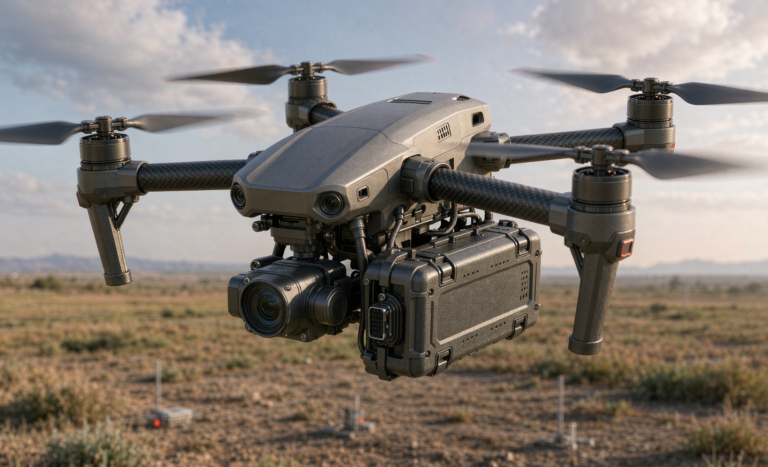
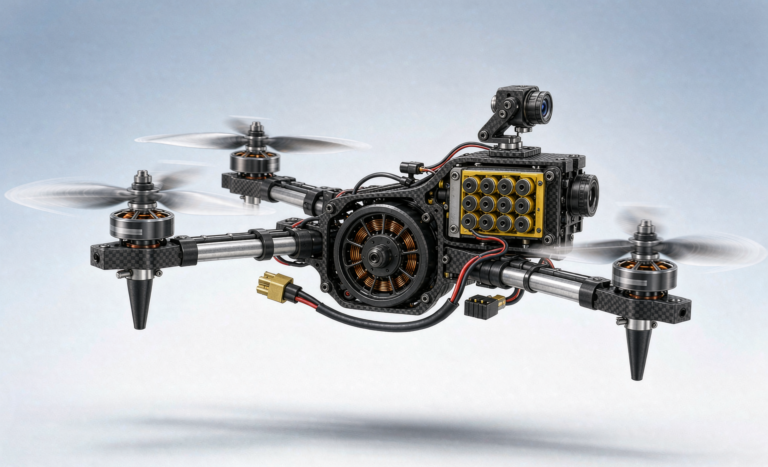
Over the last eight years running battery programs for commercial operators, I have yet to meet a serious drone operation that flies a single airframe. A typical survey, inspection, or logistics customer runs a mixed fleet: heavy-lift hexacopters for payload work, a few lightweight quadcopters for quick visual checks, maybe a fixed-wing for long linear corridors, and a VTOL hybrid for the tricky sites. The promise of a drone battery standardization program is simple to state and brutally hard to execute. When every airframe speaks a different electrical, mechanical, and communication language, your battery inventory becomes a museum of one-off packs, your pilots lose flight time to swap confusion, and your compliance paperwork multiplies. In this article I will walk through how we standardize lithium power across a mixed fleet without forcing every aircraft into a compromised design.

Why a Mixed Fleet Breaks Battery Logistics
The first problem is not engineering, it is math. If you operate six airframe families and each needs its own bespoke pack, you are managing six supply chains, six cell-lot qualifications, six spare-part SKUs, and six charge-and-storage workflows. In one agriculture-spraying program I supported, the client was carrying 11 distinct battery part numbers for 43 airframes. Their field failure rate was acceptable, but their effective availability was poor because a grounded airframe often waited days for the one compatible pack to come off the charger or return from a remote site.
Standardization is the lever that turns that complexity into redundancy. If three of your six airframes can accept the same modular drone lithium battery cartridge, a dead pack on aircraft A is instantly replaceable by a charged pack from aircraft B. You stop optimizing per-airframe and start optimizing for fleet uptime. The trade-off is that the shared pack must be designed for the worst-case electrical and mechanical envelope of the group, not the ideal envelope of any single aircraft.
Mechanical and Electrical Interface Standardization
The most durable standardization layer is physical. We define one cartridge envelope, one connector family, and one mounting interface, then adapt the airframe around it rather than the other way around. In practice that means agreeing on:
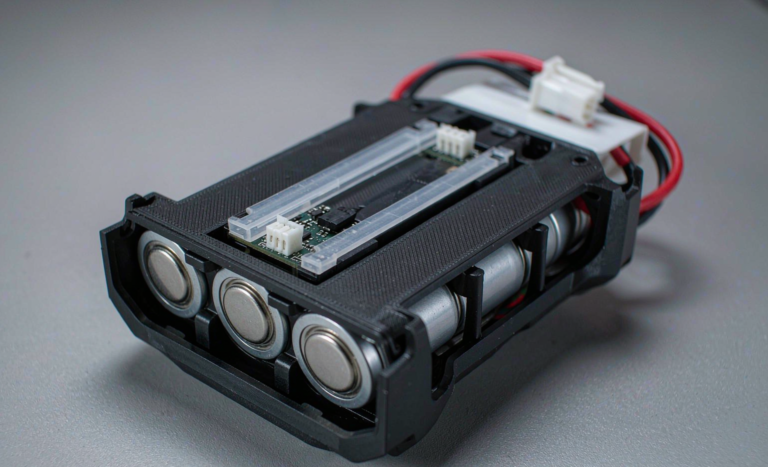
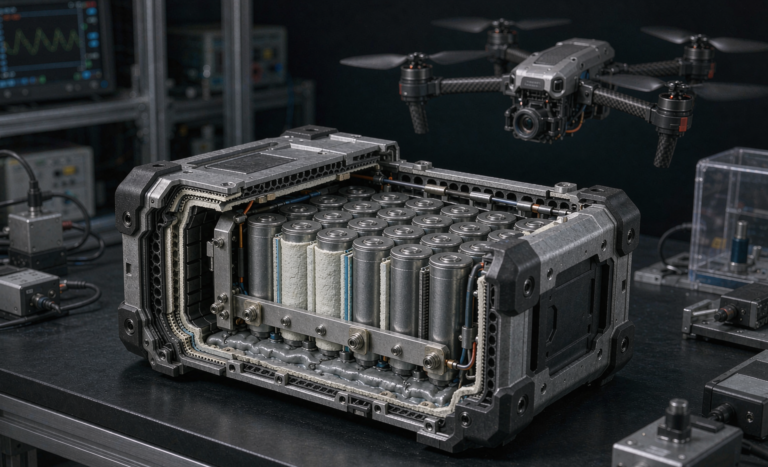
- A fixed cell format and arrangement. We standardize on 21700 cylindrical cells (4.0–4.5 Ah, NMC811 or NMC532) because they balance energy density of roughly 230–265 Wh/kg with the thermal margin that pouch cells struggle to match in field heat.
- A single high-current connector. We use an anti-spark, keyed connector rated for at least 15C continuous discharge, with a separate 4-pin signal and balance header so the same pack feeds both power and telemetry.
- A mechanical latch and polarization feature so the pack can only seat one way. Reverse-insertion is the most common human-error cause of BMS destruction we see in the field.
The adaptation cost lands on the airframe, not the battery. That is intentional. Aircraft are redesigned far less often than packs are rotated, so pinning the battery interface is what keeps the standard stable for years.
BMS Protocol and Telemetry Uniformity
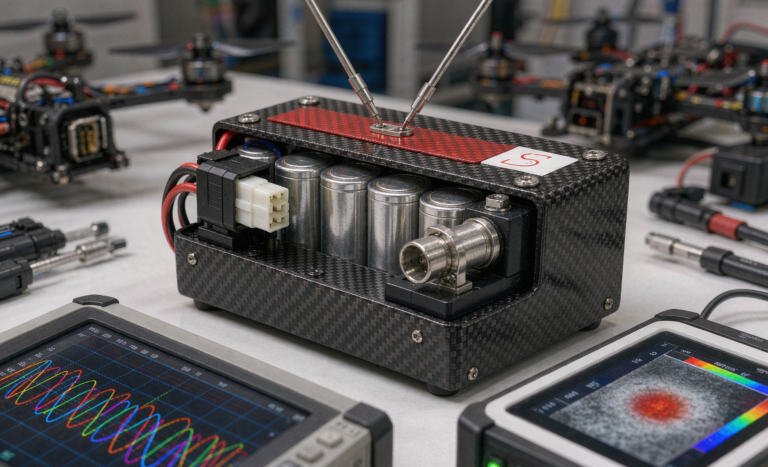
A drone battery without a readable battery management system is a liability. The second standardization layer is the digital one: every pack in the fleet must report state-of-charge, cell-level voltage, temperature, cycle count, and fault flags in the same schema. We standardize on a CAN 2.0B bus for aircraft-side integration, with an SMBus mirror for bench chargers and depot diagnostics. The key engineering decision is to expose a single telemetry dictionary so the ground-control software reads pack A and pack B identically.
In our deployments the BMS performs top-balancing with a target cell-voltage tolerance of ±10 mV across the series string, and it enforces a hard cutoff at 2.5 V per cell under load and 4.25 V on charge. We log every charge cycle to catch capacity fade early; a pack that drops below 80% of its original rated capacity is pulled from flight duty and moved to training or bench use. This single rule, applied uniformly, is what keeps a mixed fleet’s incident rate low even as individual packs age at different rates.
Certification and Air-Transport Compliance Baseline
Standardization only delivers value if every pack clears the same compliance gate. For lithium power systems we qualify against a consistent baseline:
- UN38.3 — the transport safety test covering T.1 altitude simulation, T.2 thermal, T.3 vibration, T.4 shock, T.5 external short circuit, T.6 impact/crush, T.7 overcharge, and T.8 forced discharge. Every pack variant we ship must carry a valid UN38.3 test summary.
- IEC 62133-2:2017 — the international safety standard for secondary lithium cells and batteries containing them, covering short-circuit, overcharge, and temperature-abuse behavior.
- FAA and EASA air rules — in the U.S., Part 107 operations still inherit lithium air-transport limits; in Europe, EASA regulation EU 2019/947 frames the operational side while transport follows IATA Dangerous Goods. Packs at or below 100 Wh travel as carry-on; 100–160 Wh require operator approval, and above 160 Wh is generally not permitted on passenger aircraft.
By fixing one pack architecture, we test once and reuse the certification dossier across every airframe that adopts the standard. That is where standardization pays for itself in regulatory overhead alone.
Charge Depot and Thermal Standardization
The third layer people forget is the depot. A standardized lithium battery is only as good as the way it is charged, stored, and warmed. We standardize on a single smart-charger family that reads the CAN telemetry and terminates charge at 4.20 V per cell with a 0.05C tail, and we enforce a storage charge of 3.80–3.85 V for any pack idle longer than 48 hours. Thermal discipline matters just as much: packs are conditioned to 15–35 °C before flight in cold climates, because below about 0 °C the internal resistance climbs sharply and a cold pack can sag under the same 9C burst that a warm pack handles easily. In one northern-survey deployment, simply adding a heated storage case and a pre-flight warm-up step lifted usable capacity by roughly 12% in winter conditions without changing a single cell. The lesson holds across every airframe: standardize the care routine, not just the hardware, and the fleet behaves predictably.
A Field Implementation Playbook
From experience, here is the sequence that actually works when a drone battery manufacturer and an operator build a mixed-fleet standard together:
- Audit the real duty cycles. Measure discharge C-rate, average flight duration, and ambient temperature range for each airframe over a full season, not a single demo day. We found one client’s “5C” assumption was really 9C in headwind conditions, which changed the cell selection entirely.
- Design for the envelope, not the average. Pick the cell chemistry and count that satisfies the most demanding airframe, then scale capacity down for lighter aircraft through software limits rather than hardware changes.
- Lock the connector and BMS schema first. These are the expensive things to change later. Mechanical latches and CAN dictionaries should be frozen before the first production pack.
- Pilot on two airframes, then expand. We never standardize six airframes at once. Prove the pack on the two highest-volume airframes, collect 90 days of cycle data, then roll out to the rest.
- Build a depot rotation rule. A simple 80%-capacity retirement threshold, applied identically across the fleet, prevents the slow drift that causes in-flight surprises.
When a customer has an airframe that simply cannot accept the standard cartridge, we build a custom drone battery adapter that preserves the same BMS telemetry and connector philosophy. That keeps the digital standard intact even when the mechanical one bends.
Frequently Asked Questions
What is the most cost-effective standardization level for a small mixed fleet?
Start with the BMS telemetry and connector standard, not the cell can. Standardizing the digital interface and the high-current connector is cheap and immediately eliminates cross-talk and mis-wire incidents. You can keep different cell counts per airframe and still reap most of the uptime benefit. Full mechanical cartridge uniformity is the next, more expensive step.
Can I standardize batteries across fixed-wing and multirotor airframes?
Yes, if you design for the fixed-wing’s sustained discharge and the multirotor’s burst C-rate simultaneously. Fixed wings favor capacity and steady draw; multirotors favor burst current and low internal resistance. A 21700 NMC pack with a 15C continuous rating handles both, at the cost of some weight penalty on the fixed wing. We have run this exact combo on a 1.8 m wingspan VTOL and a 15 kg hexacopter from one pack family.
How does standardization affect UN38.3 and air-transport certification?
Positively. A single qualified pack architecture means one UN38.3 test summary and one IEC 62133 dossier serve every airframe using it. When you add an airframe, you are re-validating a mechanical mounting, not re-certifying the cell system. Keep every pack under 160 Wh to stay within the IATA carry-on and approved-shipping bands.
When should a team consider solid-state or custom battery solutions?
Consider a solid state drone battery path when energy density or thermal safety becomes the binding constraint, such as high-altitude cold operations where liquid-electrolyte packs lose capacity sharply. For most mixed fleets today, a well-engineered custom battery solution based on mature 21700 NMC cells delivers better cost-per-flight-hour than bleeding-edge chemistry. We revisit the solid-state case every 12 months as the cells mature.
Standardization across a mixed fleet is never finished; it is a standing agreement between the battery team and the airframe team. Get the interface, the BMS language, and the compliance baseline locked early, and the fleet scales without the inventory nightmare. Ignore them, and you will spend more time managing part numbers than flying missions.