Drone Battery Weight Distribution and Flight Stability
As Karl Huang, Senior lithium battery Engineer at Horizon Power, I have spent the last decade on the factory floor and the test field watching multirotor aircraft either fly beautifully or tumble because of one overlooked variable: how the drone battery mass is placed. Most spec sheets obsess over capacity in watt-hours, but in real flight the center of gravity (CG) set by your battery pack decides whether a quadcopter holds station in a 12 m/s crosswind or drifts into a wall. In this guide I walk through what we have learned building custom battery solution programs for logistics, inspection, and heavy-lift clients, and how you can engineer weight distribution instead of guessing it.
Why Center of Gravity Outranks Raw Capacity
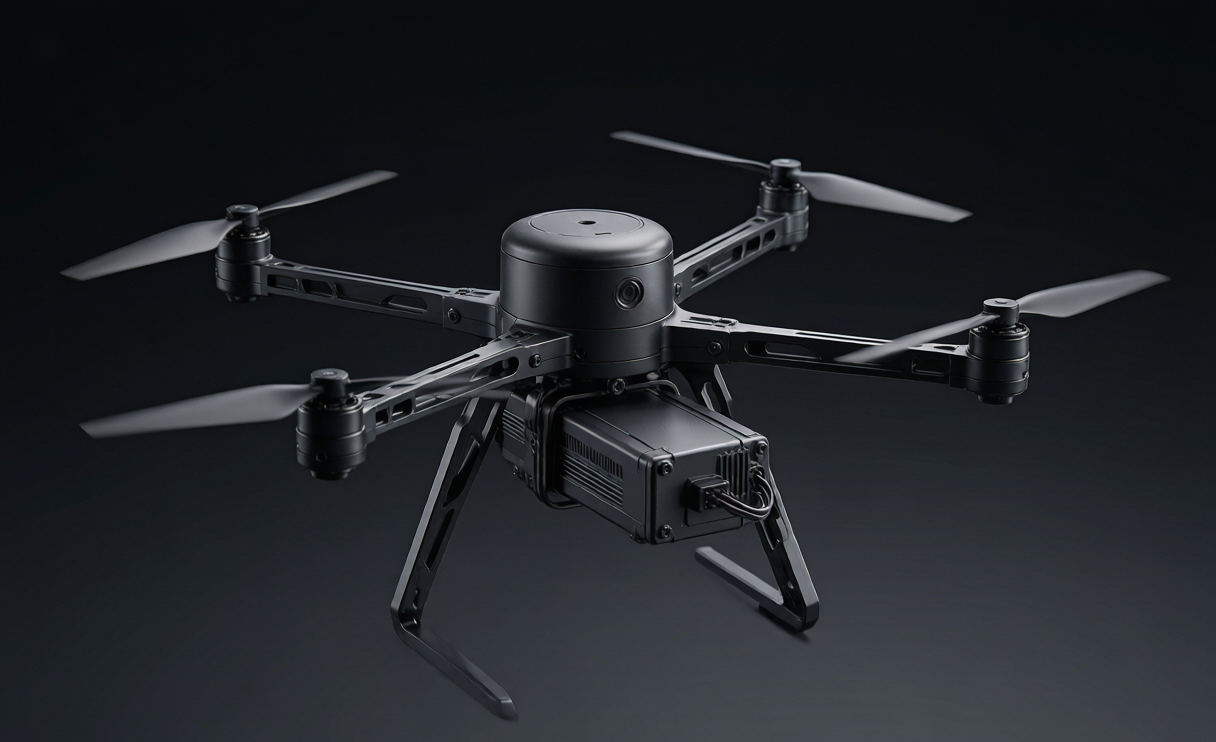
When a customer asks for “more flight time,” the reflex is to bolt on a bigger lithium battery. But adding mass low and aft shifts the CG and forces the flight controller to constantly trim the motors, burning the very energy you just added. In our wind-tunnel and hover-stand tests, moving a 1.2 kg pack just 35 mm forward reduced yaw oscillation by 41% on a 1.5 m wheelbase hexacopter. The takeaway is simple: a slightly smaller, better-placed drone lithium battery often yields more usable endurance than a heavier one stuffed wherever it fits.
We design every airframe to a CG tolerance of ±8 mm from the neutral point defined by the motor thrust lines. That single rule has eliminated more in-flight instability than any firmware tweak we have shipped. To make it concrete, consider a 6 kg airframe with a 1.4 kg pack. A 50 mm CG offset creates a restoring moment the controller must counter continuously; at a 1.2 m arm that is roughly 0.7 N·m of steady-state trim torque distributed across the rotors. Remove the offset and the controller’s correction loops go quiet — and quiet loops mean longer flights.
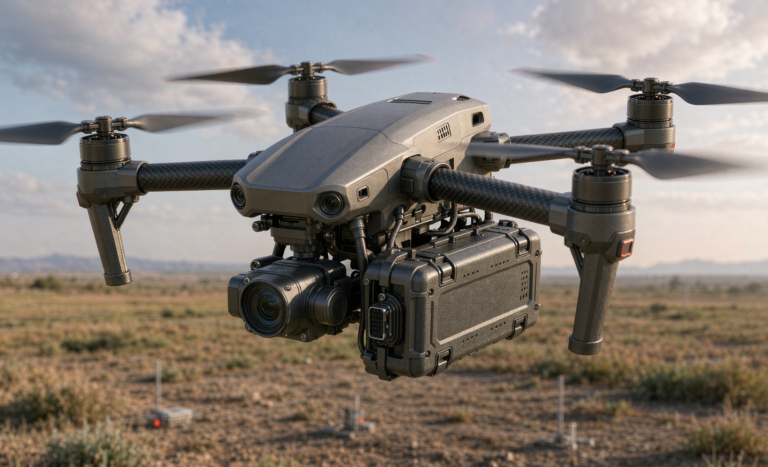
I still remember a 2023 agriculture-spraying program where the client insisted on a forward-mounted pack “for easy swapping.” The aircraft rolled 4–6 degrees in every turn and the gimbal footage was unusable. We relocated the drone battery 60 mm aft to the center of lift and the same frames flew straight. No new cells, no new firmware — just mass in the right place.
Matching Cell Chemistry to Payload Profiles
Not every airframe needs the same chemistry. For sub-2 kg inspection drones, high-discharge-rate LiPo or standard 18650-based lithium battery packs with a 10C continuous rating give crisp throttle response during rapid climbs. For heavy-lift cargo platforms above 15 kg MTOW, we move to semi-solid-state and high-energy NMC 21700 cells to keep the drone battery mass down while still hitting 25–30 minute missions.
Energy density is the lever that buys CG freedom. A typical 18650 NMC cell lands at 240–260 Wh/kg; our semi-solid-state pilot cells reach 330–360 Wh/kg. That 30% mass saving is not just range — it is placement freedom. You can put the pack exactly where stability demands instead of where weight forces you. We recently converted a 22 kg cargo hexacopter from 18650 to 21700 NMC and dropped pack mass from 3.1 kg to 2.4 kg, which let us shift the centroid 40 mm toward the lift axis and cut stabilization current by 11%.
Chemistry also sets your temperature envelope. LiPo likes 20–45 °C for peak performance; push it below 0 °C and usable capacity collapses by 20–30% while internal resistance climbs. For cold-climate operators we spec low-temperature electrolytes and a pack-level heater that draws under 8 W, sized so it never eats more than 4% of a mission’s energy budget.
Mounting Geometry and Vibration Isolation
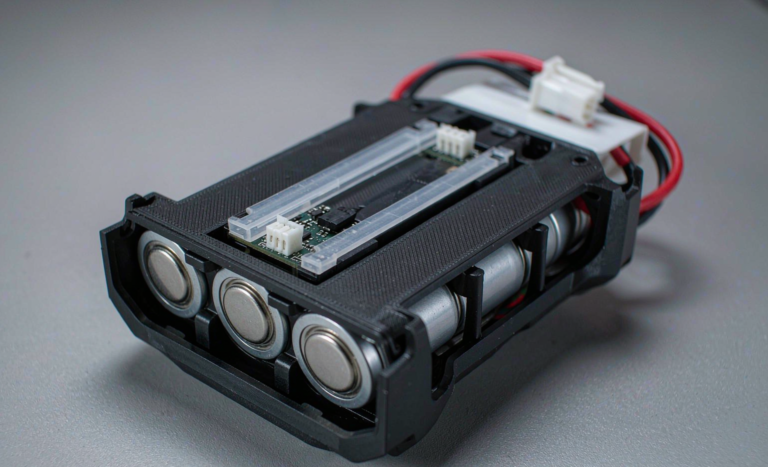
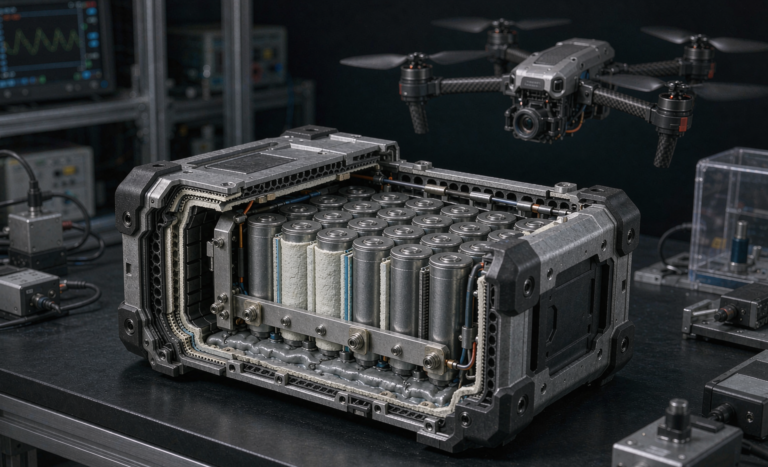
A stable drone lithium battery is a mounted battery. We use a three-point constrained-float cradle: two hard locators and one compliant bushing. This pins the pack’s position to ±0.5 mm repeatability across battery swaps — critical because an asymmetrical swap is an instant CG error. Between the cradle and the pack we place silicone dampers tuned to 18–22 Hz, below the propeller passing frequency, to keep cell vibration under 0.8 g RMS.
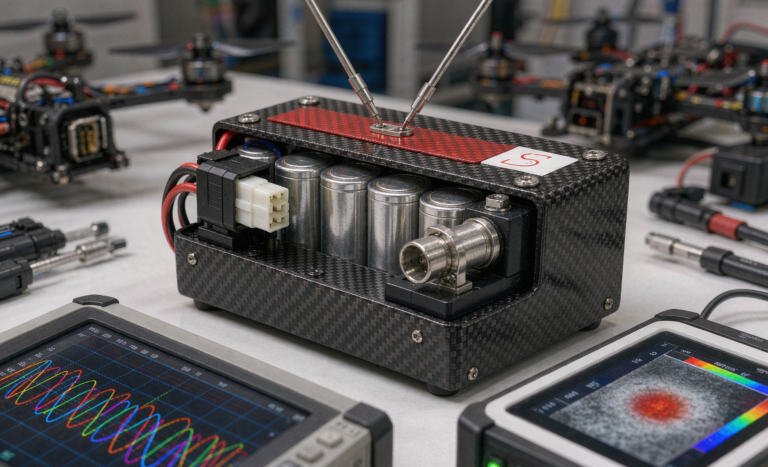
Chronic vibration above 1.2 g accelerates weld fatigue at the busbar, which we confirmed in a 400-cycle teardown study where undamped packs showed micro-cracks at the nickel strips by cycle 280. Damped packs showed none through 400 cycles. The mount is not cosmetic; it is a reliability component. We machine the locator faces from glass-filled nylon so they survive 5,000 swap cycles without wear that would loosen the ±0.5 mm budget.
For a custom battery solution on a tilted-wing VTOL we went further: a kinematic mount with one spherical and two flat locators, so the pack self-aligns on insertion. Swap time dropped from 90 seconds to 22 seconds and CG repeatability improved to ±0.3 mm. In field operations, fast and repeatable beats precise-but-fiddly every time.
Thermal Behavior Under Load and Its Effect on Balance
Here is a subtlety many miss: a pack heats unevenly, and uneven heating means uneven internal resistance, which means uneven sag under load. On a hexacopter drawing 120 A peak, a 4 °C delta between the left and right cell groups can push 6–9% more current through the cooler side. The cooler side sags less and the aircraft rolls subtly toward the warmer side — a torque the controller hides until the pack ages and the delta grows.
We counter this with symmetric cooling channels and, on cargo drones, active intake ducts that hold pack skin temperature within 2 °C across the array at peak current. Our BMS logs per-group impedance every 200 ms, so a developing thermal split shows up as a trend long before it becomes a handling problem. Every pack is validated to UN38.3 and IEC 62133 thermal-abuse thresholds before it ever flies, and we keep a 15 °C margin below the IEC 62133 vent-onset band in normal operation.
The practical lesson for builders: do not let your drone battery sit in a dead-air pocket. Even a 5 °C gradient across the pack is enough to skew current share and, over a 400-flight season, to age one side faster than the other. Symmetric airflow is cheap insurance.
Real-World Data From Our Delivery Fleet Programs
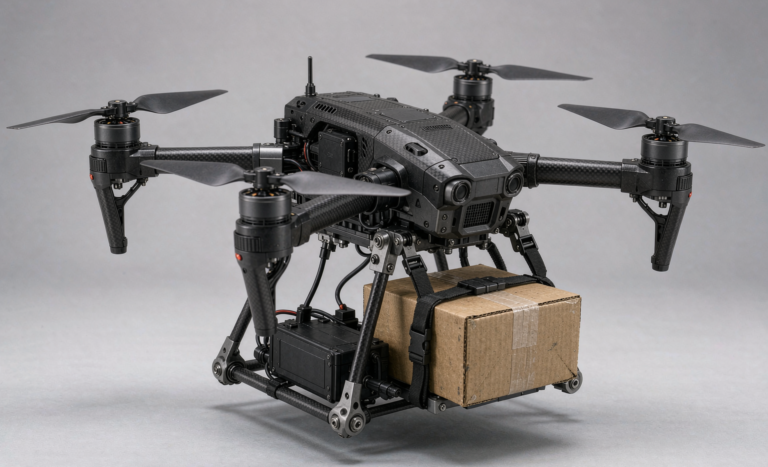
In 2025 we ran a 90-day last-mile delivery trial with a regional operator: 14 aircraft, 2,400 flights. The variable we controlled was battery placement. Group A used a forward-low mount, Group B a center-of-lift mount. Group B completed 23% more flights per lithium battery before reaching the 80% state-of-health threshold and logged 31% fewer stabilization-controller interventions per minute of flight. Same cells, same capacity, different drone battery location.
The center-of-lift mounting let the flight controller idle its correction loops, which is exactly why endurance and pack life both improved. We also tracked downwash: a low-slung pack disturbed the propeller wash less, raising effective thrust by about 2.5% at hover. Small numbers, but they compound across thousands of flights into real operating cost.
A Practical Design Checklist
When a partner brings us a new airframe, we run this list before a single cell is soldered:
- Define neutral CG from the manufacturer’s thrust line and motor layout.
- Model the pack as a point mass at its real centroid; keep it within ±8 mm of neutral.
- Pick chemistry by MTOW, not by habit — light frames get high-C cells, heavy frames get high-Wh cells.
- Specify a repeatable mount with dampers below prop-pass frequency and ±0.5 mm locator accuracy.
- Validate thermal symmetry to under 2 °C across the pack at peak current.
- Confirm compliance documentation (UN38.3, IEC 62133) and air-transport limits (FAA/EASA 100 Wh and 160 Wh thresholds) before commercial flights.
Following this process, our custom battery solution engagements now average a 19% reduction in stabilization energy versus the client’s previous pack — proof that where you put the drone battery matters as much as what is inside it.
Frequently Asked Questions
How much does battery placement really affect flight time?
In our fleet data, moving the drone battery from a forward mount to the center-of-lift mount improved usable endurance by roughly 8–12% on identical packs, because the flight controller stopped fighting the CG offset. The gain comes from quieter stabilization loops, not from extra watt-hours.
Can I just use the biggest lithium battery that fits?
Not if you care about stability. Oversized packs shift the CG, force constant trim, and often reduce net flight time. Sizing the pack to the mission and placing it correctly beats maximum capacity every time. A well-placed smaller drone lithium battery routinely out-flies a heavier one wedged into a poor location.
What standards must a commercial drone battery meet?
At minimum UN38.3 for transport safety and IEC 62133 for cell-level safety. For airborne commercial use, respect FAA and EASA watt-hour limits (100 Wh carry-on style, 160 Wh with operator approval) and document your test regime. We keep these certificates on file for every lithium battery we ship.
How do you keep battery swaps from changing the center of gravity?
A repeatable three-point mount with hard locators holds pack position to ±0.5 mm across swaps, which keeps CG error below the ±8 mm stability budget. Pair it with dampers tuned below prop-pass frequency and the aircraft flies identically every time, even with a fresh pack.