Lithium Battery Cost Optimization for UPS Systems: Spare-Parts and Service-Contract Cost Modeling, Cooling-Energy Savings, and End-of-Life Residual Value Recovery
In eleven years of specifying backup power for data centers, hospitals, and telecom huts, I have never seen a UPS battery project fail on purchase price. I have seen plenty fail on everything around the purchase price: a fuse link nobody stocked, a service contract that priced every truck roll separately, a battery room whose air conditioner ran flat out because the old VRLA strings demanded 25 °C, and a decommissioning bill that arrived five years after anyone remembered to budget for it. When buyers ask me about lithium battery cost optimization for UPS systems, I tell them the sticker price of the module is usually less than a third of the money. The rest lives in three places most RFPs never score: spares and service, cooling energy, and residual value. This article walks through how I model all three, with the numbers I actually use.
Why Purchase Price Is the Smallest Part of UPS Battery Cost
A lithium battery in a UPS application is a ten-to-fifteen-year infrastructure decision, not a component purchase. When I build a should-cost model for a client, I break the total into five buckets: acquisition, installation and commissioning, service and spares, energy (both charging losses and cooling), and end-of-life. For a typical 250 kVA single-phase-string installation, acquisition lands around 30–38% of ten-year cost. Cooling energy and service together routinely exceed that. The reason is simple physics and simple logistics: a battery string is a heat source that must be kept within a temperature window, and it is a serviceable assembly whose smallest parts — fuses, contactors, sense harnesses — cause the majority of truck rolls.
The trap is that these three cost buckets behave differently over time. Spares cost is lumpy and probabilistic; cooling cost is smooth and meterable; residual value is a single negative number at the far end of the timeline. If you evaluate them with the same flat “annual cost” assumption, you will misprice all three. So let me take them one at a time.
Lever 1: Spare-Parts Kits and Service-Contract Cost Modeling
The cheapest way to kill a lithium battery ROI case is an unscheduled site visit. A field technician with van, time, and travel costs my clients anywhere from $350 to $900 per roll in dense urban markets, and several times that at remote telecom sites. The design goal is therefore not “no failures” — that is not a purchasable thing — but “no failures that require a second visit.” Everything that can fail in a way that a trained site tech can fix should have a spare on a shelf within reach of the site.
What Goes Into a Field Spares Kit, and What It Costs
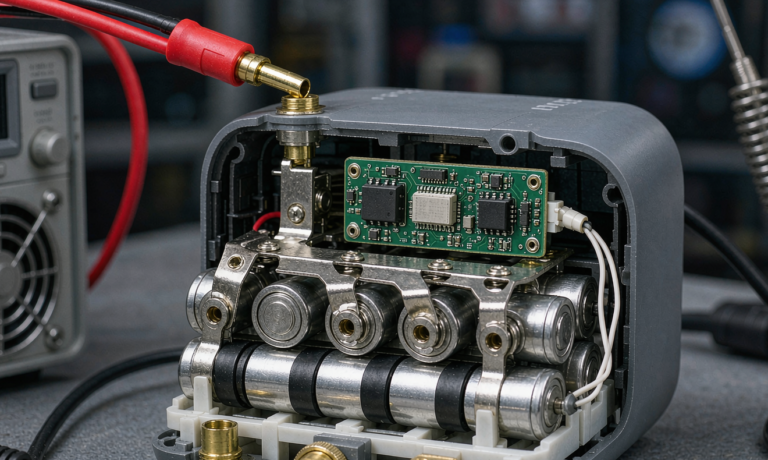
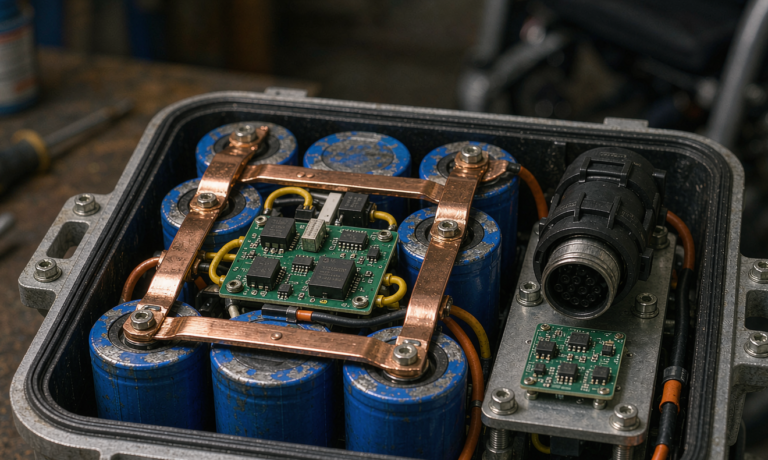
When I define a spares kit for a UPS battery installation, I start from the failure data. Across our own fleet records and published reliability studies, the distribution of field events in a well-made LFP system looks roughly like this: BMS-protective shutdowns and board swaps about 30%, DC fuse and contactor events about 20%, communication and sense harness faults about 15%, breaker and charger rectifier interaction issues about 10%, and genuine cell or module degradation under 10%. The remainder is everything else, including human error.
That distribution tells you the kit. For every eight strings on one site, I provision:
- One complete BMS control board, pre-loaded with site firmware (a swap takes a technician twenty minutes; a factory repair takes three weeks).
- Two DC fuse links per fuse rating present in the string, plus one contactor per type.
- One sense harness set and one CAN/Ethernet gateway module.
- Terminal hardware: lugs, bolts, and a calibrated torque wrench with witness-mark paint, because a retorqued connection without torque verification is how you create next year’s hot spot.
As a planning number, a complete spares kit for an eight-string, 480 V system costs 3–5% of the battery acquisition price. I have audited projects where spares provisioning was skipped to save that 4%, and the resulting two emergency truck rolls in year three erased the saving and then some. The failure math is unforgiving: if a part failure has a per-string annual probability of 2% and you have eight strings, a stocked kit converts a $700 emergency visit into a $0 visit twenty times out of twenty-one over a decade.
Service Contracts: Price the Structure, Not the Visits
The second half of this lever is contractual. Battery service contracts come in three tiers: parts-only, parts-and-labor with scheduled preventive maintenance, and full availability guarantees with response-time penalties. What matters in cost modeling is not the annual fee but the incidence structure — who pays when something fails, and what the contract counts as a covered event. I insist on three clauses:
- Defined response tiers: remote diagnosis within 4 hours, on-site within 24 hours for critical sites, and a cap on annual included truck rolls (I negotiate eight per site per year, which real fleet data says is generous).
- BMS firmware maintenance included for the contract life, not billed per update. Firmware work is where vendors quietly recapture margin.
- Spares custody terms: either the kit sits on site under a consignment agreement, or the vendor guarantees a defined spare-part availability window (72 hours is workable, 24 hours is better) with liquidated damages.
Modeled over ten years, a well-structured parts-and-labor contract with consigned spares typically prices 12–18% below a la carte service for the same fleet, and — more importantly — it caps variance. For a facility manager whose budget committee punishes surprises more than averages, capping variance is the cost optimization.
Lever 2: Cooling Energy — The Cost Line Nobody Audits
VRLA batteries forced a generation of battery rooms to be climate-controlled like server halls, because lead-acid capacity halves for roughly every 8–10 °C above 25 °C and calendar life follows the same Arrhenius logic. Most RFPs I see carry that assumption forward even after switching the chemistry to lithium iron phosphate. That is leaving money on the table.
A well-designed LFP UPS battery carries full rated performance to 35 °C ambient and acceptable (slightly accelerated calendar aging) operation to 40 °C, with UN 38.3 and IEC 62619 type testing covering the transport and safety envelope. The cooling consequence is direct: you can raise the battery-room setpoint, widen the allowed temperature band, and let the HVAC cycle instead of holding a flat 22 °C.
Here is the arithmetic I use. A 250 kVA UPS battery room with 40 kW of IT-adjacent heat load and a legacy VRLA design runs dedicated cooling at roughly 8–12 kW electrical draw averaged over the year. Raising the setpoint from 22 °C to 30 °C with an LFP retrofit typically cuts that cooling electrical load by 35–45%, because both the delta-T to ambient and the compressor lift improve. At an industrial electricity price of $0.12/kWh, that is roughly $7,400–$11,400 saved per year for one battery room. Over ten years, cooling savings alone can recover 15–25% of the battery acquisition price — before you count the avoided cost of replacing VRLA strings at year four or five.
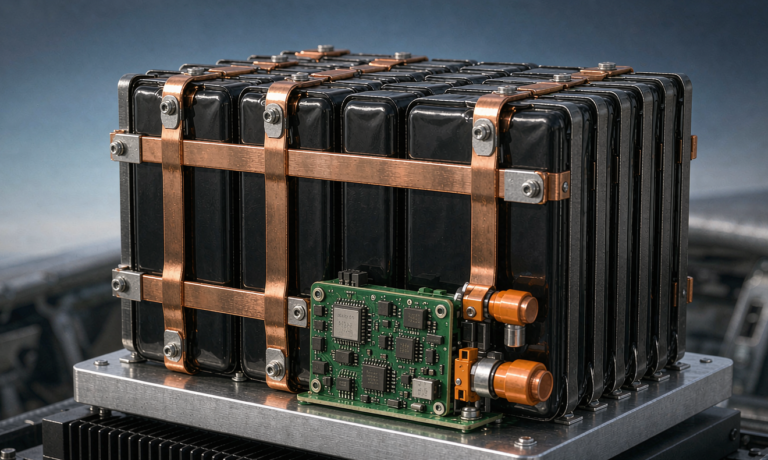
Two engineering cautions keep this honest. First, raised setpoints shift the design burden onto the pack: cell-to-cell temperature spread must stay under about 5 °C, which means the module’s internal airflow and BMS thermal derating curves matter more, and I verify them at the worst corner of the operating envelope before signing off. Second, lithium batteries still need protection against cold charging — below 0 °C the BMS must inhibit charge current, so sites in heating-dominated climates save on cooling but must keep a low-wattage anti-condensation and preheat strategy. Neither caution reverses the economics; both change who is responsible for what, and the contract should say so.
Lever 3: End-of-Life Residual Value and Second-Life Recovery
The third lever is the one with the widest spread between naive and realistic models. A lithium UPS battery at end of its UPS service life — conventionally 80% of rated capacity — is not waste. LFP modules retired from float-duty UPS applications, which see shallow cycling and gentle duty, are prime candidates for second-life stationary storage, and the residual value is real money.
How I model it: cells retired at 80% state of health from a UPS duty typically retain 2,000–3,000 additional cycles at reduced C-rate in a second-life application such as peak shaving or EV-charger buffering. Second-life buyers in current markets pay roughly $20–$45 per kWh for qualified packs, after the pack passes grading. For a 250 kVA system carrying about 180 kWh usable, that is $3,600–$8,100 of residual credit, and I have seen better prices for well-documented fleets. The key phrase is qualified: buyers pay for documentation. A pack with complete BMS logs, cycle history, and a documented IEC 62133 / IEC 62619 test pedigree trades at the top of the range; an undocumented pack scrapes the bottom or below it.
Three contract details protect this value. Specify that BMS data logs remain exportable at end of service (data trap: some vendors lock logs to their cloud). Specify the decommissioning scope — who disconnects, who packages to UN 38.3 transport provisions, who carries lithium transport liability. And specify ownership of the residual: I have reviewed tenders where the vendor’s “free recycling” clause quietly assigned them the second-life value of every module. Free recycling is worth about $0.30–$0.80 per kg of scrap credit; second-life qualification is worth five to ten times that. Know which one you signed.
A Worked Example: 250 kVA UPS, Ten-Year View
Putting the three levers together for a representative mid-size installation (eight strings, ~180 kWh, urban data-hall site, $0.12/kWh electricity):
- Acquisition, LFP system installed and commissioned: $96,000–$118,000.
- Service contract, parts-and-labor with consigned spares (3.5% kit) modeled over ten years: $21,000–$26,000, versus $28,000–$36,000 a la carte.
- Cooling energy, LFP setpoint relaxation vs. VRLA baseline: savings of $74,000–$114,000 over ten years, net of preheat parasitics.
- Avoided VRLA replacement: one full string replacement at year 4–5 ($40,000–$55,000 in the lead-acid counterfactual) avoided entirely.
- End-of-life residual credit at year 12–15: $3,600–$8,100, minus $1,200–$2,000 decommissioning and transport.
The lifetime advantage over a VRLA baseline lands at roughly 35–50% on a total-cost basis in this example, and — the part I emphasize with procurement teams — more than half of that advantage comes from the three levers above, not from the price tag on the quotation. That is why lithium battery cost optimization for UPS systems has to be scored at the model level, not the line-item level.
Procurement Checklist: What I Put in Every RFP
- Require a ten-year should-cost model from bidders, with service, spares, cooling, and residual value shown as separate lines — reject single-number TCO claims.
- Specify the consigned spares kit contents (BMS board, fuses, contactors, harnesses, torque tooling) and custody terms.
- Cap included truck rolls and define response tiers with liquidated damages; include firmware maintenance.
- State the permitted ambient envelope (35 °C full performance) and require cell-to-cell spread data at worst-case corner conditions per IEC 62619 test reports.
- Require exportable BMS logs, UN 38.3-compliant decommissioning scope, and explicit second-life residual ownership.
- Verify safety certification chain: UN 38.3 for transport, IEC 62619 or UL 1973 for the stationary application, and UL 9540A thermal-runaway test data for the installation permit file.
Frequently Asked Questions
How much of UPS battery lifetime cost is actually controllable after purchase?
Between 45% and 60% in my models — service structure, cooling setpoint policy, and end-of-life handling are all operational decisions, not procurement decisions. That is exactly why they need to be specified before the contract is signed, because after delivery you inherit the vendor’s defaults.
Can I skip the spares kit if my service contract includes 24-hour parts availability?
You can, but read the response definition carefully. A 24-hour parts guarantee that ships from a central warehouse still means a two-visit repair (diagnose, then fix) plus a weekend of reduced redundancy. A consigned kit turns most BMS and fuse events into same-day fixes by the site’s own trained staff. For critical loads I require both.
Is raising the battery room temperature really safe for lithium batteries?
Within limits, yes — that is what the chemistry and the certification envelope support. LFP tolerates 35 °C ambient at full performance; the aging acceleration between 25 °C and 35 °C is modest compared to VRLA’s halving-per-8-to-10-degrees rule. What you must engineer is pack-level thermal uniformity and cold-charge inhibition below 0 °C, and you should confirm both in the vendor’s IEC 62619 and UL 9540A documentation, not in a datasheet footnote.
How do I verify a second-life buyer’s residual value offer is fair?
Ask for the grading criteria in writing: accepted state of health, cycle count caps, and documentation requirements. Then compare your pack’s actual history against those criteria before signing anything that assigns residual ownership. A documented UPS-duty LFP fleet with exportable BMS logs should command the upper end of the $20–$45/kWh range; if a buyer prices your documented pack at scrap rates, the offer is not fair, it is a discount for their risk — negotiate or re-tender.
Does this cost model change for smaller UPS systems, like 30–50 kVA?
The levers are the same but the proportions shift. In small systems, spares and service dominate a larger share of lifetime cost because the fixed cost of a truck roll is spread over less hardware, while cooling savings shrink with room size. Residual value also matters proportionally less. For small sites, I weight the model toward service structure and remote diagnostics capability; for large sites, cooling and residual value move to the front.