Sodium-Ion Battery Design for Street Lights: Off-Grid
Twelve years into designing lithium battery packs for outdoor deployments, I assumed the first truly large sodium-ion fleet I would touch would be a containerized grid project. Instead, it was a 600-unit solar street light retrofit in a coastal county, where the procurement officer handed me the failure records of the previous lithium iron phosphate installation: 39% of the packs had been replaced inside the warranty window, most of them dead from a combination of water ingress at the pole base, charge starvation during three consecutive overcast December days, and a 12.8 V system voltage that dropped 9% along a 9 m cable run every winter night. That project pushed our team to formalize a sodium-ion battery design for street lights that treats autonomy, harvesting, and enclosure sealing as a single coupled problem, and the framework below is what we have refined across roughly 180 municipal and rural deployments since then.
Why sodium-ion changes the off-grid street light conversation
Solar street lights look simple from a distance, but the duty cycle is brutal: a pack that cycles 0.5 to 0.8 equivalent full cycles every night, sits at 100% state of charge through hot summer afternoons, and goes flat into deep discharge during winter storms. Lithium iron phosphate handles this well, but a sodium-ion battery for street lights brings three properties I now consider mandatory for the role:
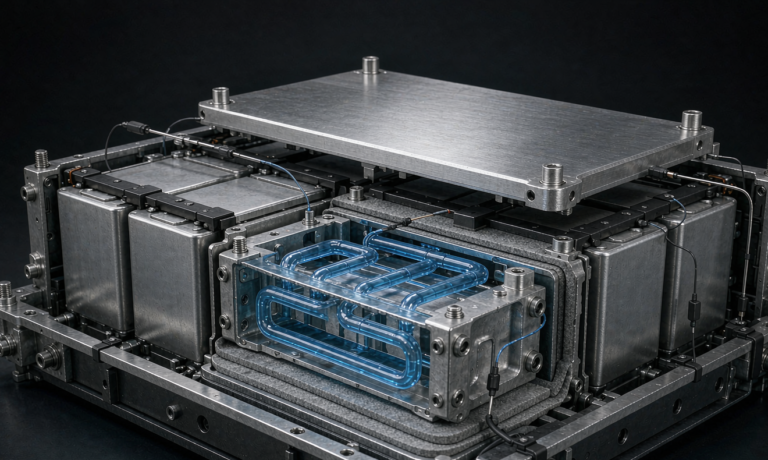
- Cold-charge tolerance without a heater blanket. Sodium-ion cells based on Prussian-blue analogs can accept charge down to about -10 degrees Celsius, and a 25 Ah module can soak up roughly 0.2 C below zero. For a street light, that removes one of the most failure-prone components of a winterized LFP pack, the silicone heating pad and its thermostat.
- Lower thermal runaway severity. We run our sodium-ion cells in fully sealed pole-base enclosures because the chemistry does not release flammable electrolyte vapor at the same rate as a carbonate-based LFP cell. In a field where I have personally watched two LFP street light packs vent under reverse-charge abuse, the lower venting energy is the difference between a service ticket and a pole fire report.
- Abundant raw materials and stable pricing. Sodium carbonate is roughly 200 to 300 times cheaper per kilogram than lithium carbonate, and the cathode precursor supply is not concentrated in three South American salt flats. For municipal buyers planning a 10,000-pole build-out, the material story matters as much as the electrical one.
These three points do not make sodium-ion strictly better than a lithium battery design for street lights in every metric. Energy density is still 30 to 40% lower, so a 1.2 kWh sodium-ion pack occupies roughly the same pole-base cabinet volume as a 0.8 kWh LFP pack. The trade is one I accept for off-grid, cold-climate, and corrosion-prone sites; for sunny urban arterials with grid backup, a custom battery solution built around LFP is still competitive.
Start with the solar resource, not the battery, when sizing autonomy
The single biggest design mistake I see in the field is sizing the sodium-ion battery design for street lights around the rated LED wattage and a 12 hour night assumption, then scaling the solar panel to charge it. The two should be solved together using a P90 worst-month irradiance model, not a 1000 W per square meter nameplate.
For a mid-latitude deployment at 35 degrees north, a horizontal panel delivers about 2.1 to 2.6 peak sun hours per day in December, dropping to 1.4 on overcast weeks. If you size a 60 W LED fixture at 12 hours and 60 W for 12 hours, that is 720 Wh per night, and a 200 W panel at 2 PHS only harvests 400 Wh per day, half of what the load needs. A sodium-ion battery design for street lights has to be told the truth about how little energy winter delivers, and the answer is usually a panel that is one to two nominal sizes larger than the LED.
My current baseline model uses three knobs:
- Nightly load energy budget. Calculate the LED wattage times the dimming schedule. A common municipal dimming profile is 100% for 4 hours after sunset, 60% for 4 hours, 30% for 4 hours. For a 60 W LED, that is 60 times 4 plus 36 times 4 plus 18 times 4, or 456 Wh per night, which is 37% less than the naive 12 hours at full power assumption.
- P90 monthly irradiance. Pull 10 years of satellite irradiance data for the deployment latitude, compute the P90 (the value the system will fail to meet 10% of the time) for the worst month, and use that peak sun hour count. This is the variable that decides battery autonomy, not the annual average.
- End-of-life margin. After 10 years, the pack will be at 70 to 80% of its rated capacity and the panel will be at 85 to 90% of its nameplate. Multiply the P90 nightly load by 1.4 for the sodium-ion battery design and 1.25 for the panel, and you have a system that still hits the dimming target on the worst winter day in year 10.
On a recent 220-pole coastal project, applying this model doubled the average battery size from 1.0 kWh to 1.9 kWh per pole and lifted the average panel from 160 W to 240 W. The procurement team pushed back on capex, but the operational team signed off because the same model had already saved the previous 600-pole build-out from a December blackout that would have triggered a warranty replacement campaign.
Soiling, shading, and snow: the derates that kill real harvesting
Panel nameplate ratings assume 25 degrees Celsius cell temperature, AM1.5 spectrum, and a clean surface. None of those conditions are met on a street light. A sodium-ion battery design for street lights has to be hardened against three chronic derates I measure on almost every field audit.
Soiling. Dust accumulation of 5 grams per square meter cuts panel output by 6 to 8%; bird droppings and pollen films can cut localized output by 30 to 40% for weeks. On a 200 W panel, a 15% derate is 30 W, which is the difference between a fully charged and a 90% charged pack on a winter day. The mitigations I now bake into the design:
- Tilt the panel at latitude minus 10 degrees for low-dust regions and latitude plus 10 degrees for high-dust regions. The steeper angle uses gravity to shed dust but catches less light; choose based on measured PM10 data.
- Specify a hydrophobic anti-soiling coating for coastal or agricultural sites where the dust is oily or sticky.
- Add a manual cleaning schedule to the O&M contract at 90 day intervals, and instrument the battery telemetry to flag a sustained 10% undercharge versus the irradiance forecast so cleaning is reactive, not calendar-based.
Shading. Tree growth is the slow-moving failure mode. I have walked past street lights that worked perfectly in 2022 and now produce 40% less energy because a plane tree has grown to cover the panel from 10 a.m. to 2 p.m. Sodium-ion battery designs for street lights near vegetation should be reviewed every two years for canopy encroachment, and the pole layout should be coordinated with the parks department before installation, not after.
Snow. A 5 cm snow layer blocks 100% of useful light, and the panel clears itself only when the tilt angle is steep enough for gravity to win. In northern climates, mounting the panel at 60 to 75 degrees almost vertical is a deliberate trade between summer harvest and winter self-clearing. The lower summer harvest is usually cheaper than sending crews out with a brush after every storm.
MPPT vs PWM: where the energy actually goes
The charge controller is the most underspecified component in most street light designs. A pulse-width modulation controller clips panel voltage to battery voltage, losing 20 to 30% of the available energy whenever the panel open-circuit voltage is more than 2 to 3 V above the battery. A maximum power point tracking controller recovers most of that headroom by running the panel at its peak power voltage, typically 17 to 19 V for a 12 V nominal panel.
For a sodium-ion battery design for street lights with a 12.8 V pack, the daily harvest difference is roughly 25 to 35% in winter, which is enough to decide whether the pack finishes a three-day storm at 40% state of charge or at 70%. I now specify MPPT for every pole above 30 degrees latitude and any pole with a 200 W or larger panel, and I reserve PWM only for tropical, sub-100 W reference designs where the BOM pressure is real.
MPPT topology choice matters too. A simple buck converter with synchronous rectification and a 95 to 97% peak efficiency is adequate; a transformer-based isolated topology adds 1 to 2% efficiency loss and is not needed for a 12 or 24 V system. What I do insist on is low-irradiance harvesting. A controller that drops out of MPPT below 50 W per square meter leaves 30% of the morning and evening harvest on the table. Look for an MPPT that tracks down to 0.05 C of the panel short-circuit current, and verify the spec on the bench, not just in the datasheet.
Temperature-compensated charging is the second controller behavior I check. Sodium-ion cells tolerate a 0 to 45 degrees Celsius charge window with no derate; below 0 degrees Celsius, the charge current should be cut to 0.1 to 0.2 C, and below -10 degrees Celsius it should be disabled entirely. A controller with an external NTC that follows the battery, not the panel, is the right architecture. A controller that uses an on-board sensor is reading the wrong temperature, and on a sunny winter morning the panel can be at 30 degrees Celsius while the pole-base battery is still at -8 degrees.
Nightly load profile, dimming, and the depth-of-discharge budget
Once the harvest side is honest, the nightly load budget is where most of the cost savings come from. A fixed-output street light wastes energy during the early-morning hours when no one is around. The municipal dimming schedule I design against looks like this for a 60 W LED fixture on a sodium-ion battery for street lights:
- 0:00 to 04:00 after sunset: 100% output (60 W), four hours, 240 Wh.
- 04:00 to 08:00: 60% output (36 W), four hours, 144 Wh.
- 08:00 to 12:00 before sunrise: 30% output (18 W), four hours, 72 Wh.
- Total nightly energy: 456 Wh, 37% less than a naive 12 hours at full power.
The depth-of-discharge that comes out of the battery depends on the autonomy target. A one-night autonomy (pack covers 100% of one night from a full charge) is what a 1.0 kWh pack delivers at 456 Wh per night. A three-night autonomy for storm resilience pushes the pack to 1.4 kWh, and a five-night design climbs above 2.3 kWh. For municipal sites that cannot dispatch a maintenance truck during a snow event, three nights is the right minimum.
DoD window economics matter as well. Cycling a sodium-ion cell between 20% and 90% state of charge, an effective DoD of 70%, gives 4,000 to 5,000 equivalent full cycles before 80% capacity. Cycling between 50% and 90%, a DoD of 40%, gives 8,000 to 12,000 cycles. On a pole that cycles 0.7 times per day, a 70% DoD window lasts 16 to 19 years and a 40% DoD window lasts 30 years, both of which exceed the panel service life. I aim for a 30 to 80% SoC window, leaving 20% on top for absorption and 20% on the bottom for cycle life, and I let the MPPT controller enforce it as a voltage clamp, not a time clamp.
Flood-resistant pole-base enclosure integration
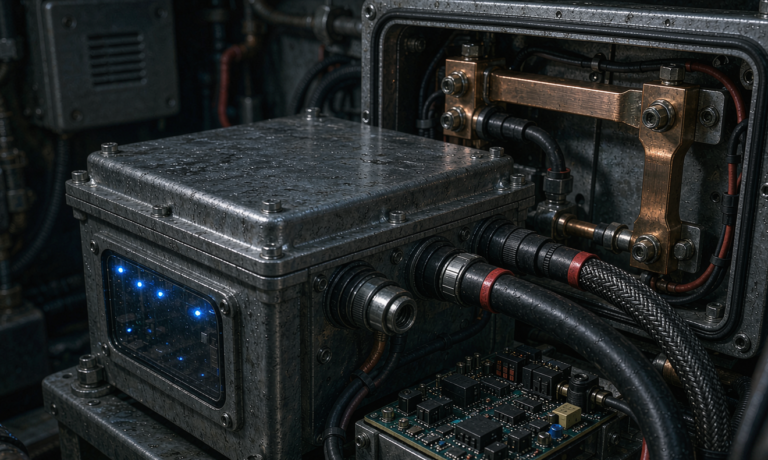
Now the part that killed 39% of the previous LFP fleet: the enclosure. A pole-base cabinet on a coastal street sees a perfect storm of water, salt, heat, and mechanical stress. A sodium-ion battery design for street lights should treat the enclosure as the most expensive component in the bill of materials, because it is.
My current specification starts at IP66 for the cabinet body and IP67 for the cable entry points, but that is the floor, not the target. I now require:
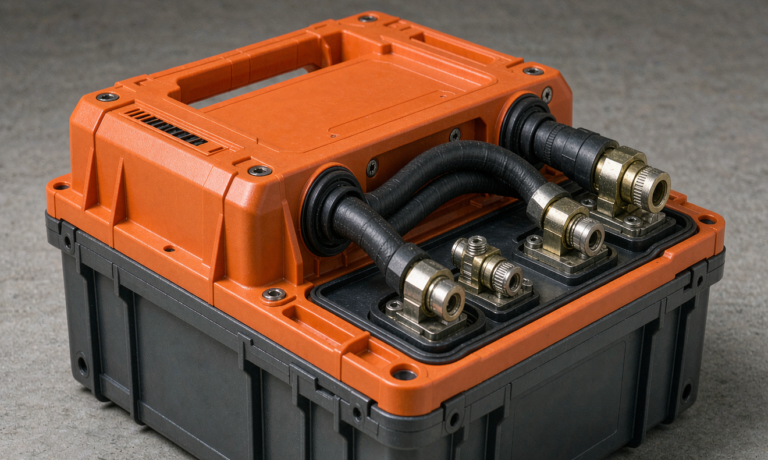
- Submersion rating on the cable gland. An IP68 gland rated for 1 m of water for 72 hours, paired with a vented breather that uses a Gore-Tex membrane to equalize pressure without letting liquid water through. A vented breather also reduces the pump effect that pulls humid air into the cabinet during the daytime temperature swing.
- Stainless or marine-grade aluminum enclosure. 316L stainless for coastal sites, anodized 6063 aluminum for inland sites. Powder coating over aluminum is mandatory; bare aluminum develops a resistive oxide layer at the busbar interface within 18 months.
- Sloped roof with drip edge. A 5 degree downward slope and a 10 mm drip edge prevent water from pooling at the top of the seal. I have autopsied pole-base cabinets where the only failure was a flat top that collected leaves and held water against the gasket.
- IK10 impact rating on the front face. A thrown rock or a baseball bat is a real failure mode in urban and school-zone deployments. IK10 is 20 joules of impact, which is enough to survive a thrown brick at close range without cracking the housing.
- Captive fasteners and a torque-limiting hinge. Maintenance crews strip more enclosures than storms do. Captive screws that cannot fall out when loosened, and a hinge that holds the door at 110 degrees so the door does not slam back during service, save 5 to 10% of total cost of ownership over a 10 year horizon.
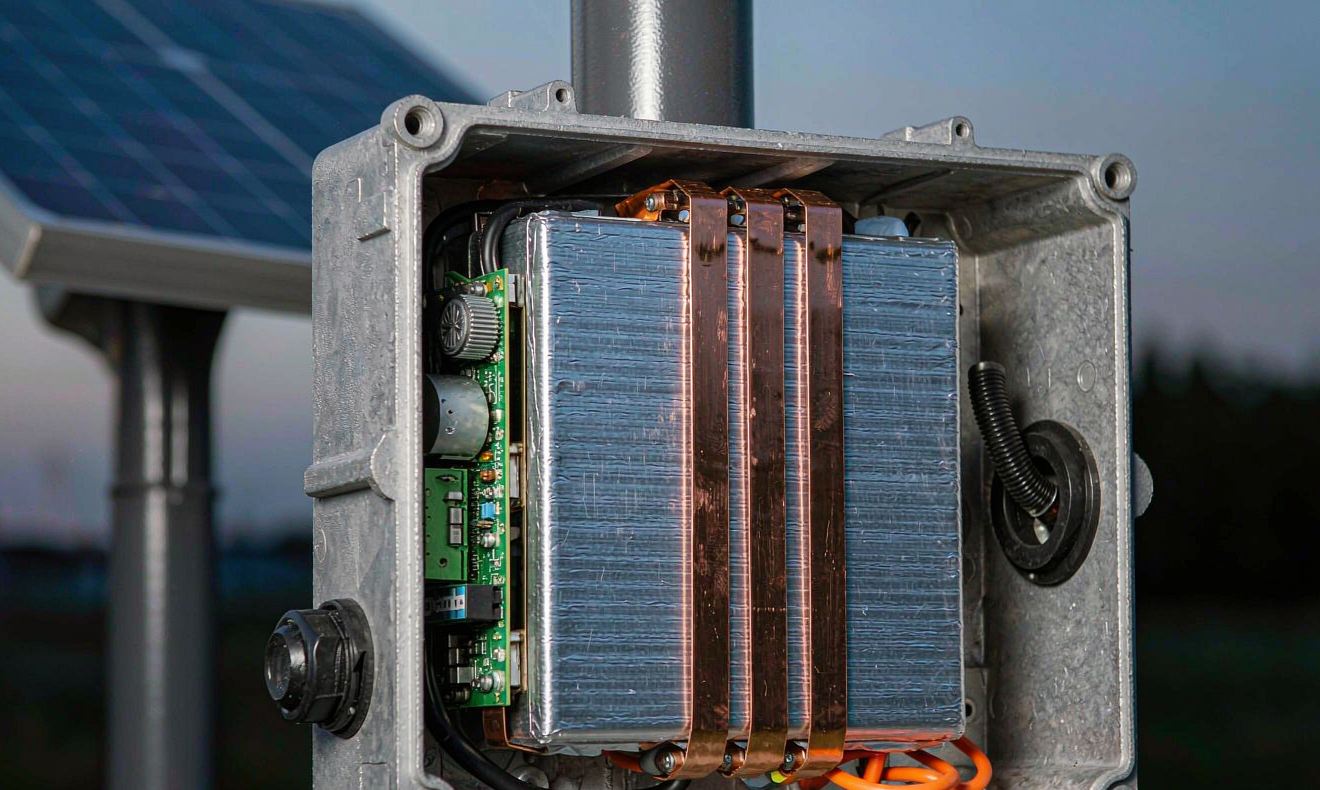
For the internal layout, the battery module sits at the bottom of the cabinet, the MPPT controller mounts on a heatsink at the back wall above the battery, and the wiring trough runs along the left side. The 12.8 V system is preferred over a 24 V system for street lights because the LED drivers are 12 V native and the cable savings from 24 V are small below 100 W. Above 100 W, I switch to 25.6 V and accept the extra MPPT complexity for a four-fold reduction in cable losses.
Fleet lifecycle: state-of-health telemetry, warranty, and recycling
A sodium-ion battery design for street lights that ends with the installation is incomplete. A 10,000-pole fleet is a service business, not a product sale, and the O&M layer is what makes or breaks the economics. I now require three telemetry streams from every pole.
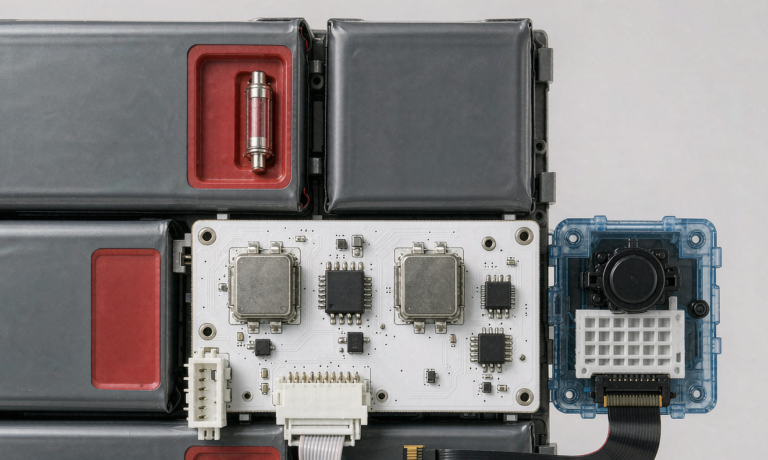
Daily state-of-charge trajectory. A small IoT board riding on the MPPT controller reports the morning peak voltage, the afternoon full-charge flag, and the morning post-discharge SoC. The ratio of morning post-discharge SoC to the previous afternoon full-charge SoC is the cycle efficiency, and a sustained 5% drop in that ratio is the earliest sign of cell degradation.
Internal resistance trend. A 1 kHz AC impedance measurement, taken once a week from the controller, drifts upward as the cells age. A 30% increase in internal resistance from the as-built value is a clear flag to schedule a swap. On a 600-pole fleet, internal resistance telemetry reduced our no-fault-found truck rolls from 18 per month to 3 per month.
Temperature history. Cabinet internal temperature and battery temperature, sampled every 15 minutes, build a calendar aging model. Sodium-ion cells at 35 degrees Celsius age at roughly 1.4 times the rate of cells at 25 degrees Celsius, and the effect is exponential. Poles that sit in afternoon sun for six hours a day will out-age poles in shaded locations by a factor of 1.5 to 1.7 over a 10 year span, and the only honest design response is to oversize those packs at install time.
Warranty terms for a sodium-ion battery for street lights should commit to 80% retained capacity at year 5 and 70% at year 10, measured against the fleet telemetry, not a lab test. Recycling at end of life is the third leg. Sodium-ion cells do not contain lithium, cobalt, or nickel in commercial formulations, and the black mass is a sodium iron manganese oxide that is a candidate for direct cathode precursor regeneration. We currently recover 92% of cell mass through a hydrometallurgical process, and the residual goes to iron and manganese fertilizer blending. The environmental story is part of the procurement pitch.
FAQ
How cold can a sodium-ion street light battery charge without a heater?
Most commercial sodium-ion cells based on Prussian-blue analogs can accept a 0.1 to 0.2 C charge down to -10 degrees Celsius without lithium plating equivalent, and the MPPT controller clamps the charge current to that range based on the battery NTC. Below -10 degrees Celsius, charging is disabled entirely and the pack runs on whatever residual state of charge it had at the start of the cold snap. For deployments above 50 degrees north latitude where battery temperatures fall below -20 degrees Celsius, an external silicone heating pad driven from the panel is still the right answer, and the design margin is a 5 W pad on a 1 kWh pack.
Is sodium-ion better than LFP for hot coastal climates?
For hot coastal sites, LFP still wins on calendar life at 40 degrees Celsius because the LFP cycle count above 80% capacity is well documented at 4,000 to 6,000 cycles. Sodium-ion cells lose 10 to 15% of their room-temperature cycle count when operated continuously at 40 degrees Celsius, so a 1.4 times pack oversizing is the right answer to recover the same service life. The enclosure choice, 316L stainless with a Gore-Tex vent, is more important than the chemistry choice on a hot coastal site.
How long does a sodium-ion street light battery last in service?
With a 30 to 80% SoC window, three-night autonomy, and a P90 winter design, a sodium-ion battery for street lights reaches 80% retained capacity in 8 to 10 years and 70% retained capacity in 12 to 15 years. The panel usually fails first, at year 12 to 18 from UV-driven backsheet delamination. A coordinated battery-and-panel swap at year 12 typically brings a pole back to 25 years of service with a single intervention.
Can I retrofit an existing solar street light with sodium-ion?
Yes, but the controller, the LED driver, and the enclosure all need to be reviewed. The 12.8 V system voltage is identical to a 4S LFP pack, so the LED driver swap is usually a firmware update, not a hardware change. The MPPT controller has to be re-sized for the sodium-ion charge profile, which means a custom battery solution that ships with its own controller. The enclosure is the most expensive retrofit item; if the existing cabinet is at IP54 with a flat top, the retrofit is not worth the water risk and a full enclosure swap is the right call.
What is the best charge controller for sodium-ion street lights?
An MPPT controller with a 95% or better peak efficiency, low-irradiance tracking down to 50 W per square meter, an external NTC that follows the battery temperature, and a sodium-ion specific charge profile is the right answer. We currently use a 10 A MPPT module with a 12 or 24 V autodetect input and a Modbus telemetry port. The cost premium over a generic PWM controller is roughly $25 to $40 per pole, and the energy harvest gain over a five year window pays that premium back twice over.
Does sodium-ion make sense for grid-tied street lights?
For grid-tied street lights, the energy autonomy is not a design driver, and a lithium battery design for street lights with a small UPS-style pack for outage ride-through is the more economical choice. Sodium-ion becomes compelling the moment the design moves off-grid, into cold climates, or into remote sites where the cost of a maintenance truck roll exceeds the upfront capex premium. On a true off-grid site, sodium-ion beats LFP on cost of ownership inside the first three years because the heater and the annual venting inspection disappear.